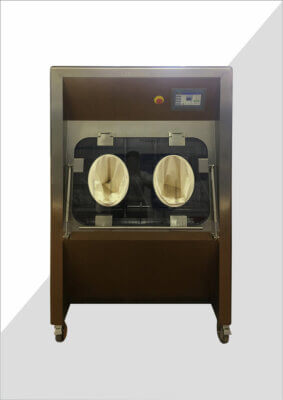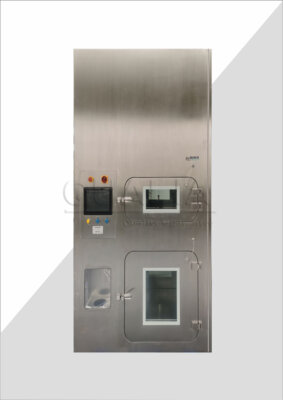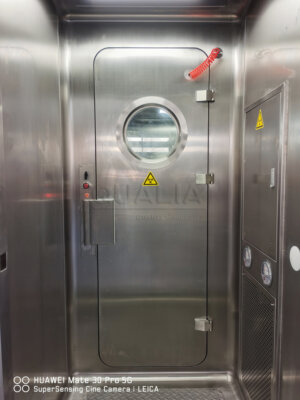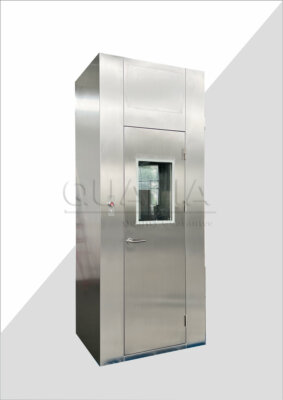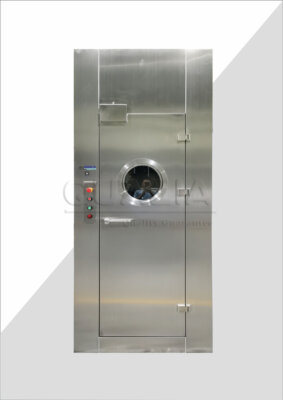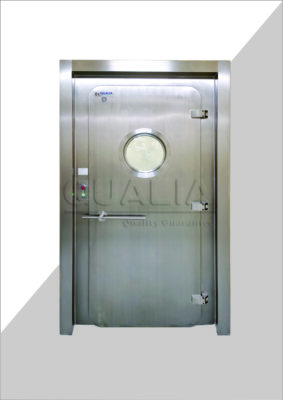

How should a sterility test isolator be released for personnel access or test use after a hydrogen peroxide decontamination cycle, and what evidence actually supports that decision? The answer is not a fixed number carried over from one project to the next. It depends on the validated cycle, the enclosure, what is loaded inside it, and how quickly different surfaces give up residual hydrogen peroxide once aeration starts.
Residue Exposure Scenarios After an Isolator Cycle
A hydrogen peroxide bio-decontamination cycle in a sterility test isolator is built around a defined set of parameters: the enclosure geometry, the load configuration, and an aeration phase intended to bring residual vapor down to a condition the site has defined as acceptable. The risk assessment does not start from the cycle itself, though. It starts from the moments when someone or something interacts with the enclosure after that cycle runs, because each of those moments carries a different exposure path and a different consequence if residue is still present.
Sample recovery is one such moment. When a sample is removed through a transfer device or opened within the isolator, the person handling it is exposed to whatever atmosphere exists at that location and at that time, which may differ from the general chamber reading if aeration has not reached equilibrium there. Glove-port use is another: gloves are manipulated directly against surfaces and in proximity to the operator’s forearms, so residue retained in the glove material or at the glove-sleeve interface becomes a direct-contact and inhalation question rather than a general chamber-atmosphere question. Door opening changes the scenario again, because opening a door can disturb boundary layers of vapor that were still equilibrating near seals or hinges, momentarily changing local concentration in a way a single chamber sensor may not capture.
Cleaning and maintenance activities extend the exposure map further. These activities may involve direct contact with surfaces that were never swept effectively by the circulating vapor-phase cycle, or disassembly of components whose internal surfaces were not directly exposed to the decontamination airflow at all. Cycle deviations compound the picture: if a cycle aborts, runs short, or a load shift blocks vapor distribution to part of the enclosure, the exposure scenarios that were assumed to be covered by the validated cycle may no longer apply, and the assessment has to treat the affected zone as unverified rather than extrapolate from the rest of the chamber.
Where the sterility test isolator is used for routine, unattended operation with minimal manual intervention, the exposure map can be narrower and more predictable. Where it is used for frequent sample recovery, glove-intensive work, or variable load configurations, the number of distinct exposure scenarios the assessment must cover expands, and each one may need its own evidence point rather than a single site-wide conclusion.
Load Materials and Surfaces That Can Retain Hydrogen Peroxide
Hydrogen peroxide vapor does not interact uniformly with every material placed inside an isolator. Some materials adsorb vapor at the surface and release it readily once the surrounding atmosphere concentration drops during aeration. Others absorb vapor into the material itself, or into seams, laminations, and porous structures, and then desorb it slowly, continuing to emit measurable residue well after the surrounding air has aerated to a condition that would otherwise be considered acceptable.
This distinction matters directly for a risk assessment because it means the enclosure’s own aeration curve is not the same as the aeration curve for everything placed inside it. A load item with high surface adsorption and rapid desorption may track closely with chamber-level readings. A load item that absorbs into its bulk, or that has internal cavities, packaging layers, or joints where vapor can become trapped, may still be releasing hydrogen peroxide into the local atmosphere long after a general sensor reading near the chamber wall has stabilized. The isolator’s own interior surfaces are not exempt from this question either: gaskets, glove material, and any flexible or textured surface finish can behave differently from a smooth, non-porous interior panel.
The practical consequence is that a generic chamber-level aeration endpoint cannot be assumed to represent every surface and every load item inside the same enclosure. Where the load is consistent, non-porous, and well-characterized from cycle to cycle, the assessment can reasonably treat the chamber reading as representative of the load as well. Where the load varies – different test samples, different packaging materials, different equipment introduced for different test runs – the assessment needs to account for the possibility that some load configurations retain hydrogen peroxide longer than others, independent of whether the validated cycle parameters were followed correctly.
This is also where the isolator’s material specification and interior finish become part of the conversation with the supplier, not as an aside but as a direct input to the risk assessment: what interior materials and surface finishes were selected for the enclosure, and what does that selection imply about how quickly those surfaces are expected to aerate relative to the load being introduced.
Aeration Endpoint Evidence for Personnel and Test Release
| Release decision | Evidence to establish | Decision boundary |
|---|---|---|
| Personnel release | Validated-cycle and aeration evidence, sensor or sampling checks tied to the defined release question, and the site risk assessment against applicable occupational requirements | No universal H2O2 endpoint or generic ppm limit is supported; the site must define the criterion for its enclosure, load, surfaces, and aeration conditions |
| Sterility-test release | Validated-cycle and aeration evidence, sensor or sampling checks tied to the defined release question, and the site risk assessment against applicable product and test requirements | Evidence for personnel release does not by itself establish test release; the applicable test and product criteria must also be met |
Two different release decisions are made after the same cycle, and they do not automatically share the same evidence. One decision is whether it is acceptable for personnel to open the isolator and work inside it. The other is whether the enclosure’s interior condition is acceptable for the sterility test itself to proceed without introducing hydrogen peroxide residue that could affect the test result. These are not the same question, and satisfying one does not establish the other.
Personnel release depends on evidence that the atmosphere personnel will be exposed to, at the locations and moments identified in the exposure assessment, meets the site’s defined criterion against applicable occupational requirements. Test release depends on evidence that residual hydrogen peroxide on surfaces and in the atmosphere will not interfere with the sterility test method or the product being tested, assessed against applicable product and test requirements. A chamber reading that satisfies an occupational criterion does not automatically confirm that residue on a slow-aerating surface is low enough to avoid affecting a sensitive test method, and the reverse holds as well.
EU GMP Annex 1 frames isolator bio-decontamination as an automated, validated, and controlled process operating within defined cycle parameters, situated within a broader contamination-control strategy for aseptic processing. That framing supports treating the decontamination cycle as a controlled process with defined inputs and outputs, but it does not specify a universal hydrogen peroxide concentration, dwell time, aeration endpoint, or residue limit that applies across isolator types or applications. ISO 13408-6 similarly addresses isolator systems for aseptic processing – their bio-decontamination, validation, operation, and control – without specifying numeric requirements for a sterility test isolator’s residue limits.
What this means practically is that the release criteria have to be derived at the site level, from the risk assessment, and matched against whichever occupational, product, and test requirements actually apply to that enclosure and that test method. A project team should expect to define its own release question for each use case rather than borrow a number from general isolator guidance, and should expect the personnel-release and test-release questions to be evaluated separately, even when the same sensor data feeds both.
Sensor Location, Sampling, and Deviation Handling
| Assessment situation | Evidence focus | What the evidence can support |
|---|---|---|
| Defined release question | Position sensor or sampling checks around the question that the release decision must answer | Whether the site-defined release criterion is met for that question; not a universal endpoint |
| Expected slow-aerating location | Place a sensor or sampling check at the identified location | Whether that location satisfies site-defined release criteria under the validated cycle and aeration conditions |
| Cycle deviation | Map possible exposure and assess the deviation against the site-defined response criteria and applicable occupational, product, and test requirements | The project-specific release or response decision; not an unconditional conclusion from a generic limit |
A sensor or sampling check is only as useful as the question it is placed to answer. Positioning a single sensor at a convenient, centrally located chamber point may produce a stable, reassuring reading while leaving the locations that matter most to a specific release question unaddressed. The risk assessment should work in the other direction: start from the release question – can personnel open this port, can this test proceed – and from the locations the load-and-surface assessment identified as likely to aerate more slowly, then place sensor or sampling checks where they can actually inform that question.
This means sampling locations are not generic. A location near a glove-port interface, a seam in flexible material, or a load item identified as having internal cavities may need its own check, separate from a general chamber-atmosphere reading, because the general reading does not speak to what is happening at that specific interface. Where the assessment has identified a location expected to aerate slowly, placing a check there and confirming it meets the site-defined criterion is what gives the release decision its evidentiary basis – not an assumption that if the chamber as a whole reads favorably, every surface within it must also be acceptable.
Deviation handling follows the same logic rather than a separate one. When a cycle runs outside its validated parameters – whether through an interrupted run, an incomplete distribution, or any other departure from the defined cycle – the exposure scenarios mapped for a normally completed cycle may no longer describe what actually happened inside the enclosure. The response is to reassess exposure for the affected condition specifically, using the same release-question logic, rather than to apply the standard release criteria to an atypical cycle outcome. A site’s response criteria for a deviation need to reference the same occupational, product, and test requirements that govern normal release, applied to the altered condition rather than assumed to still hold.
Where the sensor and sampling plan is built directly from the exposure map and the release questions defined earlier in the assessment, deviations become easier to interpret because the team already knows which locations and which questions matter. Where sensor placement was chosen for convenience rather than for its relevance to a defined release question, a deviation forces the team to improvise a response without a clear reference point for what “acceptable” means at the affected location.
Risk-Control Decisions for Cycle, PPE, and Change Management
The risk assessment’s output should translate into decisions the project team can act on, covering the cycle itself, personnel protective equipment, and how changes are controlled going forward. Each of these draws on the same underlying logic established earlier in the assessment: the exposure scenarios, the load and surface behavior, and the site-defined release criteria.
For the cycle, the decision concerns whether the validated parameters – including the aeration phase – remain matched to the load configurations actually in use. If load configurations change, introducing new packaging materials, different sample types, or additional equipment into the chamber, the assessment needs to revisit whether the existing validated cycle’s aeration phase still produces acceptable conditions for the new load, rather than assuming the original validation continues to apply unchanged.
For personal protective equipment, the decision depends on which exposure scenarios the assessment identified as still carrying residual risk after the defined aeration endpoint. Where the assessment and its supporting evidence indicate that an exposure scenario – glove-port use, sample recovery, or direct surface contact during maintenance – may involve residual hydrogen peroxide above the site-defined occupational criterion, PPE selection and use need to reflect that scenario specifically, rather than apply a uniform assumption across all interactions with the enclosure.
For change management, the operative question is which changes should trigger a reassessment of the existing risk assessment rather than be absorbed silently into ongoing operation. A change to the validated cycle, a new load material, a modification to interior surface finishes, or a change in how personnel interact with the isolator are each the kind of condition that can shift exposure scenarios or aeration behavior in ways the original assessment did not anticipate. Where such a change is introduced without revisiting the assessment, the evidence supporting the existing release criteria may no longer describe the enclosure as it is actually being used.
These same material and surface variables – and how a given enclosure’s interior finish and configuration affect aeration behavior for different loads – are also addressed from the pass-box side in the discussion of VHP pass box aeration endpoints, residue material compatibility, and release criteria, which works through comparable release-criterion logic for a related piece of VHP-based equipment. For a sterility test isolator specifically, these same considerations – exposure scenarios, load and surface behavior, and release-criteria logic – are the information a project team would bring into a configuration or quotation conversation with Qualia Bio, since the enclosure’s interior materials, port and glove arrangement, and intended load profile all affect which cycle and monitoring configuration suits the application.
Frequently Asked Questions
Q: Can one aeration endpoint release the isolator for both personnel access and sterility testing?
A: Not automatically. Define separate personnel and sterility-test release questions, then tie each decision to the validated cycle, relevant sensor or sampling evidence, the site risk assessment, and the applicable occupational, product, and test requirements. Evidence that supports personnel release does not by itself establish test release.
Q: What should be defined before choosing sensor or sampling locations?
A: Start with the exact release question and the possible exposure scenarios, including sample recovery, glove-port use, door opening, cleaning, maintenance, and cycle deviations. Then map checks to the enclosure, actual load, exposed surfaces, and locations expected to aerate slowly so each measurement supports a stated decision.
Q: How should load materials and surfaces be assessed for retained hydrogen peroxide?
A: Evaluate the materials and exposed surfaces actually present under the validated cycle and aeration conditions. Identify where retention could affect the release question and gather evidence at those locations rather than assuming a universal material ranking or endpoint.
Q: Is a generic hydrogen peroxide ppm limit enough for release?
A: No universal limit is supported for every sterility-test isolator project. Derive the release criterion from the site risk assessment and the applicable occupational, product, and test requirements, with the enclosure, load, surfaces, validated cycle, and aeration conditions clearly defined.
Q: What should happen when the cycle deviates from validated conditions?
A: Apply the site-defined deviation response instead of treating routine release evidence as automatically sufficient. Map the possible exposure, check the affected locations and release questions, and assess the result against the applicable occupational, product, and test criteria before deciding on personnel or test release.