Biological and chemical indicator placement for a portable VHP cycle follows the room boundary, the load arrangement and the vapor distribution configuration — not an even grid across the floor plan. Put biological indicators where the vapor reaches last or least: shadowed surfaces behind equipment, inside enclosed furniture, under benches, in return-path corners and at positions distant from the distribution outlets, and put chemical indicators at the positions where you need location-specific evidence that the agent actually arrived. A biological indicator (BI) is a defined population of resistant spores on a carrier used as the microbiological challenge; a chemical indicator (CI) is a reactive material that changes appearance on exposure to the agent. The conditions that decide the plan are physical and lookup-able: where the generator and any circulation fans sit, which surfaces are blocked by the load, how the room’s air path closes during the cycle, and which surfaces the protocol actually claims to treat.
Link the placement plan to the room and load
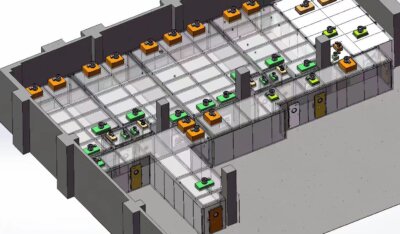
Map the room before you pick a single indicator position. The map needs the treatment boundary (which openings are sealed, which dampers close, whether the HVAC is isolated or recirculating), the generator position and any distribution aids, and the load as it will actually stand during the cycle — racks, carts, instruments, cabinets, open or closed drawers, and anything stacked against a wall.
That mapping exercise is what makes the indicator plan a challenge to the real treatment task rather than a symmetric decoration of the floor plan. Vapor distribution in an enclosed room is driven by the generator output, the air movement in the space and the obstructions in it; a position that looks remote on a drawing may be well swept by the return path, while a position two meters from the nozzle may sit in a dead pocket behind a freezer. Decide positions from the airflow and obstruction picture, not from distance alone.
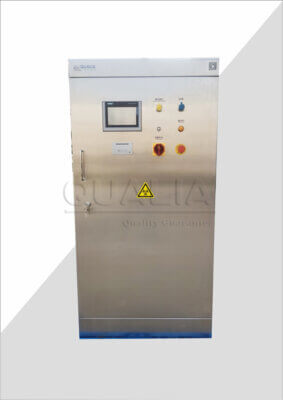
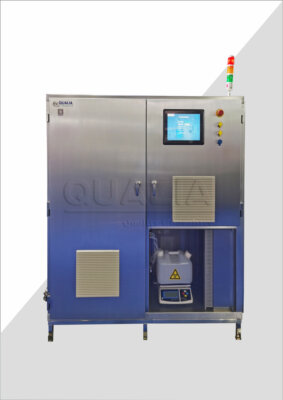
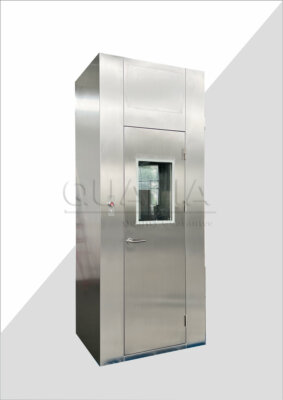
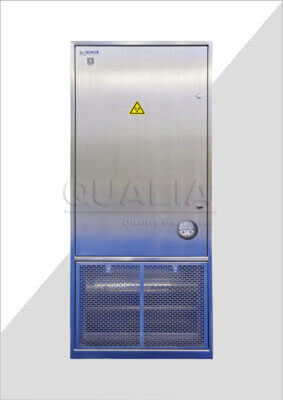
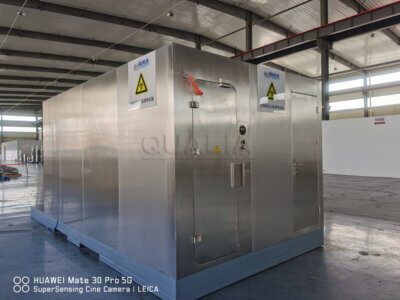
Record the configuration with the same discipline as the positions. The portable generator’s location and orientation, fan placement, door and damper states, and the load layout are all part of what the qualification covers. Where the generator is a portable VHP unit that can be wheeled to different rooms — the Type II and Type III portable VHP generator family is used this way — the unit’s position inside the room is a cycle variable, and a plan that does not fix it has not fixed the challenge either.
One practical consequence: define the load arrangement before the protocol is written, not during execution. If the arrangement is still fluid, the qualification will either be re-run or will describe a configuration nobody repeats.
Choose and record difficult challenge locations
Difficult challenge locations are chosen from observed access and distribution difficulty, and each one is recorded precisely enough that the next operator finds the same condition. “North wall, low” is not a location. “Inside the lower compartment of the stainless cabinet on the north wall, rear left corner, cabinet door closed, carrier taped to the underside of the shelf” is a location, because it names the surface, the orientation, the enclosure state and the surrounding load.
The Canadian Biosafety Handbook’s chapter on gaseous decontamination describes placing biological indicators at difficult-to-reach locations as part of demonstrating a decontamination cycle; that guidance is historical Canadian technical material rather than proof of compliance with any current edition, and the agent, room, load, protocol and jurisdiction govern how it is applied on your project. The underlying reasoning is the part that transfers: the indicator earns its value by sitting where the cycle is least likely to succeed.
Candidate conditions worth examining when you walk the room include enclosed volumes with restricted openings (cabinets, drawers, equipment housings), surfaces facing away from vapor movement, narrow gaps between the load and walls, high points where a warmer, stratified layer may form, and floor-level corners shielded by the load. Which of these qualify as “difficult” is a site observation, not a standing list — a cabinet with its doors removed is not the same challenge as the same cabinet closed.
Some surfaces cannot be challenged at all: sealed instrument interiors, wall cavities, the inside of ducts isolated from the cycle. The protocol has a legitimate option here that is often overlooked — exclude those surfaces from the treatment claim and state the exclusion, rather than assert coverage that no indicator supports. An honest boundary on the claim is stronger evidence than a placement scheme that pretends the boundary does not exist, and it tells the next team exactly which items still need wipe-down, autoclaving or separate handling.
Photograph each position with the load in place, and keep the photographs with the placement plan. Written coordinates and photographs together are what make the location repeatable on requalification.
Keep BI effectiveness and CI exposure roles distinct
| Indicator | Evidence it provides | How to use the result |
|---|---|---|
| Biological indicator (BI) | Biological challenge evidence relevant to treatment effectiveness | Retain the result with its challenge location and interpret it with the chemical indicators and physical cycle record under the defined protocol. |
| Chemical indicator (CI) | Agent exposure at the selected position | Use it as location-specific exposure evidence; it does not replace the biological challenge result in the effectiveness decision. |
A chemical indicator tells you the agent reached that position; the biological indicator tells you whether the challenge organism at that position survived. They answer different questions, and a favorable chemical result at a difficult location does not substitute for the biological result there.
The functional difference is worth being concrete about. A chemical indicator responds to agent contact and, depending on its type, to some combination of concentration and time; it changes state and gives an immediate visual reading at the end of the cycle. That makes it useful for mapping where vapor went, confirming that a position was not simply bypassed, and catching gross distribution problems before the biological results return. A biological indicator carries a defined spore population and is incubated afterward, so it reports on lethality against a resistant organism at that specific surface — the thing the effectiveness decision actually rests on.
Keep all three record types together for each location: the chemical reading, the biological result and the physical cycle data the generator produced for that run. The effectiveness conclusion is made from the set, under the protocol’s defined interpretation, by whoever the project designates to approve it. No single element of the set is sufficient on its own, and a chemical indicator that developed fully does not license a conclusion while a biological result at the same position is outstanding or positive.
Specify a suitable indicator system and interpretation
Specify the indicator system in the protocol as a named, documented item: the organism and carrier for the biological indicator, the indicator type and intended agent for the chemical indicator, the lot and expiry, the storage and handling requirements, the recovery or incubation method, and the reading rules. The purchasing decision and the interpretation rule are the same decision — an indicator whose interpretation is not written down produces results nobody can act on.
Match the indicators to vaporized hydrogen peroxide specifically. Indicators are developed against particular agents and processes; the organism, carrier material and chemistry that make sense for steam, ethylene oxide or another gaseous agent do not transfer by analogy. Importing a familiar spore species, a population figure or an acceptance rule from a different process is a common specification mistake, and it tends to surface late, when a result has to be defended rather than when the order is placed.
The carrier matters as much as the organism. A spore carrier on a paper strip inside a glassine envelope and the same organism inoculated onto a stainless coupon do not present the same challenge in a vapor process, because the envelope changes how the agent reaches the spores. Decide which carrier represents the surfaces you are claiming, and say so in the protocol.
Interpretation requirements that belong in the document, written before any cycle runs, include how a positive, negative and inconclusive reading is defined, what positive and negative controls are run and how they are handled, and what the protocol does with an indicator that is damaged, lost or unreadable at the end of the cycle. The acceptance criterion itself — how many indicators, in which positions, with which outcome — comes from the project’s approved validation procedure and its designated approver, not from a generic rule.
Handle conflicting results and changed placement conditions
When a biological result conflicts with the chemical indicators or the physical cycle data at the same location, preserve every record and investigate before any conclusion about room treatment is drawn. Freeze the placement plan, the photographs, the chemical readings, the incubation records, the controls and the generator’s cycle data for that run; the discrepancy cannot be analyzed once the evidence has been tidied away.
Treat the conflict as information about a specific position, not as noise to be averaged out. A positive biological indicator behind a cabinet with a fully developed chemical indicator next to it points at something real — insufficient dwell at that surface, condensation, a carrier handling problem, an incubation or control issue, or a load obstruction the mapping underestimated. Favorable readings at the other positions do not resolve the disputed one. The protocol’s defined failure disposition governs what happens next, and any repeat work or release decision belongs to the responsible project team under the approved procedure.
Placement conditions also change after qualification, and that is the quieter risk. When the room later takes a different load, a relocated instrument, a new storage rack or a different generator position, review whether the recorded difficult locations still represent the hardest challenge in that configuration. Fixed coordinates become meaningless when the obstruction they were chosen for has moved; a position that was shadowed by a freezer is an easy position once the freezer is gone, and the new dead pocket is somewhere nobody is measuring.
The practical rule is to tie the review to the placement rationale rather than to the coordinates. If the reason a location was chosen — enclosure, shadowing, distance from distribution, restricted opening — still applies in the new arrangement, the existing plan holds. If the reason has moved, the qualification plan is revised and the challenge re-established. Where the change stays inside a documented permitted envelope that the qualified room and load already cover, the existing protocol continues to apply without new work.
For the supplier discussion that sets this up, have ready the room dimensions and sealed boundary definition, the proposed generator position and any distribution aids, the load layout with the enclosed items identified, the surfaces you intend to claim and those you intend to exclude, the agent and indicator system you plan to specify, and the qualification evidence your approved procedure requires. Those six items determine whether the placement plan can be written before the first cycle runs or only discovered during it.
Frequently Asked Questions
Q: Can I order a standard indicator kit before the placement plan is finished?
A: Confirm the planned challenge locations and indicator suitability before fixing the kit contents. Base the order on the defined room, load and distribution arrangement, and document the handling and interpretation requirements. Do not borrow an indicator count or acceptance rule from a different process.
Q: What should I record so another operator can repeat the same placement?
A: Record the exact position, surrounding load and distribution configuration, together with why that location challenges the treatment. A location label alone may not recreate the same condition if the obstruction or load arrangement changes.
Q: Can we accept the cycle if the chemical indicators show exposure but a biological result is unfavorable?
A: Do not conclude that treatment was effective while the biological challenge remains unresolved. Keep the disputed location record, all indicator results and the physical cycle record together, investigate the discrepancy, and follow the protocol’s failure disposition. Favorable exposure readings elsewhere do not resolve that result.
Q: Should an inaccessible surface be included in our room-treatment claim?
A: Include it only when the qualification plan supports that claimed coverage. Identify the surface and its access difficulty before finalizing the placement plan; if it is excluded, make that limit explicit in the protocol rather than implying that indicators elsewhere demonstrate its treatment.