Selecting VHP equipment without first defining the operational boundary it needs to control is one of the more common procurement mistakes in containment facility projects — and it surfaces late, usually during IQ/OQ, when setup verification exposes gaps that the original scope never addressed. A portable generator deployed in a room with inadequate sealing or insufficient HVAC aeration capacity will produce inconsistent cycle outcomes regardless of how well the unit itself is calibrated. Conversely, a pass box commissioned without confirming load geometry and material compatibility against fixed chamber dimensions creates transfer workflow failures after installation. The decision threshold between these two equipment types is not about performance level — it is about which operational scope each was designed to control, and whether the site conditions match those assumptions.
Portable VHP Scope for Rooms and Enclosures
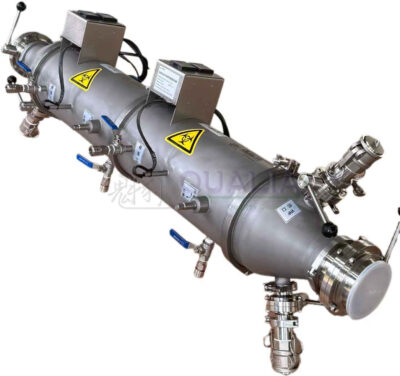
Portable VHP generators are designed to treat large, variable spaces — whole rooms, enclosures, animal facilities, and cleanroom suites — where the treatment boundary shifts between deployments. That flexibility is also the source of their validation complexity: because the boundary is defined by the room rather than by the equipment, every deployment condition that affects distribution, concentration, and aeration becomes a site-specific variable the qualification program must account for.
Model class determines the practical reach of a portable unit. Depending on configuration, portable generators can address spaces in the range of 300 m³ to 400 m³, which positions them as the appropriate tool for facility-scale decontamination where pass box chamber volumes are simply not relevant. Those figures should be treated as design-range parameters tied to specific units and room geometries, not as universal performance guarantees — room leakage, circulation paths, and temperature stratification all affect whether a given generator can achieve effective distribution across the full volume.
What this scope means in practice is that portable generators are not an alternative to pass boxes for routine material transfer — they are a different class of equipment solving a different problem. Teams that enter procurement treating them as interchangeable are likely to discover during qualification that one has been scoped for the wrong application.
Integrated Pass Box Chamber Boundary Control
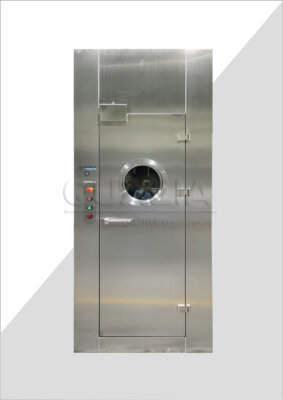
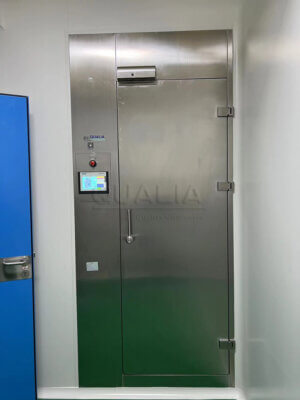
Where portable systems depend on site conditions to define their treatment boundary, an integrated VHP pass box carries its own fixed, pre-qualified chamber. The boundary is the equipment itself: a sealed enclosure with controlled doors, internal gas distribution, and a defined aeration pathway. That fixed geometry is what makes repeatable cycle development achievable at the chamber level.
Pre-cycle airtightness verification is the first checkpoint for confirming that the chamber boundary holds. A leakage rate of ≤0.5%VOL/h at 100 Pa is the design-level acceptance criterion used to confirm integrity before a sterilization cycle proceeds. If the chamber does not meet that figure, VHP distribution during the cycle is compromised, and any biological indicator results are difficult to defend. This test should be executed as part of installation qualification and repeated whenever door seals or gaskets are replaced.
Door interlock logic is the operational expression of that boundary control. The high-grade side door remains locked during the decontamination cycle and releases only after residual H₂O₂ has been reduced to ≤1 PPM within the chamber. That interlock is not a procedural recommendation — it is the mechanism that prevents operator exposure to residual vapor and maintains cleanroom grade separation during transfer. Any failure of interlock function or premature override is a containment event, not a minor cycle deviation.
Setup Verification for Portable Generator Cycles
The gap between a portable VHP generator performing well in a vendor demonstration and performing reliably in a specific facility comes down entirely to setup verification. On-site material compatibility testing and IQ/OQ execution are prerequisites for cycle development — not optional steps that can be deferred once the unit is operational. ASTM E3116 provides a useful framework for structuring IQ/OQ documentation expectations, though it does not govern every portable deployment as a mandate.
Skipping or compressing setup verification tends to produce a particular failure pattern: teams develop and execute a cycle, observe borderline biological indicator results, and then spend qualification time adjusting generator parameters without having confirmed whether injection placement, room sealing, or HVAC interactions are the actual variables driving inconsistency.
Each critical parameter — H₂O₂ injection rate, temperature, and humidity — must be verified using high-precision sensors positioned to capture actual conditions at the distribution points, not just at the generator output. Variability in any of these parameters during the exposure phase compromises cycle repeatability, and repeatability is what makes a validated cycle defensible during audit.
| Requisito di verifica | Perché è importante |
|---|---|
| On-site material compatibility testing | Avoids equipment damage or failed cycles |
| IQ/OQ execution | Avoids equipment damage or failed cycles |
| H₂O₂ injection rate verification | Prevents inconsistent decontamination outcomes |
| Temperature verification | Prevents inconsistent decontamination outcomes |
| Humidity verification | Prevents inconsistent decontamination outcomes |
The practical implication for project scheduling is that setup verification should be scoped as a distinct pre-validation activity with its own timeline and deliverables, not folded into general commissioning. Discovering that a room has uncontrolled leakage paths or that the HVAC system creates temperature gradients during the cycle at the IQ stage adds weeks of rework that early-stage site assessment could have avoided.
Cycle Traceability and Load Limits in Pass Boxes
Pass box cycle traceability is built into the equipment architecture in a way that portable room decontamination cannot replicate. Automated curve recording, electronic audit trails, and signature controls are designed to generate the documentation that GMP audit review expects — cycle parameters, run timestamps, and outcome records tied to individual transfer events. For facilities operating under regulatory oversight, this is a meaningful operational advantage over manual logging approaches.
The constraint that offsets that traceability advantage is chamber geometry. A pass box processes only what physically fits the chamber, and that boundary is fixed at installation. Load size must be verified against chamber dimensions before each transfer workflow is finalized — and material compatibility must be confirmed before commissioning, because liquids, powders, and cellulose are excluded by design. Teams that scope transfer workflows without accounting for those exclusions frequently encounter rework when certain load types cannot be processed through the installed unit.
| Aspetto | Dettagli | Impatto della convalida |
|---|---|---|
| Cycle Traceability | Automated curve recording, audit trail, electronic signatures for GMP compliance | Supports regulatory audit requirements |
| Load Size Limits | Only loads that fit the chamber geometry can be processed | Requires dimensional verification before each cycle |
| Material Exclusions | Liquids, powders, and cellulose are not compatible | Material compatibility pre-check essential to avoid cycle failure |
| Sterilization Program Options | D-value-based overkill programs (6LOG, 12LOG) or concentration-time cycles | Determines the sterilization assurance level and cycle design |
Cycle program selection — whether a D-value-based 6LOG or 12LOG overkill program or a concentration-time approach — sets the sterilization assurance level and should be determined as part of URS development, not after commissioning. Changing the program post-qualification requires revalidation, so the intended load types and sterility assurance requirements need to be defined before the unit is ordered. For organizations handling multiple material types with different risk profiles, that decision also affects whether a single pass box configuration can support the full transfer scope or whether additional units with different cycle parameters are needed.
Aeration and Release Responsibility Differences
Aeration is where the operational risk profile between portable generators and integrated pass boxes diverges most sharply — and where vendor specifications are least likely to surface the real facility constraint.
For portable generators, area release depends on the room HVAC system reducing H₂O₂ concentration below 1 PPM, the OSHA-referenced occupational exposure threshold. The facility owns that responsibility: if ventilation performance is inconsistent, seasonal, or affected by adjacent pressure zones, release timelines become unpredictable. That variability rarely appears in equipment specifications, but it regularly affects operational scheduling in facilities where decontamination cycles need to complete within defined maintenance or changeover windows.
Pass boxes carry their own catalytic aeration and laminar flow ventilation, which means the ≤1 PPM release threshold is managed internally by the cycle sequence without dependence on facility HVAC. The high-grade door interlock releases automatically when the chamber endpoint is confirmed. That self-contained release path is a significant operational advantage for routine transfer use cases, where predictable cycle duration matters for workflow planning.
| Aspetto | Portable VHP Generator | Integrated VHP Pass Box |
|---|---|---|
| Aeration Method | Relies on room HVAC for residue removal | Dedicated catalytic aeration and laminar flow ventilation |
| H₂O₂ Target Threshold | <1 PPM per OSHA; facility must achieve | ≤1 PPM self-contained, no external exhaust required |
| Dependency on Facility HVAC | High; inadequate ventilation delays area release | None; release independent of facility HVAC |
| Release Responsibility | Facility must verify ventilation adequacy and monitor H₂O₂ levels | Pass box cycle automatically completes release when threshold met |
The downstream procurement implication is that portable generator deployments require HVAC capacity and ventilation pathway assessment as part of the site evaluation — not as a post-installation discovery. Facilities that have not confirmed ventilation adequacy before generator deployment often find that area release delays consume the operational time savings that the portable unit was expected to provide.
Use-Case Separation Before Equipment Selection
The most defensible equipment selection follows from use-case definition, not from feature comparison. Portable generators and integrated pass boxes are not competing options for the same requirement — they address structurally different problems, and qualifying either unit for the wrong scope creates both validation and contamination-control risk.
Portable generators belong in applications where large-space treatment is the defined requirement: whole-room decontamination in pharmaceutical cleanrooms, BSL-3 suites, animal facilities, and similar environments where the treatment boundary spans a full room volume and site-dependent setup is acceptable in exchange for spatial reach. Attempting to use a portable unit as a substitute for a fixed transfer sterilization point introduces boundary control assumptions that the equipment was not designed to satisfy.
Pass boxes are the appropriate selection when the requirement is surface sterilization during routine material transfer across cleanroom grade boundaries. The fixed chamber, interlocked doors, and self-contained aeration exist precisely to support that application — not room-scale decontamination. Deploying a pass box as a room treatment solution is not feasible at the volume scale, but the reverse mistake — assuming a portable generator can provide the grade-boundary transfer control a pass box is designed for — is a more realistic procurement error.
| Attrezzatura | Caso d'uso primario | Applicazioni tipiche | Limitazioni |
|---|---|---|---|
| Portable VHP Generator | Decontaminazione dell'intero ambiente | Healthcare, pharma cleanrooms, bio-labs, animal facilities, public spaces | Not suitable for routine material transfer; relies on site setup for containment |
| Integrated VHP Pass Box | Surface sterilization during material transfer between cleanroom grades | Cleanroom grade boundaries, material airlocks | Limited to loads that fit the chamber; excludes non-compatible materials (liquids, powders, cellulose) |
The validation consequence of misapplication is not just a failed IQ protocol — it is a qualification program that cannot produce defensible evidence for the actual operational requirement, because the equipment boundary assumptions embedded in the cycle design do not match the use case being qualified. Separating facility decontamination, small-space treatment, and routine material transfer as distinct requirements before equipment selection is the step that prevents that outcome.
For teams evaluating portable configurations across room volumes, Generatore portatile di perossido di idrogeno VHP (tipo II, tipo III) e Generatore di perossido di idrogeno VHP tipo I address different capacity ranges and deployment contexts. Fixed transfer sterilization requirements should be evaluated against the VHP Pass Box as a separate scope.
The concrete pre-procurement checkpoint is use-case definition written at the URS stage: does the requirement call for treating a room volume under site-dependent conditions, or does it call for repeatable surface sterilization within a fixed, pre-qualified chamber boundary at a grade transition point? If those two requirements exist in the same facility, they warrant separate equipment selections and separate qualification programs — not a single unit expected to satisfy both.
Before finalizing either selection, the facility conditions that the equipment depends on must be confirmed: room sealing and HVAC ventilation adequacy for portable deployments, and chamber load geometry, material compatibility, and interlock function for pass box installations. Both sets of conditions are discoverable during pre-commissioning assessment. Neither set should be treated as a qualification discovery.
Domande frequenti
Q: What happens if a facility needs both large-room decontamination and routine material transfer sterilization — does one unit cover both?
A: No single unit covers both requirements adequately. A portable generator is sized and validated for room-volume treatment under site-dependent conditions, while a pass box is designed for repeatable surface sterilization within a fixed chamber at a grade boundary. Attempting to satisfy both requirements with one equipment type forces the qualification program to defend boundary assumptions the equipment was not designed to meet. Facilities with both requirements should write them as separate scopes in the URS and evaluate them independently.
Q: If a portable VHP generator meets the room volume specification, is that sufficient to confirm it will work in the target facility?
A: Volume capacity is a necessary condition, not a sufficient one. A generator rated for 300–400 m³ still depends on site-specific factors — room sealing integrity, injection placement, HVAC interactions, and temperature stratification — that the volume figure does not account for. A room that nominally fits within the unit’s rated range can still produce inconsistent cycle outcomes if those conditions are uncontrolled. Volume specification confirms that room-scale decontamination is technically within scope; site assessment and setup verification confirm whether the specific facility can support repeatable execution.
Q: Can a pass box’s built-in cycle traceability substitute for a formal validation protocol under regulatory review?
A: Automated curve recording, audit trails, and electronic signatures satisfy documentation structure requirements, but they do not replace a qualification program. GMP audit review expects evidence that the cycle was developed for the actual load and sterilization assurance level required — not just that data was captured. Cycle program selection (6LOG, 12LOG, or concentration-time), load compatibility confirmation, and airtightness qualification must be completed and documented separately. The traceability architecture supports that evidence base; it does not generate it automatically.
Q: At what point does the portable generator’s dependence on facility HVAC for aeration become a disqualifying constraint versus an acceptable operational condition?
A: It becomes disqualifying when HVAC ventilation performance cannot reliably achieve sub-1 PPM H₂O₂ concentration within the operational window the facility requires. If decontamination cycles must complete within fixed maintenance or changeover schedules and HVAC output is seasonal, variable, or affected by adjacent pressure zones, the release timeline becomes unpredictable in a way that undermines operational planning. Facilities where ventilation adequacy has been confirmed through pre-commissioning assessment and is consistent across operating conditions can manage portable aeration as a procedural dependency. Facilities that cannot confirm that baseline should treat HVAC-dependent aeration as a structural risk, not a scheduling variable.
Q: Is ISO 22441:2022 or ASTM E3116 the more applicable standard for validating a portable VHP deployment in a pharmaceutical cleanroom?
A: They address different scopes and are not mutually exclusive. ISO 22441:2022 covers low-temperature vaporized hydrogen peroxide sterilization broadly, including cycle development and performance requirements. ASTM E3116 provides a framework specifically structured around VHP equipment validation, including IQ/OQ documentation expectations, which makes it directly applicable to structuring setup verification for a portable deployment. For pharmaceutical cleanroom contexts under GMP oversight, both are relevant reference points — ISO 22441 for sterilization process requirements and ASTM E3116 for equipment qualification structure. Neither governs all portable deployments as a universal mandate, so applicability should be confirmed against the regulatory framework governing the specific facility.