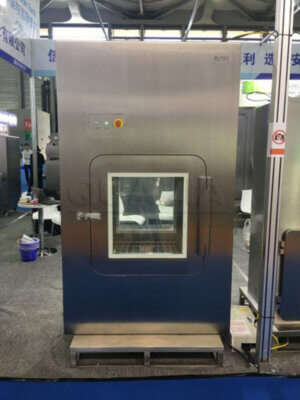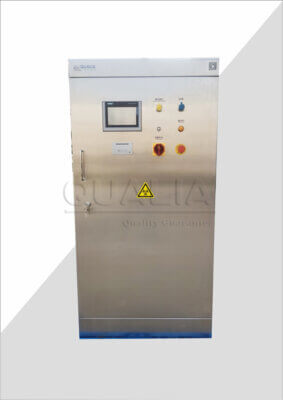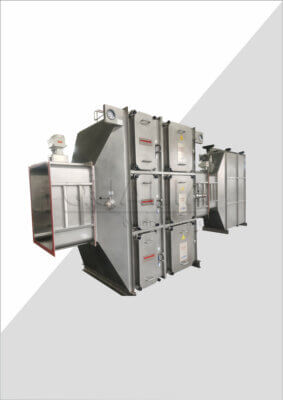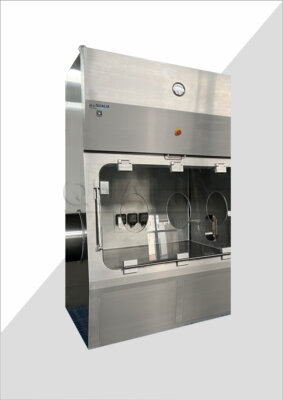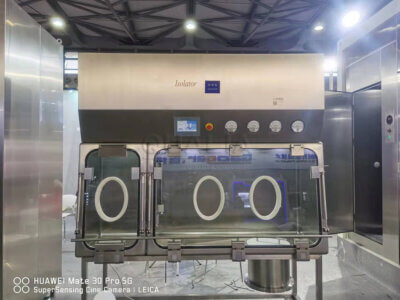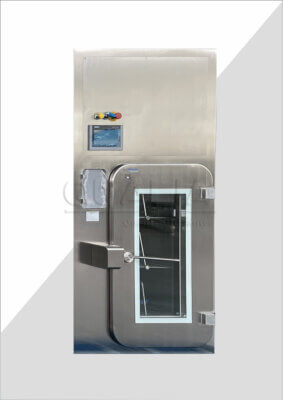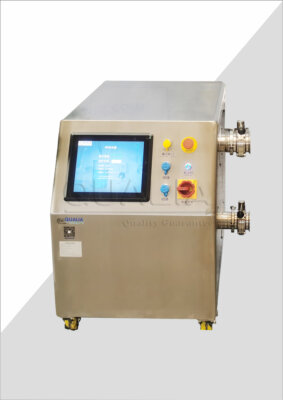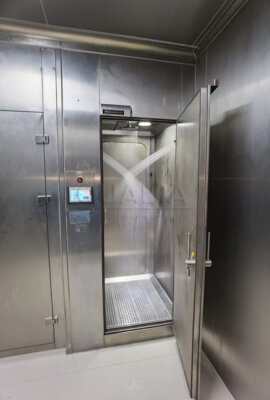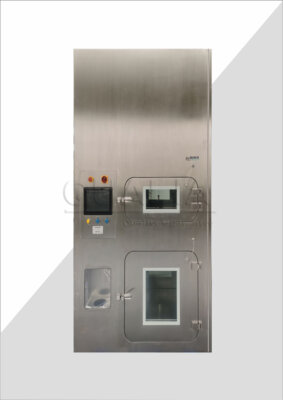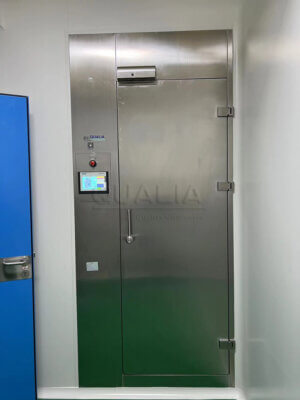
A useful mechanical APR door RFQ checklist carries four things suppliers cannot infer from a product name: the opening and its containment duty, a dimensioned wall and floor interface, the actual cleaning and decontamination exposure the seal will see, and the control interface responsibility at the door. Add a response schedule that separates the assembly, installation, interfaces, test work, documents, spares and services, and the quotations become comparable instead of merely priced. An APR door — an airtight, pressure-resistant door — uses a seal at the frame-to-leaf joint to hold a pressure boundary between two spaces; on a mechanical-seal door that seal is compressed by the latching or clamping mechanism itself rather than by a pneumatic supply.
Describe the opening and containment duty
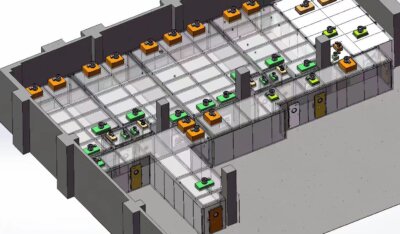
Start the inquiry with the operating boundary rather than the catalog name, because the boundary determines which assembly a supplier can offer and which assumptions they must declare. Send the door location on the layout, the intended containment duty, the spaces on each side, the clear opening dimensions and a description of the traffic that passes through it. Asking for a price against the words “mechanical APR door” leaves the bidder to invent all of this, and the invented version is what you end up comparing.
Containment duty means what the door is being asked to hold. State which side is the protected or contained space, the intended pressure relationship between the two rooms, and whether the door sits on a biosafety containment line, a cleanroom pressure cascade, or a potent-compound suite boundary. These are different design problems: aseptic product protection, operator exposure control and biosafety containment can all involve a sealed door, but they place different weight on leak-tightness, surface cleanability, directional airflow at the opening and what happens when the door is left ajar.
Traffic description is the part most often left out, and it changes hardware selection more than the nominal size does. Say whether the opening passes personnel only, carts, pallet trucks, drums or equipment on wheels, roughly how often, and whether the leaf must be openable with both hands occupied. Swing direction, headroom and floor finish at the threshold follow from that, and so does the question of whether a flush or near-flush threshold is required for rolling loads.
Supply the wall detail and installation constraints
For a new opening or an altered one, include a dimensioned wall and floor detail showing the construction type, the available structural support, the finished floor and ceiling levels, and the access available for installation. The frame-to-building interface is where quoted scope and installation effort are actually set: a frame fixed into a modular panel wall with a known panel thickness is a different job from one anchored into masonry with a wet finish, and a supplier who cannot see which one it is will either carry a contingency or exclude the work.
Mark unresolved survey items explicitly instead of leaving them silently missing. If the slab level at the threshold has not been checked, or the stud spacing behind a finished wall is unknown, say so on the drawing and say when the measurement will exist. A bidder who knows one dimension is provisional can price the assembly and flag the installation assumption separately; a bidder who assumes the dimension is final will later issue a variation. Where a verified existing interface drawing is available and its dimensions still agree with the site, that drawing can serve in place of a new survey.
Installation constraints belong in the same package. Note the route the frame and leaf must travel to reach the opening, any lifting restriction, whether the surrounding wall finish, flooring or ceiling will be complete before installation, and whether the room will be live or shut down during the work. Access for sealing, for later adjustment of the mechanical seal mechanism, and for any adjacent service penetration should be drawn rather than described, because clearance is what decides whether the work is straightforward or staged around other trades.
State material exposure and compatibility evidence needs
Write down the agents the door will actually meet, the exposure conditions, the frequency and the components exposed, then ask each bidder to identify the proposed seal formulation and the compatibility evidence behind it. A request for a “chemically resistant door” is an invitation for suppliers to make their own exposure assumptions, and two bidders can satisfy that phrase with elastomers that behave very differently under repeated sporicidal wipe-down or gaseous decontamination.
The exposure statement should name each agent by chemistry — the disinfectant concentration used in routine wipe-down, the sporicide used after a spill, any gaseous cycle the room is subject to — and say how often and for how long each contacts the door. Say whether exposure is wipe-and-dry, wet dwell, or vapor phase at room condition, and list which parts are exposed: the seal, the frame, the leaf surface, the viewport gasket, the hardware. Seal degradation is a boundary problem, not a cosmetic one, because the mechanical seal is what makes the closed door a pressure boundary at all.
Where vaporized hydrogen peroxide decontamination is part of the room’s regime, the Canadian Biosafety Handbook, Second Edition discusses material compatibility qualitatively, within the chosen agent and the engineering configuration in use. That framing is the right one for the RFQ: compatibility is a property of a specific material against a specific agent, concentration and exposure pattern, not a general label. Ask the bidder to name the elastomer family and grade they propose and to supply whatever compatibility data they hold for it under conditions comparable to yours, and state plainly that selection and acceptance of the material for your process remain with the project’s approved procedure and its designated approver.
Define control interfaces and quoted responsibilities
If the door forms part of an airlock sequence or an access-controlled boundary, supply the required door-state sequence, the interface signals, the power assumptions and the intended fault response, then ask for a marked list of included and excluded control functions. “Interlock optional” on a quotation is not a scope statement; it leaves the buyer comparing a price that may or may not contain the wiring, the controller, the field devices and the commissioning of a sequence.
Describe the sequence in terms of door states and conditions: which doors may be open together and which must not, what releases a door, what happens on a card read or a request-to-exit, and what indication the operator sees on each side. Name the signal types and voltages available at the door, who supplies the control panel, and where the interface terminates. Fault response needs its own sentence because it is a design decision rather than a default: state the intended behavior on power loss, on loss of a pressure signal, and on a device failure, and note that emergency egress from the room must remain available by the means the project’s safety design specifies.
A standalone mechanical-seal door with no automatic interface is a legitimate scope, and quoting it that way is cheaper and simpler to maintain. Take that route only when the project has confirmed the boundary does not need sequencing, and say so explicitly in the RFQ so bidders do not price a controller nobody asked for. When interfaces are required, name the party responsible for each side of the connection — door supplier, building management contractor, access control contractor — so that the same responsibility split appears in every response.
Normalize inclusions and exceptions across quotations
| Scope item | What to make explicit in each quotation |
|---|---|
| Door assembly | Identify the offered assembly and the opening and containment-duty assumptions used for the quote. |
| Installation | Separate installation scope and exceptions, including the frame-to-building interface and installation constraints. |
| Control interfaces | Mark included and excluded functions against the requested door-state sequence, signals, power assumptions and fault response. |
| Test work | Identify the quoted factory and site evidence and the response to each specified function; state who owns the acceptance criteria. |
| Documents | Identify the assembly drawing and the document schedule included in the response. |
| Spares | Separate the spares response and state inclusions or exceptions against the requested items. |
| Services | Identify quoted services; treat training, maintenance or qualification services as included only when the quotation says so. |
The comparison only works when every bidder answers the same structured schedule and records exceptions against each requested item rather than burying them in a single lump sum. Separating the assembly from installation, interfaces, test work, documents, spares and services is the practice the Asian Development Bank’s user’s guide to procurement of plant for design, supply and installation applies to plant generally — it distinguishes plant, spares, design and installation services, and asks that employer and other-contractor interfaces be clarified before bidding. The same separation on a door package exposes work that otherwise hides inside one total.
What this reveals is usually not price but assumption. One bidder’s figure may include anchoring into the wall and making good the finish, while another’s stops at delivery to the opening; one may include a factory leak test on the assembly, another only a site function check. Without a line-by-line response, both look like the same door at different prices. Requiring exceptions against each item also forces the bidder to declare where they have assumed the opening dimension, the wall construction or the control interface, which is exactly where variations originate.
Treat the schedule as a procurement comparison aid, not a supplier score and not a statement of what will be delivered. The actual contract decides responsibility allocation, and a model procurement document, however well structured, does not override the terms you sign.
Request the test and document response schedule
Close the package by naming the factory and site evidence you want, who owns the acceptance criteria, and the document schedule the supplier must return — and ask for a response against each specified function rather than a general assurance of testing. A concrete evidence request is what lets you compare how two bidders intend to demonstrate the scope they are offering, which is a different question from whether their doors are similar.
For documents, ask for an identified assembly drawing: a drawing bearing a product identification that ties the submittal to the configuration being supplied, with the interface dimensions shown and configuration-specific options marked. UFGS 01 33 00 Submittal Procedures, a US Department of Defense editable guide specification, is a documentation example of that practice — dimensioned interface drawings, product identification and marking of configuration-specific options. It is a guide specification rather than a universal requirement, but it is a useful model for what an identifiable drawing contains when you are describing your own submittal expectation.
For test work, list the functions you want evidenced — seal engagement and release through the mechanical mechanism, latching, door-state signaling where interfaces are included, any leak or pressure-hold check the project requires — and ask the bidder to respond function by function with what they will test, where, and against what criterion. State clearly who sets the acceptance criteria and who signs them off; acceptance, release and return-to-service decisions belong to the project’s approved procedure and its designated approver, not to the supplier’s test sheet. And do not carry training, maintenance or qualification services into your comparison as included unless the quotation itself names them.
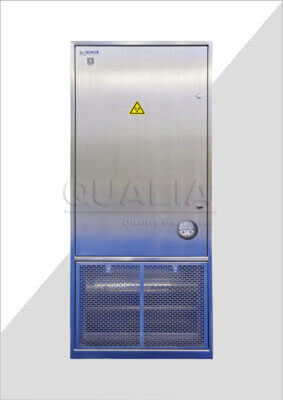
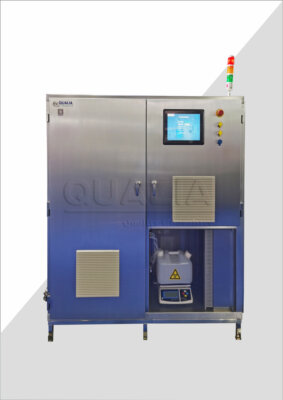
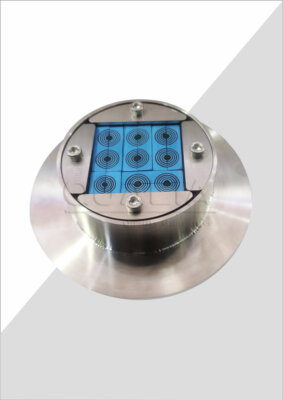
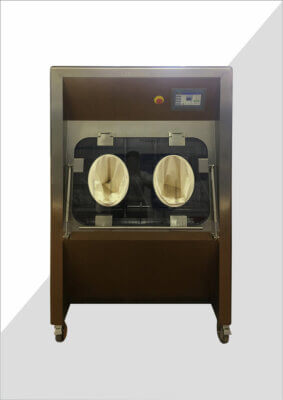
Before issuing, have on hand the marked layout with the door location and adjacent spaces, the containment duty and intended pressure relationship, clear opening dimensions and traffic description, the dimensioned wall and floor detail with any provisional dimensions flagged, the cleaning and decontamination agent list with exposure conditions, the control sequence and signal interface description, and the document and test schedule you expect back. If a specific product family is already in view — QUALIA’s mechanical-seal APR doors, for example — attach that inquiry to the package rather than letting it replace the boundary description, because the assembly is chosen from the duty, not the other way around.
Frequently Asked Questions
Q: What should I do if the final opening dimensions are not confirmed when I request quotations?
A: Mark unverified dimensions and survey items explicitly. Send the available wall and floor details, then require each bidder to identify the assumptions used. Resolve those assumptions before treating quotations as equivalent or using the quoted interface details for installation.
Q: Can I use one compatibility statement if our cleaning or decontamination process may change?
A: Do not treat evidence for one exposure as confirmation for an unlisted exposure. Describe the current agents, conditions, frequency and exposed components, and flag proposed changes separately. Request evidence tied to the proposed seal formulation and the exposure scenarios being quoted.
Q: How should I specify controls when another contractor is responsible for the airlock sequence?
A: Define the handoff between the door supplier and that contractor. State the required sequence, interface signals, power assumptions and fault response, then have the quotation identify which functions and interfaces it includes. A separate controls contract should not leave the door-side responsibility implicit.
Q: Is a cheaper quotation comparable if installation or services are excluded?
A: Compare the same scope before comparing totals. Identify who will provide each excluded item and keep its cost and responsibility visible in the evaluation. Do not assume training, maintenance or qualification services are included unless the quotation identifies them.
Q: Does an assembly drawing prove that the offered door meets the requested functions?
A: No. An identified assembly drawing helps establish what is being offered and how it interfaces with the building. Request a separate response showing the proposed factory and site evidence for each specified function, with responsibility for defining the acceptance criteria made explicit.