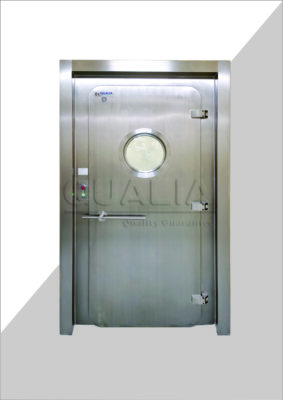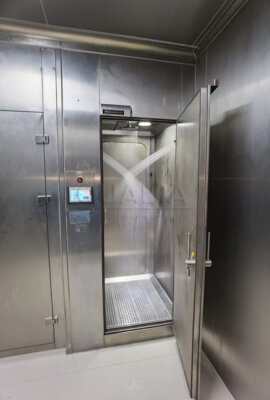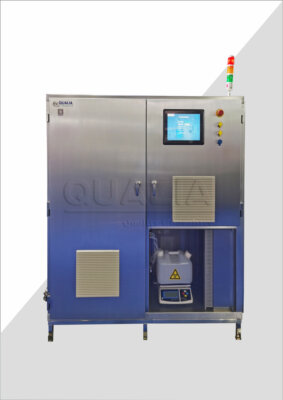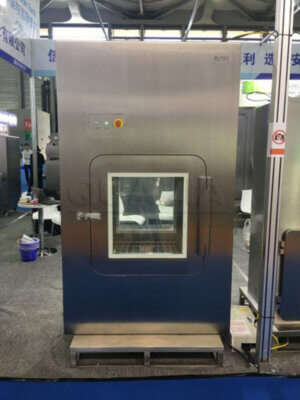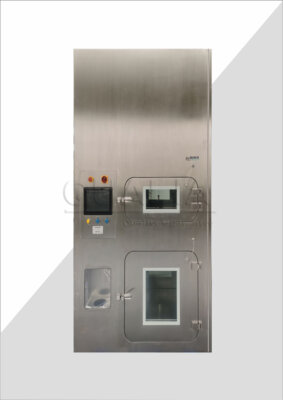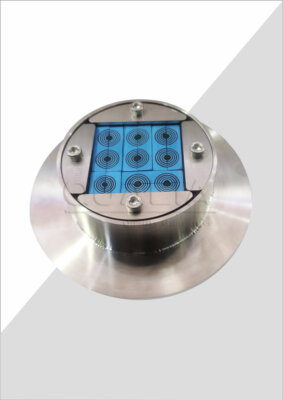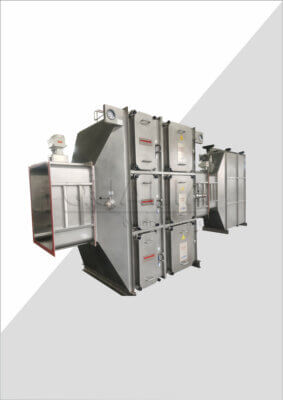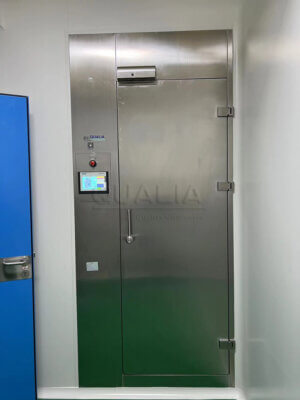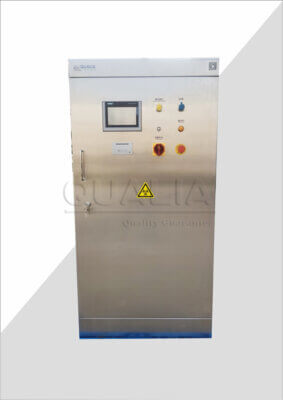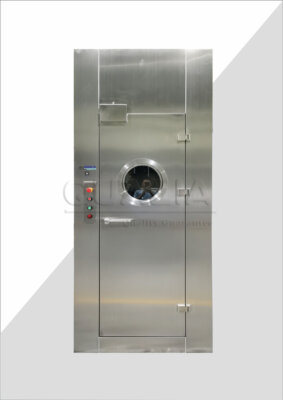

A mechanical APR door FAT and SAT split along one line: the factory protocol tests the supplied door assembly and the functions the manufacturer can demonstrate on its own frame and controls, while the site protocol tests the installed door — its connection to the building wall, its alignment in the finished opening, and the signals it actually exchanges with the airlock or access control system on site. The two sets of records answer different questions about the same door, so neither substitutes for the other. An APR (airtight pressure-resistant) door with a mechanical seal uses a compression gasket driven by the latching or locking mechanism itself, rather than an inflatable gasket fed by compressed air, which means the sealing result is tied directly to the door’s closure geometry, hinge alignment, and the squareness of the installed frame.
Allocate factory and site checks by the actual boundary
| Test setting | Boundary covered | Evidence to identify | Limitation affecting acceptance |
|---|---|---|---|
| Factory acceptance test | Supplied door assembly and its documented functions | Tested door and seal configuration, closure condition and observed results | Identify the limits of any simulated site function; factory results do not by themselves establish the installed frame-to-wall connection or actual control interfaces. |
| Site acceptance test | Installed door, frame-to-building connection and actual control interfaces | Installation checks and observed signals shared with the actual airlock or access controller | A justified unaffected function may retain its factory evidence after the appropriate project review; the installed boundary still needs its applicable checks. |
Decide for every test line which physical boundary it is capable of proving, then write it into the protocol where that boundary exists. The factory test has the supplied assembly — leaf, frame, mechanical seal, hardware and whatever control or indication components ship with the door — set up on the manufacturer’s bench or test wall. That setup is enough to demonstrate the door’s own documented functions and, where the project specifies one, a seal or leakage result for a named door and seal configuration. It cannot speak to the mortar, grout or sealant joint between the frame and the building, and it cannot speak to an airlock controller that does not yet exist.
Where a factory protocol simulates a site function — for example by substituting a signal from the real access controller with a test input, or by operating the door with a temporary power supply — record what was simulated and how it differed from the intended site arrangement. That note is what later tells the site team which functions still need live confirmation and which were already exercised in their final form. Without it, the reader of the FAT report has a pass mark and no way to judge its reach.
The reverse allocation also matters. Not every factory check needs repeating on site. Under EudraLex Volume 4 Annex 15, the EU GMP qualification framework, FAT results may be used without repetition where it is documented and justified that transport and installation have left the relevant function unaffected — and that justification is a project review decision, not a default. For a mechanical-seal door, functions that depend on frame geometry are poor candidates for reuse, because installation is exactly what changes them. Functions internal to the leaf and its hardware are better candidates, subject to the same review.
Identify seal-test conditions and acceptance criteria
A seal or leakage figure in a factory report is only interpretable when the conditions that produced it are recorded beside it. Specify, in the protocol and then in the result, which door and seal configuration was tested, the closure condition under which the measurement was taken, the test setup, the method, the instruments used and the project acceptance basis the figure is being compared against. A number reported without these cannot be checked against the door requirement the project actually wrote.
Each condition changes the physics. The door and seal configuration fixes which gasket profile and compression the result applies to, so a figure from one leaf size or gasket variant does not transfer to another. The closure condition — how the mechanism was engaged, and whether any adjustment was made to achieve it — determines the compression at the gasket, which is the variable the measurement depends on. The setup determines whether the test wall or frame contributed leakage of its own, and the method determines what is being measured at all: a pressure-decay measurement and a tracer-based measurement describe different things and are not directly comparable. The instruments and their calibration status determine the resolution and confidence of the reading.
The acceptance basis deserves its own line because there is no universal door leakage or pressure value in biosafety guidance. CDC/NIH BMBL 6th Edition provides laboratory door, access and containment boundary context for US facilities, and its BSL-3 and BSL-4 suit-facility provisions differ in scope; which value applies to a given opening follows from the facility’s risk assessment, local rules and the project’s own specification. The protocol should name that specification — a requirement identifier, a leakage class or a stated project limit — rather than carrying an implied criterion. Where the criterion is absent, the single missing variable is the project door requirement, and it sits with the process or containment engineer who defined the pressure boundary, not with the test witness.
Check closure states and fault recovery
A normal open-and-close demonstration leaves the operating states that matter untested. Beyond the ordinary cycle, the protocol should exercise the incomplete-closure case, the specified fault cases and the defined recovery behavior of any mechanical closure hardware or state indication supplied with the door, and record the state observed in each case rather than a bare pass mark. The useful record is what the door, the indicator and any shared signal actually did, compared against the sequence the specification describes.
Incomplete closure is the state with the most practical consequence on a mechanical-seal door. The gasket compresses as the mechanism travels through its final engagement, so a leaf that is latched but not fully driven home can look shut, report shut on a simple position switch, and still present a reduced seal. Whether the project wants that condition distinguished — by a separate signal, by indication logic, or by a mechanical arrangement that prevents partial engagement — is a specification question, and the protocol has to state which behavior is expected before it can record whether the door produced it.
Fault and recovery cases follow the same discipline. Define, for each challenge, what the door is expected to do, what it should indicate, and what the operator is expected to find afterward. Interlock-related challenges, door-release behavior, and anything touching emergency egress or the containment boundary must be controlled by the project’s approved test procedure, with its designated approver deciding what may be challenged, under what conditions and in what sequence. Tests that restrict access or temporarily affect the pressure boundary are not for the test team to improvise on the day.
Verify the installed frame and live interfaces
Site checks begin at the point the factory could not reach: the door in its opening, in its building, wired to the real controller. Check leaf-to-frame alignment and the uniformity of the reveal around the leaf, because a frame racked during installation changes gasket compression unevenly and that is the mechanism by which a door that passed at the factory underperforms on site. Check the threshold condition and the clear passage dimension against what the project specified, since floor finishes applied after frame setting can alter both. Check the frame-to-building interface — the structural fixing and the sealing or grouting detail that makes the frame part of the pressure boundary — because the wall joint is a leakage path the factory never tested.
Then exercise the live interfaces. Any signal the door shares with the actual airlock sequencer or access controller — position or closure indication, release command, alarm output — should be confirmed in its installed form, with the observed response recorded at both ends of the signal rather than at the door alone. The factory may have simulated these with a test input; the site protocol confirms them against the controller that will run the room.
Some factory results can carry forward. Where a function is demonstrably unaffected by transport and installation, Annex 15 allows that result to stand without repetition where the justification is documented, and that review belongs to the project. Treat it as a case-by-case argument tied to a specific function, not as a blanket reduction of the site protocol, and note that even a reused result leaves the installed-boundary checks — alignment, threshold, passage, building connection, live signals — to be performed in full.
Resolve deviations and hand over traceable records
When a test fails and the response is a hardware change, a seal replacement or a control modification, record the deviation against the revised configuration and decide which neighboring checks the change has disturbed before the retest result is considered. On a mechanical-seal door the connection is direct: adjusting hinges, strike plates, closure hardware or gasket profile alters the compression geometry along the whole perimeter, so a seal result, an alignment check and a closure-state observation taken before the change may no longer describe the door that now exists. A control change can similarly shift state logic beyond the single signal that failed. Which earlier results are invalidated and which stand is an assessment to be made and written down, and acceptance of the corrected result rests with the project’s approved procedure and its designated approver.
The handover package should let a reader who was not present reconstruct what was proven. Compile the requirement identifiers the tests were written against, the approved protocols, the raw results with their recorded conditions, the configuration records for the door as tested and as finally installed, the deviations with their resolutions, and the acceptance conclusions. Keep the equipment acceptance clearly separated from subsequent qualification activity so that the operational-qualification team inherits a defined starting point: which door functions already have evidence, under what conditions, and which operating functions still need demonstrating in the finished facility.
For GMP projects the separation is also a governance point. Annex 15’s reuse conditions and site review apply, which means vendor signatures on a FAT report are supplier acceptance of the assembly, not site release of the installed door; the site’s own review and approval governs that. Writing the package this way keeps the two sets of signatures doing different work instead of blurring into one.
Before opening the protocol discussion with the supplier of a mechanical seal APR door, have the project door requirement and its acceptance basis in writing, the room pressure relationship and which side the door faces, the interface list for the airlock or access controller including signal types and the expected sequence, the opening and threshold details from the architectural drawings, and the project’s approved approach to challenging interlocks and egress functions. With those in hand, the factory and site protocols can be split by boundary on the first pass instead of being renegotiated after the door ships.
Frequently Asked Questions
Q: What project information should we settle before agreeing the door acceptance protocol?
A: Define the door and seal configuration, required closure sequence, installation boundary and signals exchanged with the airlock or access controller. Link the proposed tests to those requirements and their acceptance criteria, and identify any site functions that the factory setup will only simulate.
Q: Must we repeat every successful factory test after installation?
A: Not necessarily. A function may retain its factory evidence when the project review justifies that transport and installation have not affected it. Identify that function and its supporting evidence explicitly; the installed frame-to-building connection and actual control interfaces still need their applicable site checks.
Q: Can we compare two door leakage results using the reported result alone?
A: No. Compare the tested door and seal configuration, closure condition, setup, method, instruments and acceptance basis alongside each result. A result without that context does not establish whether the test addresses your intended door requirement.
Q: If a failed test is corrected by changing the seal or closure hardware, is repeating that test enough?
A: Do not assume so. Record the revised configuration against the original deviation and assess whether the change also affects closure geometry, state indication or other checks. Use that assessment to define the affected checks before accepting the corrected result.
Q: Does a signed factory or site acceptance record mean the door is ready for operational qualification or site release?
A: The signature alone does not establish either conclusion. Check which requirements passed, under which configuration and conditions, and whether deviations remain open. Keep equipment acceptance conclusions separate from subsequent qualification activities; for GMP projects, apply the relevant Annex 15 evidence-reuse conditions and site review before relying on vendor acceptance records.