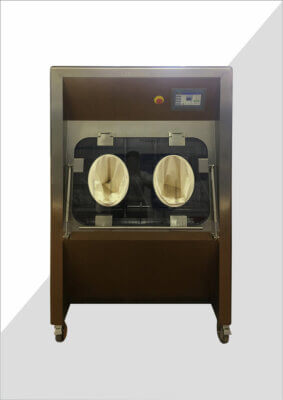


Where should a glove port go: wherever the chamber geometry allows, or wherever the task actually happens? The question matters because once a chamber is fabricated, moving a glove port is a structural change, not a layout tweak, and an operator who cannot reach, see, or sustain a working posture at a given position will compensate in ways that compromise both the manipulation and the barrier itself.
Work Tasks That Set Glove-Port Locations
| Planning input | What it must show | Layout decision it informs |
|---|---|---|
| Task sequence | The order and work-zone location of each manipulation | Position glove ports around the actual work rather than spacing them evenly across the chamber face |
| Work-zone map | Where each manipulation is performed | Relate each proposed glove position to the work zone it serves |
| Representative containers, tools, and racks | How the required items occupy and move across the work zone | Check whether proposed glove positions support actual handling before chamber geometry is fixed |
A glove port placed before the work is defined is a guess dressed up as an engineering decision. The sounder approach starts from the task sequence: what is done, in what order, and where in the chamber each action occurs. This sequence is the primary input because glove-port geometry is fixed early in isolator design, while process detail is often still being finalized. Where the task sequence is incomplete or assumed rather than confirmed, the resulting layout risks serving an idealized process rather than the one that will run inside the chamber.
Building a work-zone map from that sequence turns a list of actions into a spatial layout problem. Each manipulation occupies a location, and that location, not the chamber face as a whole, is what a glove port must serve. Evenly spacing glove ports across the chamber face treats the chamber as a generic enclosure rather than a configured workspace tied to specific operations; it produces a layout that looks balanced on a drawing but may leave some ports oversubscribed and others barely used.
The third input, representative containers, tools, and racks, matters because a work zone is not empty space. An operator’s reach and posture at a glove port depend on what is being manipulated and how it moves through that zone during the task, not on the unoccupied chamber volume. Where the actual containers, tools, or racks differ in size, shape, or handling pattern from what was assumed during early layout, the glove positions that looked workable on paper may not support the real handling sequence. This is the condition under which a project should revisit glove-port placement before chamber geometry is committed, rather than discovering the mismatch after fabrication.
The consequence of skipping this task-first approach is not confined to operator comfort. A glove port that does not align with the work it is meant to serve forces awkward reach angles, extended arm positions, or repeated repositioning, each of which increases the chance of glove-sleeve stress or inadvertent contact with chamber surfaces. Confirming the task sequence, the work-zone map, and the representative items to be handled, in that order, before freezing glove-port positions is the practical safeguard against this outcome.
Reach, Visibility, and Posture Checks Before Layout Freeze
| Check | Evidence to obtain before layout freeze | Decision boundary |
|---|---|---|
| Reach | Representative operators perform each manipulation with representative containers, tools, and racks | Evaluate the occupied work zone; an empty-chamber check is insufficient |
| Visibility | Visibility is checked during each manipulation with representative items in the work zone | Use predefined project criteria; the applicable criterion is project-specific |
| Hand orientation | The hand orientation required for each manipulation is observed at the proposed glove position | Judge the actual manipulation rather than glove-port spacing alone |
| Sustained posture | The sustained posture required for each manipulation is observed with representative operators | Use predefined project criteria; the applicable criterion is project-specific |
Once candidate glove positions exist, the question shifts from where the work happens to whether an operator can actually perform it there. This is an ergonomic verification step, not a repetition of the task-mapping exercise, because a position can be geometrically correct relative to the work zone and still fail an operator in practice.
Reach is the first check, and it must be evaluated with representative operators performing the actual manipulation using representative containers, tools, and racks, not with an empty chamber. An empty-chamber walk-through can confirm that a glove port is physically reachable in the abstract, but it cannot confirm that reach holds once an operator’s hand is occupied with a container or tool and the manipulation requires a specific approach angle. Where the chamber is evaluated empty, the reach check has not actually tested the condition that matters.
Visibility follows the same logic: it must be checked during the manipulation itself, with the representative items present, because an operator’s sightline into the work zone changes once hands, tools, and containers occupy the space between the operator and the task. Visibility criteria are project-specific, so the acceptance boundary for this check depends on what the project has defined as adequate sightline for the manipulation in question, not on a general standard.
Hand orientation is the third check, and it must be observed at the proposed glove position, because the same glove port can support a comfortable approach for one hand orientation and a strained one for another. A manipulation that requires a rotated or inverted grip changes the ergonomic demand on the glove port even if the straight-line reach distance is unchanged.
Sustained posture is the fourth check and addresses a different failure mode than instantaneous reach. A manipulation performed briefly may be tolerable at a given glove position even if the posture is not ideal, but where the same posture must be held for an extended portion of the task, the position needs separate evaluation against project-defined posture criteria. ISO 14644-7, which frames separative-device design, construction, installation, test, and approval as a customer-supplier requirement discussion, does not itself supply ergonomic dimensions or application-specific layouts; those criteria remain the project’s to define and confirm, and local rules still apply. The layout decision is not finished until these four checks have been performed against the actual manipulations, not an idealized or empty chamber.
Container, Tool, and Transfer Movements Across the Work Zone
Glove-port placement is only half the layout problem; the other half is how containers, tools, and transfer items move across the work zone once the operator is positioned at those ports. A glove port that supports reach and visibility for a static manipulation can still create a problem if the item being handled must move from one part of the work zone to another, or must pass between two operators working at different glove positions.
Movement introduces a timing and sequencing dimension that a static reach check does not capture. An item that starts within comfortable reach of one glove port may need to travel toward a transfer point, a tool rack, or a second work zone before the task is complete, and the glove-port layout has to accommodate that full path, not just the starting and ending positions. Where a task sequence involves handing an item between two glove positions, the spacing and orientation of those two ports relative to each other becomes part of the layout question, in addition to each port’s individual reach and visibility performance.
Tools present a related but distinct issue. A tool that is picked up, used, and returned to a fixed location changes the demand on a glove port depending on where that fixed location sits relative to the port. If the tool’s storage position was not part of the original work-zone map, the glove-port layout may have been validated against the manipulation itself but not against the full retrieval-and-return cycle that the task actually requires.
Transfer movements, where material enters or leaves the chamber through a transfer device during the task, add a further layer: the operator’s attention and hand position shift toward the transfer interface at specific points in the sequence, and the glove ports nearest that interface need to support both the primary manipulation and this transfer-related reach. A layout that treats the transfer interface as a separate, unrelated zone may understate the demand placed on the glove positions closest to it.
None of this is adequately captured by evaluating glove positions one at a time against a single manipulation. The work-zone map and task sequence established earlier need to be read as a continuous path of movement, with containers, tools, and transfer items tracked across their full handling cycle, before the glove-port layout can be considered complete.
Glove-Sleeve Integrity, Changeout, and Maintenance Access
A glove-port layout that performs well during active manipulation can still create problems during the activities that surround normal operation: glove-sleeve changeout, integrity testing, and maintenance access. These are not secondary concerns to be resolved after the operational layout is fixed; they belong in the same layout decision because the physical space, reach, and access that changeout and testing require can conflict with the positioning chosen purely for task performance.
Glove-sleeve changeout requires enough clearance around the glove port for an operator, often gowned and working through a restricted opening, to remove and fit a new glove-sleeve assembly without damaging adjacent components or compromising the barrier. A glove position chosen to optimize reach for a manipulation may sit close enough to a neighboring port, a fixture, or a chamber wall that changeout becomes difficult, even though the position works well during normal use. This conflict is easiest to resolve before the layout is frozen; afterward, the fix options narrow considerably.
Integrity testing, which confirms that a glove-sleeve assembly maintains the barrier it is meant to provide, depends on access to the glove and port from both inside and outside the chamber, depending on the test method in use. A layout that places glove ports in locations difficult to reach from outside the chamber, because of surrounding equipment, structural supports, or adjacent systems, can make routine integrity testing slower or more error-prone than a layout that kept external access in view from the start.
Maintenance access extends this concern beyond the glove-sleeve assembly itself to the broader question of whether technicians can reach fasteners, seals, or related chamber components near each glove position without obstruction. Where glove positions are set purely from task and ergonomic evidence, without a parallel check against maintenance access, a project may end up with a layout that performs well operationally but creates recurring difficulty during routine service or return-to-service activity. Readers evaluating how glove access and reach hold up once a line is already running, including the scenarios discussed in the companion review of glove access and operator reach on legacy filling lines, will recognize this as a cost that shows up well after the original layout decision.
Mockup Evidence Required for Design Approval
The task-sequence mapping, the ergonomic checks, and the movement analysis all converge on a single evidentiary question at the design-approval stage: has this layout actually been tested, or only reasoned about? Mockup evidence is what separates a layout that is theoretically sound from one that has been demonstrated to work under realistic conditions.
A mockup, whether physical or digital, needs to include representative operators, representative containers, tools, and racks, and the actual manipulations the task sequence identified. Testing an empty chamber, or testing with generic stand-in objects that do not match the real items in size, weight, or handling behavior, produces evidence that looks relevant but does not actually confirm reach, visibility, hand orientation, or posture under the conditions that will exist in production use. The gap between a generic mockup and a representative one is often invisible on paper; it only becomes apparent when an operator attempts the actual manipulation and finds that the assumed glove position does not accommodate the real container geometry or the real tool-handling sequence.
Design approval, in this context, depends on tracing each glove position back to the task evidence, the ergonomic checks, and the mockup results that support it. This traceability mirrors the logic EudraLex Volume 4 Annex 15 applies to qualification and validation more broadly: requirements need to be traceable through a URS, verified at the design-qualification stage, and supported by evidence measured against criteria that were defined in advance, rather than criteria selected after the fact to match whatever the mockup happened to show. The exact ergonomic criteria and test methods remain project-specific, which means the project team, not a general standard, defines what counts as acceptable reach, visibility, or posture before the mockup is run, and then checks the mockup results against that predefined criteria.
Where mockup evidence reveals a problem, the project faces a choice between adjusting the glove-port position, the chamber geometry, or the task sequence itself, and the earlier this choice is made, the fewer downstream consequences it carries. A project team preparing this evidence for a QUALIA project review benefits from having the task sequence, the work-zone map, and the mockup results assembled together, since each piece informs how the glove-port configuration is interpreted during that review. Where the mockup has not yet produced conclusive results, the project should treat the layout as provisional rather than approved, since freezing chamber geometry ahead of confirmed mockup evidence removes the ability to correct a position that later testing shows to be unworkable. For isolators already in service, the same evidentiary logic applies when a glove-sleeve replacement, a transfer-interface change, or a cleaning-process change prompts a requalification review, since the original mockup evidence and acceptance criteria remain the reference point against which any later change is judged.
Frequently Asked Questions
Q: Is a glove-port position acceptable if the target can be reached in an empty chamber?
A: No. Evaluate each actual manipulation in the occupied work zone with representative operators, containers, tools, and racks, then check reach, visibility, hand orientation, and sustained posture against predefined project criteria before freezing the layout.
Q: Can a standard determine the exact glove-port positions for an isolator?
A: No. Standards can frame design requirements, approval, and qualification evidence, but the ergonomic criteria and application-specific layout must be defined for the project and verified through the planned manipulations.
Q: What should the team do if one glove position works for one task but restricts another?
A: Treat the tasks as separate layout requirements. Map the sequence and work zone for each manipulation, observe how representative items move between zones, and revise the proposed positions before chamber geometry and steelwork are fixed.
Q: What evidence should support approval of the glove-port layout?
A: Link the task sequence and work-zone map to mockup observations for each manipulation, including the representative operators and items used, the predefined ergonomic criteria, and the results of glove-sleeve changeout, integrity-testing, and maintenance-access checks.