
A venturi valve installed backwards can pass every normal-operation check for a decade. The installation error remains invisible until a simulated failure finally stresses the system in a way that routine monitoring never does—and if that stress arrives as an unplanned event rather than a controlled test, the lab itself becomes the experiment. That is the core risk teams underestimate when failure-mode testing is treated as a commissioning formality: the first real exhaust fault or power interruption exposes gaps that should have been closed months earlier, often under conditions that carry actual biological risk. Understanding how to define, stage, and close each failure scenario—along with who owns the response records—is what separates a defensible system from one that is documented as operational but untested where it counts.
Power loss response in containment systems
Power loss testing is not about confirming the UPS activates. The more consequential question is whether the control logic defaults to a containment-safe state without human intervention, and whether that logic has been verified under actual de-energized conditions rather than accepted as a specification line item.
Two failure patterns recur in BSL-3/4 environments when this testing is skipped or abbreviated. The first involves fire alarm integration: systems where a fire alarm shuts down HVAC and exhaust before a space smoke detector has tripped can depressurize a containment zone unnecessarily, creating an unwarranted containment loss event. The sequencing logic—smoke detector trip must precede HVAC shutdown command—needs to be tested against the actual installed control sequence, not assumed from the design drawings. The second involves PLC fail-secure behavior. Electromagnetic locks, pneumatic seal inflation, and stored-air backup systems are designed to engage when power is removed, but that designed behavior must be confirmed through third-party witnessed testing. A control sequence that functions correctly under normal power cycling may not behave identically when power is removed abruptly, and the gap between design intent and actual field behavior is not detectable through documentation review alone.
The downstream consequence of skipping witnessed power-loss testing is not hypothetical. If the fail-secure mode is never verified, the first unplanned power event in an occupied or post-decontamination-pending lab becomes the live test, with no protocol, no witness, and no controlled recovery plan.
| What Can Go Wrong | Consequence of Unverified State | Cosa confermare |
|---|---|---|
| Fire alarm system shuts down HVAC without smoke detector trip | Unwarranted containment loss; lab systems depowered unnecessarily | Smoke detector trip must precede HVAC shutdown command |
| PLC fail‑secure mode (locks engage, seals inflate) unverified | Containment door may remain unsealed during actual power loss | Third‑party witnessed testing verifies electromagnetic lock engagement and pneumatic seal inflation using stored air |
Confirmation that electromagnetic locks engage and pneumatic seals inflate using stored air must come from a witnessed test that removes power under controlled conditions and records the physical state of every containment boundary. Accepting fail-secure behavior as a specification line item without testing it creates a gap that is difficult to defend at audit and impossible to close retroactively after an incident.
Exhaust failure alarm and recovery testing
Exhaust system failure modes are often tested at the alarm boundary—meaning the test confirms the alarm activates when a threshold is crossed—without confirming the mechanical condition of the components that lead to that threshold. The practical consequence is that a fan with degrading bearing condition can approach critical failure without triggering any existing alarm, because final-state alarms monitor outcome parameters, not component health. Failure-mode testing scoped only to alarm-triggered responses will miss this pattern entirely.
Three areas consistently contain verification gaps. Fan mechanical condition is rarely included in formal failure-mode protocols even though bearing degradation is a leading cause of unplanned exhaust loss. HEPA filter integrity is frequently confirmed by filter efficiency certificates alone, but certificates document factory performance and cannot detect bypass leakage caused by installation damage or housing defects. Installed-condition aerosol challenge scanning per EN 1822-1 with a BIBO housing leak test is the correct verification method; certificates are a supplement, not a substitute. The third gap involves pneumatic supply monitoring: a low-pressure alarm threshold—typically set below 0.15 MPa in design specifications—needs to appear in PLC alarm logs with timestamps so that alarm response can be traced and validated. Without timestamped log entries, there is no basis for confirming when the alarm activated relative to the failure event, and the validation record remains incomplete.
| Test Area | Common Gap | Requisito di verifica |
|---|---|---|
| Fan mechanical condition | Exhaust fan bearing damage undetected by final‑state alarms | Include mechanical condition assessments during failure‑mode testing |
| Integrità del filtro HEPA | Reliance on filter efficiency certificates misses bypass leakage from installation damage or housing defects | Verify via installed‑condition aerosol challenge scanning per EN 1822‑1 with BIBO housing leak test |
| Pneumatic supply low‑pressure alarm | Alarm threshold not timestamped in PLC logs; alarm response cannot be validated | Confirm threshold <0.15 MPa is documented with timestamps in PLC alarm logs |
The BIBO filter change-out procedure connects directly to exhaust failure response. If an exhaust filter fails or requires emergency replacement, the operator exposure monitoring data embedded in the change-out procedure is what confirms that the response protocol protects personnel under the actual conditions of a containment breach. Validated exposure data should be documented as part of the exhaust failure response record, not treated as a separate maintenance file.
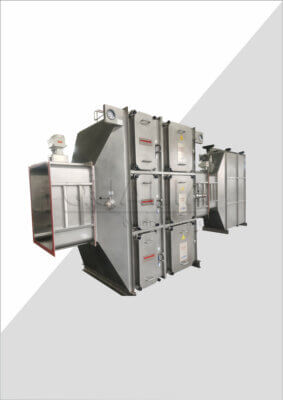
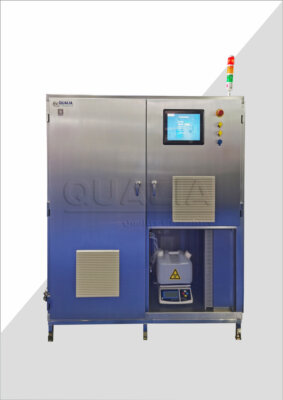
For teams planning exhaust failure test protocols, the Effluent Decontamination System and exhaust infrastructure together form a coupled containment boundary—failure scenarios that affect one often affect both, and test staging should reflect that dependency.
Door interlock behavior during abnormal states
Normal-operation interlock testing confirms that the system behaves correctly under expected conditions. It does not confirm what happens when a power loss, alarm state, or partial system fault stresses the interlock logic at the same time a door cycle is being requested. Those are the conditions under which containment integrity is most at risk, and they require a distinct test sequence.
Two measurable thresholds define acceptance here. PLC response latency for interlock activation should be at or below 50 ms. Generic PLCs operating at 150–200 ms can allow pressure cascade to drop below containment thresholds during door cycling, because the command to prevent a second door from opening arrives after the pressure transient has already begun. This latency gap is invisible during routine operation checks but becomes a documented containment breach risk when witnessed transient recording is required for formal acceptance. The second threshold applies to pressure cascade stability: the differential pressure across the containment boundary must remain at or above 15 Pa through 10 consecutive door inflation and deflation cycles, with each cycle completing within 5 seconds and data logging at intervals of 1 second or finer. Both thresholds must be met under witnessed conditions, not inferred from average pressure readings.
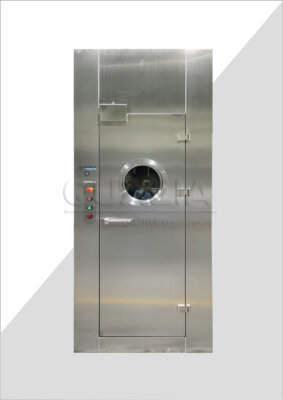
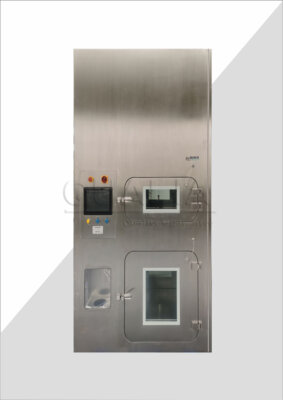
Passthrough interlock behavior under abnormal states deserves specific attention. The requirement that only one door opens at a time must be confirmed not just during normal commissioning but during simulated power-loss and alarm conditions. Interlock logic that holds correctly under normal power may release both doors simultaneously when the control system enters an alarm or fault mode, creating a direct breach path through the passthrough. This is a failure mode that normal-operation testing is not designed to stress.
| Criterio | Acceptance Threshold | Metodo di prova |
|---|---|---|
| PLC interlock response latency | ≤50 ms | Measure latency during door cycling under abnormal states (e.g., power loss, alarm) |
| Pressure cascade during door cycling | ≥15 Pa across 10 consecutive cycles, each ≤5 s, data logging ≤1 s | Witnessed transient pressure recording over 10 cycles |
| Interlock integrity under abnormal states | Only one passthrough door opens at a time | Test interlock logic during power‑loss and alarm states |
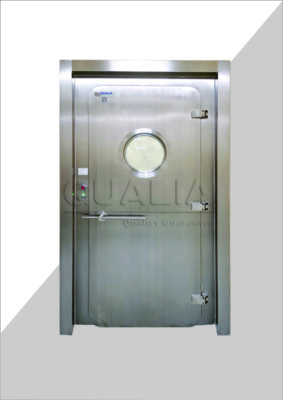
For facilities using pneumatic seal APR doors, the interaction between PLC latency, pneumatic supply pressure, and seal inflation timing is a critical system dependency. A pressure cascade that holds at 15 Pa during normal cycling can fall below threshold if seal inflation is delayed by even a fraction of a second under abnormal conditions—which is why these tests must be conducted under the actual abnormal states they are intended to simulate, not under normal-power approximations.
Safe staging of simulated failures
Simulated failure testing can damage equipment or invalidate other tests if scenarios are sequenced without a governing risk assessment. The staging problem is not theoretical: a power-loss simulation conducted before pneumatic systems have been verified at working pressure can leave seals in an intermediate state that corrupts subsequent pressure cascade measurements. Improper sequencing creates a situation where the test record shows a passing result derived from a compromised initial condition, and that result will not survive scrutiny at audit or re-testing.
Risk-assessment-based scenario selection should precede execution protocol development. The scenarios that need to be staged include, at minimum: power loss under occupied and unoccupied states, exhaust fan trip under varying pressure conditions, HEPA filter bypass, door interlock logic under alarm states, and pneumatic supply low-pressure events. Each scenario should define the trigger condition, the expected safe state, the alarm response, the recovery action, the record format, and the responsible responder. That structure is what separates a failure-mode test from a fault observation.
The venturi valve case illustrates what happens when failure-mode testing is omitted. A backwards-installed valve can operate within normal-condition parameters because normal airflow patterns accommodate the installation error without triggering a differential pressure alarm. Only a simulated failure—one that forces the system to respond outside normal operating ranges—reveals the error. Ten years of normal operation did not surface it; one controlled simulated failure did. The practical implication is that failure-mode tests are the only mechanism for detecting certain classes of installation or configuration error, and that deferring them to a later project phase or omitting them entirely leaves those errors latent until a live incident.
Sensor calibration must be verified before any failure-mode test begins. An uncalibrated differential pressure transmitter will produce pass or fail readings that cannot be traced to the actual physical state of the system. This is not a formality: if calibration is not confirmed beforehand, the entire test sequence must be repeated after calibration is established, with no ability to credit the earlier results.
Emergency responder ownership in records
Failure-mode testing generates records that need to name who responds to each alarm, what training that person has completed, and what authority they carry to initiate recovery actions. In most commissioning projects, engineering owns the test execution, biosafety owns the procedure oversight, and emergency response has separate training requirements. These three domains do not naturally synchronize, and when they are not explicitly coordinated in the failure-mode test protocol, the records produced tend to satisfy one domain while leaving the others incomplete.
The gap surfaces at audit. A test record that documents alarm activation and recovery sequence but does not identify a named, trained responder for each failure mode is formally incomplete. It confirms that the system behaved correctly during the test but provides no assurance that the correct response will occur during an unplanned event—because no one has been assigned ownership of that response in a documented and verifiable way.
Assignment of emergency responder ownership should be built into the test protocol itself, not appended after the fact. Each failure scenario should include a field identifying the responder role, the individual assigned, and the training record reference. This structure makes the failure-mode test record function as both a technical acceptance document and an operational readiness confirmation—which is the correct scope for high-containment environments.
For exhaust filter failure specifically, the BIBO change-out procedure should include validated operator exposure monitoring data. That data confirms that the emergency response procedure protects the assigned responder under realistic breach conditions. Including it in the exhaust failure response record ties personnel protection verification directly to the scenario where it is most needed.
Closure threshold for failure-mode acceptance
Closing a failure-mode test requires three conditions to be met simultaneously: the system response was correct, the recovery was documented, and the records are traceable and defensible. Teams that close testing after confirming system response—before fully resolving the record condition—create rework that arrives at the worst possible time, typically during final regulatory review or site acceptance.
Calibration documentation is the most commonly incomplete record element at closure. Calibration certificates that list an instrument model and a pass/fail result are not sufficient for high-containment environments. Each differential pressure transmitter used in failure-mode testing should have a calibration certificate that includes as-found and as-left data, a measurement uncertainty statement, and ISO 17025 traceability. Without those elements, the test data produced by that instrument cannot be independently verified, and the acceptance decision cannot be defended if the measurement is questioned. This is not a documentation preference—it is what makes the test result auditable.
Door interlock transient pressure testing has a specific closure requirement: witnessed recording of 10 consecutive cycles with pressure cascade never dropping below 15 Pa. That criterion must appear in the acceptance record as a pass/fail result, not as a general statement that testing was completed satisfactorily. Witnessed, cycle-by-cycle documentation is what distinguishes a verified result from an observed one.
For regulated pharmaceutical environments, the complete IQ/OQ/PQ validation package—including all calibration records—should be delivered before site acceptance, with records structured for a minimum 10-year retention period in a format consistent with 21 CFR Part 11 audit trail requirements. In other jurisdictions and contexts, equivalent record integrity standards apply; the specific retention period and electronic record requirements should be confirmed against the applicable regulatory framework. The practical consequence of missing or structurally non-compliant records is the same regardless of jurisdiction: the failure-mode acceptance remains formally open, and the project cannot close.
| Criterio di accettazione | Requisito minimo | Regulatory/Quality Link |
|---|---|---|
| Calibration documentation | As‑found/as‑left data, measurement uncertainty statement, ISO 17025 traceability for every differential pressure transmitter | Unverifiable test data; acceptance non‑defensible without complete calibration records |
| Door interlock transient pressure test | Witnessed 10 consecutive cycles, cascade never below 15 Pa | Confirms pressure cascade stability under repeated cycling |
| Validation package delivery | Complete IQ/OQ/PQ package with calibration records retained minimum 10 years in 21 CFR Part 11 compliant format | Missing or non‑compliant records create regulatory exposure and invalidate failure‑mode acceptance |
The closure criteria exist because verified response is not the same as defensible acceptance. A system that behaved correctly during testing but lacks traceable calibration records, named responder assignments, and a complete validation package has demonstrated performance but not established it in a form that survives scrutiny. Those are different outcomes, and the gap between them is what closure criteria are designed to close.
The clearest pre-decision judgment this testing sequence demands is whether failure-mode testing is scoped as a distinct verification discipline or folded into commissioning as a supplemental check. Those are not equivalent approaches. A commissioning-appended scope tends to test alarm activation under normal conditions and call that sufficient. A distinct failure-mode discipline tests trigger, safe state, alarm, recovery, documentation, and responder ownership as a complete chain—under conditions specifically designed to stress the system outside normal operating parameters. The latent installation errors, PLC latency gaps, and incomplete responder ownership records that pass undetected under the first approach typically surface under the second.
Before accepting closure on any failure-mode test package, confirm that calibration certificates carry as-found/as-left data with ISO 17025 traceability, that pressure cascade recordings are witnessed and cycle-resolved, that each alarm scenario names a trained responder with a linked training record, and that the IQ/OQ/PQ package is structured for long-term retention under the applicable regulatory framework. A test that is technically correct but records-incomplete remains open—and opening it again after site acceptance is a significantly more costly problem than resolving it before.
Domande frequenti
Q: Does this testing approach still apply if the facility is not regulated under 21 CFR Part 11 or a pharmaceutical framework?
A: Yes — the core failure-mode discipline applies regardless of regulatory framework, though specific record retention periods and electronic audit trail requirements will vary by jurisdiction. The underlying risk is the same in any BSL-3/4 environment: unverified fail-secure logic, untested interlock behavior under abnormal states, and incomplete responder ownership create latent gaps whether or not a pharmaceutical regulator is reviewing the records. Confirm the applicable retention and record-integrity requirements for your jurisdiction, but do not treat the absence of pharmaceutical regulation as a reason to reduce the scope of failure-mode testing.
Q: What should be done immediately after all five failure-mode categories pass acceptance — before the lab goes into operational use?
A: The validated failure-mode records should be formally transferred to the operational readiness owners — biosafety, facilities management, and emergency response — with explicit confirmation that each named responder has reviewed the scenario assigned to them and that training records are current. Passing acceptance creates a documented baseline, but that baseline loses its value if the personnel who will respond to live events have not been formally handed ownership of their assigned scenarios before first use. This transfer step is distinct from test closure and should be treated as a separate operational readiness gate.
Q: At what point does PLC latency become acceptable if a facility cannot source a system that meets the 50 ms threshold?
A: There is no defined alternative threshold in the evidence provided, which means a system operating above 50 ms carries an unresolved containment risk for pressure cascade during door cycling. The practical path is not to accept a higher latency but to evaluate whether the pressure cascade margin at the installed differential — combined with door cycle timing — can be engineered to compensate. That evaluation requires witnessed transient pressure recording under the actual abnormal states, not modeled approximations. If 10 consecutive cycles cannot maintain ≥15 Pa at the installed PLC latency, the control system or door sequencing logic needs to be resolved before acceptance, not after.
Q: How does failure-mode testing scope change for a retrofit or expansion of an existing BSL-3/4 facility versus a new build?
A: A retrofit or expansion introduces the additional risk that modified systems interact with unmodified legacy systems in ways that new-build testing is not designed to detect. Failure-mode tests for a retrofit must explicitly include scenarios that stress the boundary between new and existing systems — for example, whether a new PLC correctly interprets alarm states generated by legacy sensors, or whether a new exhaust fan trip propagates correctly through an existing fire alarm integration sequence. Testing only the newly installed components and accepting the legacy behavior as previously validated leaves the interaction boundary untested, which is precisely where configuration errors tend to occur.
Q: Is third-party witnessed testing worth the cost for a smaller BSL-3 facility that has an experienced in-house engineering team?
A: Third-party witnessing is necessary for defensibility, not just competence. An experienced in-house team can execute the test correctly, but a witnessed record carries a fundamentally different evidentiary status at regulatory audit, insurance review, or incident investigation. The specific failure modes where this distinction matters most — fail-secure PLC logic under abrupt power removal and pressure cascade stability under abnormal door states — are exactly the scenarios where a self-certified result is most likely to be questioned. The cost of third-party witnessing for those specific scenarios is modest relative to the cost of reopening acceptance after site handover, or of defending an incident record that lacks independent verification.