Treating a BSL-3 personnel shower as a binary checkbox — present or absent — is the design assumption most likely to produce a costly compliance failure. Facilities that install a water-only shower without evaluating the transmission route of their target agent can commission an entire suite, complete IBC review, and still face an immediate inspection finding the first time a Select Agent program inspector reviews the risk assessment. The retrofit cost is significant: introducing chemical shower capability into an operating BSL-3 suite requires containment disruption, system re-validation, and full reapproval of the modified exit protocol before the facility can resume work. Understanding exactly which agent characteristics trigger the upgrade from water-only to chemical-capable exit decontamination — and what documentation must accompany that upgrade — is the judgment that determines whether your shower infrastructure will hold up under audit or become the centerpiece of a corrective action cycle.
What BMBL Section IV-B specifies for BSL-3 shower requirements: mandatory versus risk-based obligations
BMBL 6th Edition Section IV-B establishes shower facilities as a core design requirement for all BSL-3 laboratories — not a recommended enhancement, but a baseline condition. A facility without any shower provision fails the foundational standard before any agent-specific analysis begins. What the standard does not do is treat all BSL-3 shower installations as equivalent. The actual compliance threshold branches based on what the facility intends to do inside the suite.
The split matters most during facility design and risk assessment. A water-only shower may be defensible for BSL-3 work with agents that do not present an aerosol transmission risk and fall outside Select Agent classification — but that defensibility depends entirely on a documented risk assessment that reaches that conclusion explicitly. Without the written rationale, a water-only installation creates an ambiguity that inspectors are not obligated to resolve in the facility’s favor.
| Type d'exigence | Condition de déclenchement | System & Documentation Needed |
|---|---|---|
| Baseline Shower Facilities | All BSL-3 work | Shower facilities (water-only may be acceptable if risk assessment justifies). |
| Chemical Exit Shower | Working with aerosol-route pathogens ou Select Agent pathogens (42/9 CFR) | Chemical-capable system with an IBC-approved protocol (agent, concentration, duration). |
The practical implication is that the chemical shower requirement is not absolute across all BSL-3 work, but the risk assessment that justifies avoiding it carries the full weight of IBC approval. Facilities that skip that documentation step — even when the underlying science might support a water-only protocol — have no documented basis to defend their installation if an inspector questions it.
The agent characteristics that trigger mandatory chemical shower: aerosol route transmission and Select Agent classification
Two agent characteristics independently trigger the requirement for a chemical-capable exit shower, and either one is sufficient to make a water-only system inadequate. The first is aerosol route transmission. When a pathogen’s primary exposure pathway is inhalation of aerosolized particles, the risk of surface contamination and environmental carryover through a water-only exit sequence is not adequately controlled. The exit shower is not simply a hygiene measure at that point — it is a functional containment barrier, and chemical decontamination capability is part of what makes it function.
The second trigger is Select Agent classification under 42 C.F.R. Part 73 or 9 C.F.R. Part 121. Federal Select Agent Program oversight imposes a stricter containment and decontamination standard than BMBL alone. For Select Agent work, a chemical decontamination exit protocol is effectively non-negotiable during program inspection — not because BMBL states it in those exact terms, but because inspectors reviewing the risk assessment expect to find documented justification for every exit decontamination decision, and the absence of chemical capability for Select Agent work is difficult to justify credibly.
| Agent Characteristic | Why It Triggers Requirement | Consequence of Non-Compliance |
|---|---|---|
| Transmitted via aerosol (inhalation) route | Elevated risk of environmental contamination and personnel exposure via airborne particles. | Facility fails Select Agent Program inspection if risk assessment lacks justification for water-only exit. |
| Classified as a Select Agent (42 CFR 73 / 9 CFR 121) | Federal regulations impose stricter containment and decontamination standards. | Chemical decontamination exit protocol is non-negotiable for inspection compliance. |
The downstream consequence of missing either trigger during the design phase is infrastructure that cannot be corrected without operational disruption. Retrofitting chemical shower capability into a commissioned suite is not a paperwork fix — it involves physical system modification, re-validation of the modified installation, and a full revision cycle through IBC approval before the revised exit protocol can be used. Facilities working with aerosol-route or Select Agent pathogens that are still in the design or pre-commissioning stage should treat chemical shower capability as a fixed design parameter, not an optional upgrade decision.
What the institutional biosafety committee must approve and document for BMBL-compliant shower protocols
The IBC’s role in shower protocol compliance is often framed as a review function, but it carries direct liability for any protocol deficiency an inspector identifies. When BMBL specifies that the IBC must approve the specific chemical shower protocol — including the decontaminating agent, its concentration, and the required contact duration — it does not simultaneously provide a default standard that covers the gap if the IBC’s documentation is incomplete. The flexibility to tailor those parameters to specific pathogens is real and operationally useful, but it means the IBC cannot point to a published standard if the protocol is found deficient. The IBC approved the protocol; the IBC owns the finding.
| Documentation Responsibility | When Required | Key Details to Confirm |
|---|---|---|
| Initial Protocol Approval | Prior to facility operation with the agent. | IBC must approve and document the specific chemical shower protocol (agent, concentration, contact duration). |
| Annual Review & Re-verification | At least annually during operational reviews. | IBC must re-verify and document that all operational parameters and procedures (including shower protocols) remain current and functional. |
Annual re-verification is the element most frequently treated as a formality and most frequently checked during inspection. Inspectors reviewing facility records will look for documentation showing that the shower protocol was reviewed during the annual operational verification cycle — not just that the chemical supply was replenished, but that the protocol parameters were confirmed to remain current, appropriate for the agents in use, and functional as written. IBC minutes from that review need to reflect actual deliberation, not a pro forma approval of an unchanged document. If the agent profile for the facility has changed since the last approval cycle and the shower protocol has not been updated to reflect that, the annual review record creates a documented compliance gap rather than closing one.
The chemical concentration log deserves specific attention prior to any Select Agent program inspection. An approved protocol that specifies a contact concentration is only as defensible as the maintenance records showing that the system has been operating at that concentration. A gap between the approved protocol and the operational log — whether because of dilution drift, supply substitution, or an undocumented adjustment — is the kind of discrepancy that escalates a routine documentation review into a significant finding.
Exit protocol documentation requirements: what CDC Select Agent inspectors verify during program inspection
Select Agent program inspectors approach exit shower documentation as an integrated system review, not a checklist of individual equipment items. Confirming that a shower exists and that a chemical protocol is on file is the starting point, not the conclusion. What inspectors are evaluating is whether the documented protocol and the actual operational state of the system are consistent, and whether the personnel using the system have a clear, approved procedure to follow under normal and abnormal conditions.
Functional verification is a baseline item. Inspectors expect documentation confirming that the shower system — including any drench or eye wash components — has been confirmed operational as part of routine facility maintenance. If that verification has not been documented at appropriate intervals, it signals a breakdown in the maintenance and documentation cycle, not just a gap in a specific record. The absence of maintenance logs can call into question whether the system was actually functional during periods for which no record exists.
The documentation standard for critical systems that inspectors apply to HVAC — requiring evidence of performance under failure conditions, not just normal operation — provides a useful frame for understanding what they expect from shower protocol documentation. A shower SOP that describes normal operation only, without addressing what happens when the system is not available, reflects the same documentation gap as an HVAC validation that never tested for airflow reversal. The principle is consistent: critical containment systems require documented performance verification at the boundaries of their operating envelope, not just under ideal conditions. For the exit shower, that boundary condition is system failure.
Contingency protocols: what BMBL requires when the shower system is not operational
The most difficult finding to close after a Select Agent program inspection is not a missing piece of equipment. Equipment findings have procurement timelines. The hardest finding to clear is the absence of a documented contingency protocol for shower system failure, because the resolution path requires developing a new SOP, cycling it through IBC review and approval, and submitting evidence of that approval to the program before the finding is considered closed. There is no shortcut in that sequence, and the IBC review cycle does not compress because an inspection deadline is pending.
BMBL’s requirement for a documented contingency decontamination method when the primary shower system is not operational reflects the same containment logic as the primary protocol itself: personnel who have worked with aerosol-route or Select Agent pathogens cannot simply exit the facility through an uncontrolled pathway because a system went offline. The exit decontamination requirement does not pause when the hardware fails. The contingency protocol has to specify what personnel actually do — what alternative decontamination method is used, what chemical agent at what concentration, what contact time, and who is notified — in enough operational detail that personnel can execute it without improvising.
Facilities that have an approved exit SOP but have never reviewed whether that SOP addresses system failure are carrying a compliance risk that may not be visible until an inspector asks to see the contingency section. The question to ask before that inspection occurs is straightforward: if the shower system failed right now, does the current IBC-approved SOP tell personnel exactly what to do, and is that alternative method feasible with resources currently available in the facility? If the honest answer is no, or uncertain, the SOP has a gap that IBC reapproval needs to close before the next inspection cycle — not after.
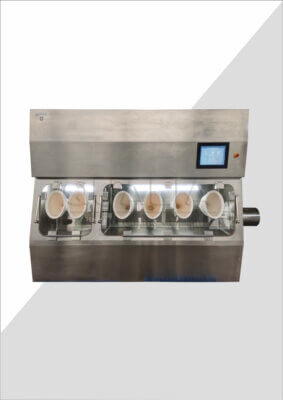
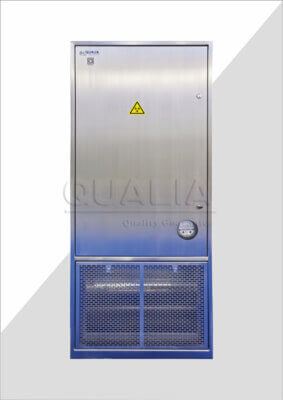
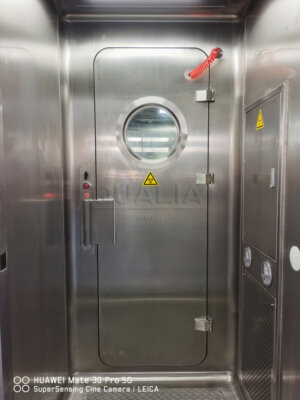
For facilities evaluating shower system design, equipment that combines reliable chemical delivery with documented failure detection and alarm capability reduces the operational pressure on contingency protocols by minimizing undetected downtime. A system that alerts personnel and facility management to a malfunction immediately narrows the window during which a contingency protocol must be executed. Qualia Bio’s Douche brumeuse is one example of purpose-built personnel decontamination equipment designed for BSL-3 containment exit sequences, though the appropriateness of any specific system depends on the IBC-approved protocol parameters for the agents in use.
The clearest pre-inspection check for any BSL-3 facility working with aerosol-route or Select Agent pathogens is to read the current IBC-approved exit SOP as if you have never seen it before and ask whether it specifies the chemical agent, concentration, contact duration, and what personnel do when the shower system is unavailable. If any of those elements is missing, the finding already exists — the inspector will simply be the one to document it. For facilities still in the design or commissioning phase, the more consequential question is whether chemical shower capability is built into the infrastructure from the start, because adding it after the fact is a containment disruption problem, not a paperwork problem.
The IBC’s role in this compliance architecture also means that preparation for a Select Agent inspection is not solely a biosafety officer responsibility. The IBC’s approval records, meeting minutes documenting annual re-verification, and the specific protocol parameters on file are all inspection artifacts. If those records do not reflect the system as it is actually operating — or if the annual review cycle produced approvals without substantive review — that gap is visible to an inspector and cannot be explained away by pointing to the equipment itself. The infrastructure and the documentation have to match, and the IBC’s records are what confirm that they do. More detail on how BSL-3 containment requirements compare to higher-risk facilities is available in Naviguer dans le confinement biologique : Les différences essentielles entre les laboratoires BSL-3 et BSL-4.
Questions fréquemment posées
Q: Does the chemical shower requirement apply if a facility works with a BSL-3 agent that is not a Select Agent but is still transmitted by the aerosol route?
A: Yes — aerosol route transmission is an independent trigger for chemical shower capability, regardless of whether the agent carries Select Agent classification. Either characteristic is sufficient on its own to make a water-only system inadequate. A facility working with a non-Select Agent BSL-3 pathogen transmitted by inhalation still requires a chemical-capable exit shower, and the IBC-approved risk assessment must reflect that determination explicitly.
Q: What is the first concrete step after identifying a gap in the contingency protocol before an upcoming inspection?
A: The immediate priority is drafting a revised exit SOP that specifies the alternative decontamination method, chemical agent, concentration, contact duration, and notification chain for a shower system failure — then submitting it to the IBC for formal review and approval before the inspection occurs. The finding cannot be resolved by verbal explanation or interim corrective action; inspectors require evidence of IBC-approved documentation. Starting the IBC review cycle as early as possible matters because that cycle does not compress to meet an inspection deadline.
Q: At what point does a water-only shower installation become permanently defensible for BSL-3 work — or is that determination always subject to revision?
A: A water-only installation is never permanently defensible — it remains defensible only as long as the facility’s agent profile and IBC-approved risk assessment continue to support it. If the facility adds aerosol-route pathogens or Select Agent work after the initial IBC approval, the original risk assessment justifying a water-only protocol is no longer valid. The annual re-verification cycle is the mechanism through which this alignment is supposed to be confirmed, which is why inspectors look at IBC minutes for evidence of substantive review rather than pro forma re-approval of an unchanged document.
Q: How does BMBL’s chemical shower requirement for BSL-3 compare to what the WHO Laboratory Biosafety Manual 4th Edition requires at an equivalent containment level?
A: The article’s compliance framework is built around BMBL and the Federal Select Agent Program, and a direct comparison with WHO LBM 4th Edition requirements for equivalent containment levels is not resolved here. Facilities operating under WHO guidance rather than — or in addition to — BMBL should consult the WHO Laboratory Biosafety Manual 4th Edition directly to determine whether equivalent triggers and documentation standards apply, since the two frameworks may differ in how they specify exit decontamination obligations and institutional oversight responsibilities.
Q: Is purpose-built chemical shower equipment worth the cost over a facility-engineered solution, given that BMBL does not mandate a specific equipment type?
A: Purpose-built systems are worth evaluating seriously because the compliance value lies not just in chemical delivery capability but in documented failure detection — a characteristic that directly reduces the operational burden on contingency protocols. BMBL does not specify equipment type, so a facility-engineered solution can satisfy the requirement if the IBC-approved protocol parameters are met and the system can be validated under failure conditions. However, purpose-built equipment designed for BSL-3 exit sequences typically provides more straightforward documentation of performance at those boundaries, which is precisely what inspectors look for when reviewing critical containment system records. The decision ultimately depends on whether a custom installation can produce equivalent validation documentation.
Contenu connexe :
- Mist Shower vs Air Shower for BSL-3 Personnel Decontamination: Which Exit Protocol Is Appropriate
- Mist Shower Requirements Under BMBL 5th Edition: What BSL-3 Exit Protocols Must Include
- Systèmes de douche à brouillard : Une référence technique pour la décontamination du personnel BSL-3 et BSL-4
- Mist Shower Design for BSL-4 Laboratories: Enhanced Containment Specifications Beyond BSL-3 Standards
- Quand passer d'un laboratoire modulaire de niveau de sécurité 2 à un laboratoire modulaire de niveau de sécurité 3 ? Évaluation des risques et éléments déclencheurs de la réglementation
- Entrée et sortie du BSL-4 : Procédures de sécurité critiques
- Entretien des douches à air comprimé : Conseils d'entretien préventif
- Validation des douches à air : Garantir la performance
- Douches chimiques BSL-4 : Systèmes de déconditionnement avancés