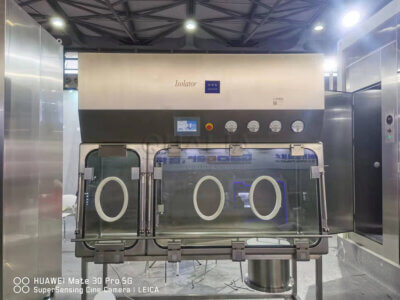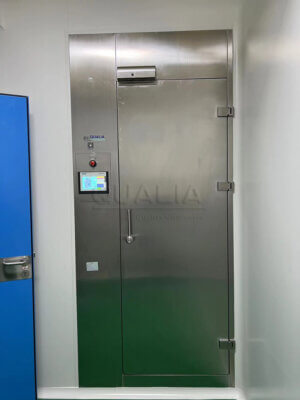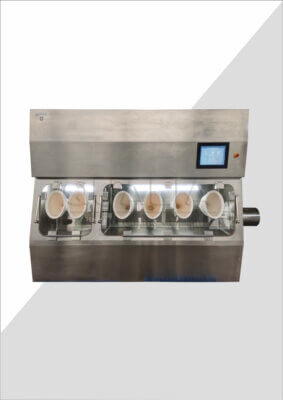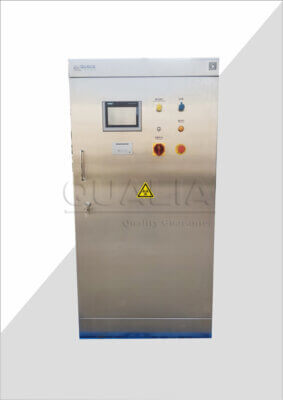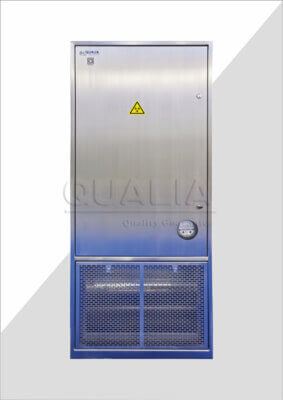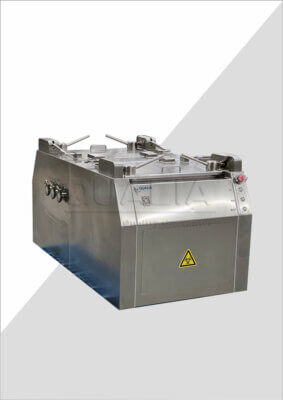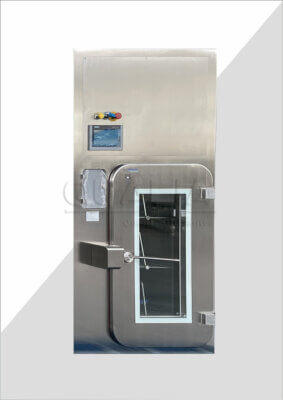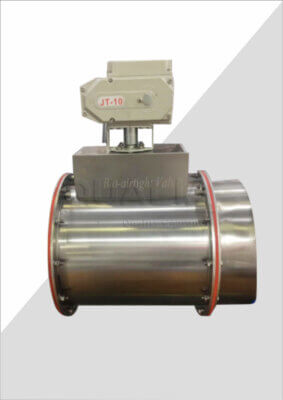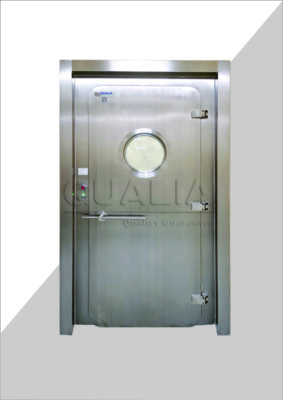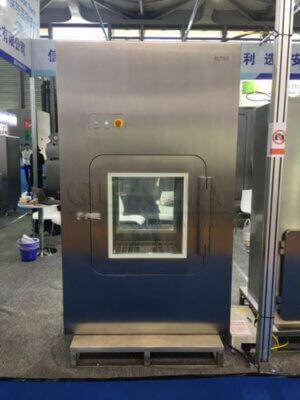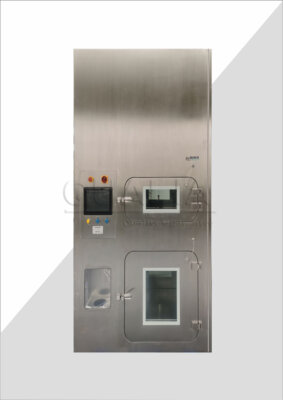
Selecting the wrong material exit route in a high-containment environment rarely becomes visible during procurement — it surfaces during validation, when a dunk tank protocol cannot produce the cycle evidence an auditor expects, or during operations, when a VHP pass box cycle queue becomes a throughput bottleneck that no one modelled before installation. Both technologies maintain a containment barrier through double-door interlocking, and both can be justified in the right context, but the selection criteria interact in ways that make a surface-level comparison unreliable. The decision turns on four compounding factors: what the load material tolerates, what validation evidence the environment requires, what transfer frequency the operation demands, and what the facility’s air handling can support. Working through each of those factors in sequence will give you a more defensible basis for specifying one system over the other before the URS is finalised.
Immersion-Compatible Loads for Dunk Tank Use
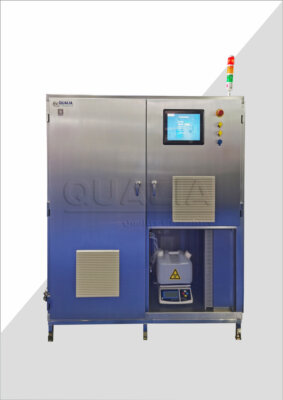
A dunk tank is a practical exit route when the load is physically compatible with full immersion and the biosafety protocol can specify disinfectant contact conditions with enough precision to support efficacy claims. The material compatibility question is not only about whether an object survives getting wet — it is about whether every external surface can be reliably contacted by disinfectant solution under realistic packaging and load geometry conditions. That distinction matters more than most teams expect.
The 304 stainless steel construction of a biosafety dunk tank is compatible with a broad range of chemical classes documented for this application: phenolics, glutaraldehydes, quaternary ammonium compounds, hydrogen peroxide, alcohols, proteinated iodines, and sodium hypochlorite are each used in practice depending on the agent and the site biosafety protocol. That list represents options, not universals — the disinfectant selection must be made at the protocol level, with the specific agent, concentration, and replenishment schedule defined before operational use begins.
The planning consequence that teams underweight is the replenishment side. Disinfectant concentration degrades with load volume, organic burden, and time, and a protocol that does not define a clear replenishment schedule will gradually operate below the concentration needed for reliable efficacy. This does not show up as an obvious failure — the tank looks functional, transfers continue, and the problem only becomes visible when someone asks for evidence that the concentration was maintained over a defined operational period. At that point the gap is in documentation, not in the equipment itself.
| Planning Factor | What to Confirm | Why It Matters |
|---|---|---|
| Material compatibility | 304 stainless steel tank is compatible with the selected disinfectant | Prevents degradation, corrosion, or contamination of the tank and load |
| Disinfectant selection | Disinfectant chosen from approved classes: phenolics, glutaraldehydes, quaternary ammonium compounds, hydrogen peroxide, alcohols, proteinated iodines, sodium hypochlorite | Ensures the chemical is effective and safe for the load and tank materials |
| Disinfectant type in protocol | Biosafety protocol explicitly defines the disinfectant type to be used | Avoids ad-hoc chemical choices that may compromise efficacy |
| Replenishment schedule | Protocol defines how often disinfectant is replenished or replaced | Maintains required concentration and activity over repeated use |
| Concentration requirements | Protocol specifies target concentration for each disinfectant used | Ensures sufficient contact kill efficacy during immersion |
Use the planning factors above as a pre-operational check before writing the dunk tank into a biosafety protocol. If any row cannot be confirmed against site-specific conditions, that gap should be resolved at protocol design, not after commissioning.
Dry Transfer and Residue Control for VHP Pass Boxes
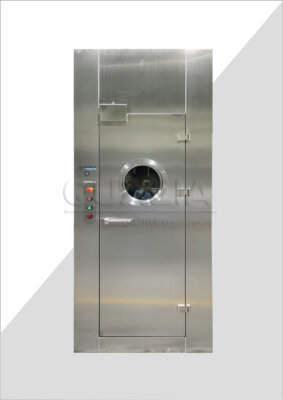
VHP pass boxes are the more defensible exit route for loads where moisture contact creates damage risk — biologics, electronics, labelled materials, certain packaging formats, and items where post-transfer residue could interfere with downstream use. The dry, low-heat decontamination profile protects those load categories in ways that liquid immersion structurally cannot.
The performance baseline for a validated VHP cycle — 6-log surface reduction confirmed with Geobacillus stearothermophilus biological indicators — provides a specific, documentable kill claim that can be carried through to GMP submission and audit. ISO 22441:2022 offers a framework for testing low-temperature vaporised hydrogen peroxide sterilization cycles against biological indicators; where a pass box cycle is validated using this method, the evidence pathway is substantially more structured than protocol-adherence-based liquid disinfection. That does not mean dunk tanks are unacceptable in GMP environments, but it does mean the validation evidence takes different forms and carries different weight in a regulatory review.
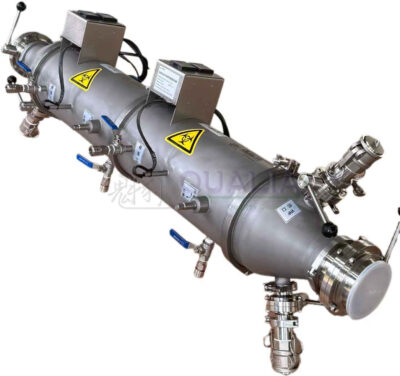
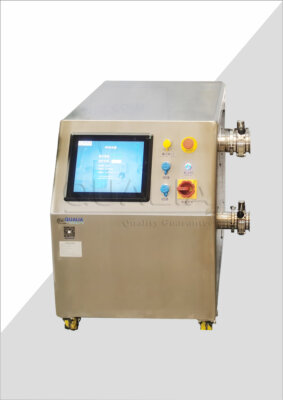
The facility integration implication that affects specification is air handling. Residual hydrogen peroxide must be aerated below safe release thresholds before the door on the clean side can open, and how that aeration is managed depends on whether the H₂O₂ generator is integrated into the unit or supplied as a mobile system, and whether independent ventilation is configured at the point of installation. These are not afterthoughts — they affect layout, extract connection points, and the cycle time that operations teams will actually experience. A 30-minute baseline cycle can extend to 40–45 minutes depending on load and aeration requirements, and that duration is what determines practical transfer throughput.
| Capability | Specification | Transfer-Decision Relevance |
|---|---|---|
| Decontamination level | 6Log surface reduction | Provides measurable, validated kill performance for regulatory acceptance |
| Cycle time baseline | From 30 minutes | Allows transfer-frequency planning and workflow integration |
| Biological indicator validation | Geobacillus stearothermophilus spores, 6 log reduction | Supports validation evidence for GMP and biosafety compliance |
| Thermal profile | Low-heat, dry decontamination | Protects heat-sensitive items such as biologic preparations and electronics |
| Data integrity | Data acquisition system supports 21 CFR Part 11 | Meets FDA electronic records and audit trail requirements |
| Facility integration | Integrated or mobile H₂O₂ generator; independent ventilation options | Offers flexible air handling and residue control for different facility layouts |
The table above carries the specification detail; the planning implication is that each capability listed has a facility-side precondition — aeration options need extract connections, 21 CFR Part 11 data acquisition needs integration with site network and record management, and mobile versus integrated generator configuration affects both installation cost and cycle reproducibility. Resolve those preconditions at URS stage, not during FAT.
Floating, Leaking, and Air-Trapping Package Risks
The most operationally silent failure mode in dunk tank use is incomplete surface contact — not because the disinfectant is wrong or the concentration is inadequate, but because the package itself prevents the liquid from reaching every external surface. This failure is common enough to warrant explicit attention in protocol design, and it tends to appear as an assumption gap rather than a documented risk.
Packaging that floats reduces the contact surface to whatever stays below the liquid line. Bags with trapped air, sealed containers with positive buoyancy, and double-bagged materials are all routine items in high-containment workflows, and none of them behave predictably in a liquid immersion environment without active measures to submerge and orient them during contact time. A protocol that defines immersion time but not orientation and submersion confirmation is incomplete in a way that may not be obvious until someone asks whether the underside of a floating container received disinfectant contact equivalent to the surfaces that were submerged.
Packaging with compromised seals presents a different risk: liquid ingress during immersion may contaminate the contents of the container, which is particularly significant for biological samples, test articles, or documentation being transferred out of the zone. Some seal failures are visible before immersion; others are not. Foil-sealed secondary bags and double-sealed primary containers warrant explicit packaging integrity verification at the protocol level, not a general assumption that exit-side packaging is adequate for liquid immersion.
Air-trapping in recessed surfaces, threaded fittings, and lid-seat interfaces creates localised no-contact zones that are invisible during a standard immersion transfer. These zones are more predictable in geometry than floating or leaking failures, but they are equally invisible in the absence of a surface contact verification step in the protocol. The downstream consequence is not just efficacy uncertainty — it is the absence of any documented evidence that those surfaces received contact. For a dunk tank exit route supporting a select agent laboratory or a clinical manufacturing suite, that absence is a reviewable gap.
None of these risks disqualify dunk tanks from high-containment use. They do require that the biosafety protocol be written with surface contact verification in mind, not just disinfectant selection and immersion time.
Cycle Evidence and Aeration Burden in VHP Transfer
The VHP pass box produces a different kind of operational record than a dunk tank. Each cycle is monitored and logged by PLC, with critical parameters recorded for the duration of the run. In FDA-regulated environments where 21 CFR Part 11 applies, that data acquisition supports audit-ready electronic records and cycle-level traceability that liquid immersion protocols structurally cannot generate. The practical implication is not that VHP cycles are automatically compliant, but that the evidence pathway is built into the process — whereas dunk tank efficacy depends on operator adherence to a protocol that may or may not generate contemporaneous documentation.
The trade-off is throughput. A cycle that runs 30 to 45 minutes per load, with that range driven by load characteristics and the time required to aerate residual hydrogen peroxide to safe release levels, creates a fixed transfer interval that does not compress. In low-to-moderate frequency transfer environments — one to five exits per shift, for example — that cycle time is manageable. In environments where materials exit the containment zone continuously throughout an operational day, the aeration burden accumulates into a meaningful throughput constraint. Teams that select VHP based on decontamination performance without modelling transfer frequency against cycle time tend to discover the operational conflict after installation, when the pass box becomes a queue rather than a transfer mechanism.
The aeration and air handling options available on current VHP pass box configurations address residual peroxide management, but they do not eliminate the cycle time. They determine whether the residual is vented to room air, extracted to a dedicated system, or catalytically destroyed — and the choice between those options has both installation and maintenance implications. An independent ventilation configuration requires a connection to the facility extract; a catalytic destruction approach requires consumable replacement on a defined schedule. Neither is a passive system element, and both should be specified at the URS stage with the facilities engineering team engaged rather than treated as a commissioning detail.
Operator Safety and Transfer Frequency Factors
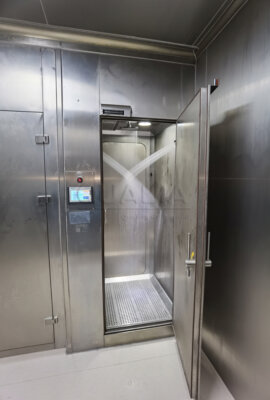
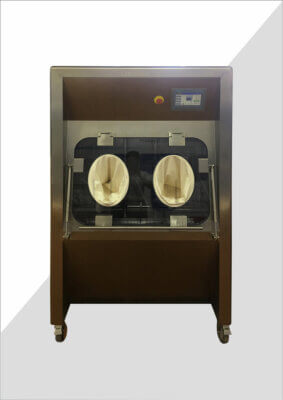
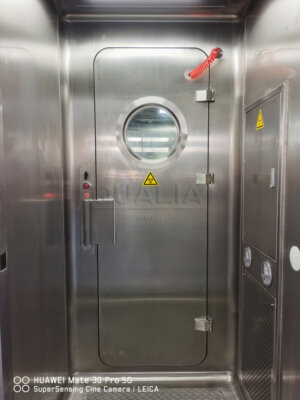
Both systems maintain containment during transfer through double-door interlocking, which means the common baseline — preventing simultaneous opening of the clean-side and dirty-side doors — is present in both. The safety differentiation between the two systems lies above that baseline, and it is most relevant in environments where transfer frequency is high or where emergency scenarios require specific response capability.
The VHP pass box includes an emergency stop button and emergency release valve, features that are relevant when an operator needs to interrupt a cycle in progress without waiting for normal cycle completion. In a high-containment environment where VHP is present in the chamber, the combination of interlocked inflated gasket airtight doors and an accessible emergency release pathway reflects a specific operational risk scenario — one that should be accounted for in operator training and emergency procedures, not assumed to be managed solely by the hardware.
| Safety Feature | VHP Pass Box | Dunk Tank |
|---|---|---|
| Door interlocking | Interlocked inflated gasket airtight doors | Double door interlocking |
| Emergency stop | Emergency stop button | — |
| Emergency release | Emergency release valve | — |
| Operator interface | Intuitive touch screens and override buttons | — |
| Containment barrier during transfer | Maintained via interlocked door system | Maintained via double door interlocking |
From an operational tempo standpoint, the touch-screen interface and override capability on the VHP pass box supports repeatable cycle execution without requiring manual protocol steps between transfers. The dunk tank workflow is operationally faster per transfer — immersion time is shorter than a full VHP cycle — but the absence of automated cycle evidence means that transfer frequency creates documentation burden rather than reducing it. In environments where every transfer event needs to be traceable, a high-frequency dunk tank operation may require manual logging practices that become harder to sustain reliably at volume.
Decision Matrix for High-Containment Exit Routes
The selection between these two systems cannot be resolved by comparing decontamination performance in isolation. Validation evidence strength, cycle time predictability, load compatibility, and facility configuration flexibility all carry weight in the decision, and underweighting any one factor produces a system that solves the problem it was optimised for while creating a constraint somewhere else in the operation.
The VHP pass box offers a validation evidence pathway — 6-log reduction against Geobacillus stearothermophilus biological indicators, PLC-recorded cycle parameters, and 21 CFR Part 11-compliant data acquisition — that is structurally stronger than a protocol-adherence-based efficacy model. For environments operating under FDA oversight, or where an inspection is likely to scrutinise decontamination validation records at the exit route level, that distinction matters and should be weighted accordingly. The WHO Laboratory Biosafety Manual, 4th edition, addresses decontamination principles applicable to both liquid disinfection and vapour-phase methods; it does not mandate a specific exit technology, but it does establish the expectation that decontamination methods be validated and that validation evidence be documented and maintained. That expectation applies to both systems and should shape how each is specified and operated.
The dunk tank is more operationally direct for immersion-compatible loads in environments where transfer frequency is high and the biosafety protocol can be written with sufficient precision to address concentration maintenance, surface contact verification, and documentation. Its limitation is not the technology — it is the absence of an automated cycle evidence mechanism, which places the documentation burden on the protocol and the operator rather than on the system. In environments where that burden can be reliably managed, the dunk tank remains a practical and legitimate exit route.
| Decision Factor | VHP Pass Box | Dunk Tank |
|---|---|---|
| Validation evidence | 6Log reduction with biological indicators (Geobacillus stearothermophilus) | Efficacy relies on disinfectant contact and biosafety protocol adherence |
| Cycle / contact time | Defined: 30–45 minutes (load-dependent) | Protocol-dependent immersion time |
| Load compatibility | Dry loads requiring residue control; moisture-sensitive or heat-sensitive items | Immersion-tolerant loads compatible with liquid disinfectants |
| Configuration flexibility | Integrated or mobile H₂O₂ generator; adaptable to facility layout | Fixed 304 stainless steel tank installation |
| Containment barrier | Double door interlocking | Double door interlocking |
The table above maps the five key decision factors side by side. The configuration flexibility row is worth particular attention during facility layout planning: the VHP pass box can be supplied with an integrated or mobile H₂O₂ generator and adapted to different ventilation configurations, which gives engineering teams more options for installation across varied facility footprints. The dunk tank is a fixed stainless steel installation, which simplifies the mechanical scope but reduces layout flexibility if transfer point locations change during facility design.
For detailed specification guidance on the VHP pass box configuration options, including generator integration and air handling variants, see the VHP Pass Box product page. Background on when VHP is the required exit route technology — rather than a selected preference — is covered in VHP Pass Box for Biosafety: When Hydrogen Peroxide Is Required.
The most productive framing for this decision is not which system performs better, but which system fits the constraints that are hardest to change: the load material’s tolerance for moisture, the validation evidence standard the regulatory environment will require, and the transfer frequency the operation actually needs to sustain. If any of those three constraints pulls strongly toward one system, it will typically outweigh the remaining factors. Where the constraints are genuinely balanced, the configuration flexibility of the VHP pass box and the operational speed of the dunk tank become the differentiating variables, and the selection narrows to facility layout and throughput modelling rather than decontamination performance.
Before writing either system into a URS, confirm the biosafety protocol’s documentation model for the dunk tank or the facility’s extract and air handling capacity for VHP — whichever system is under consideration. Both are late-stage constraints that will affect validation scope if they are not resolved early.
Frequently Asked Questions
Q: Can a dunk tank be used in an FDA-regulated GMP environment, or does regulatory oversight automatically require VHP?
A: A dunk tank is not disqualified from GMP environments, but the validation evidence it can produce is structurally different from VHP. Because dunk tank efficacy depends on protocol adherence rather than automated cycle recording, the documentation burden falls on the operator and the written protocol — there is no PLC-generated cycle log to carry into a submission or audit. Where an FDA inspection is likely to scrutinise exit-route decontamination records at the cycle level, that gap becomes a reviewable risk. Teams should assess whether their site’s documentation infrastructure can reliably sustain manual logging at the transfer frequency they actually operate before committing to a dunk tank in a regulated manufacturing context.
Q: What happens to transfer throughput if a VHP pass box is installed in a suite that runs continuous material exits throughout the shift?
A: Throughput will be constrained by the aeration phase, not the decontamination phase. A 30-minute baseline cycle can extend to 40–45 minutes depending on load characteristics and the time required to reduce residual hydrogen peroxide to safe release levels — and that interval cannot be compressed without changing the aeration configuration. In low-to-moderate frequency operations, the fixed cycle time is manageable. In continuous-exit environments, the cumulative aeration burden creates a queue that the pass box was not sized to absorb. Transfer frequency should be modelled against the full cycle duration — including aeration — before the system is specified, not after installation reveals the bottleneck.
Q: If the load material is immersion-compatible, is there any condition under which VHP would still be the better choice?
A: Yes — when the load’s external packaging cannot reliably achieve full surface contact during immersion. Even if the contents tolerate moisture, packaging geometry that traps air in recessed surfaces or threaded fittings, or primary containers with any seal uncertainty, introduces incomplete contact risk that the dunk tank protocol cannot automatically resolve. In those cases, VHP’s dry vapour profile contacts surface geometry more uniformly without depending on liquid wetting, and the 6-log biological indicator validation provides documented kill evidence that a surface-contact-dependent immersion protocol cannot replicate. Material tolerance for moisture is a necessary condition for dunk tank use, but it is not sufficient when packaging geometry is complex or seal integrity cannot be confirmed at every transfer.
Q: How does the choice between an integrated and a mobile H₂O₂ generator affect day-to-day VHP pass box operation?
A: The article establishes that both configurations are available but does not resolve the operational trade-off between them. An integrated generator ties the H₂O₂ supply directly to the unit, which supports cycle reproducibility and reduces the variables that affect concentration delivery — but it also means the pass box is out of service if the generator requires maintenance. A mobile generator preserves flexibility and can serve multiple units in a facility, but introduces variability in connection, positioning, and generator maintenance scheduling that affects cycle consistency. The choice has downstream consequences for both validation scope and maintenance planning, and should be made with the facilities engineering team at URS stage rather than treated as a configuration detail at FAT.
Q: Is a dunk tank a realistic exit route for a select agent laboratory, or does that biosafety classification require vapour-phase decontamination?
A: A dunk tank can be a legitimate exit route at select agent containment levels, but the biosafety protocol requirements become substantially more demanding. The CDC/USDA select agent regulations and the WHO Laboratory Biosafety Manual, 4th edition, establish that decontamination must be validated and that evidence must be documented and maintained — they do not mandate a specific exit technology. However, select agent environments are subject to inspection by federal authorities who will review decontamination validation records in detail. The absence of automated cycle evidence in a dunk tank operation places the full documentation burden on the protocol, the disinfectant concentration monitoring schedule, and the operator. Whether that burden can be sustained reliably at the required frequency and standard is a site-specific question that should be resolved with the registered entity’s biosafety officer before the exit route is specified.