An isolator’s pressure direction is a design output, not a starting assumption. Choosing it before the protection objective is defined leads to a barrier that performs well against the wrong risk. The decision belongs to whoever owns the product-protection or containment case for the project, and it should be settled before glove configurations, transfer interfaces, or monitoring strategy enter the conversation.
Protection Objective Before Pressure Direction
| Protection objective | Pressure concept generally evaluated | Decision boundary |
|---|---|---|
| Resist contaminant ingress for product protection | Positive pressure | Direction alone does not establish that the design is safer; define the product, operator, and environmental hazards. |
| Retain hazardous material for operator or environmental protection | Negative pressure | Direction alone does not establish containment or that the design is safer; use project-specific risk assessment and acceptance criteria. |
A pressure direction is a mechanism for controlling which way air moves across a barrier boundary. It does not, by itself, describe what the barrier is protecting. Two isolators can look identical in frame, glove ports, and transfer hardware and still serve opposite purposes, because the purpose lives in what the differential pressure is resisting: contaminant entry toward a protected product, or hazardous material escape toward an operator or the surrounding environment.
This is why the protection objective has to be named first, in terms specific enough to support a design decision. Naming “sterility” or “containment” as a goal is not sufficient; the project needs to identify what is being protected from what. A product that must stay free of environmental or operator-sourced contamination points toward one evaluation path. A material that is hazardous to the people or environment around the isolator points toward another. Where a project involves both a product that must remain uncontaminated and a compound that is itself hazardous, the two objectives can pull toward different pressure directions, and the resolution depends on isolator configuration choices — cascaded pressure zones, dedicated transfer paths, or segregated process steps — rather than on picking a single direction and treating it as universally protective.
The consequence of skipping this step shows up later, when acceptance criteria are being written. A pressure setpoint, an alarm threshold, or a transient-recovery target only make sense once it is clear what failure mode they are meant to catch. Writing those criteria before the objective is settled tends to produce numbers that are defensible in isolation but disconnected from the actual hazard. This is also why isolator selection discussions that start from “we need positive pressure” or “we need negative pressure” without first stating the hazard the project is managing are difficult for a supplier to engage with constructively — the direction is a conclusion, not an input.
The project team’s task at this stage is to document, in writing, what the isolator is meant to keep out and what it is meant to keep in, including any secondary hazard that coexists with the primary one. That document becomes the reference point for every pressure-related decision that follows.
Product-Protection Risks Addressed by a Positive-Pressure Concept
A positive-pressure concept is generally evaluated where the governing concern is contaminant ingress toward a product that must remain sterile or otherwise protected from the surrounding environment. The isolator interior is held above the pressure of the adjacent space, so that any leak path at a door seal, glove port, or transfer interface drives air outward rather than drawing unfiltered air inward. The mechanism protects the product by using pressure as a passive barrier against entry, independent of operator vigilance.
This concept assumes that what originates inside the isolator — the product, the process air, any residual material — does not itself pose a hazard that outward leakage would create. Where that assumption holds, positive pressure is a direct way to defend an aseptic boundary, and it aligns with contamination-control strategies described for sterile product protection, including the pressure monitoring, recording, and alarm expectations set out in EU GMP Annex 1 for barrier systems used in sterile manufacturing. Annex 1’s framing is specific to the sterile-manufacturing context, and its room-pressure guidance does not translate directly into a universal isolator setpoint; the applicable cascade and differential still have to be derived for the specific process and room configuration.
The condition that changes this judgment is what the isolator processes. If a positive-pressure aseptic isolator is later used, or considered for use, with a compound that carries operator or environmental hazard, outward leakage stops being a tolerable side effect and becomes the exact failure mode a containment objective exists to prevent. This is the reason positive pressure cannot be treated as a general-purpose “cleaner is safer” default. It is safer for the product. It is not inherently safer for the people or environment around the unit.
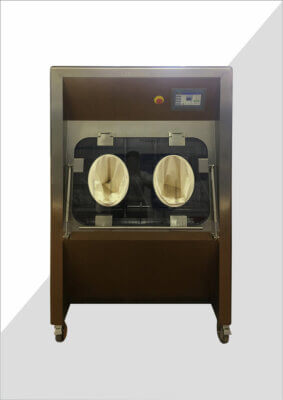
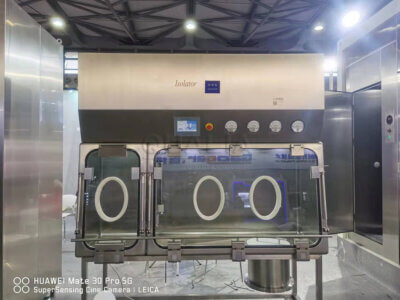
Configuration choices that follow from a positive-pressure, product-protection objective include transfer interfaces designed to limit ingress during material movement, glove and sleeve systems selected for integrity under sustained positive differential, and monitoring arrangements that treat a drop toward ambient pressure as the primary alarm condition rather than a rise. A sterility test isolator built for this objective is configured around resisting entry, and that framing should be explicit in the project’s URS rather than left implicit in equipment naming.
Operator or Environmental Hazards Behind a Negative-Pressure Concept
A negative-pressure concept is evaluated where the material inside the isolator is the hazard, and the protection objective is keeping it from reaching the operator or the surrounding environment. The isolator interior is held below the pressure of the adjacent space, so that any leak path draws air inward instead of pushing contained material outward. The mechanism is the same physical principle as the positive-pressure case — differential pressure governing leak direction — applied to the opposite retention problem.
This concept assumes the inward airflow it relies on does not itself compromise something the project also needs to protect, such as product sterility inside the same enclosure. Where a project involves a hazardous active ingredient that also requires aseptic handling, negative pressure alone addresses containment but leaves the aseptic question open, and the two requirements have to be reconciled through additional design measures rather than through pressure direction alone. This is consistent with the risk-assessment and closed-system or barrier-design approach described in WHO guidance on pharmaceutical products containing hazardous substances, which frames containment and operator protection as outcomes of a documented risk assessment rather than a fixed pressure value. That guidance does not assign a compound-specific exposure limit or a specific containment result; those still come from the project’s own risk assessment and the occupational exposure band assigned to the material in question.
The condition that most directly changes configuration here is the containment level the hazard demands. Higher-hazard material handling, such as OEB4/OEB5-class operations, typically drives more deliberate choices around glove-port systems, rapid transfer port interfaces, and the way inbound and outbound material movement is isolated from the surrounding space — considerations developed further for negative-pressure isolator selection in OEB5-specific applications. The isolator supplier cannot assign a containment result without knowing the compound’s hazard classification and the operating states the project needs covered; that information has to originate with the project owner’s risk assessment, not with the equipment design.
A negative-pressure isolator’s monitoring strategy also inverts relative to the positive-pressure case: a rise toward ambient pressure, not a drop, is the condition the alarm structure is built to catch, because a rise is what signals the loss of inward draw that keeps hazardous material from migrating out.
Failure Responses for Leaks, Glove Breaches, and Pressure Alarms
Transient events — a glove breach, a door opening, a fan fault, or a pressure excursion that trips an alarm — are where a pressure concept is actually tested, because steady-state performance says little about what happens when the barrier is momentarily compromised. The response a project needs is not the same for a positive-pressure, product-protection isolator and a negative-pressure, containment isolator, because the risk each failure mode creates runs in opposite directions.
For a positive-pressure concept, a glove breach or door opening threatens an inward contamination path; the relevant question is how quickly and reliably the system can reestablish outward airflow and how the process inside should respond while recovery is underway. For a negative-pressure concept, the same physical event threatens an outward release path, and the acceptable response may include different isolation or interlock behavior, because the hazard moving the wrong way is what the project is trying to prevent.
This is why generic alarm language in a specification is insufficient. A workable URS states what the isolator must do, in each operating state, for each named transient condition: glove breach during active handling, door opening during material transfer, fan fault during idle hold, and alarm persistence beyond a defined duration. Where the project also defines interlocks — process hold, transfer lockout, or operator notification — those behaviors need to be tied to the specific transient event they respond to, not stated as a single blanket reaction.
The condition that changes the required response is the hazard’s reversibility. Where the consequence of a brief ingress event is rework or batch risk, the response can reasonably prioritize minimizing disruption. Where the consequence of a brief egress event is operator exposure, the response has to prioritize stopping the pathway even where that means halting the process. Neither response is universally more conservative than the other; each is correct for the hazard it is built against. A project team moving from objective definition into specification should confirm that every named transient condition has an assigned response, a defined recovery behavior, and a stated basis for why that response fits the governing protection objective.
Acceptance Tests That Prove the Chosen Concept in Operation
| Decision scope | Relevant framework | Evidence to define or check | What the framework does not establish |
|---|---|---|---|
| Product-protection barrier | EU GMP Annex 1 | Contamination-control strategy, pressure monitoring, recording, and alarms in the operating states named in the URS | A universal isolator pressure setpoint or an occupational-containment result |
| Hazardous-material retention and operator protection | WHO GMP for pharmaceutical products containing hazardous substances | Risk assessment and closed-system or barrier-design evidence in the operating states named in the URS | A compound-specific exposure limit or a project-specific containment result |
| Separative-device design and approval | ISO 14644-7:2004 | Design, installation, testing, and approval evidence for the selected application | Application-specific pressure values or processes; the edition is marked for revision |
Proving a pressure concept works means testing it in the operating states the project actually uses, not only at steady-state idle. A pressure differential that holds during undisturbed operation says little about what happens during a glove breach, a transfer event, or a fan fault, which is why the operating states named in the URS need to be the states exercised during acceptance testing, not a simplified subset of them.
Where the project’s objective is product protection, the acceptance evidence aligns with the contamination-control strategy, pressure monitoring, recording, and alarm expectations described in EU GMP Annex 1 — tested specifically within the operating states the URS defines, since Annex 1’s sterile-manufacturing context does not supply a universal pressure setpoint or an occupational-containment result on its own. Where the objective is hazardous-material retention and operator protection, the evidence aligns instead with the risk-assessment and closed-system or barrier-design approach described in WHO’s guidance for hazardous pharmaceutical products, again exercised across the states the URS names, since that guidance does not assign a compound-specific exposure limit or a project-specific containment outcome. A project with both objectives in play needs acceptance evidence for each, rather than a single test campaign assumed to cover both.
For the separative device itself — the isolator structure, its interfaces, and its installation — ISO 14644-7 provides the design, installation, testing, and approval framework for separative devices generally. It does not supply application-specific pressure values or process parameters, and the edition itself is marked for revision, so a project team citing it should treat it as a structural testing framework to be populated with the project’s own acceptance criteria, not as a source of fixed numbers.
This is the stage where the project information a buyer supplies becomes directly usable: a URS that states the protection objective, the operating states to be tested, and the transient conditions to be exercised gives a supplier’s quotation and configuration review something concrete to respond to, rather than requiring assumptions about which failure modes matter. Acceptance testing that follows from this documentation — whether structured as FAT, SAT, or a qualification stage — demonstrates that the specific configuration delivered meets the criteria the project defined, not that the pressure direction chosen was generically correct. Where the URS is vague about operating states or transient conditions, that gap surfaces during acceptance testing as ambiguity about what “pass” means, which is a more costly point to resolve than during initial specification.
Frequently Asked Questions
Q: What if the project needs both product protection and hazardous-material containment?
A: Do not choose pressure direction from either objective in isolation. Document the product, operator, and environmental hazards, decide which failure consequences the design must control, and set project-specific acceptance criteria for the resulting concept.
Q: What information should be defined in the URS before an isolator pressure concept is evaluated?
A: State the protection objective, relevant hazards, required monitoring and alarms, and the operating states in which the concept must be demonstrated. Include normal operation and foreseeable transients such as door openings, glove breaches, fan faults, and pressure-alarm conditions.
Q: How should glove breaches and other transient events affect acceptance testing?
A: Treat them as named operating conditions with predefined response and acceptance criteria. The test plan should verify the selected concept under each applicable condition instead of relying only on a normal-operation pressure reading.
Q: Does alignment with EU GMP Annex 1, WHO GMP, or ISO 14644-7 prove that the chosen pressure direction is suitable?
A: No. These frameworks can guide the relevant contamination-control, containment, design, monitoring, and testing evidence, but they do not supply a universal isolator setpoint, a compound-specific exposure limit, or a project-specific containment result. Suitability still has to be demonstrated against the project’s defined hazards, operating states, and acceptance criteria.