
Designing a prefabricated cleanroom requires precise air change rate (ACH) calculation. A misstep here leads to non-compliance, wasted energy, or contamination risk. Professionals must move beyond generic rules-of-thumb to a performance-based engineering approach.
The latest ISO 14644-4:2022 standard mandates this shift. It replaces broad assumptions with quantitative contamination source analysis. This ensures your modular facility meets classification targets with operational and economic efficiency.
The Core ACH Formula for Prefabricated Cleanrooms
Understanding the Foundational Equation
The air change rate quantifies how often room air is replaced with HEPA-filtered air each hour. The formula is ACH = (Total Supply Airflow (CFM) × 60) / Room Volume (cubic feet). This calculation is specific to non-unidirectional (mixed/turbulent) airflow, standard for ISO 5 through ISO 9 prefabricated rooms. Unidirectional (laminar) flow rooms for ISO 1-5 are designed using average face velocity, not ACH. Selecting the correct calculation method based on the required airflow pattern is the first, non-negotiable step.
Applying the Formula to a Modular Design
Consider a modular cleanroom measuring 20′ x 15′ x 9′, yielding a volume of 2,700 cubic feet. If the design specifies a total supply airflow of 10,000 CFM, the ACH calculates to approximately 222. This result immediately indicates a design targeting ISO 5 or 6 classification. The derived number is not an endpoint but a starting point for system specification and validation.
Volume and Airflow: The Direct Relationship
The formula reveals a direct, linear relationship. To increase ACH, you must increase supply airflow proportionally. This directly impacts the number and capacity of Fan Filter Units (FFUs) and the supporting HVAC system. In my experience, overlooking the interaction between ACH and room volume during early layout planning is a common source of costly redesigns.
| Parameter | Example Value | Unit / Note |
|---|---|---|
| Room Volume | 2,700 | cubic feet |
| Total Supply Airflow | 10,000 | CFM |
| Calculated ACH | ~222 | Air Changes per Hour |
| Resulting Classification | ISO 5 or 6 | Target range |
Source: Technical documentation and industry specifications.
Key ISO Class ACH Ranges & Design Implications
Navigating Published ACH Bands
Published ACH ranges for ISO classes are intentionally broad to accommodate varying contamination risks. An ISO 8 room may require 5-48 ACH, while an ISO 5 room needs 240-600+ ACH. These wide bands reflect the significant impact of internal variables like personnel count, equipment particle generation, and process activity. Simply selecting a mid-range value is insufficient and can lead to under- or over-engineering.
The Cost of Contamination Risk
The “high end” of an ACH range can be orders of magnitude cleaner than the low end, representing a major capital and operational cost variable. A strategic design requires a detailed process risk assessment to justify a specific ACH within the band. This balances contamination control against lifecycle energy costs. A higher ACH within a class directly translates to faster recovery time from events like door openings, enhancing operational resilience.
| ISO Class | Typical ACH Range | Primary Design Implication |
|---|---|---|
| ISO 8 | 5 – 48 | Broad contamination risk band |
| ISO 7 | 30 – 70 | Process-dependent specification |
| ISO 6 | 70 – 160 | High internal particle generation |
| ISO 5 | 240 – 600+ | Very high personnel/process activity |
Source: ANSI/ASHRAE Standard 170-2021 Ventilation of Health Care Facilities. This standard provides authoritative, code-mandated minimum air change rates for controlled environments in healthcare, illustrating the application-specific ranges similar to those used for ISO classified cleanrooms.
Advanced Calculation: Using the ISO 14644-4:2022 Method
The Performance-Based Equation
The latest ISO 14644-4:2022 Cleanrooms and associated controlled environments — Part 4: Design, construction and start-up advocates a more precise method. Its core equation, Q = S / (ε × C), determines required airflow (Q) based on target particle concentration (C), estimated particle source strength (S), and ventilation effectiveness (ε). This moves beyond generic ACH ranges to a quantitative assessment.
Quantifying Contamination Sources
This method forces engineers to assign values to contamination sources. For example, a single gowned operator may generate 600-1200 particles ≥0.5μm per second. The total source strength (S) is the sum of all personnel and process contributions. The derived required airflow (Q) is then used to calculate the necessary ACH, tailoring the system to the actual operational challenge and mitigating the risk of mis-specification.
| Calculation Variable | Symbol | Example Source / Value |
|---|---|---|
| Required Airflow | Q | Derived from equation |
| Particle Source Strength | S | 600-1200 particles/sec/person |
| Target Concentration | C | ISO class limit |
| Ventilation Effectiveness | ε | System-specific factor (≤1) |
Source: ISO 14644-4:2022 Cleanrooms and associated controlled environments — Part 4: Design, construction and start-up. This standard advocates the performance-based Q = S / (ε × C) calculation method, moving beyond generic ACH ranges to a quantitative assessment of contamination sources for tailored system design.
Designing Your FFU Layout for Target Airflow & Coverage
Translating CFM to FFU Quantity
Achieving a target ACH requires translating calculated total supply airflow (CFM) into a physical Fan Filter Unit layout. The combined output of all FFUs must meet or exceed the CFM requirement. Each FFU’s performance curve at the intended operating static pressure must be reviewed to ensure it delivers the specified airflow.
The Misunderstood Role of Ceiling Coverage
While older guidelines reference FFU ceiling coverage percentage (e.g., 35-70% for ISO 5), this is not an ISO performance parameter. It persists primarily as a preliminary cost-estimation tool. Strategically, buyers should treat coverage quotes as budgetary guides, not technical specifications, and insist on final validation against ISO particle counts. The primary goal is to achieve cleanliness with an optimized, not maximized, ACH.
| Design Aspect | Traditional Guideline | Modern Strategic Approach |
|---|---|---|
| Ceiling Coverage (ISO 5) | 35% – 70% | Budgetary estimation tool |
| Performance Validation | Not an ISO parameter | ISO 14644-3 particle counts |
| Layout Optimization | Rule-of-thumb placement | Computational Fluid Dynamics (CFD) |
| Primary Goal | Meet generic coverage % | Achieve cleanliness with optimized ACH |
Source: Technical documentation and industry specifications.
Integrating ACH with Room Pressurization & Climate Control
The Pressurization Cascade Requirement
ACH cannot be designed in isolation. To maintain a positive pressure cascade, the cleanroom supply airflow must exceed the total exhaust airflow by 10-15%. This differential creates the pressure barrier against infiltration. Your ACH calculation must account for this additional supply CFM, ensuring the final design achieves both cleanliness classification and directional airflow control.
The Recirculation vs. Single-Pass Decision
The chosen air handling strategy presents a fundamental trade-off. Recirculating systems return room air to be re-filtered and re-conditioned, offering superior control over temperature and humidity with far greater energy efficiency. Single-pass systems exhaust all supply air, simplifying contamination control design but drastically increasing HVAC load and operational cost. The decision dictates long-term economics and must align with process environmental requirements.
Validating Performance: Testing Airflow & Particle Counts
Confirming Supply: Airflow Velocity Tests
Post-installation validation begins with confirming each FFU delivers its specified CFM via velocity measurements across the filter face. This verifies the installed hardware meets the design intent for total supply airflow, which is the driver of the calculated ACH. Discrepancies here require immediate correction before proceeding.
The Ultimate Benchmark: Particle Count Testing
The definitive performance test is airborne particle count testing per ISO 14644-3:2019 Cleanrooms and associated controlled environments — Part 3: Test methods. This verifies the room meets its ISO class concentration limits in the operational state. The recovery test, which measures the time to purge an introduced particle cloud, is a direct functional test of the ACH’s effectiveness, demonstrating operational resilience.
| Test Type | Measures | Validates |
|---|---|---|
| Airflow Velocity | Individual FFU CFM | Supply meets design |
| Particle Counts | Airborne concentration | ISO class compliance |
| Recovery Test | Time to purge particles | ACH functional effectiveness |
Source: ISO 14644-3:2019 Cleanrooms and associated controlled environments — Part 3: Test methods. This standard defines the test methods, including particle count and recovery tests, required to empirically confirm that a cleanroom’s performance, driven by its ACH, meets the specified ISO classification.
Optimizing Your Prefabricated Cleanroom Design for ACH
Strategic Contamination Zoning
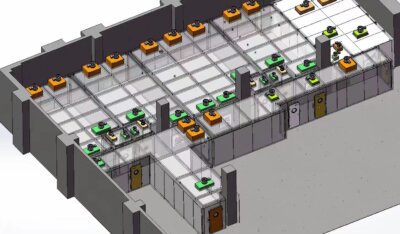
Prefabricated modular construction enables contamination zoning. You can create isolated areas, like anterooms or process enclosures, within a larger envelope. This allows for applying higher ACH or unidirectional flow only where critically needed. It optimizes capital and operational expenditure by avoiding conditioning the entire footprint to the highest, most energy-intensive standard.
Implementing Demand-Controlled Filtration
An emerging optimization strategy is demand-controlled filtration using variable-speed FFUs paired with real-time particle monitors. Dynamically adjusting fan speed (and thus ACH) based on occupancy and particle levels slashes energy use during idle periods without compromising cleanliness during operations. This transforms the cleanroom into an adaptive, efficiency-driven asset and is becoming an ESG imperative.
| Optimization Strategy | Method | Outcome |
|---|---|---|
| Contamination Zoning | Isolated anterooms/enclosures | Targeted high ACH areas |
| Demand-Control | Variable-speed FFUs + sensors | Dynamic ACH adjustment |
| Energy Savings | Lower ACH during idle periods | Reduced operational cost |
| ESG Impact | Adaptive, efficient operation | Sustainability imperative |
Source: Technical documentation and industry specifications.
Next Steps: From Calculation to System Specification
Synthesizing the Design Package
Moving from calculation to a bid-ready specification requires synthesizing all factors. The final package must specify FFU quantities, models, and fan curves; detail return air grille locations and pathways; and select HVAC capacity for full load conditioning at the design ACH. It should also mandate the performance-based calculation methodology and final validation testing per current ISO standards.
Evaluating Implementation Pathways
The specification must also consider implementation economics. The proven use of Commercial Off-The-Shelf (COTS) components and refurbished, high-efficiency FFUs can significantly lower capital barriers for startups and academic labs, democratizing access to high-class environments. The complete design should justify the potential ROI from investing in advanced tools like CFD modeling and smart control systems for a facility that is both high-performing and economically sustainable.
Your cleanroom’s performance hinges on moving from generic ACH ranges to a calculated, risk-assessed design. Prioritize the ISO 14644-4:2022 performance equation over rules-of-thumb. Integrate ACH with pressurization and climate control from the start, and mandate particle count validation as the final acceptance criterion.
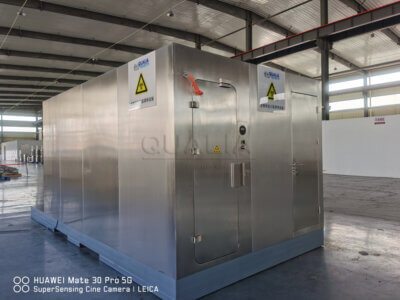
Need professional guidance to specify and validate a high-performance prefabricated cleanroom system? The engineering team at QUALIA specializes in translating these calculations into compliant, efficient modular facilities, including advanced mobile high-containment laboratory solutions. Contact us to discuss your project’s specific contamination control and operational resilience requirements.
Frequently Asked Questions
Q: How do you calculate the required air change rate for a prefabricated ISO 5 cleanroom?
A: Use the standard volume-based formula: ACH = (Total Supply Airflow in CFM × 60) / Room Volume in cubic feet. For an ISO 5 classification, this typically results in a range from 240 to over 600 ACH. The exact value within this wide band must be justified by a detailed process risk assessment. This means facilities with high personnel activity or particle-generating equipment should budget for systems at the upper end of this range to ensure faster contamination recovery and operational resilience.
Q: What is the ISO 14644-4 method for determining cleanroom airflow, and why is it superior?
A: The ISO 14644-4:2022 standard advocates a performance-based calculation: Q = S / (ε × C). This determines required airflow (Q) based on your target particle concentration (C), estimated particle source strength (S) from equipment and personnel, and ventilation effectiveness (ε). This method tailors the system to your actual contamination challenge rather than relying on generic ranges. For projects where energy efficiency is critical, this engineering-first approach prevents costly over-engineering while still meeting compliance targets.
Q: How should we interpret vendor quotes for Fan Filter Unit (FFU) ceiling coverage percentage?
A: Treat FFU coverage percentages (e.g., 35-70%) strictly as preliminary budgetary tools, not as ISO performance parameters. The ISO standard validates performance through particle counts, not coverage. Strategically, use the quoted percentage to estimate cost by multiplying FFU quantity by unit price. If your operation requires guaranteed ISO classification, insist that the final contract specifies validation via particle count testing per ISO 14644-3:2019 rather than just achieving a coverage metric.
Q: How does air change rate (ACH) design integrate with cleanroom pressurization and climate control?
A: ACH cannot be designed in isolation; supply airflow must exceed exhaust by 10-15% to maintain critical positive pressurization. Furthermore, you must choose between a recirculating system, which offers efficient temperature and humidity control, or a single-pass system that simplifies design but drastically increases HVAC energy consumption. This means facilities requiring precise environmental control for sensitive processes should plan for the higher upfront complexity of a recirculating system to achieve long-term operational cost savings.
Q: What are the best methods for validating that our installed cleanroom meets the target ACH and ISO class?
A: Final validation requires a two-part test protocol. First, confirm individual FFUs deliver their specified airflow. Second, and most critically, perform airborne particle concentration testing as defined in ISO 14644-3:2019. The recovery test, which measures purge time after a contamination event, directly proves the ACH’s effectiveness. If your facility has frequent door openings or internal activity, a fast validated recovery time is essential for maintaining classification integrity and minimizing operational downtime.
Q: Can we optimize a prefabricated cleanroom’s energy use after achieving the target ISO class?
A: Yes, through contamination zoning and smart controls. Design isolated higher-class zones within a larger envelope to avoid conditioning the entire footprint. Furthermore, implement demand-controlled filtration using variable-speed FFUs tied to real-time particle monitors. This dynamically lowers ACH during idle periods. For projects where ESG and energy costs are major concerns, investing in this adaptive design during specification can transform the cleanroom into a high-performance, efficiency-driven asset.
Q: What standards provide mandatory ACH benchmarks for prefabricated cleanrooms in healthcare applications?
A: For healthcare settings like pharmacies, ANSI/ASHRAE Standard 170-2021 provides code-mandated minimum air change rates for various room types to control airborne contaminants. This standard operates alongside ISO classifications. This means integrators designing for healthcare must cross-reference both ISO 14644 requirements and the specific ACH minima in ASHRAE 170 to ensure the facility meets all regulatory and safety ventilation benchmarks.
Related Contents:
- How to Calculate HVAC Air Changes Per Hour (ACH) Requirements for Modular BSL-2 and BSL-3 Laboratories
- ISO 14644 and Biosafety Cabinets: Clean Air Standards
- Biosafety Isolators: ISO 14644 Compliance Guide
- ISO 7 vs ISO 8 Prefabricated Cleanrooms: Airflow Pattern & Air Change Rate Requirements for Pharmaceutical Packaging
- OEB4/OEB5 Isolators: Achieving ISO 14644-7 Compliance
- ISO 14644-1 Classification Requirements for Prefabricated Cleanrooms: ISO 4 to ISO 8 Design Standards & Particle Count Specifications
- Air Shower Particle Counts: Meeting Standards
- ISO 14644-1 Guidelines For Cleanroom Classification
- What Particle Count Limits Apply to ISO 6 Prefabricated Cleanrooms in Semiconductor Manufacturing?