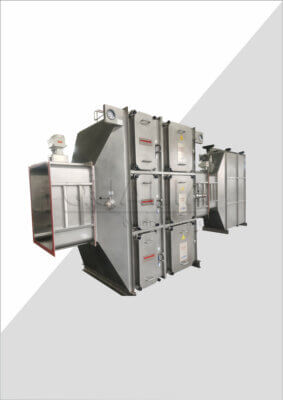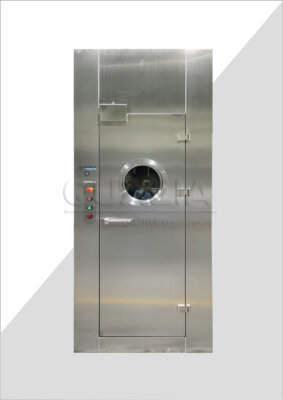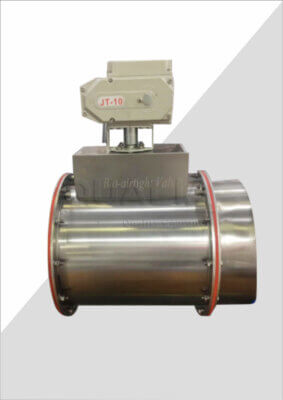

A damper that passes a leak test before a decontamination cycle is not the same damper that passes one after repeated cycles. The seal compound sitting in the blade edge or casing joint is what actually determines whether that closure holds, and material selection for that seal is a decision with consequences for every retest that follows. Choosing it well means asking the supplier for evidence that matches the project’s real exposure conditions, not a material-family name that sounds adequate.
Decontamination cycle conditions the seal must survive
A damper placed in a decontamination boundary experiences conditions that differ from a damper used only for airflow control. The seal is exposed to the decontamination agent itself, to whatever cleaning chemicals contact it between cycles, and to the temperature and humidity profile the cycle produces. Each of these interacts with the seal compound differently, and a compound that resists one exposure may degrade under another. Where the cycle also repeats over the life of the installation, the relevant question is not only whether the material tolerates one exposure, but whether its properties hold up after many exposures in sequence.
This is why recording the decontamination agent and the project’s actual cycle conditions has to happen before a supplier is asked to recommend a seal compound. A recommendation made without that information is a recommendation for a different, unstated set of conditions. If the cycle runs at conditions the supplier did not anticipate, a seal compound that performs well in general industrial use may still compress unevenly, lose resilience, or shrink in ways that open a leak path that was not present when the unit was first installed.
Biosafety guidance documents frame this requirement at the level of risk assessment rather than prescribing a universal cycle. BMBL 6th Edition addresses decontamination in the context of defined maintenance or renovation events for BSL-3 facilities, and includes validated gaseous or vapor decontamination for BSL-4 suit facilities in specified circumstances, without establishing one decontamination cycle that applies across all containment levels. The WHO Laboratory Biosafety Manual similarly frames control measures as proportionate to a risk assessment rather than fixed by a single standard. The practical implication for seal selection is that the cycle conditions are project-specific: the agent, concentration, duration, temperature, and humidity used at one facility do not necessarily describe what another facility’s damper seal will face. A supplier’s seal recommendation is only as good as the cycle description it was given.
Where the cycle involves higher humidity or elevated temperature during exposure, the compound’s compression set behavior under those specific conditions becomes the relevant property to confirm, rather than its resistance to the chemical agent alone. Where cleaning between cycles introduces a different chemical than the decontamination agent itself, that separate exposure needs its own consideration, because a compound compatible with one chemical is not automatically compatible with the other.
Elastomer compatibility evidence to request
| Evidence dimension | What the evidence should match | Decision boundary |
|---|---|---|
| Seal compound | The actual elastomer proposed for the damper | A material-family name alone does not establish compatibility for the proposed compound. |
| Decontamination exposure | The actual decontamination agent and project cycle conditions | Evidence for a different agent or different cycle conditions does not establish suitability for this project. |
| Cleaning exposure | The actual cleaning chemicals that can contact the seal | Decontamination-agent evidence alone does not cover separate cleaning exposure. |
| Temperature and humidity | The temperature and humidity conditions of the planned cycle | Compatibility remains conditional when the evidence does not cover the planned conditions. |
| Repeated exposure | The planned repeated exposure, rather than only the material name | Evidence that omits repeated exposure does not resolve the effect of the planned cycle pattern. |
Once the cycle conditions are documented, the next judgment is whether the evidence a supplier offers actually applies to the seal being proposed. A reference to a polymer family name is a starting point, not an answer, because compounding, cure, and filler content vary between manufacturers and even between batches, and these variations affect how the material responds to chemical exposure and to temperature and humidity over time. Evidence that does not identify the actual compound proposed for the damper leaves the compatibility question open.
The same logic applies separately to each exposure the seal will face. Compatibility data generated against one decontamination agent does not establish compatibility against a different agent, and data describing a different set of cycle conditions, such as a different temperature or humidity range, does not transfer cleanly to a project that runs its cycle differently. Cleaning chemicals are a distinct exposure from the decontamination agent itself; a compound that tolerates the decontamination agent has not thereby been shown to tolerate whatever solvent or disinfectant is used for routine cleaning. Where both exposures occur, both need their own supporting evidence.
Repeated exposure is the condition most likely to be omitted from a simple compatibility statement, yet it is often the one that determines service life. A compound can show acceptable swelling or hardness change after a single exposure and still behave differently after many exposures, because cumulative effects such as extraction of plasticizers or progressive loss of elasticity do not necessarily appear in a one-time test. If the project’s cycle will repeat over the equipment’s service life, evidence limited to single-exposure testing does not resolve how the seal will behave under the planned pattern of use.
Swiss biosafety guidance on BSL-3 structural and technical safety measures points to this same boundary from a different direction: fumigatable-boundary penetrations require attention to seal chemical resistance together with local leak location and final tightness testing, and retesting after any repair. That framing supports the general principle that chemical resistance alone does not establish a sealed boundary; it has to be confirmed by tightness testing specific to the installed configuration, and that guidance is nonbinding and does not establish a transferable acceptance threshold or a universal proof of material suitability.
When these dimensions are organized together, a reader can check whether a supplier’s compatibility claim actually corresponds to the project’s own compound, agent, cleaning chemical, temperature and humidity range, and exposure pattern, rather than resting on a general material description.
Compression, blade-edge, and casing-joint leakage paths
A damper intended to hold a decontamination boundary is not a single seal but a set of interfaces that together define the closure. The blade edge against its seat is the most visible of these, but it is not the only one. The shaft penetration where the blade mechanism passes through the casing is a separate leak path, because the sealing geometry there differs from a flat blade-to-seat contact and may use a different compound or a different compression arrangement. The casing joints, where sections of the damper housing meet, are a third path, and the connected duct flanges where the damper meets the surrounding ductwork are a fourth. A compatibility result for the blade-edge seal does not, by itself, describe the condition of the shaft seal or the gasket at a casing joint.
Treating these as one boundary rather than as isolated points changes how a compatibility or leak evaluation should be scoped. If a project evaluates only the blade-edge material and leaves the shaft penetration or casing joints unexamined, the resulting conclusion describes part of the boundary, not the whole one. Where the duct flange connection uses a separate gasket material from the damper’s internal seals, that gasket is exposed to the same decontamination and cleaning conditions and needs the same kind of compatibility consideration, even though it is a different component from the damper itself.
Compression also behaves differently at each of these locations. A blade-edge seal relies on even contact pressure across its full length, and any distortion from heat, chemical swelling, or mechanical wear changes that contact uniformly. A shaft seal relies on contact around a rotating or moving element, so wear patterns and compression behavior differ from a static gasket joint. A casing or flange gasket under compression between two rigid surfaces responds differently again, since its sealing depends on sustained clamping force rather than a moving contact surface. Because these mechanisms differ, a change that affects one leak path does not necessarily affect another in the same way or to the same degree, and an inspection approach built around only one mechanism will miss the others.
This is the basis for evaluating leakage at the blade edge, shaft penetration, casing joints, and connected duct flanges as one boundary when planning inspection or retest, rather than assuming that a result at one location describes the condition of the others.
Aging, cleaning, and replacement effects on closure
A seal that was compatible with the decontamination agent and the cycle conditions at installation does not necessarily remain in that same condition indefinitely. Elastomers age through mechanisms that include loss of plasticizer, oxidation, and progressive changes in hardness and elasticity, and these mechanisms continue whether or not the equipment is cycled, though repeated chemical exposure and repeated compression can accelerate them. The practical consequence is that a seal’s qualified condition at the time of initial testing is a starting point, not a permanent state, and the interval over which that condition holds depends on the specific compound, the specific cycle, and the specific cleaning regime applied to it.
Cleaning introduces its own aging pathway that is separate from decontamination exposure. A cleaning chemical selected for general compatibility with the equipment housing is not automatically evaluated for its effect on the seal compound, and repeated cleaning can extract compounds from the elastomer or alter its surface in ways that change how it compresses against its mating surface. Where cleaning frequency differs from decontamination frequency, these two aging pressures act on different schedules, and a seal evaluation that accounts for only one of them is incomplete.
A seal material change, whether prompted by aging, by a supply change, or by a decision to use a different compound for improved performance, resets the compatibility question rather than extending the original qualification. The new material may share a family name with the old one, but compounding differences mean its behavior under the same decontamination agent, cleaning chemical, and cycle conditions cannot be assumed to match the material it replaces.
Because aging and material changes both affect the qualified closure condition, inspection, replacement, and retest actions need to be defined in advance rather than decided reactively. An inspection plan that specifies what is checked, a replacement plan that specifies when a seal is replaced rather than reused, and a retest plan that specifies what is re-verified after either event, together define how the closure condition is maintained over the equipment’s service life. Without these defined in advance, a seal that has aged past its qualified condition, or a replacement seal of a different material, can be put back into service without the boundary being re-confirmed.
Qualification plan after a seal material change
| Qualification element | Project-specific record or check | What it establishes—and what it does not |
|---|---|---|
| Changed seal material | Identify the actual elastomer and the compression design in which it will be used. | Defines the material-and-design combination being evaluated; a material-family name alone is insufficient. |
| Exposure compatibility | Match evidence to the decontamination agent, cleaning chemicals, temperature, humidity, and repeated exposure. | Supports compatibility only for the conditions addressed by the evidence; it does not establish closure tightness. |
| Complete closure boundary | Include the blade edge, shaft penetration, casing joints, and connected duct flanges in the evaluation. | Defines the leakage boundary to be checked; listing the locations does not demonstrate a passing result. |
| Lifecycle controls | Define inspection, replacement, and retest actions for aging seals and future material changes. | Sets the planned response to conditions that can affect the qualified closure state. |
| Retest basis | Define the project-specific retest action and acceptance basis after the change. | Re-establishes the closure decision for the changed configuration; no universal acceptance threshold is implied. |
A seal material change is a configuration change to the closure, and the qualification response to it should treat it that way rather than as a routine parts replacement. The starting point is identifying precisely what changed: the actual elastomer now in use and the compression design in which it is installed, since the same material behaves differently depending on how it is compressed and against what geometry. A description limited to a material-family name does not identify the material-and-design combination that needs to be evaluated.
From there, the exposure compatibility question has to be re-asked for the new material against the same set of conditions established earlier: the decontamination agent, the cleaning chemicals, the temperature and humidity range, and the repeated-exposure pattern the project actually uses. Evidence addressing only some of these conditions supports compatibility only for the conditions it covers; it does not, by itself, establish that the closure will hold tight, because chemical compatibility and mechanical sealing performance are different properties.
The evaluation also needs to extend across the complete closure boundary rather than stopping at the component that changed. If the material change applies to the blade-edge seal, the shaft penetration, casing joints, and connected duct flanges still need to be included in the evaluation, because a change at one location can alter how the whole assembly compresses, and because the other locations may use related materials exposed to the same conditions.
Lifecycle controls carry forward from this point: the inspection, replacement, and retest actions defined for the original seal material need to be reconsidered for the new one, since a different compound may age differently or respond differently to the same cleaning regime. Finally, the retest basis itself needs to be project-specific. There is no universal acceptance threshold that applies across projects or configurations; the retest action and its acceptance basis have to be defined against the project’s own closure design and exposure conditions, and documented so that the changed configuration’s closure decision is re-established rather than carried over from the original seal material by assumption. Where this information is organized clearly, it gives a project team and a supplier a shared basis for configuring or reviewing a damper for the specific decontamination duty it will face, including where that review covers a Bio-safety Isolation Damper proposed for the project’s boundary or a VHP Hydrogen Peroxide Generator Type I defining the agent and cycle the seal must tolerate.
Frequently Asked Questions
Q: What information should I provide before requesting a damper seal recommendation?
A: Provide the decontamination agent, cycle temperature and humidity, repeated-exposure pattern, cleaning chemicals, and proposed compression design. This gives the supplier a project-specific basis for recommending an actual seal compound rather than relying on a material-family name.
Q: Is a general chemical-resistance statement enough to approve an isolation damper seal?
A: No. The evidence should identify the actual elastomer and cover the planned decontamination agent, cycle conditions, cleaning exposure, and repeated use. Any condition that is not covered should remain an open verification item before selection.
Q: Does compatible seal material prove that the damper will remain leak-tight?
A: No. Material compatibility addresses exposure resistance, while closure performance also depends on the compression design and the complete leakage boundary. The project evaluation should include the blade edge, shaft penetration, casing joints, and connected duct flanges under a defined test and acceptance basis.
Q: Can seal evidence from another facility or decontamination cycle be reused?
A: Only when it covers the actual elastomer and the relevant conditions of the new project. Differences in agent, cleaning chemicals, temperature, humidity, or exposure pattern must be checked rather than assumed to be transferable.
Q: What should the maintenance plan define for damper seals?
A: Define how seals will be inspected, when replacement will be considered, and what retest action follows replacement or a material change. The retest basis should be specific to the changed configuration because no universal acceptance threshold is established here.