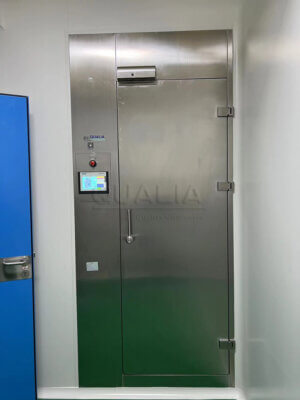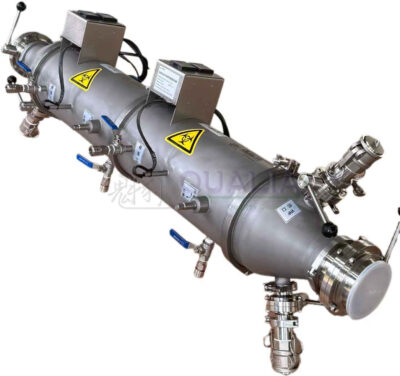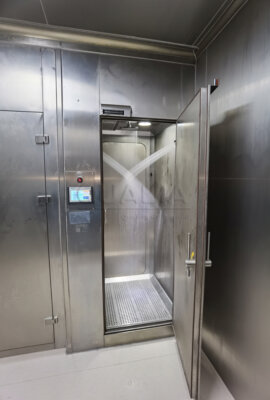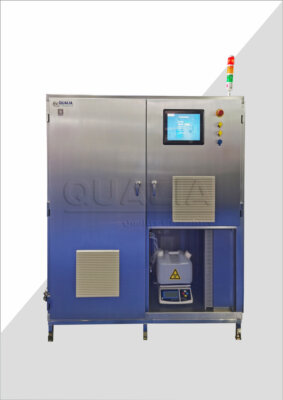

Procurement teams that reach the IQ/OQ phase before realizing their RFQ omitted a leak tightness class face a specific and avoidable problem: the isolator they specified, sourced, and installed may require redesign or re-qualification before a single batch is released. That schedule cost — measured in weeks or months, not days — typically traces back to decisions made before supplier selection, not during it. The same early-stage blind spots apply to surface finish specifications and pressure classification trade-offs, where what looks like a detail at concept stage becomes a qualification constraint or an HVAC coordination failure later. What follows is structured to help engineering and procurement teams identify the specification choices that foreclose options downstream, and make them deliberately rather than by default.
Understanding Isolator Classification: Positive vs Negative Pressure
Pressure classification is the foundational design decision in isolator specification, and it directly determines which risks the equipment is controlling and in which direction. Positive pressure protects the product — it is the appropriate configuration for non-hazardous aseptic compounding where the primary concern is contamination ingress. Negative pressure protects the operator — it creates an inward airflow that prevents hazardous compounds from escaping the containment envelope. The two configurations are not interchangeable, and selecting the wrong one is not a calibration issue that can be corrected at commissioning.
The practical threshold for hazardous compound handling is a chamber maintained at a minimum of approximately -125 Pa relative to the surrounding cleanroom. Some configurations are designed for -200 Pa to provide additional containment margin. These are engineering design figures that define where the pressure boundary sits, not universally mandated regulatory minimums — but they represent the reference range that determines alarm thresholds, HVAC coupling, and containment verification methodology. A chamber set below its intended negative pressure setpoint may trigger nuisance alarms; one that drifts above it may not reliably contain aerosolized hazardous material.
The deeper trade-off emerges when an application demands simultaneous compliance with cGMP ISO Class 5 air cleanliness and BSL-3-level containment. ISO Class 5 typically requires unidirectional downward laminar airflow. Negative-pressure containment requires inward airflow to prevent escape. These two requirements create opposing directional demands on the same air handling system, and resolving that tension is a genuine engineering problem — not a solved or standardized one with a single accepted configuration. Projects that treat this as a detail to be worked out during HVAC coordination routinely discover that their exhaust capacity assumptions were sized for the cleanroom, not for the isolator’s single-pass exhaust demand, at a point when facility infrastructure changes are expensive. That coordination problem is addressed more precisely in the RFQ parameters that follow — but it originates here, in the pressure classification decision.
Key Specification Parameters for Pharma RFQ
The most common RFQ failure pattern is not specifying the wrong value — it is omitting a specification entirely and discovering its absence when it becomes a compliance gate. ISO 10648-2 Class 2 leak tightness is the most consistent example. It is a well-established tightness class for pharmaceutical isolators, and it is routinely absent from early RFQ drafts because it feels like a supplier responsibility rather than a buyer specification. When it surfaces during IQ/OQ as a requirement that was neither confirmed nor tested by the supplier, the outcome is either a redesign or a requalification cycle — both carrying schedule consequences that were entirely avoidable at the specification stage.
| RFQ Parameter | Required Value / Standard | Why It Matters |
|---|---|---|
| Leak tightness | ISO 10648-2 Class 2 | Omission becomes a compliance gate during IQ/OQ and can force redesign or delay. |
| HEPA filtration | H14 >99.995% at MPPS (0.1–0.3 µm); double H14 exhaust | Required to achieve ISO Class 5 air cleanliness inside the isolator. |
| Chamber pressure | Negative -125 Pa or -200 Pa ±20% tolerance (factory-configured) | Incorrect pressure setting compromises containment integrity and triggers nuisance alarms. |
| Exhaust configuration | Single-pass total exhaust; flow rates vary by isolator size (see exhaust flow reference) | Facility HVAC must be sized to support the isolator’s exhaust demand. |
Exhaust flow rate is a related planning failure that tends to emerge later in the project, during HVAC coordination rather than supplier selection. Single-pass total exhaust is the standard configuration for hazardous compound isolators — recirculation is not an option when the chamber must remain under negative pressure and product cannot be returned to the cleanroom air. The exhaust demand scales with isolator size, and the tolerance band is wide enough that facility planning must account for the upper bound, not the nominal figure.
| Isolator Configuration | Number of Gloves | Exhaust Flow Rate (cmh) | Tolerance |
|---|---|---|---|
| 2G | 2 | 1000 | ±30% |
| 3G | 3 | 1550 | ±30% |
| 4G | 4 | 1800 | ±30% |
Port configuration choices — RTP port sizes, transfer hatch positions, glove count — interact with exhaust flow and pressure maintenance in ways that are difficult to retrofit. An isolator designed around a 2G configuration that is later expected to support a 4G workflow will carry a structural exhaust mismatch. These decisions should be treated as structural during the RFQ phase, not as options to be finalized at design freeze.
Material Finish and Surface Compatibility
Surface finish specification is where procurement decisions most reliably create hidden downstream costs. The consequence is not contamination risk alone — it is qualification duration. Projects that fail to specify electropolished 316L stainless steel at ≤0.4 Ra for internal chamber surfaces from the outset often find themselves absorbing significantly longer surface qualification cycles, a delay that is entirely predictable but rarely anticipated at concept stage. The directional estimate from engineering practice is 30–40% longer qualification time compared to projects that specify correctly from the start — not a published benchmark, but a consistent enough pattern to treat as a planning criterion.
| Component | Material & Finish Requirement | Impact on Validation |
|---|---|---|
| Internal chamber | 316L stainless steel, surface finish ≤0.4 Ra | Reduces surface qualification time 30–40% and improves cleanability. |
| External structure / support frame | 304 stainless steel, finish ≤0.6 Ra | Maintains cleanroom compatibility and simplifies wipe-down. |
| Work surfaces | Smooth, non-porous, decontamination-resistant (stainless steel); minimal seams; VHP-compatible | Prevents residue accumulation and withstands hydrogen peroxide vapor decontamination. |
The VHP compatibility requirement is a related surface decision that is sometimes treated as secondary to the Ra specification. It should not be. Hydrogen peroxide vapor decontamination is the standard cycle for pharmaceutical isolators, and surface materials that degrade under repeated VHP exposure will develop microscopic irregularities over time that undermine both cleanability and qualification integrity. The requirement for minimal seams and corners is not an aesthetic preference — it is a decontamination surface area problem. Seams and sharp internal corners accumulate residue, are difficult to validate as decontaminated, and represent the most likely failure points during bioburden reduction confirmation.
Specifying 304 stainless steel at ≤0.6 Ra for external structure and support frames maintains cleanroom compatibility while keeping cost proportionate to the surface function. Internal and external surface grades should not be treated interchangeably. The validation work required for internal surfaces is disproportionately higher, and that is where the material specification decision carries the most consequence.
Validation Documentation Requirements
Validation documentation failures are rarely discovered during equipment selection. They appear during IQ/OQ — when a protocol calls for pressure decay test data that was never specified in the supplier scope, or when an FDA audit requests cycle records that the HMI is not configured to generate. The isolator may perform correctly in every mechanical sense and still create a compliance gap if the documentation architecture was not defined before manufacturing began.
| Validation Focus | Standard / Requirement | What to Confirm |
|---|---|---|
| Chamber leak tightness | Pressure testing per ISO 10648-2 or EN 12469; optional automated pressure decay tests | Verify test procedure and acceptable decay rate are included in IQ/OQ protocols. |
| Biodecontamination efficacy | H2O2 vapor system achieves 6-log reduction of bioburden; cycle records maintained for FDA audits | Confirm decontamination cycle development, validation data, and record-keeping capability. |
| Electronic records & signatures | HMI/PLC control system capable of 21 CFR Part 11 compliance | Ensure audit trail, user authentication, and electronic signature functions are in place. |
Biodecontamination cycle validation deserves specific attention because the efficacy target — a 6-log reduction of bioburden using H2O2 vapor — is the industry-accepted benchmark for pharmaceutical containment systems, but achieving it requires cycle development work, not just equipment installation. The integrated H2O2 vapor system must be validated to demonstrate that specific reduction under the actual chamber geometry, load configuration, and environmental conditions of the intended site. A supplier who provides the equipment but not the cycle validation data — or whose records are not structured for FDA audit review — leaves that validation gap for the buyer to close, typically on the critical path.
The 21 CFR Part 11 capability of the HMI/PLC control system is a procurement review check, not a self-executing compliance guarantee. A control system that is described as Part 11-capable may still require configuration, user authentication setup, electronic signature workflow implementation, and audit trail verification before it functions as a compliant record-keeping system. Confirming capability at RFQ is necessary but not sufficient — implementation must be scoped as a distinct deliverable in the supplier agreement.
Supplier Qualification Checklist
Supplier qualification for a pharmaceutical isolator is not primarily a reference check exercise. The questions that matter most concern what the supplier will document, test, and support — and which of those are included in scope versus quoted as options.
Ergonomic design thresholds are a useful starting point because they reveal how a supplier approaches long-cycle operator workflows. Inadequate lighting at the work surface forces operators into compensating postures that affect both quality of aseptic technique and fatigue accumulation over a shift. Noise levels that exceed comfortable working thresholds compound operator stress during high-concentration tasks. These are not GMP-codified requirements in most jurisdictions, but they are qualification criteria worth verifying during supplier assessment because they affect the operational reliability of the system over time.
| Ergonomic Factor | Threshold / Requirement | What to Verify |
|---|---|---|
| Lighting | ≥500 Lux at work surface | Confirm illumination uniformity and suitability for detailed aseptic tasks. |
| Noise | ≤80 dBA | Measure sound level during normal operation and alarm conditions. |
| Glove port adjustability | Adjustable height and reach | Check range of adjustment for operator comfort and varied task alignment. |
| Working height | Adequate for seated and standing operation | Validate working height supports intended operator posture and process workflow. |
Failure mode testing is a supplier capability to explicitly scope and verify — not a universally required standard protocol, but a meaningful differentiator in qualification. A supplier who tests containment integrity under fan failure and membrane breach conditions before delivery is providing data that would otherwise be generated under uncontrolled conditions during actual use. Confirming whether this testing is included in the standard qualification package or available on request clarifies a risk allocation question that is better answered before purchase order than after.
| Capability | Options / Details | Purpose / Compliance Impact |
|---|---|---|
| RTP ports | Sizes 105, 190, 270, 350 mm | Flexibility for material transfer without breaking containment. |
| Glove leak testers | Integrated or portable units | Routine glove integrity verification. |
| H2O2 monitoring | Integrated hydrogen peroxide vapor sensors | Real-time decontamination cycle control and data logging. |
| Spray ball CIP | Clean-in-place integration | Facilitates automated cleaning and reduces manual intervention. |
| Failure mode testing | Testing under fan failure, membrane breach conditions | Validates containment integrity during equipment fault scenarios. |
| Passthrough technology | Interlocking doors, decontamination procedures, leak-proof design | Maintains containment during material loading and unloading. |
Passthrough and transfer hatch interlock design is the operational continuity question that gets least attention during RFQ. The integrity of the containment envelope depends not only on the isolator’s static pressure maintenance but on what happens during material transfer. Interlocking door sequences, decontamination procedures integrated into the transfer cycle, and leak-proof transfer port design collectively determine whether containment is maintained or briefly compromised each time material enters or exits the chamber. This is a design detail that should be reviewed with the supplier at the same level of rigor as HEPA filter specification — it is not a peripheral feature.
The most actionable implication across the specification decisions covered here is sequencing: the choices that carry the highest downstream cost are made earliest, often before a supplier is engaged. Leak tightness class, surface finish grade, pressure configuration, exhaust flow accommodation, and port layout are all design-stage decisions, and treating any of them as implementation details to be finalized later converts a straightforward procurement into a qualification recovery project.
Before issuing an RFQ, engineering teams should be able to confirm in writing: the required leak tightness class and how it will be tested, the internal surface material and finish specification, the intended chamber pressure setpoint and its tolerance band, the exhaust flow rate the facility HVAC can actually support, and the port configurations needed for current and anticipated future process workflows. Suppliers who cannot respond specifically to those inputs — or who treat them as interchangeable options — are communicating something meaningful about the qualification support that will follow delivery.
Frequently Asked Questions
Q: What happens if the facility HVAC was sized for cleanroom use only and cannot meet the isolator’s single-pass exhaust demand?
A: The isolator cannot be commissioned without resolving the HVAC mismatch — negative-pressure containment depends on single-pass total exhaust, and recirculation is not a viable workaround. If the facility exhaust capacity falls short of the isolator’s flow rate requirement (including the upper bound of the ±30% tolerance band), the gap must be addressed through facility infrastructure changes before qualification can proceed. This is an expensive correction at late project stages, which is why exhaust flow compatibility should be confirmed against actual building capacity during the RFQ phase, not at HVAC coordination.
Q: Is 21 CFR Part 11 compliance guaranteed if the supplier confirms their HMI/PLC is “Part 11-capable”?
A: No — capability is not compliance. A control system described as Part 11-capable still requires deliberate configuration: user authentication, electronic signature workflow implementation, audit trail verification, and record retention setup must all be scoped and executed. If these are not defined as explicit deliverables in the supplier agreement, the buyer inherits the implementation gap, typically on the critical path ahead of an FDA inspection. Treat Part 11 implementation as a distinct project scope item, not a feature that activates on delivery.
Q: Does the 30–40% reduction in qualification time from specifying 316L electropolished surfaces apply equally to retrofit projects, or only to new installations?
A: The benefit is substantially harder to capture in a retrofit. The qualification efficiency gain comes from specifying the correct material and finish before manufacturing begins, allowing surface qualification protocols to be written against a known, stable specification. In a retrofit where existing surfaces must be evaluated, re-worked, or replaced piecemeal, the qualification process must account for surface history, weld repairs, and potential inconsistencies — conditions that negate the clean baseline that makes the time reduction achievable in new builds.
Q: At what point does negative pressure containment become insufficient for a given hazard level, and should a different containment approach be considered?
A: A single-barrier isolator operating at -125 Pa to -200 Pa is designed for BSL-3-level containment. For BSL-4 applications or agents with the highest airborne transmission risk, the containment architecture typically shifts toward redundant barrier systems, positive-pressure personnel suits, or dedicated maximum containment suite infrastructure — contexts where a standard pharmaceutical biosafety isolator is not the primary containment strategy. If the hazard classification of the compound or agent being handled is at or approaching BSL-4, the isolator specification should be reviewed against the specific containment requirements for that classification rather than extrapolated from BSL-3 parameters.
Q: How should procurement teams weigh a supplier’s standard qualification package against one that includes failure mode testing, given the cost difference?
A: For applications where containment failure carries regulatory or safety consequences — hazardous compound handling, BSL-3 workflows, or any setting subject to FDA inspection — the cost difference is best evaluated against the alternative: generating failure mode data under uncontrolled conditions during actual operation. A supplier who tests fan failure and membrane breach scenarios before delivery produces data you can include in your IQ/OQ documentation. A supplier who does not means that data either does not exist or must be generated post-installation, where the conditions and risks are no longer controlled. For high-stakes containment environments, that is a risk allocation decision, not simply a budget line.