Adding one cable to a BSL wall penetration sounds like a minor task, but it touches the containment boundary itself, and the boundary has already been accepted once under a defined condition. The question is not whether the cable fits through the wall. It is what has to be re-established before that boundary is considered accepted again, and what evidence proves it.
Existing cable schedule and seal condition before the change
A wall-mounted cable transit at a containment boundary is only as trustworthy as the record of what it currently holds and how that condition was verified. Before anyone proposes adding a cable, the working document is the as-built service schedule: which cables occupy which positions, what transit or sealing elements sit around them, and what condition was accepted the last time this penetration was signed off. This is the baseline the change is measured against, not a general description of the port’s rated capacity.
Where the as-built schedule is current and matches the physical wall, the reviewer can reason directly about the proposed addition against known occupied and spare positions. Where the schedule has drifted from reality — through undocumented prior changes, field substitutions, or incomplete closeout — the reviewer first has to reconcile the record with the actual wall condition before any new cable can be evaluated responsibly. This reconciliation step changes the nature of the request. A schedule-verified port turns the request into a straightforward fit check. An unverified port turns it into a limited field investigation before the fit check can even begin.
The previously accepted wall condition also carries information beyond the cable count. It records what sealing configuration was tested and accepted, which matters because a spare position that looks physically open may have been left in a specific state — capped, filled, or reserved with a particular sealing element — for reasons tied to that earlier acceptance. Treating an open-looking position as generically available skips over why it was left that way.
For the buyer or facility team initiating the request, the practical implication is sequencing: pull the current schedule and the last accepted condition before describing the proposed cable to anyone, including a supplier. Trying to evaluate fit or sealing compatibility without that baseline risks a decision made against an assumed condition rather than the actual one, which surfaces later as a discrepancy at reseal or at test.
Access and decontamination decisions for opening the boundary
Opening a wall penetration at a containment boundary is an access event to the boundary itself, not a routine maintenance task, and the decision about how to approach it sits with the site’s own hazard assessment and operating procedure rather than with a generic rule about cable ports. What isolation is required, who may access the space, and whether any decontamination step precedes the physical opening all depend on the specific hazard profile of the zone and the material or organism the containment is designed against.
This matters because a universal fumigation or decontamination step cannot be assumed for every cable-addition event. The CDC/NIH BMBL sixth edition addresses whole-laboratory decontamination in the context of defined use-change, renovation, or maintenance events at BSL-3 facilities, but the method and the need for it depend on the risk assessment for that specific event, not on an automatic rule that treats every boundary opening the same way. A penetration change made in an unoccupied, verified-clean interval carries a different access and decontamination profile than the same physical task performed where the adjacent space has an active hazard condition or unresolved containment history.
The consequence for planning is that the access decision cannot be finalized before the hazard assessment is run for this specific opening, at this specific time, under this specific zone’s operating procedure. A team that defaults to “we always fumigate before opening a port” or, conversely, “we never need to decontaminate for a cable change” is substituting a shortcut for the site-specific judgment the procedure exists to make. Where the boundary separates a zone with an active or recent hazard condition from an accessible area, the assessment may call for isolation and decontamination before the wall is touched. Where the zone is confirmed clear and the boundary’s integrity elsewhere is not at issue, the same assessment may support direct access with no decontamination step, provided that determination is documented rather than assumed.
For the project team, this section of the change is where the operating procedure — not the transit hardware — governs the sequence of events, and the decision should be traceable to that procedure rather than to a default habit carried from other changes.
Spare position fit and resealing of the revised service pack
| Проверить | Compare against the proposed addition | Boundary for the decision |
|---|---|---|
| Spare-position fit | Proposed service and transit configuration against the available spare position | A reserved opening alone does not establish this product’s spare capacity or material compatibility. |
| Reseal configuration | Existing blocks or other sealing elements against the revised cable pack | Reconfiguration must not leave an undocumented gap at the containment plane. |
Once access is resolved, the physical work centers on two separate acceptance questions that are easy to blur into one: does the proposed cable and transit configuration actually fit the available spare position, and does reconfiguring the sealing elements around it preserve the containment plane that was previously verified.
Fit is not only about physical clearance. A spare position sized for one cable diameter or jacket type does not automatically accommodate a different diameter, a bundled configuration, or a different transit method, even where the position looks geometrically available. The Swiss Expert Committee for Biosafety’s guidance on BSL-3 structural and technical safety measures addresses planning reserve openings in multi-service transits and considering sealing-material suitability, but this is non-binding guidance rather than proof that a specific product’s spare capacity or material compatibility matches this project’s proposed cable. A reserved opening existing on paper or in the wall does not by itself establish that the new service is compatible with it; that compatibility has to be checked against the actual proposed service and transit configuration, including the sealing material’s suitability for the specific cable jacket and any facility interface it presents.
The second question — reseal configuration — is where undocumented gaps at the containment plane most easily get introduced. Existing blocks or other sealing elements may be reconfigurable to accommodate the new cable pack, but reconfiguration changes the geometry and material distribution at the boundary. Where the existing sealing system was accepted as a specific arrangement of blocks, grommets, or filler around a known cable set, altering that arrangement to fit an added cable means the boundary’s sealed condition has changed even if no new hole was cut. Treating this as a trivial adjustment — reusing blocks in a new configuration without re-examining whether the resulting arrangement still closes the boundary completely — is how an undocumented gap gets carried forward into the next baseline.
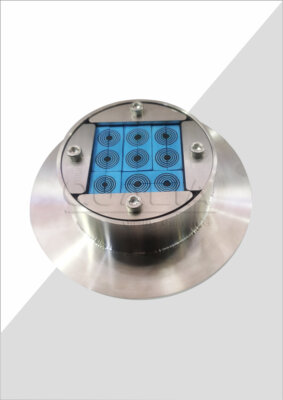
The decision for the project team is to treat both questions as separate acceptance criteria rather than a single “does it fit” judgment, and to resolve the sealing-material and reconfiguration question specifically against the revised, not the original, cable pack. This is also where information supplied about the project’s cable specifications and existing transit hardware enters QUALIA’s configuration or quotation review, since a Порт для шнура и кабеля Vacu-Pass‘s suitability for a specific added service depends on matching the proposed configuration against the unit’s documented spare-position and sealing arrangement rather than assuming general compatibility.
Verification triggered by the modification and its risk
Once the port is resealed, the remaining decision is how much re-verification the change warrants, and this is where the modification’s actual risk to the containment plane, not a fixed checklist, should drive the selection among visual inspection, local testing, and any facility-level re-verification.
Сайт Канадский стандарт биобезопасности, третье издание, addresses documented verification after changes, repairs, or modifications that may affect biocontainment, including conditional inspection and smoke-pencil checks of penetration seals — but this is scoped to Canadian containment-zone requirements and their exceptions, and it does not prescribe one universal retest or repair procedure applicable regardless of jurisdiction or project criteria. The applicable project or jurisdictional criteria for this specific facility determine which verification level is warranted for this specific change.
The underlying logic is that verification scope should track the scope of what was disturbed. A change confined to a single sealed cable position, where the surrounding sealing elements were not reconfigured and the rest of the transit was undisturbed, may be assessed through a local, targeted check — visual inspection of the resealed area, or a local integrity check such as a smoke-pencil pass at the seal line. A change that required reconfiguring multiple sealing elements, or that raises a question about whether the reconfiguration affected areas beyond the immediate cable position, presents a different risk profile and may call for broader local testing. A change that raises doubt about the boundary’s performance at a level beyond the penetration itself — for instance where the reconfiguration’s effect on the surrounding wall assembly is not confidently bounded — is the category of event where facility-level re-verification becomes the relevant question, again subject to the project’s own criteria rather than a default assumption either way.
The risk that governs this choice is specific to what changed: the number of positions disturbed, whether the reconfiguration affected sealing elements beyond the target cable, and whether the site’s operating procedure or jurisdictional standard treats this class of change as requiring escalation. A team that applies the same verification level to every cable addition regardless of what was actually disturbed is not tracking the standard’s own logic, which ties verification depth to the nature and extent of the change. Confirming which verification level applies means examining what the resealing actually touched, not defaulting to the lightest or heaviest option out of habit.
Updated drawings and test records for return to service
| Record | Post-change information to carry forward | Use at the next change |
|---|---|---|
| Чертежи | Revised wall-penetration arrangement | Start from the updated physical arrangement. |
| Cable inventory | Added cable and revised service pack | Check the next proposed service against the current inventory. |
| Intervention record | Opening and resealing of the boundary | Identify what was changed at the interface. |
| Test evidence | Results of the selected post-change verification | Retain the verification basis for the revised condition. |
The change is not complete when the port passes verification; it is complete when the documentation baseline reflects the new condition, because the next cable-addition request will start from whatever is on record now, not from what was physically done.
Four records carry this change forward, and each answers a different question for the next reviewer. The drawings need to show the revised wall-penetration arrangement as it now physically exists, so the next request starts from the correct physical layout rather than the pre-change one. The cable inventory needs to reflect the added cable and the revised service pack, so the next proposed addition is checked against what is actually occupying the transit now, not against a stale count. The intervention record needs to capture what was opened and how it was resealed, so a future reviewer can see exactly what was changed at the interface rather than inferring it from the drawings alone. The test evidence needs to preserve the basis for whatever verification was selected — visual, local, or facility-level — so the revised condition’s acceptance is traceable to a specific result rather than to an unrecorded assumption that it passed.
Where any one of these four records lags behind the physical change, the gap does not stay contained to this event. The next request inherits it: a reviewer checking spare-position fit against an outdated cable inventory, or a team assuming a sealing configuration that documentation never confirmed, are the direct consequence of carrying forward incomplete records rather than the updated baseline. This is also the point where the project’s delivery and maintenance planning intersects with the supplier relationship, since coordinating updated records with equipment such as the Vacu-Pass port’s documented configuration supports maintainability across future changes rather than only closing out this one.
Confirming that all four records are current — drawings, inventory, intervention record, and test evidence — before the change is considered closed is what makes the next cable-addition request a schedule-verified port review rather than another field reconciliation exercise.
Часто задаваемые вопросы
Q: Is an unused Vacu-Pass opening enough to approve an additional cable?
A: No. Compare the proposed cable and transit configuration with the as-built service schedule, the available position, and the previously accepted wall condition. A reserved opening does not by itself establish spare capacity or sealing-material compatibility; the revised service pack must also leave no undocumented gap at the containment plane.
Q: Does every cable addition require decontamination before the port is opened?
A: No universal decontamination step applies to every change. Use the site’s hazard assessment and operating procedure to decide the necessary isolation, access, and any decontamination before opening the boundary.
Q: Does resealing the port automatically require a full facility-level retest?
A: No. Select visual, local, and any facility-level re-verification according to the modification’s effect and the applicable project or jurisdictional criteria. Keep the chosen test evidence with the change record rather than assuming one fixed retest scope for every cable addition.
Q: What should be documented before the modified penetration returns to service?
A: Update the wall-penetration drawings and cable inventory to show the revised arrangement, record the opening and resealing intervention, and retain results of the selected verification. These records become the baseline for assessing the next proposed change.