
When a BSL-3 wall shows a suspect cable or conduit penetration, the question is not just whether a defect exists but which test can actually answer that. A smoke-pencil check and a room tightness test look at different things, produce different kinds of results, and support different conclusions. Choosing the wrong one, or reading its result as if it answered the other question, can send a project team chasing the wrong fix or accepting a boundary that has not actually been verified at the scale that matters.
What a local smoke check can reveal at a cable seal
A smoke-pencil check works by releasing visible smoke near a penetration and observing whether it moves toward or away from the seal. Where the space is under negative pressure relative to the corridor or adjacent area, and where inward airflow is the design intent at that point, smoke drawn into the seal confirms the direction is behaving as intended; smoke that escapes or fails to move as expected flags a local defect at that specific seal.
This gives the reader a narrow but genuinely useful piece of information: it can reveal an inward-airflow defect at a wiring or conduit seal where that test applies. It says nothing about the seal a meter away, and nothing about the wall as a whole. The test is local by construction. It examines the interface between a cable or conduit and the wall penetration it passes through, not the assembled boundary that the penetration sits in.
The condition that changes how useful this check is comes from what kind of penetration is being tested and what the room’s airflow design expects at that point. If the local design intent is inward airflow at the seal, a smoke check gives a directly interpretable answer: smoke behaves as expected or it does not. If the penetration is sealed to a different design intent, or if the surrounding wall condition is unresolved, a smoke finding cannot be generalized past the seal being tested.
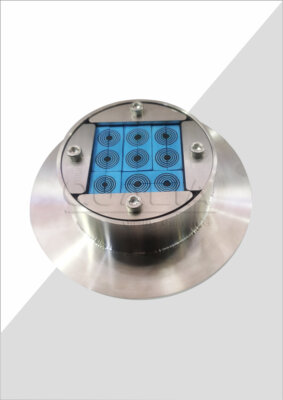
For a cable or cord port specifically, this means the seal detail and the transit device around the cable matter as much as the cable itself. A device such as the Порт для шнура и кабеля Vacu-Pass is built around a defined penetration and seal geometry, and a smoke check at that location tests the assembly as installed, not just the cable passing through it. Where a project team is evaluating a suspect penetration, confirming what kind of transit hardware is installed, and what its sealing detail is designed to do, is part of interpreting any smoke-pencil result taken there.
Conditions under which inward-airflow testing applies
Inward-airflow testing at penetrations is not a default check applied to every wall in every containment facility; it applies where the containment configuration and the facility’s approved protocol call for it at that specific location. Whether it is in scope depends on the containment level, the activity conducted in the space, and the jurisdiction under which the facility operates.
Сайт Канадский стандарт биобезопасности, третье издание, describes visual inspection and smoke-pencil testing of penetration seals, including conduits and wiring, where inward airflow is required, but this applicability is stated as containment-level and activity-specific rather than universal. A wall segment in one facility may fall under an inward-airflow testing requirement while a comparable-looking segment in another facility, under a different activity profile or jurisdiction, may not.
This matters directly for how a project team plans verification. If a facility’s protocol calls for inward-airflow testing at a class of penetrations, the smoke-pencil method described above becomes a defined step with a defined scope, and the result at each seal can be logged against that requirement. If the protocol does not call for it at a given wall or penetration type, applying a smoke check there anyway produces an observation that has no defined acceptance path, because there is no requirement it is being tested against.
The condition to confirm before running any local check is therefore not just “is this a BSL-3 wall” but “does this wall, at this location, fall under a requirement for inward-airflow verification.” That answer comes from the facility’s containment-level and activity designation as interpreted through its jurisdiction’s applicable standard, not from a general assumption that all BSL-3 boundaries carry the same testing obligation at every penetration.
Why an assembled-room tightness result answers a different question
| Вопрос | Local smoke-pencil check at a cable or conduit seal | Assembled-room tightness test |
|---|---|---|
| Область применения | Local penetration seal where inward-airflow testing applies | Assembled room boundary under the applicable project protocol |
| What the result can show | May reveal a local inward-airflow defect | Evaluates tightness of the assembled boundary |
| What the result cannot establish | Does not quantify whole-room tightness | Cannot identify the cable transit alone as the cause of a leak |
A room tightness test does not examine a single seal; it evaluates the assembled boundary as a whole, typically by establishing a pressure difference across the room envelope and observing how that pressure behaves over time. The result speaks to the aggregate performance of every joint, penetration, door seal, and wall surface that forms the tested envelope, combined.
This is a fundamentally different measurement from a local smoke check, and the difference matters most when a result comes back outside its expected range. A room-level result can show that the assembled boundary is not holding pressure as intended, but it cannot, by itself, identify which penetration, seam, or component is responsible. The cable transit that a smoke check might flag individually is only one of many possible contributors to a room-level finding, and the aggregate test has no mechanism to isolate it.
This asymmetry runs in only one direction. A local smoke-pencil check can reveal a defect at a specific seal without saying anything about the room. A room test can reveal that the room is not tight without saying anything about which seal caused it. Neither test substitutes for the other, and neither result should be read as if it answered the other test’s question.
Сайт Рекомендации Швейцарского экспертного комитета по биобезопасности относительно структурных и технических мер безопасности в лабораториях уровня BSL-3 draws this same distinction, separating local leak location at penetrations from final assembled-room tightness testing, and calling for retesting after any repair. That structure reflects the underlying logic: locating a defect and confirming the room’s overall tightness are two separate verification steps, and one does not stand in for the other.
For a project team investigating a suspected cable-seal problem, this means a room tightness result alone is not sufficient grounds to conclude the cable transit is or is not the cause. If the room result is out of range, the next step is a local investigation at candidate penetrations, not a repair applied to the cable seal on the assumption that it caused the room-level finding.
Project inputs that govern method and pass criteria
| Project input | Decision it informs | Boundary to retain |
|---|---|---|
| Facility jurisdiction | Which testing provisions and acceptance criteria apply | The Canadian standard has containment-level and activity-specific applicability; the Swiss BSL-3 recommendation is nonbinding. |
| Containment configuration and activity | Whether inward-airflow checking at penetrations or room pressure-decay testing is in scope | A pressure-decay test is not universal to every BSL-3 wall. |
| Approved project protocol | The selected method and acceptance criterion for this facility | No transferable pass limit follows from the cited Swiss recommendation. |
There is no single pressure-decay test or smoke-check protocol that applies uniformly to every BSL-3 wall; the method and the criterion it is judged against come from the specific project’s inputs, not from the containment level alone.
The facility’s jurisdiction sets the first boundary. The Canadian Biosafety Standard’s provisions on penetration testing and inward airflow have a containment-level and activity-specific applicability within Canadian practice, and a facility outside that jurisdiction, or a facility with a different activity designation, may fall under different testing provisions and acceptance logic entirely. The Swiss Expert Committee for Biosafety’s recommendation, meanwhile, is a nonbinding technical guide describing an approach to structural and technical safety in BSL-3 laboratories; it does not carry a transferable numeric pass limit or a named-product certification that a project team could apply elsewhere without further confirmation.
The containment configuration and the activity conducted in the space form the second input. Whether inward-airflow checking at penetrations applies, whether room-level pressure-decay testing applies, or whether both apply to different parts of the same facility, depends on how that specific room is configured and what work is authorized in it. A pressure-decay test is not something to assume for every BSL-3 wall by default; its applicability follows from the configuration, not from the containment level name alone.
The approved project protocol is what finally fixes the method and the acceptance criterion for a given facility. Where jurisdiction and configuration establish which category of testing is in scope, the protocol specifies how that testing is executed and what result counts as a pass for this project. A project team reviewing a penetration or a room result should be able to point to the protocol clause that governs the specific test being run, rather than inferring a criterion from a general BSL-3 reference.
When a customer brings this kind of question into a project review, the facility’s containment configuration, activity profile, and applicable protocol are exactly the inputs that determine what testing scope and interface a supplier’s equipment needs to support, including how a component like a cable or cord port is specified and confirmed for that installation.
Test records needed to locate, repair and retest a defect
| Record element | Use in defect follow-up |
|---|---|
| Tested wall condition and service population | Establishes the baseline condition against which a later cable change can be compared. |
| Method and observation | Preserves whether the finding came from a local check or an assembled-room test; a room result alone does not locate the cable transit. |
| Corrective retest after repair | Captures the post-repair observation for comparison with the original finding; the Swiss recommendation calls for retesting after repair. |
A defect finding is only useful if it can be traced back to a known baseline and forward to a confirmed repair. That requires a record that captures more than the pass or fail result itself.
The tested wall condition and the service population passing through it need to be recorded at the time of test. This establishes what was actually in place, cable by cable and conduit by conduit, so that a later cable addition, removal, or replacement can be compared against a known starting point rather than against an assumption about what the wall originally contained.
The method and the observation need to be recorded together, not just the outcome. Because a local smoke-pencil finding and an assembled-room tightness finding answer different questions, the record has to preserve which kind of test produced which result. A room-level finding recorded without noting that it came from a room test, rather than a local check, risks being misread later as evidence about a specific penetration when it was never capable of identifying one.
Where a defect is found and repaired, a corrective retest captures the post-repair observation using a method comparable to the one that found the defect, so the new result can be compared against the original finding rather than against an unrelated baseline. The Swiss Expert Committee for Biosafety’s recommendation explicitly calls for retesting after repair, which reflects that a repair claim is only supported by a retest, not by the repair action alone.
For a project team, this record serves a purpose beyond the immediate defect: it becomes the reference point for future changes. A facility’s commissioning records, of the kind built during FAT, SAT, and IQ/OQ airflow testing, and the validation documentation compiled from URS and DQ through test reports, are the natural home for this kind of baseline. Without that reference, a future cable change at the same wall has no documented condition to be measured against, and any new finding has to be interpreted from scratch rather than compared to what was previously confirmed.
Часто задаваемые вопросы
Q: Can a smoke-pencil check substitute for a room tightness test at a cable penetration?
A: No. Where inward-airflow testing applies, a smoke-pencil check may reveal a local defect at a cable or conduit seal, but it does not measure the tightness of the assembled room boundary.
Q: Does every BSL-3 cable penetration need a pressure-decay test?
A: No universal pressure-decay test applies to every BSL-3 wall. Determine the applicable method and acceptance criterion from the facility’s jurisdiction, containment configuration and activity, and approved project protocol.
Q: If an assembled-room tightness test fails, does that prove the cable transit is leaking?
A: No. The result evaluates the assembled boundary, not the cable transit alone. Keep the test method and observation in the record, then investigate the local seal where the applicable testing scope calls for it.
Q: What should be recorded before a later cable change is compared with a tested wall?
A: Record the tested wall condition and service population, method, and observation. If a defect is repaired, also record the corrective retest so the later change can be compared with the baseline.