
How many fixed VHP generators does a facility need, and how large should each one be? The question looks like a nameplate-capacity exercise, but a generator selected from throughput specification alone can still leave zones waiting on cycles, or force an operating schedule that the ventilation interfaces cannot support. Scoping capacity correctly means starting from the treatment demand the facility will actually create, not from a single output figure on a datasheet.
Capacity Starts with the Treatment Demand, Not the Generator Nameplate
A fixed VHP generator is rated for an output capability, but that figure describes what the equipment can deliver under defined conditions, not what a specific facility will require from it. Capacity screening begins with the treated room volumes the facility contains, the number of zones that will need decontamination, the expected cycle frequency in each zone, and the concurrency windows when more than one zone may need treatment at or near the same time. Room count alone does not describe this demand. Two facilities with the same number of rooms can present very different treatment demand if one operates its zones in strict sequence and the other expects several zones to complete cycles within overlapping windows.
This distinction matters because generator sizing decisions made against nameplate output alone tend to assume the best-case scenario: one zone, one cycle, no competing demand. Where a facility’s operating model requires overlapping cycles, or where cycle frequency is high enough that zones queue for access to the same generator, the usable capacity of that generator in service is lower than its rated output would suggest. The buyer’s task at this stage is to establish the treatment demand profile first, independent of any specific equipment, and only then compare that demand against what a given generator configuration can support.
Where a facility expects to run one zone at a time with generous time between cycles, a smaller generator matched conservatively to room volume may fully cover demand. Where the facility expects concurrent or near-concurrent cycles across multiple zones, the same per-zone volume calculation understates what the installed capacity must deliver, because the generator must serve overlapping demand rather than sequential demand. This is the condition that separates a straightforward volume-based sizing exercise from one that requires scheduling analysis before a generator configuration can be confirmed.
Treated room volume remains the starting input, and correct unit sizing for room and isolator volume is a necessary foundation. But volume alone answers only part of the sizing question. The remaining part depends on how the facility intends to operate across time, which the next sections address directly.
Room Volume, Load and Leakage Inputs That Shape Each Cycle
Once treated volume is established as the baseline, the inputs that shape an individual cycle’s demand on the generator go beyond geometry. Enclosure leakage, the load present in the room or isolator during treatment, temperature and humidity conditions, and the distribution of vapor-phase hydrogen peroxide through the space all affect how a cycle performs and how long it occupies the generator and the zone.
Leakage changes the picture because a treated enclosure that loses concentration during dwell requires the generator to compensate, which extends cycle time or demands higher output to reach and hold the target condition. A facility that has not characterized leakage for a given room or isolator configuration is working from an assumption, not a confirmed input, and that assumption carries directly into capacity planning. Where leakage is higher than assumed, the cycle consumes more generator time than a sizing model built on an idealized enclosure would predict.
Load behaves similarly but through a different mechanism. Materials, surfaces, and equipment present in the treated space absorb and release vapor-phase hydrogen peroxide at rates that depend on surface area, material type, and arrangement. A heavily loaded room with complex surface geometry can require a different cycle profile than an empty or lightly loaded one of the same volume, because distribution of the agent throughout the space becomes harder to confirm uniformly. Temperature and humidity conditions at the start of a cycle further affect how quickly the target concentration is reached and how it behaves during dwell, which means a facility operating in variable ambient conditions, or one with zones that condition differently, cannot treat all rooms as identical cycles even where their volumes match.
The consequence for sizing is that volume-based screening sets the starting estimate, but load, leakage, temperature, humidity, and distribution conditions determine what the cycle actually demands of the generator in practice. These conditions are project-specific and are not interchangeable between rooms, which means a capacity model built on one room’s characterized conditions should not be extended to another room without confirming that the same conditions hold. This is also where the connection to validation becomes direct: the same inputs that shape cycle demand are the inputs a project will later need to confirm through indicator placement and recovery, which is why identifying the biological and chemical indicators appropriate to VHP cycle validation depends on first understanding what the cycle is being asked to do in that specific enclosure.
Zoning and Concurrency Scenarios for the Operating Schedule
| Operating scenario | Demand inputs to compare | Scheduling decision it supports |
|---|---|---|
| Sequential zone operation | Treated volume, load profile and complete cycle demand for each zone | Establish the throughput available when zones do not overlap |
| Planned zone overlap | Zones active together, concurrency windows and the defined door, damper, HVAC and area-release states | Check whether the proposed overlap fits the generator and ventilation interfaces |
| Peak cycle-frequency window | Expected cycle frequency by zone and the periods of highest planned demand | Identify whether the operating schedule creates a capacity bottleneck |
Treatment demand and cycle-shaping conditions describe what a single zone requires. The operating schedule describes how multiple zones interact, and this is where capacity planning shifts from a per-room calculation to a facility-level one. The central judgment here is whether zones will operate in strict sequence, whether some planned overlap exists, or whether peak periods create a concentration of demand that neither sequential nor lightly overlapping assumptions would capture.
Sequential operation is the simplest case to size for, because each zone’s complete cycle demand, including conditioning, gassing, dwell, and aeration, can be summed against available generator time without needing to resolve competing claims on the same equipment. This assumption breaks down as soon as a facility’s operating schedule calls for planned overlap, where two or more zones are active within the same window. At that point, the generator and the ventilation interfaces serving each zone must be evaluated together, because a configuration adequate for sequential use may not hold when overlap is introduced.
Before any overlap can be reasonably estimated, the facility needs to define the state of doors, dampers, HVAC, and area-release conditions for each zone independently. This definition is a precondition, not a parallel task: estimating which cycles may safely or practically overlap depends on first knowing how each zone’s interfaces behave, because a zone that releases to occupied space through a shared air handling path constrains scheduling differently than one with an independent interface. Skipping this step and assuming overlap is feasible based on generator output alone risks a schedule that the interfaces cannot actually support.
Peak cycle-frequency windows add a third dimension. Even a facility that mostly operates zones sequentially may have periods where operational demand concentrates, such as a changeover period affecting several zones together. Identifying whether such a window exists, and what it demands of the generator relative to the rest of the operating schedule, determines whether the facility is sizing for its average case or for the case that actually controls capacity. A generator configuration sized to average demand can leave the facility without headroom precisely when concentrated demand arrives, which is why the controlling scenario — not the typical one — should set the capacity target.
HVAC, Damper and Aeration Interfaces That Can Limit Throughput
A fixed VHP cycle is not a single uniform process; it moves through conditioning, gassing, dwell, and aeration, and each of these steps places a different demand on the generator and on the ventilation interfaces around the treated zone. Conditioning prepares the enclosure environment before active gassing begins. Gassing introduces the agent to reach and hold target conditions. Dwell maintains those conditions for the period needed to achieve the intended effect. Aeration then clears the agent from the space before the zone can be released for occupancy or further use.
Because these steps differ in mechanism, they also differ in what limits their duration. Gassing performance depends heavily on the generator’s output and on how the agent distributes through the enclosure, so generator capacity speaks directly to this step. Aeration, by contrast, depends more on the ventilation and exhaust interfaces serving the zone — how quickly conditioned air can be cycled through the space to clear residual agent — and a generator with ample output does not shorten an aeration step that is limited elsewhere. The consequence is that the step with the slowest completion, not the step the generator most directly drives, can set the effective throughput of the whole cycle and therefore of the zone.
This matters for capacity planning because a facility may size its generator against gassing demand and still find that aeration, governed by HVAC capacity and damper sequencing, is the step that determines how quickly a zone becomes available again. Where aeration is the limiting step, adding generator capacity does not shorten the cycle; it only ensures gassing is not the bottleneck while leaving the actual constraint on zone turnaround untouched elsewhere. Conversely, where ventilation and aeration pathways are generous relative to the zone’s volume, gassing and the generator’s output become the governing constraint, and capacity decisions should focus there instead.
Area-release conditions tie back to this directly: a zone cannot be considered available for the next cycle, or for occupancy, until its release state is confirmed, and that confirmation depends on the aeration interface having done its work, not merely on the generator having completed gassing. Facilities that treat the generator as the sole throughput-determining component risk misjudging how quickly zones can actually be turned over, because the limiting step may sit in the HVAC, damper, or exhaust path rather than in the generator itself. Identifying which interface is limiting for a given zone, under its specific load and leakage conditions, is a project-specific determination that depends on how that zone’s ventilation and release states have been configured.
Translating the Model into URS and Validation Inputs
| Input group | Record in the capacity brief and URS | Decisão que ela apoia | Limite das evidências |
|---|---|---|---|
| Treatment demand | Treated room volume for each zone and expected cycle frequency | Establish the initial capacity-screening basis | Room count or generator output alone does not establish validated process performance |
| Load and enclosure conditions | Load profile, enclosure leakage, temperature, humidity and distribution conditions | Carry the relevant conditions into sizing and project validation | Final capacity and cycle performance remain project-specific |
| Operating model | Zones, concurrency windows, and the demands of conditioning, gassing, dwell and aeration | Compare schedule options and locate the step that may set throughput | The controlling step depends on the project configuration and cycle conditions |
| Interface states | Door, damper, HVAC and area-release states for each zone | Define the boundaries for estimating which cycles may overlap | These states must be defined for the project before overlap is estimated |
| Qualification and validation | URS requirements and design-qualification checks against those requirements | Maintain the link from user requirements to design verification | Exact qualification stages and acceptance criteria remain project-specific |
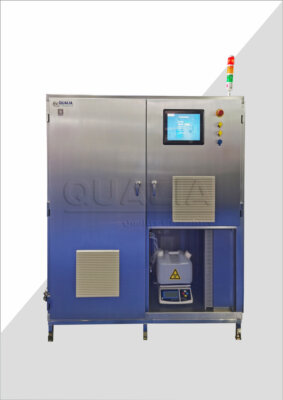
The treatment-demand model, the cycle-shaping conditions, the concurrency scenarios, and the interface limits identified through the preceding analysis do not stay as planning artifacts; they need to be captured in a form the project can carry into procurement and qualification. This is where the capacity brief becomes a structured input to the user requirements specification, and where the project information a buyer assembles enters QUALIA’s configuration and quotation review for a fixed VHP generator such as the Gerador de peróxido de hidrogênio VHP Tipo I.
EudraLex Volume 4 Anexo 15 establishes the URS as a reference maintained across the validation life cycle, and requires design qualification to verify that the selected design complies with the requirements the URS sets out. This framework means that the capacity brief is not a document produced once and set aside; the treated volumes, cycle frequencies, load and leakage conditions, zoning assumptions, and interface states identified during capacity scoping need to be present in the URS in a form that design qualification can later check against. A capacity model that stays informal, without being translated into explicit URS requirements, gives the project nothing concrete to verify design compliance against at the qualification stage.
ISO 14644-4:2022 addresses cleanroom design, construction, and start-up at the facility level, including verification and life-cycle maintenance considerations, though it does not prescribe a specific technology, process, or contractual delivery method. This means the standard supports the facility-level framework within which a fixed VHP capacity decision sits, without dictating how that capacity should be configured or delivered; the project-specific requirements still need to be developed and carried through the URS independently.
Because exact qualification stages and acceptance criteria remain project-specific, the buyer’s task is not to assume a fixed checklist applies uniformly, but to ensure that the treatment demand, load and enclosure conditions, operating model, and interface states are all explicitly recorded and traceable from the capacity brief through the URS and into design qualification. Where this traceability is incomplete, a facility may find that the equipment configuration it receives satisfies the generator’s rated output without actually matching the operating schedule, zoning logic, or interface states the facility intends to run, because those conditions were never captured as explicit requirements. Carrying the capacity model forward with this level of specificity is what allows the generator configuration selected for the project, and the ventilation and interface coordination around it, to be verified against what the facility actually needs rather than against a generic capability claim.
Perguntas frequentes
Q: Is treated room volume enough to size a fixed VHP generator?
A: No. Use the treated volume as a starting point, then account for the load profile, enclosure leakage, temperature, humidity, distribution conditions, cycle frequency, and any planned overlap between zones. Generator output alone does not establish validated cycle performance.
Q: How should planned overlap between VHP cycles be evaluated?
A: Define which zones would operate together and the exact concurrency windows, then document the required door, damper, HVAC, and area-release states for each zone. If those states are not defined, do not assume the cycles can overlap in the capacity model.
Q: What can limit throughput even when the generator output appears sufficient?
A: The controlling constraint may be conditioning, gassing, dwell, aeration, or a linked ventilation interface. Compare the complete cycle demand for each zone against the operating schedule so the slowest step, rather than nameplate output alone, sets the throughput expectation.
Q: How can buyers compare two fixed VHP capacity proposals fairly?
A: Compare them against the same zone volumes, load and enclosure conditions, cycle-frequency assumptions, concurrency windows, and interface states. Each proposal should also identify its controlling cycle step and distinguish a capacity estimate from performance that still requires project-specific validation.
Q: When is a capacity model ready to become a URS input?
A: It is ready when the treatment demand, operating model, relevant room and load conditions, and zone interface states are documented clearly enough to check the design against user requirements. Qualification stages and acceptance criteria should remain project-specific rather than being inferred from the preliminary sizing model.