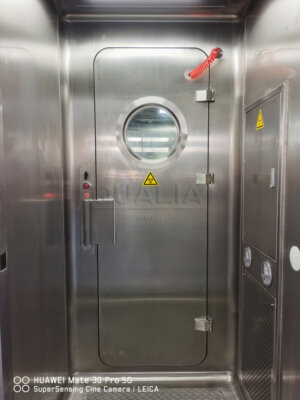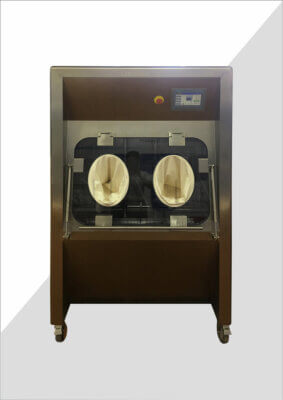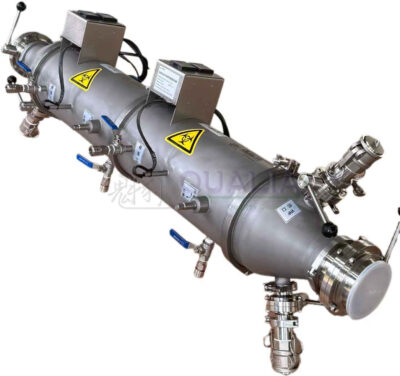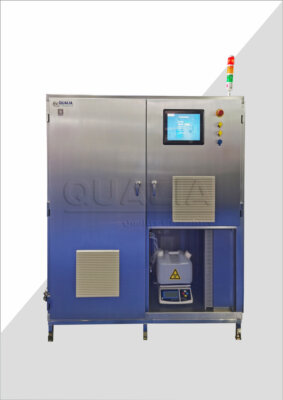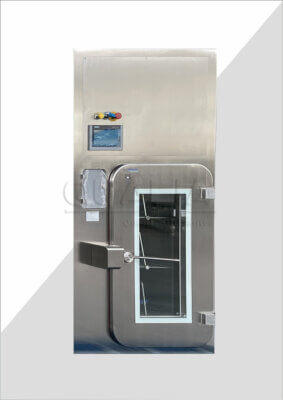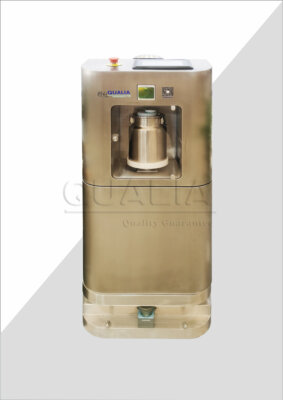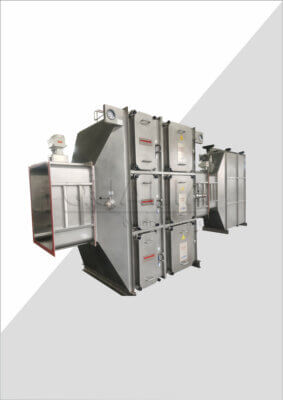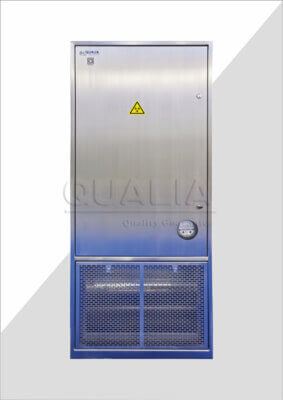

Grade claims on pharmaceutical pass boxes frequently appear in supplier literature without a traceable path to materials, filter specifications, or test records for the unit that will actually be delivered. When that gap surfaces during qualification—rather than during procurement—the documentation burden falls back on the buyer, often at a point when fabrication is already complete and a change order is the only resolution. The difference between a compliant unit and a compliant-sounding one comes down to whether the specification covers type selection, interlock design, surface finish, and consumable schedules before the purchase order is released. What follows gives procurement, engineering, and quality teams the practical criteria to distinguish real compliance from market language at each stage of the evaluation.
Use-case definitions behind pharmaceutical-grade claims
Type selection is a concept-stage decision with consequences that reach into qualification. Choosing incorrectly between static and dynamic designs is not a setting that can be adjusted after installation—it determines whether the unit is physically capable of generating the air cleanliness evidence that regulated transfers require.
The primary planning criterion is the classification relationship between the two spaces the pass box connects. A static pass box uses only sealed construction and a door interlock; it relies on both sides of the transfer already being controlled to the same level. Once a transfer route crosses a grade boundary—moving material from an uncontrolled or lower-classified area into a controlled zone—a static design allows contamination ingress that its construction cannot address. A dynamic pass box resolves that gap with a built-in HEPA-filtered air supply that maintains ISO-class cleanliness within the chamber during the transfer event itself.
Material risk adds a second dimension to type selection that teams often treat as secondary. Raw materials, primary packaging components, finished goods, and waste streams each carry different contamination risk profiles, and the pass box type should reflect the highest-risk transfer it will routinely handle. A unit specified for secondary packaging may be inadequate if the same airlock is later used for component entry into an aseptic suite. Selecting for the actual use population rather than the nominal use case avoids a forced replacement when the transfer program expands.
For transfers involving hazardous materials, containment integrity during the transfer event itself becomes the governing concern rather than air cleanliness alone. Rapid Transfer Port designs address that directly. For high-risk aseptic transfers where bioburden reduction must be validated, vaporized hydrogen peroxide decontamination provides a repeatable, documentable cycle that sealed construction and filtration alone cannot replicate.
| Scenariusz transferu | Appropriate Pass Box Type | Uzasadnienie |
|---|---|---|
| Transfers between cleanrooms of the same classification | Statyczna skrzynka przepustek | Sealed interlock only; no active air handling is needed when both sides are at the same cleanliness level. |
| Transfers from uncontrolled or lower-classified areas into controlled zones | Dynamiczne pole przepustek | Built-in HEPA-filtered air supply maintains ISO-class air cleanliness during cross-grade transfers. |
| Hazardous goods requiring containment during transfer | RTP pass box | Rapid Transfer Port design preserves containment and prevents release of hazardous materials. |
| High-risk aseptic transfers needing validated decontamination | Skrzynka przepustek VHP | Vaporized hydrogen peroxide decontamination provides a validated bioburden reduction step. |
The contamination-risk logic embedded in this selection framework aligns with the biorisk management thinking described in ISO 35001:2019, which treats transfer events as points where containment barriers must be actively maintained rather than assumed. The practical implication for procurement is simple: define the transfer route and the risk profile of the material before specifying the unit type, because the type decision is irreversible without a full replacement.
Specifications that separate market language from real compliance
A supplier’s grade claim is only meaningful if it traces to specific components, dimensions, and material choices in the delivered unit. Broad compliance language in a brochure says nothing about whether the unit in front of an auditor can actually demonstrate that cleanliness level.
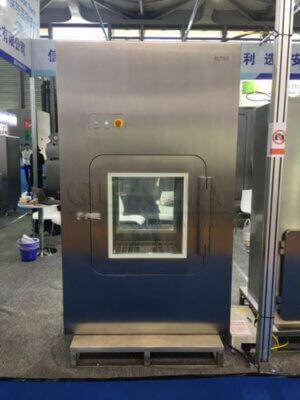
For a dynamic pass box, five components determine whether ISO-class air cleanliness is achievable and verifiable: a built-in fan that drives airflow through the filtration train, a G4 pre-filter that protects the HEPA stage from coarse particulate loading, an H13 or H14 HEPA filter rated at 99.995% efficiency or better, a differential pressure gauge spanning 0–250 Pa that monitors filter condition in real time, and a DOP/PAO test port that makes in-place HEPA leak testing possible. The absence of any single item in that list is not a minor gap—it removes either the filtration capability or the means to verify it. A unit without a test port cannot be challenged with aerosol; a unit without a pressure gauge cannot show that filter loading is being tracked. Neither can be qualified for ISO-class service regardless of how the specification sheet describes them.
| Komponent | Funkcja | Konsekwencje w przypadku braku |
|---|---|---|
| Built-in fan | Generates airflow through the filtration system. | Without active airflow, the pass box cannot deliver filtered air to the chamber. |
| G4 pre-filter | Captures coarse particulates and protects the HEPA filter. | HEPA filter loading accelerates; air cleanliness maintenance is compromised. |
| H13/H14 HEPA filter (≥99.995% efficiency) | Removes sub-micron particles to achieve target ISO class. | The unit cannot meet certified air cleanliness requirements. |
| Differential pressure gauge (0–250 Pa) | Monitors filter loading and integrity in real time. | No objective indication of filter condition; performance drift goes undetected. |
| DOP/PAO test port | Enables in-place HEPA filter leak testing and aerosol challenge. | Filter integrity cannot be validated; the unit lacks the basis for ISO certification. |
Interlock type and material selection are the two specification decisions most commonly deferred until after PO release, and both have compliance consequences that are difficult to address retroactively. Mechanical fail-safe pin interlocks provide immediate, verifiable evidence that both doors cannot be open simultaneously, require no active electronics, and present no silent failure mode. Electronic electromagnetic interlocks with control panels and alarm outputs enable sequencing, audit trail generation, and integration with facility monitoring systems—capabilities that mechanical designs do not offer. The choice is an engineering trade-off between auditability and maintenance simplicity, not a universal preference for one type. What matters is that the decision is documented before fabrication begins, because the interlock mechanism is integrated into the unit structure and is not interchangeable after manufacture.
Interior material and corner geometry follow the same logic. SS304 is the standard base material; SS316L offers meaningfully higher resistance to the concentrated cleaning agents and disinfectants used in GMP environments and is worth specifying for interiors that will see aggressive cleaning cycles. Coved interior corners remove the right-angle joints where residue accumulates and swabbing is difficult. Non-coved designs are cleanable but require more effort to verify, and that effort becomes an audit question when surface monitoring data is reviewed. Specifying coved corners from the outset is less expensive than justifying the deviation later.
Consumable schedules—UV lamp replacement at 4,000 hours of use, pre-filter replacement at six-month intervals, HEPA filter replacement between six and twelve months—are manufacturer-derived design figures, not universal regulatory replacement mandates. Their practical value is that they provide a defensible, pre-defined maintenance program that an auditor can review. A unit without documented replacement intervals has no baseline to measure compliance against.
Certification records expected during technical review
Certification review for a dynamic pass box is not a matter of confirming that a certificate exists—it is a matter of confirming that the certificate is traceable to the specific unit, reflects a test performed on the delivered configuration, and covers the records that will be requested during qualification.
The three record categories that consistently surface during technical review follow a logical sequence: HEPA filter integrity, filter performance monitoring, and decontamination evidence. DOP or PAO test port documentation confirms that the HEPA filter in the delivered unit was physically challenged with aerosol, that the downstream particle count met the target ISO class, and that no leaks around the filter seal were detected. This is not a factory certificate that can be transferred from a test unit to a production unit—it must reflect the actual unit being installed. Without that documentation, the unit has no objective basis for an ISO-class cleanliness claim, and the qualification team will need to generate it from scratch after installation, which takes time and requires test equipment access.
| Record/Evidence | Dlaczego to ma znaczenie | Collection Frequency/Trigger |
|---|---|---|
| DOP/PAO test port documentation (HEPA filter leak test, particle count verification) | Provides objective proof that the dynamic pass box meets ISO-class air cleanliness. | At commissioning and during periodic requalification. |
| Differential pressure gauge readings | Tracks filter integrity and enables early detection of breaches. | At regular intervals defined in the site monitoring plan. |
| UV lamp performance and replacement documentation | Confirms effective decontamination and prevents compliance gaps due to expired lamp life. | Upon reaching 4000 hours of use; after each replacement. |
Differential pressure records serve a different function: they provide ongoing evidence of filter integrity between certification events. A single commissioning certificate establishes a baseline; pressure monitoring at defined intervals in the site monitoring plan tracks whether that baseline holds. Missing pressure records make it difficult to demonstrate that the filter has not degraded between qualification cycles—a gap that is easy to overlook until a periodic review asks for trend data that was never collected.
UV lamp documentation is the record category most often treated as informal. The 4,000-hour design figure for lamp service life is meaningful only if actual hours of use are tracked against it. A replacement log that shows the date, the elapsed hours at replacement, and confirmation of the new lamp’s specification closes an audit question that an absent or informal record leaves open. For facilities where the pass box operates continuously, 4,000 hours can be reached within months; for lower-utilization units, tracking still matters because the clock runs on operating hours, not calendar time.
Supplier package differences that affect approval speed
The cost difference between a high-document supplier and a generic fabricator is real, and it is also frequently smaller than the combined cost of the change orders and qualification delays that low-document procurement produces. That trade-off is easiest to see in retrospect, which is why it is worth making explicit before the purchase order is issued.
Three supplier package elements have a direct and predictable effect on approval speed. Accessory scope—flanges for wall sealing, support stands for thin-wall installations, factory-fitted UV lamps—must be resolved before PO release. Each accessory affects installation interface and, in some cases, electrical integration. Treating these as post-PO decisions creates change orders that extend delivery within a supply window that already runs two to four weeks under favorable conditions. The accessories are not difficult decisions; they are decisions that require the installation drawings and the cleanroom wall specification to be available at procurement, not at site readiness.
| Punkt decyzyjny | Ryzyko, jeśli niejasne | Co należy potwierdzić |
|---|---|---|
| Optional accessories (flange for wall sealing, support stand, factory-fitted UV lamp) | Post-PO accessory decisions trigger change orders and extend project timelines. | Confirm accessory selection and ensure it is included in the original PO scope. |
| Supplier lead time (e.g., 2–4 weeks vs. longer) | Mismatched delivery schedule can halt validated facility operations. | Verify the committed delivery window aligns with the project schedule. |
| Spare parts and post-installation ordering | Lack of post-installation support forces a full unit replacement when a single component fails. | Confirm that critical spare parts and accessories can be ordered after installation. |
Lead time verification sounds like a logistical detail but is a qualification risk in facilities with tight validation schedules. A committed two-to-four-week delivery window that slips by two additional weeks can displace a validation event that has already been scheduled with a third-party testing firm. The cost of that displacement—rescheduling fees, extended validation timelines, delayed product manufacturing dates—is rarely traced back to the pass box procurement decision even when it originates there.
Spare parts availability after installation is a long-term ownership question that procurement teams infrequently raise. A supplier that cannot provide replacement HEPA filter cartridges, UV lamp assemblies, or interlock components on a post-installation basis converts a component-level failure into a unit-level replacement event. Confirming spare part availability and lead times before PO release is a five-minute conversation that prevents a potentially months-long equipment gap.
Evidence-backed qualification support as the grade threshold
The practical threshold for pharmaceutical service is not whether a pass box carries a grade label—it is whether the unit can produce objective, traceable evidence of the performance it claims. A supplier that cannot provide that evidence has not met the procurement standard for regulated use, regardless of the language in the specification sheet.
For dynamic pass boxes, the DOP/PAO test port is the physical feature that makes HEPA filter validation possible. Without it, there is no means to perform an aerosol challenge or to generate particle count data inside the chamber; the filter may be present and correctly specified, but its integrity cannot be demonstrated to a qualified standard. The differential pressure gauge provides the ongoing monitoring layer: filter loading and potential integrity breaches are tracked between qualification events, so the evidence record extends through the unit’s operational life rather than existing only at commissioning.
| Pass Box Design/Feature | Qualification Evidence Provided | Grade Threshold Implication |
|---|---|---|
| Statyczna skrzynka przepustek | Sealed construction and interlock only; no active filtration or airflow monitoring. | Cannot produce evidence of particulate removal; fails to meet the threshold for applications requiring documented air cleanliness. |
| Dynamiczne pole przepustek | DOP/PAO test port enables HEPA filter validation; differential pressure monitoring supports ongoing integrity checks. | Provides objective evidence that the chamber meets ISO-class air cleanliness; suitable for higher-grade pharma transfers. |
| Pulsed light pass box | 6-log reduction in <1 minute with monitored, reproducible energy delivery. | Delivers a high grade of decontamination evidence suitable for high-risk aseptic transfers. |
| Mechanical interlock (fail-safe pin) | Simple verifiable test confirms both doors cannot be open simultaneously; no active electronics that can fail silently. | Provides maintenance-free containment integrity evidence that supports audit documentation. |
Pulsed light technology occupies a distinct position in this comparison. A 6-log reduction achieved in under one minute, with monitored and reproducible energy delivery, represents a decontamination evidence standard that is meaningfully higher than what sealed construction or standard UV lamp operation provides. That performance figure is specific to pulsed light designs and should not be generalized as a benchmark for other decontamination methods—but for facilities where aseptic transfer risk justifies the investment, the reproducibility of the result is the qualification advantage.
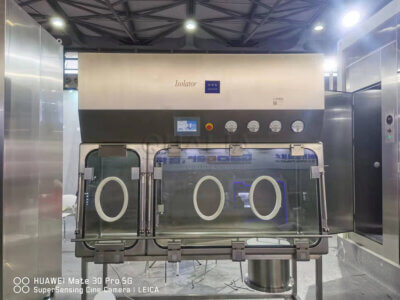
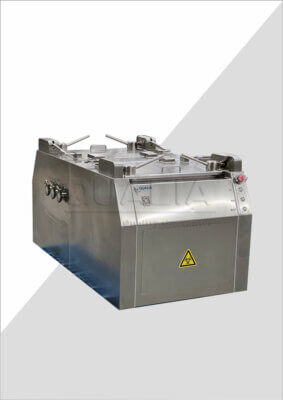
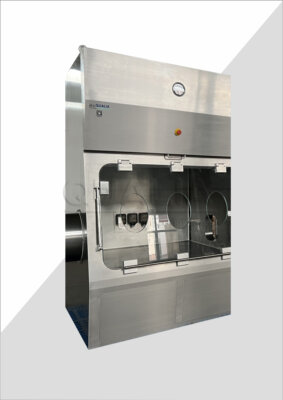
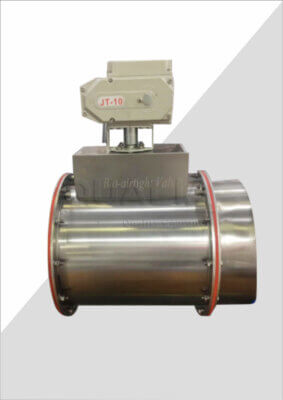
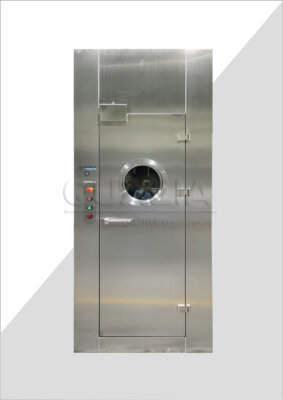
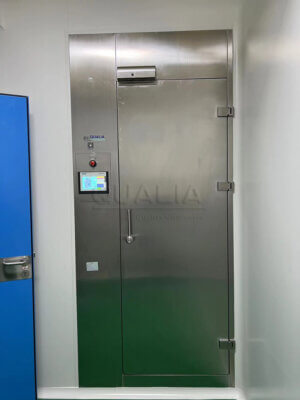
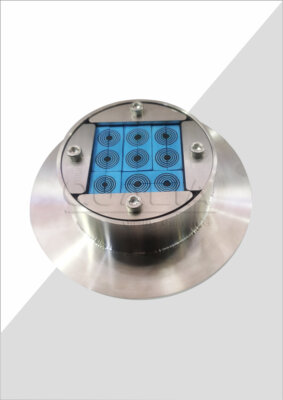
The mechanical interlock’s qualification value is often underestimated precisely because it is simple. A physical test that verifies both doors cannot be open simultaneously produces unambiguous evidence that requires no electronic logging, no software validation, and no active component to function correctly. It does not generate an audit trail in the sense that an electronic system does, but it does not require one to be credible; the mechanism is testable on demand. That trade-off—less documentation capability, fewer failure modes—is worth understanding rather than dismissing in either direction. The Skrzynka bezpieczeństwa biologicznego oraz VHP Pass Box product lines reflect configurations at different points along this spectrum, covering applications from containment-focused transfers to validated VHP decontamination cycles.
Static pass box designs occupy a specific, limited position in the qualification hierarchy. Their sealed construction and interlock provide reliable containment integrity evidence for same-grade transfers. They cannot generate particle count data, cannot demonstrate active filtration, and cannot support ISO-class air cleanliness claims for the chamber interior. Specifying a static design for a transfer route that will later require documented air cleanliness is not a configurable gap—it is a full replacement scenario. The qualification implication, supported by the WHO Laboratory Biosafety Manual’s layered approach to contamination control, is that the design choice at procurement determines the ceiling of what can ever be demonstrated during qualification, and that ceiling cannot be raised without replacing the hardware.
The most durable procurement decision on a pharmaceutical pass box is made before the purchase order is released: type selection, interlock specification, material and corner finish, accessory scope, and consumable schedules all need to be resolved at that stage because none of them are retrofit decisions once fabrication begins. The certification package—HEPA leak test records, differential pressure data, UV lamp service logs, material certificates—should be requested and reviewed before delivery acceptance, not assembled under time pressure during qualification.
What a supplier can produce at the pre-PO stage is often the clearest signal of what will be available during an audit. If the supplier cannot trace grade-related specifications to the delivered unit’s actual components and provide test evidence for those components specifically, that gap will reappear at qualification. Confirming what documentation exists, for which unit, tested under which conditions, is the verification step that separates a compliant pass box from one that is described as compliant.
Często zadawane pytania
Q: What happens if a static pass box was already installed on a transfer route that now requires documented air cleanliness?
A: The unit will need to be replaced — there is no retrofit path. Static designs lack active filtration, airflow components, and test ports, so they physically cannot generate particle count data or support ISO-class cleanliness claims for the chamber interior. The qualification ceiling is set by the hardware at installation, and a static design’s ceiling stops at same-grade containment integrity. Replacement with a dynamic unit is the only resolution, which is why type selection must be locked before fabrication begins rather than revisited after a transfer program expands.
Q: After accepting delivery, what should quality teams do before the pass box is released for use in a validated cleanroom?
A: Request and review the full certification package against the delivered unit’s serial number before signing off on delivery acceptance. Confirm that the HEPA leak test record reflects an aerosol challenge performed on that specific unit — not a factory reference unit — and that the differential pressure baseline reading is documented for the as-installed configuration. UV lamp hours should be initialized at zero in the site maintenance log at this point. Starting the monitoring record at commissioning, rather than reconstructing it later, prevents the data gap that periodic qualification reviews most frequently flag.
Q: Does the choice between mechanical and electronic interlock affect what documentation an auditor will expect?
A: Yes, and the difference is structural rather than cosmetic. A mechanical fail-safe pin interlock produces on-demand physical evidence that both doors cannot open simultaneously, but it generates no audit trail of individual transfer events. An electronic electromagnetic interlock with a control panel can log sequences, trigger alarms, and integrate with facility monitoring systems — outputs that auditors in high-frequency or high-risk transfer environments may treat as expected rather than optional. If the site’s quality system requires transfer-event logging or alarm history for deviation investigation, a mechanical interlock cannot provide that, and adding it after fabrication is not feasible. The interlock decision should be made against the site’s audit documentation expectations, not defaulted to the simpler option.
Q: At what point does specifying SS316L interior over SS304 become worth the additional cost?
A: When the interior will be regularly exposed to concentrated disinfectants, sporicidal agents, or high-frequency cleaning cycles, SS316L’s higher chemical resistance justifies the cost difference. SS304 is adequate for standard cleaning protocols, but in aseptic or high-bioburden environments where aggressive agents such as peracetic acid or concentrated bleach solutions are used routinely, SS304 surfaces can show corrosion over time — which then becomes a surface integrity question during environmental monitoring reviews. The cost of specifying SS316L at procurement is fixed and minor relative to the cost of addressing a surface condition finding during an audit or requalification cycle.
Q: Is a VHP pass box always the right choice for high-risk aseptic transfers, or are there situations where a different decontamination method is more appropriate?
A: Not always — the right choice depends on whether the transfer requires validated bioburden reduction or containment integrity during the transfer event itself. VHP decontamination provides a repeatable, documentable cycle suited to high-risk aseptic transfers where sporicidal activity must be demonstrated. For hazardous material transfers where the governing concern is preventing containment breach rather than bioburden reduction, a Rapid Transfer Port design addresses that requirement more directly than VHP. Pulsed light technology occupies a separate position again, offering a sub-minute 6-log reduction with monitored energy delivery for applications where decontamination speed and reproducibility are both critical. Matching the decontamination method to the actual risk profile of the transfer — rather than defaulting to the highest-specification option — is the correct selection logic.