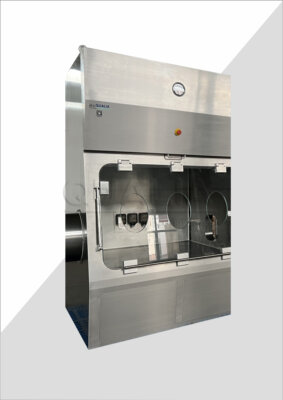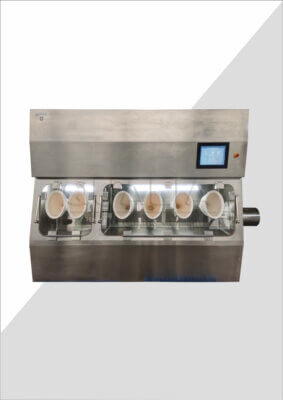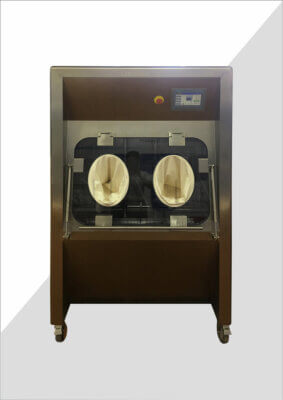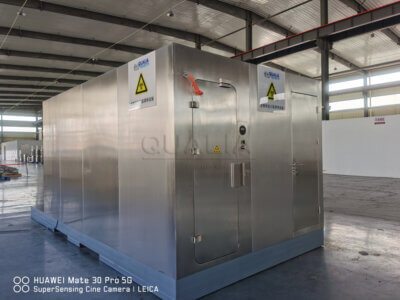

Facilities that commission a mist shower late in a BSL-3 construction sequence often discover that the spray system was specified around generic chamber dimensions rather than validated nozzle geometry, and the first formal performance test fails because lateral body zones receive no measurable chemical contact. That failure triggers a qualification delay, and in some cases a full nozzle-bank redesign that has to be accommodated in a chamber already fitted with final finishes. The underlying planning error is treating atomization performance as a procurement checkbox rather than as a set of interdependent parameters — droplet size, nozzle count, contact time, and concentration — each of which affects whether the system achieves a defensible log-reduction result. Understanding the mechanism behind each parameter gives procurement teams and biosafety officers the judgment needed to evaluate a specification before it becomes a retrofit problem.
The atomization mechanism: how nozzle pressure converts liquid disinfectant into a suspension that reaches PPE surfaces
The first question a system specification has to answer is what droplet size the nozzle assembly actually produces under operating pressure, because the answer determines whether the disinfectant contacts the PPE surface or simply remains airborne until the cycle ends.
When pressurized liquid is forced through a nozzle orifice, the fluid stream breaks into droplets whose size is controlled by nozzle geometry, orifice diameter, and feed pressure. The relationship is not linear: small changes in pressure produce meaningful changes in droplet diameter. For a mist shower serving as a decontamination exit, the functional droplet range that reliably wets PPE surfaces falls between roughly 30 and 100 microns. Droplets below approximately 10–20 microns lose enough momentum that they remain suspended in the chamber airstream rather than impinging on the suit surface; they are effectively aerosolized rather than delivered. Droplets above roughly 150 microns carry enough mass to run off the surface immediately, shortening the period during which the disinfectant is in contact with the material. Neither extreme produces the sustained wet contact that decontamination chemistry requires.
Two broad atomization technologies are used in practice. Hydraulic-only atomization relies entirely on liquid pressure to shear the stream into droplets. It is mechanically simpler and has fewer infrastructure dependencies, but achieving fine droplet distribution requires either very high pressures or nozzle designs that increase maintenance frequency. Pneumatic atomization — which introduces compressed air at the nozzle tip to assist breakup — achieves finer, more uniform droplet distributions at lower liquid pressures, but it adds a dedicated compressed air supply to the facility infrastructure. That infrastructure cost is a real trade-off: pneumatic systems may require less chemical concentration to compensate for droplet coarseness, but they add a utility dependency that must be maintained, monitored, and qualified alongside the spray system itself. The right choice depends on which constraint is more expensive for the facility — higher chemical usage or additional mechanical infrastructure.
Flow rate per nozzle is the other parameter that shapes system sizing. A properly atomizing nozzle in this application typically delivers between 0.24 and 0.33 liters per minute. That figure drives reservoir volume calculations, chemical replenishment cycles, and the practical duration of a spray cycle at a given concentration.
| Parametr | Threshold / Range | Key Risk if Not Met |
|---|---|---|
| Minimum Droplet Size | < 10 microns | Droplets lose contact momentum and fail to adequately wet PPE surfaces, compromising decontamination. |
| Flow Rate per Nozzle | 0.24 – 0.33 L/min | Impacts chemical delivery rate and system sizing calculations. |
The consequence of specifying a nozzle assembly without confirming its droplet size distribution under actual operating pressure is that the system may pass a visual inspection — the chamber fills with apparent mist — while failing to deliver adequate surface-wetting for decontamination. Visual mist and functional droplet size are not the same metric.
Spray coverage geometry: nozzle placement patterns required to validate full-body contact
Coverage geometry is where the most common validation failures originate, and it is the easiest specification weakness to overlook at procurement because nozzle count often appears in a brochure without a corresponding diagram of actual body-zone coverage.
A single top-mounted nozzle is the most persistent failure pattern in under-specified systems. Facilities that rely on a single-point ceiling nozzle consistently fail spray distribution validation because the upper-body anterior surface receives direct spray while the posterior torso, lateral arms, and lower limbs receive only incidental contact from drift or bounce. Validation tests designed to confirm full-surface coverage — using indicator dye on a suited mannequin or fluorescent tracer on PPE material — make this gap immediately visible, but only if the test is performed before the system is accepted. If acceptance testing is skipped or deferred to post-occupancy qualification, the geometry failure is discovered under operational pressure.
BMBL-referenced design principles for full-body decontamination systems establish that adequate surface coverage requires multiple nozzle positions distributed to surround the occupant, not just overhead. A minimum of four nozzle positions is the practical threshold that allows coverage of the head, anterior torso, posterior torso, and lower limbs. Five nozzles, positioned to include lateral coverage, produce a total system flow rate of approximately 2 liters per minute — a planning figure that directly informs reservoir sizing and cycle duration. Fixed nozzles aimed at defined anatomical zones — head, upper back, hip level — are preferable to adjustable configurations in validated environments because fixed geometry produces a repeatable and defensible coverage pattern. Adjustable nozzles introduce the risk that field positioning drifts from the validated configuration between maintenance cycles.
| Aspekt projektu | What the System Must Provide | Dlaczego ma to znaczenie dla walidacji |
|---|---|---|
| Liczba dysz | Multiple nozzles positioned to surround the body | A single nozzle cannot provide full-surface contact; multiple nozzles are key for effective coverage. |
| Nozzle Positioning | Fixed nozzles aimed at key body zones (head, back, hips) | Fixed positioning provides consistent, validated coverage patterns. |
| Total System Flow Rate | 2 L/min (for a 5-nozzle system) | Impacts chemical consumption, reservoir sizing, and cycle duration planning. |
The downstream consequence of geometry compromise is not only a failed qualification test. If a gap in lateral or posterior coverage is identified after facility occupancy, correcting it requires modifying the nozzle bank inside a completed chamber, which may require breaching sealed wall panels or repositioning plumbing that was finished to BSL specification. The procurement specification for nozzle count and positioning should therefore be treated as a design-freeze decision, not a field-adjustable detail.
Contact time and dwell requirements: how duration and concentration interact to achieve log-reduction targets
Contact time is not a fixed number; it is the output of a relationship between chemical agent, target pathogen or pathogen class, applied concentration at the surface, and the temperature of the spray environment. Specifying a cycle duration without anchoring it to those variables produces a number that is difficult to defend to an institutional biosafety committee.
For conventional BSL-3 human pathogens, a validated spray duration in the range of 30 to 60 seconds at confirmed nozzle pressure has been cited as operationally sufficient when paired with an appropriate disinfectant concentration. Some system designs extend the complete decontamination cycle — including pre-wet, active spray, and dwell phases — to approximately nine minutes to account for the full sequence of wetting, chemical contact, and drainage. That extended cycle duration is a planning figure relevant to personnel throughput calculations: a facility with high exit frequency needs to account for cycle time as a bottleneck in egress design.
The boundary condition that changes the recommendation is pathogen class. Spore-forming organisms and highly resistant pathogens require a different calculation. The disinfectant chemistry effective against vegetative BSL-3 pathogens may not achieve adequate kill against spores within a standard 30–60 second dwell at the same concentration, and extending spray duration alone may not compensate if the chemistry is not sporicidal at the applied surface concentration. In those cases, the institutional biosafety committee, not the equipment specification, should define whether extended contact time, a secondary agent, or a pre-shower chemical step is required. That is an important division of authority: the mist shower system should be capable of executing the validated cycle, but the cycle parameters are a biosafety determination, not an equipment default.
Temperature is an underappreciated variable. Disinfectant efficacy for many agents is concentration- and temperature-dependent. A system operating in a cold room or a low-ambient-temperature egress corridor may deliver adequate volume but reduced chemical activity, meaning a concentration that achieves the target log-reduction at 20°C may not do so at 10°C. This does not require a new system design, but it does require that validation testing be conducted at actual operating temperature rather than room-temperature laboratory conditions.
Chemical delivery and concentration: the difference between reservoir concentration and effective surface concentration
The concentration listed on a disinfectant label or in a system validation protocol is the reservoir concentration — the concentration in the bulk fluid before it leaves the nozzle. The concentration that matters for decontamination is what reaches and remains on the PPE surface, and those two figures are consistently different.
Three mechanisms reduce effective surface concentration below reservoir concentration. First, atomization introduces dilution at the nozzle: any moisture already on the PPE surface, from prior spray or ambient humidity, dilutes the incoming droplet on contact. Second, runoff removes disinfectant from the surface continuously throughout the spray cycle, meaning the effective concentration at any point on the suit is not the spray concentration but the concentration remaining after partial drainage. Third, some disinfectant chemistries react with organic material or the PPE substrate material itself, consuming active ingredient at the surface. The cumulative effect is that surface concentration is typically 15 to 30 percent lower than bulk spray concentration under real operating conditions, a gap that has to be accounted for in the validation protocol, not assumed away.
The practical implication is that a system validated at a reservoir concentration of, say, 1,000 ppm of an active ingredient is not delivering 1,000 ppm to the PPE surface. If the minimum effective concentration for the target pathogen is 700 ppm, a 25 percent surface-concentration deficit means the system is operating near or below the efficacy threshold, and the safety margin is much narrower than the label concentration suggests.
A self-contained, dedicated reservoir — sized at roughly 2 to 3 liters for a single-operator system — supports more precise concentration management than a centralized supply system, because it allows the formulation to be prepared and confirmed independently of the building’s chemical distribution. This also simplifies the documentation required to demonstrate that the correct concentration was used in each validated cycle. The trade-off is that a small dedicated reservoir requires more frequent replenishment and concentration verification, particularly in high-throughput facilities.
For procurement teams, the specification question is not what concentration the reservoir will be set to, but what test method will be used to confirm surface concentration during initial validation and during periodic requalification. A system that cannot demonstrate surface concentration — as distinct from reservoir concentration — is difficult to defend under regulatory review.
Exit sequencing and door interlock: how the spray cycle integrates with APR door release logic
A mist shower that a user can exit before the spray cycle completes is not a decontamination system; it is a wet chamber with an incomplete safety function. Door interlock integration is what closes that gap, and its absence is a design deficiency that is not always caught in equipment review because the interlock logic sits at the interface between the spray system and facility access control, which are often procured and reviewed separately.
The functional requirement is that the exit-side door of the mist shower chamber cannot release until the spray cycle has completed its full validated duration and, where applicable, a confirmed dwell period has elapsed. This requires an electromagnetic interlock integrated with the spray cycle controller, not a mechanical latch that personnel can override manually under pressure. The interlock logic also has to account for the entry-side door: in a properly sequenced system, the entry door should not be openable while the spray cycle is active, preventing personnel from stepping partially in or out and interrupting the coverage geometry.
| Komponent | Function / Requirement | Risk if Unclear or Absent |
|---|---|---|
| System blokady drzwi | Electromagnetic interlock for the mist shower cabin door | Fails to meet core safety requirement for integrating the spray cycle with personnel entry/exit sequencing. |
The downstream consequence of poorly documented interlock logic appears at facility qualification. When a biosafety officer or regulatory reviewer asks for documentation of cycle completion before door release, a system with a mechanical override or an interlock that was added as an afterthought to the facility access control system will produce incomplete records. Door release events need to be logged in relation to cycle completion events, not managed through separate systems that cannot produce a unified audit trail. Facilities that procure the mist shower and the access control system from separate vendors without a defined integration requirement often discover this gap late in commissioning, when the delay to add interlock wiring and controller logic to a finished chamber is both expensive and disruptive.
For air pressure-rated (APR) suit facilities, the sequencing question is more complex: the spray cycle has to be coordinated with suit air disconnection, suit integrity checks, and pressure equalization if the decontamination chamber is pressure-differentiated from the egress corridor. Any interruption in that sequence — whether caused by an interlock failure, a cycle abort, or a programming error — should trigger a defined alarm state rather than defaulting to door release.
Validating mist shower performance: the test methods used to confirm spray coverage and chemical delivery
| Aspekt walidacji | Method / System Feature to Confirm | Purpose of Validation |
|---|---|---|
| Redukcja drobnoustrojów | Swab tests for bacterial load on skin or surrogate surfaces | Provides empirical evidence of cleaning efficacy comparable to standard methods. |
| Cycle Programmability | The mist shower cycle must be programmable | Allows for executing validated, repeatable performance tests and ensuring consistent decontamination. |
Performance validation is the step that converts a specified mist shower into a qualified decontamination system, and the hardest part of that process is demonstrating what happens at the PPE surface rather than inside the reservoir or at the nozzle.
Coverage validation and chemical efficacy validation are related but distinct tests, and both are required. Coverage validation confirms that disinfectant reaches all body zones under the specified nozzle configuration and cycle parameters. The standard approach uses a fluorescent tracer or indicator dye applied to a suited test subject or a suited mannequin, with post-cycle inspection under UV light to identify unsprayed zones. This test is sensitive to nozzle angle and chamber occupant position, so protocols should define the standing position required during a spray cycle — centered, arms slightly away from the body — and that protocol must be reproducible by actual users. If validation is done with a mannequin in an idealized posture that trained users will not replicate under exit conditions, the coverage test does not represent real use.
Chemical efficacy validation at the surface level typically involves swab testing for bacterial reduction on skin or surrogate PPE surfaces following a complete cycle. Surrogate challenge organisms are selected to represent the resistance profile of the target pathogen class, and the reduction result is expressed as a log-reduction value against the starting inoculum. The gap between reservoir concentration and surface concentration discussed earlier is a direct input to this test design: if the test is designed assuming reservoir concentration at the surface, the log-reduction target may appear
Często zadawane pytania
Q: Does the guidance on spray duration change if the facility operates at low ambient temperature?
A: Yes — standard 30–60 second contact times validated at room temperature may not be sufficient in cold egress corridors or cold-room exits. Many disinfectant chemistries are concentration- and temperature-dependent, so a formulation that achieves the required log-reduction at 20°C may fall short at 10°C even at the same reservoir concentration. Validation testing should always be conducted at the actual operating temperature of the decontamination chamber, not under laboratory ambient conditions.
Q: If a facility already has a mist shower installed with a single top-mounted nozzle, can additional nozzles be retrofitted without rebuilding the chamber?
A: Retrofitting is possible but consistently more expensive than specifying the correct geometry at procurement. Adding lateral nozzle positions requires breaching sealed wall panels, repositioning plumbing finished to BSL specification, and re-validating the full coverage geometry from the beginning. The retrofit cost — in both materials and qualification delay — is the predictable outcome of treating nozzle count as a field-adjustable detail rather than a design-freeze decision before chamber finishing begins.
Q: How should procurement teams decide between pneumatic and hydraulic-only atomization when both can produce an acceptable droplet range?
A: The decision turns on which constraint is more expensive for the specific facility: higher chemical consumption or additional mechanical infrastructure. Pneumatic atomization achieves finer, more uniform droplet distribution and may allow lower reservoir concentrations to meet surface efficacy targets, but it requires a dedicated compressed air supply that must be maintained and qualified as part of the system. Hydraulic-only systems eliminate that infrastructure dependency but may need higher chemical concentrations to compensate for coarser atomization. Facilities with existing compressed air infrastructure and a need for tight concentration control typically favor pneumatic; facilities where mechanical simplicity and maintenance burden are the primary constraints often favor hydraulic.
Q: Who has the authority to define spray cycle parameters when the facility handles spore-forming or highly resistant pathogens?
A: The institutional biosafety committee, not the equipment specification or manufacturer defaults. The mist shower system is responsible for executing a validated cycle reliably, but determining whether extended contact time, a secondary chemical agent, or a pre-shower step is required for spore-formers or highly resistant organisms is a biosafety determination. Procurement specifications should confirm that the system is programmable and capable of running the cycle the biosafety committee defines — not that the equipment default is sufficient for the pathogen class.
Q: What documentation does a facility need to produce to defend surface-concentration results during regulatory review?
A: Reviewers will expect a test method that distinguishes surface concentration from reservoir concentration, not just a label concentration or reservoir preparation record. This means the validation protocol must include a defined sampling method — such as swab-based chemical assay or surrogate organism reduction on PPE material — that captures concentration after atomization, contact, and partial runoff. A system that can only document what was placed in the reservoir, without a corresponding surface measurement, leaves a 15–30 percent concentration deficit unaccounted for and is difficult to defend under formal qualification review.
Powiązane treści:
- Systemy pryszniców mgłowych: Informacje techniczne dotyczące odkażania personelu BSL-3 i BSL-4
- Dysze natryskowe: Czyszczenie z dużą prędkością
- Testowanie natrysków powietrznych: Weryfikacja wydajności
- Walidacja natrysków powietrznych: Zapewnienie wydajności
- Bezpieczeństwo natrysków powietrznych: Zgodność z przepisami
- Konserwacja natrysków powietrznych: Wskazówki dotyczące konserwacji zapobiegawczej
- Panele sterowania natryskami powietrznymi: Precyzyjne zarządzanie
- Nawiewniki o niskim poziomie hałasu: Komfortowa obsługa
- Przepływ powietrza Air Shower: Optymalne usuwanie cząstek