
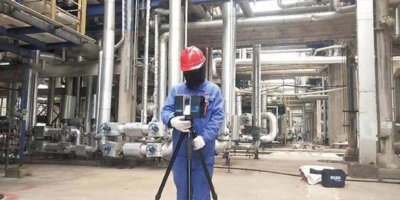
Where does an exhaust or extract duct end, and where does the HEPA or BIBO housing’s own protected scope begin? That boundary decision determines whether a planned intervention on the filter train stays inside the equipment’s safe-change design or drifts into open ductwork that was never built for operator protection or containment during service. Getting the boundary wrong does not show up until the day maintenance actually begins.
Service boundary around the HEPA or BIBO housing
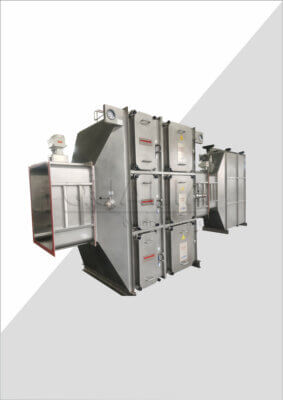
An isolation damper’s function is narrow: it closes a duct section so that a defined length of ductwork, together with the HEPA or BIBO housing inside it, can be treated as isolated from the rest of the exhaust or extract train. That isolation is a prerequisite for safe work, not the work’s protection itself. The housing’s own safe-change features—bag-in/bag-out sleeve, gel-seal filter frame, or equivalent—are what protect the person performing filter removal or replacement at the moment of contact with a potentially contaminated or hazardous filter. The damper decides where the isolated zone starts and stops; it does not decide what happens to the operator once that zone is open for service.
This distinction matters because the two functions are verified differently and fail differently. A damper is checked for seat tightness and position confirmation; a safe-change housing is checked for containment during the bag-change or filter-removal sequence itself. If a project treats damper closure as sufficient justification to open a housing without its own safe-change procedure, the isolation boundary is sound but the operator exposure risk at the point of filter contact is not addressed. Conversely, a housing with excellent safe-change design does not help if the duct section around it cannot be reliably isolated from an active fan or pressure zone, because then the housing opens into a system that is still moving air.
Where the HEPA or BIBO housing serves a hazardous-pharmaceutical exhaust path, WHO GMP for Pharmaceutical Products Containing Hazardous Substances (TRS 957 Annex 3) frames safe-change and BIBO housings as the layer that protects operators during filter replacement, coordinated with differential-pressure monitoring, change-out resistance tracking, and installed leakage-test access. That framing confirms the housing’s role but does not itself define duct layout, damper placement, or a universal pressure limit — those remain project-specific decisions the buyer and supplier work through together.
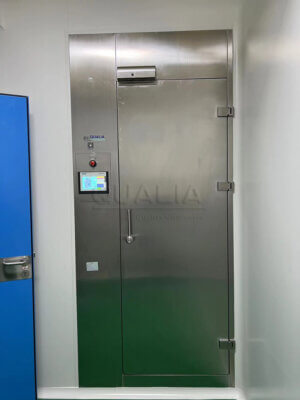
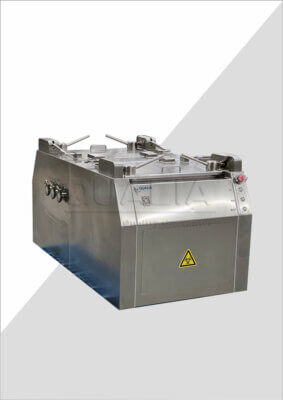
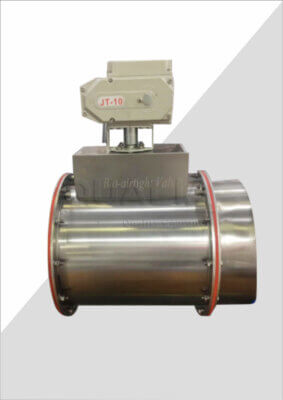
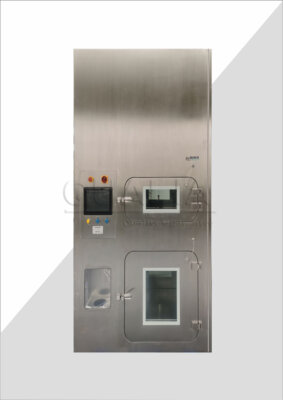
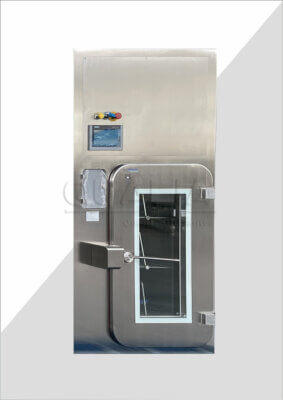
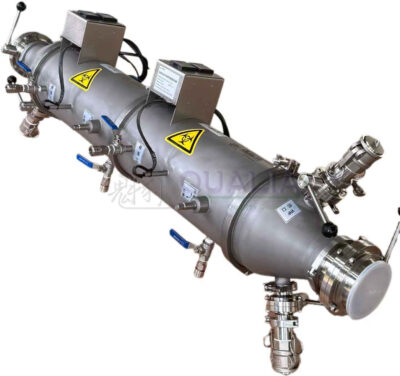
The practical judgment for a buyer is to define, before layout is fixed, exactly which length of duct and which housing the isolation damper is meant to protect, and to confirm separately that the housing’s safe-change features are adequate for the hazard the filter train actually sees. A Clapet d'isolement de biosécurité establishes the boundary; it does not substitute for a Entrée du sac Sortie du sac housing’s own change-out design, and the two should be specified as complementary rather than interchangeable.
Damper sequence during shutdown and filter work
The sequence in which dampers close, a fan is stopped or modulated, and pressure is allowed to settle is where a theoretically correct isolation boundary can still produce an unsafe transient. If a damper closes before the fan response is accounted for, the fan can pull against a closed system and create a pressure spike or reversal in the isolated section — exactly where a technician may shortly be opening a housing. If the fan is stopped before the damper closes, the isolated section may settle to an uncertain pressure state that gives no reliable indication of what is inside the ductwork when work begins.
This is why damper sequencing cannot be treated as a mechanical afterthought to the damper’s selection. The sequence has to be engineered together with the fan control logic and the pressure monitoring that tells the operator the isolated section is actually in a safe state, not just that the damper has reached its closed position. A damper position switch confirms the damper moved; it does not by itself confirm that the pressure or flow condition inside the isolated section is safe for the next step of work.
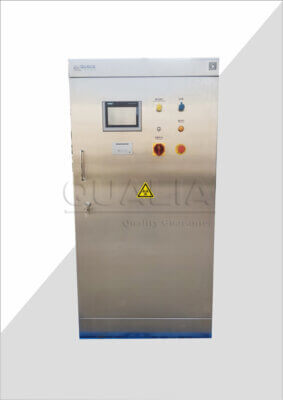
Interlocks exist to prevent the sequence from being executed out of order — for example, preventing a fan from running in a configuration that would leave an isolated section at a pressure state inconsistent with the hazard assessment for that filter train. Work instructions carry the part of the sequence that cannot be enforced by hardware alone: confirming visually or instrumentally that the isolated section has reached and held the intended state before a housing is opened for bag change, inspection, or filter removal.
The condition that changes this judgment is the hazard class and pressure regime the filter train serves. A filter train handling a less hazardous airstream may tolerate a simpler sequence with fewer interlocked steps; a filter train in a hazardous-pharmaceutical or biosafety exhaust path warrants a sequence where each step’s completion is confirmed before the next step is permitted, because an unconfirmed transient in that context has a different consequence than the same transient elsewhere. The buyer’s task before duct layout is approved is to specify which fan and pressure behavior is unacceptable during isolation, and to have the damper, fan control, and interlock logic designed against that specification rather than against the damper’s closing function alone.
Test injection and downstream sampling access
A HEPA installation is only as verifiable as the access built into the duct layout for introducing a test aerosol upstream of the filter and sampling it downstream. Isolation dampers interact directly with this access because the same duct section that gets isolated for filter service is typically the section where injection and sampling ports need to sit. If the damper boundary is drawn without reference to where injection and sampling will physically occur, the isolated section may not include a usable upstream mixing length or a representative downstream sampling point, and the installed leak test becomes harder to execute or interpret.
Differential-pressure monitoring taps face the same coordination problem. A pressure tap placed without regard to the isolation boundary may end up isolated when the system is in service mode, or exposed to ambient conditions when the system is isolated for work — either way giving a reading that does not reflect what the reader needs to know at that moment. The practical consequence is that injection ports, sampling ports, and pressure taps all need to be located with the damper positions already decided, not added afterward to a duct layout that was finalized around the damper alone.
Filter access — the physical clearance and orientation needed to reach the housing for bag change, cartridge removal, or inspection — is the fourth element that has to be reconciled with the same boundary. A damper placed too close to the housing can obstruct the access path a technician needs for safe-change work; placed too far, it can leave more ductwork inside the isolated zone than the hazard assessment intended.
Where the filter train sits in a context like a BSL-3 primary-barrier exhaust path, the CDC/NIH Biosécurité dans les laboratoires microbiologiques et biomédicaux (BMBL) describes HEPA filtration on certain primary-barrier exhaust with filters tested and replaced as part of ongoing operation — a cited context for why installed test access matters, without establishing a complete housing or BIBO standard on its own. The buyer’s task is to bring injection, sampling, pressure monitoring, and filter access into the same layout conversation as damper placement, before the duct design is fixed, rather than treating each as a separate afterthought to be resolved once the main ductwork is drawn.
Decontamination and safe-change coordination
| Service activity or control | Supported role in the service plan | Front de décision |
|---|---|---|
| Amortisseurs d'isolation | Create the defined service boundary around the HEPA or BIBO housing | They do not replace the housing’s safe-change features |
| Bag change | Use the BIBO housing’s safe-change features to protect operators during filter replacement | The supplier procedure must be defined for the actual filter train and hazard assessment |
| Décontamination | Define the decontamination step for the actual filter train and hazard assessment | No universal supplier decontamination procedure is established by the cited sources |
| Inspection and installed leak test | Define inspection and leak-test steps and provide installed leakage-test access | Filter-element classification does not establish installed housing or BIBO maintenance performance |
Decontamination, bag change, inspection, and installed leak testing are distinct activities with distinct evidence requirements, and an isolation damper’s service boundary is the condition that makes each of them possible to perform safely — not the procedure for any of them. Treating the damper as having resolved the service question leaves the actual sequence of decontamination and safe-change work undefined.
A bag change relies on the BIBO housing’s own safe-change features to protect the operator during filter replacement; the isolation damper’s contribution ends at having created the boundary within which that housing can be opened. Decontamination — whatever form it takes for the actual filter train and hazard it carries — has no universal procedure established by filter-element or primary-barrier standards; it has to be defined against the specific hazard assessment for that train. Inspection and installed leak testing depend on access that was planned, as discussed, into the duct layout; ISO 29463-1:2024 establishes classification, assessment, marking, and test-result documentation for the HEPA or ULPA filter element itself, which supports confirming what the filter element is rated to do without establishing how the installed housing or BIBO system performs once in service.
The condition that changes how tightly these activities need to be coordinated is the hazard profile of the material the filter train has handled. Where the airstream carries a hazard requiring decontamination before the housing is opened, the decontamination step has to be sequenced ahead of bag change and completed to a defined endpoint before safe-change work proceeds; where the hazard assessment does not require that sequencing, bag change and inspection may follow a simpler order. Either way, the sequence and its acceptance point are project-specific decisions, not a property of the isolation damper or the housing design alone.
Bringing this to a supplier conversation means presenting the actual filter train configuration and hazard assessment early, because the decontamination step, the bag-change procedure, and the inspection and leak-test plan all depend on that information to be specified rather than assumed.
Restart evidence before the exhaust train returns to service
| Restart evidence to check | What it supports | Ce que cela n'établit pas |
|---|---|---|
| Installed leakage-test result | Evidence from the installed filter test | A filter classification document alone does not establish installed housing performance |
| Filter classification and test-result documentation | The filter element’s classification and documented test result | Installed housing or BIBO maintenance performance |
| Differential-pressure monitoring evidence | The monitored condition used with filter service planning and change-out resistance | A universal pressure limit or damper layout |
| Completion of the defined decontamination, bag-change, inspection, and restart steps | Evidence that the project-specific service plan was completed before return to service | A universal procedure or acceptance outcome beyond the actual filter train and hazard assessment |
Returning an isolated exhaust or extract section to service depends on evidence that answers two different questions: did the installed system perform correctly, and was the defined service plan actually completed. Conflating these two leaves gaps either way.
An installed leakage-test result speaks to the first question — it demonstrates the performance of the filter as installed in its housing, under actual duct and seal conditions, which a filter classification document cannot do on its own. The filter’s classification and test-result documentation, of the kind ISO 29463-1:2024 supports, confirms what the filter element is rated and tested to achieve before installation; it is evidence about the component, not about the installed assembly. Both pieces of evidence are needed because one confirms the part and the other confirms the installation.
Differential-pressure monitoring evidence serves a different purpose again: it is the ongoing condition used alongside filter service planning and change-out resistance tracking, giving a basis for deciding when a filter train is approaching the point where service is warranted, rather than confirming that a specific restart is acceptable.
The fourth category — confirmation that the defined decontamination, bag-change, inspection, and restart steps were actually completed in sequence — is procedural evidence rather than performance evidence. It demonstrates that the project-specific service plan, built around the actual filter train and hazard assessment, was executed as specified. None of these four categories substitutes for another, and a restart decision that relies on only one of them is missing information the others would have supplied.
The condition that governs how much of this evidence a given restart requires is the hazard class of the filter train and the scope of work performed. A train handling a lower-hazard airstream, where only inspection was performed, may rely on a narrower evidence set than one where decontamination and bag change both occurred in a hazardous-pharmaceutical or biosafety exhaust path, where the fuller set — leakage-test result, pressure monitoring trend, and documented completion of each defined step — supports the decision to return the train to service.
Questions fréquemment posées
Q : What must be settled before the duct layout around a HEPA or BIBO housing is approved?
A : Define the service boundary, required damper positions, and access for aerosol injection, downstream sampling, differential-pressure monitoring, and filter work. Confirming these together prevents the duct arrangement from blocking the planned isolation and test activities.
Q : Can isolation dampers replace the safe-change features of a BIBO housing?
A : No. The dampers create the defined service boundary around the housing, while the housing’s safe-change features address operator protection during filter replacement; the service plan must account for both functions.
Q : What should the damper interlock design prevent during filter service?
A : It should prevent an unsafe fan or pressure response while the service section is isolated. Define the project-specific damper sequence, interlock behavior, and related work instructions for the actual exhaust train before maintenance begins.
Q : How should a project define its decontamination and filter-change procedure?
A : Base it on the actual filter train and hazard assessment, then document the required decontamination, bag-change, inspection, installed leak-test, and restart steps. A universal supplier procedure cannot be assumed from the filter classification or the presence of isolation dampers.
Q : Is HEPA filter classification documentation enough to release the installed exhaust train back to service?
A : No. It documents the filter element’s classification and test result, but it does not establish installed housing or BIBO maintenance performance. Keep it distinct from the installed leakage-test result, differential-pressure monitoring evidence, and confirmation that the defined service and restart steps were completed.