
Most fit-up problems with pass box installations are not discovered during design review — they surface during site work, when walls are already closed and sleeve depths are fixed. At that stage, correcting a misaligned flange, an undersupported panel, or a gasket detail that never made it onto the drawing is a construction problem, not a specification conversation. The upstream cause is almost always the same: chamber type, wall integration, and utility allocation were treated as separate decisions resolved by separate disciplines, without a shared moment where position, classification boundary, and maintenance access were confirmed together. The decisions that matter most — where to position the unit, which chamber type is appropriate for the classification boundary, and how interlock type relates to pressure differential need — must be resolved before procurement, because each one constrains the others. Reading through the sections below will give you a structured basis for evaluating those choices at the right project stage.
Transfer path analysis before chamber selection
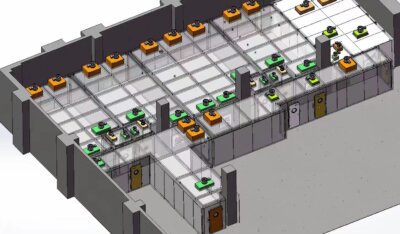
The location of a pass box within the room layout carries more consequence than teams typically assign to it during early design. A unit placed adjacent to the primary workbench or equipment minimizes the movement required to transfer materials and keeps personnel traffic from crossing active work zones. When placement is deferred to a late layout revision, the box often ends up in a wall position that is structurally convenient but workflow-inefficient — creating diagonal foot traffic that increases exposure events and complicates cleaning protocols.
Location is one planning input. What the transfer actually involves is the other. Before a chamber type can be meaningfully specified, four parameters need to be confirmed in writing: the ISO classification on each side of the wall, whether the transfer is a hand-pass or involves a trolley or rack, the expected dwell time of materials inside the chamber, and the throughput volume at peak demand. These are not administrative niceties. Classification on both sides determines whether a static unit is defensible or whether recirculated filtration is required. Dwell time is the variable that most often catches teams off guard — a box specified for quick hand-passes may be used in practice for staged material storage, which changes whether active or dynamic filtration is warranted. Throughput determines whether the interlock and door cycle design can meet demand without creating a bottleneck that pressures operators to prop doors open.
Each of these items should be confirmed before the equipment is quoted, not during submittal review.
| Planning Item | Ce qu'il faut confirmer | Pourquoi c'est important |
|---|---|---|
| Pass box location | Place adjacent to high-use equipment; avoid cross-traffic and personnel congestion. | Prevents workflow inefficiency and cross-contamination from unnecessary movement. |
| Cleanroom classification (both sides) | Document ISO class of each adjacent room. | Determines required chamber type and boundary protection level. |
| Transfer method and load | Clarify manual hand-pass or trolley/rack transfer. | Impacts chamber size, floor flushness, and structural support needs. |
| Material dwell time | Estimate typical and maximum time materials remain inside chamber. | Influences whether active or dynamic filtration is warranted. |
| Throughput volume | Define transfers per hour and peak-hour load. | Ensures interlock and door cycle design can meet demand without creating bottlenecks. |
Skipping this review does not just produce a mismatched chamber selection. It produces a chain of downstream corrections: a unit that is too small for trolley loads requires a second specification cycle; a static box installed at an ISO boundary where pressure differentials matter requires replacement or supplemental engineering; a poorly positioned unit generates the kind of cross-flow traffic that was meant to be eliminated. The cost of resolving those issues after procurement is consistently higher than the cost of a structured pre-specification review.
Wall and panel details that affect clean integration
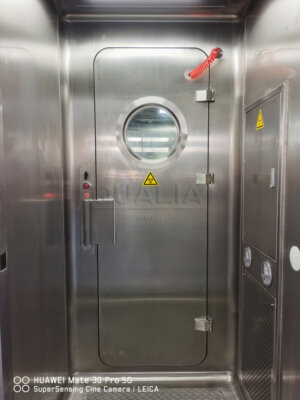
Wall integration details are where specification gaps most reliably become construction problems. The connection between a pass box and its surrounding panel system requires three things to hold the clean boundary: a sealed gap at the perimeter, adequate structural support for the unit’s weight, and interior surfaces that can be cleaned without trapping contamination. When any of these is unresolved at the time of installation, the result is not a minor aesthetic tolerance issue — it is a contamination pathway at the one point in the envelope that is opened repeatedly during operations.
The flange-to-wall seal is the most common failure point. Sleeve depth must match actual wall thickness. If the sleeve is specified off a standard drawing without field verification, the flange either sits proud of the surface — leaving a gap behind it — or bottoms out before the cabinet is flush, creating a ledge that traps particulates and resists cleaning. Sandwich panel walls present an additional structural issue: they are not always capable of bearing the static load of a mounted pass box without local deformation, which is why support stands are a required design element for thin-panel assemblies, not an optional upgrade. Deformation of the panel at the mounting perimeter breaks the seal geometry even if the flange was initially correct.
The interior chamber details follow the same logic. A floor lip — even a small one — becomes a cleaning trap in a regulated environment and creates a transfer barrier for carts or racks. Hard-edge door gaskets perform more predictably over repeated open-close cycles than soft wiper-style seals, which shed particles as they degrade. These are fit-up and process-level specifications that need to be on the drawing before the wall is built.
| Integration Detail | Ce qu'il faut spécifier | Risk if Neglected |
|---|---|---|
| Wall opening sealing | Use flanges to seal the gap; confirm sleeve depth matches wall thickness. | Fit-up gaps lead to seal compromises and contamination leakage across the boundary. |
| Panel load capacity | Provide support stands when wall panels are thin (e.g., sandwich panels). | Pass box weight can deform panels, breaking the clean barrier. |
| Chamber floor profile | Specify flush cabinet floor with no lip. | Crevices trap contamination and complicate cleaning, endangering classification. |
| Door gasket detail | Require hard-edge door gaskets; avoid soft wipers that degrade. | Prevents particulate shedding and maintains seal integrity over repeated cycles. |
The consequence pattern, when these details are left open, is not immediately obvious. The initial installation looks acceptable. The problem emerges during qualification or routine cleaning audits, when the gap behind the flange is identified as a potential contamination pathway, or when a degraded gasket is found to be shedding. Retrofitting a correct flange seal or replacing a gasket type after the wall is closed requires partial deconstruction of the panel joint — work that is far more disruptive than specifying it correctly the first time. The clean boundary at the pass box opening is only as strong as the least-resolved integration detail in that wall segment.
Chamber types matched to cleanroom risk levels
The most consequential chamber-type decision is whether the pass box carries its own filtration or depends on the facility. That dependency determines whether the unit can maintain its internal classification during a transfer, and what happens when conditions on either side of the wall change.
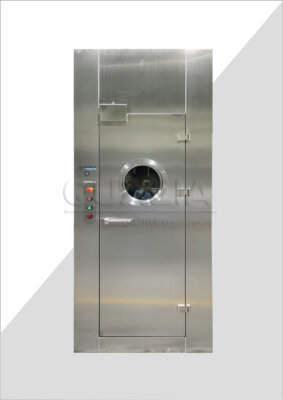
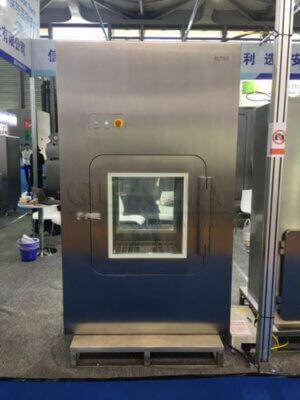
A static pass box — interlocked doors, no active filtration, cleanable interior — is appropriate when both adjacent rooms share the same ISO classification and no pressure differential needs to be maintained across the opening. The interlock prevents both doors from being open simultaneously, which limits direct air communication, but it does not actively restore cleanliness inside the chamber between uses. If material dwell time is short and both rooms are ISO 7 or ISO 8, that is often sufficient. The failure mode occurs when a static unit is installed at a boundary between differing classifications: the interlock alone cannot hold the pressure relationship, and contaminants carried in with materials from the lower-classification side are not removed before the inner door opens.
Semi-active designs introduce a supply connection from the facility HVAC system to maintain cleanliness inside the chamber, with HEPA filtration optional. These are appropriate when the facility can sustain the pass box’s internal classification through its own airflow and when a duct connection is available at the installation location. The dependency is real: if the HVAC system serving the box is isolated, upgraded, or rebalanced, the pass box’s cleanliness assumption changes. That dependency needs to be documented during design, not discovered during a commissioning survey.
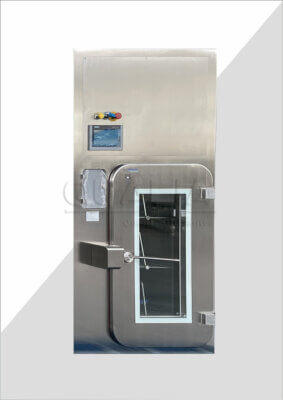
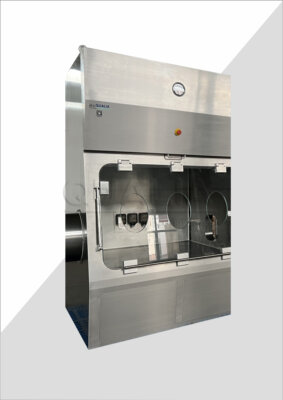
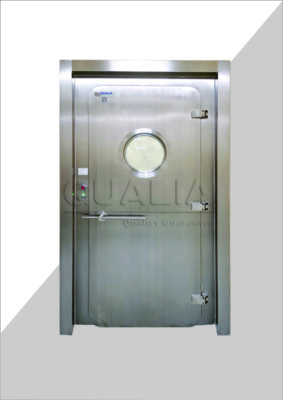
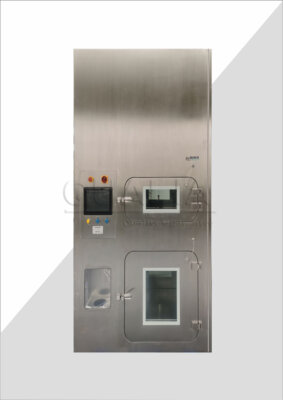
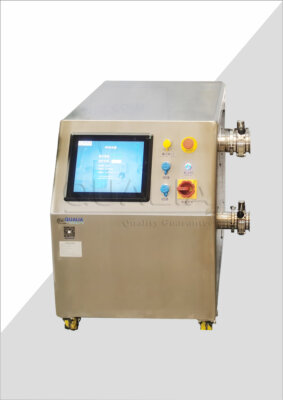
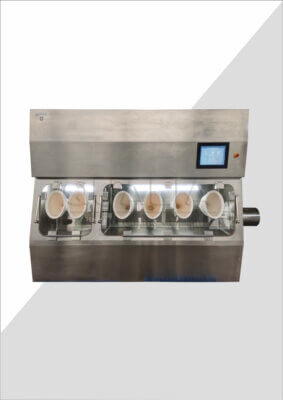
Active units — self-contained fan filter units with HEPA and positive overpressure — address the HVAC dependency by providing independent filtration. They are a practical choice for ISO 6–7 targets when a dedicated duct connection is not available or when future flexibility is valued. Dynamic pass boxes go further by recirculating air through HEPA continuously, which makes them appropriate for ISO 5–7 applications and for any transfer involving extended material dwell time. The recirculation means cleanliness inside the chamber is maintained even when both doors are closed between uses, which passive and semi-active designs cannot guarantee.
| Chamber Type | Applicable ISO Range | Key Features & Dependencies | Quand utiliser |
|---|---|---|---|
| Statique | ISO 7–8 | Interlocked doors, no active filtration, cleanable interior. | Transfers between rooms of identical cleanliness; no pressure differential needed. |
| Semi-actif | ISO 7–8 | HEPA optional; relies on ducted HVAC supply from facility. | When facility HVAC can maintain pass box cleanliness; requires duct connection. |
| Active (FFU + HEPA) | ISO 6–7 | Self-contained fan filter unit with HEPA and overpressure; no facility HVAC needed. | When dedicated HVAC connection is unavailable but ISO 6–7 cleanliness is required. |
| Dynamic (recirculated HEPA + monitoring) | ISO 5–7 | Recirculated HEPA filtration, differential pressure monitoring; stand-alone boundary. | Extended dwell times; transfers between differing cleanliness levels, including non-cleanroom to cleanroom. |
| Aseptic (welded body) | ISO 5 and aseptic zones | Full welded body with smooth radius corners; integrated HEPA filtration. | Aseptic manufacturing where particle traps must be eliminated. |
For aseptic manufacturing environments, the chamber construction itself becomes a specification variable. Smooth-radius, fully welded interiors eliminate the crevices and joints that collect particles, and they are necessary where classification demands it — not as a general upgrade applicable to any installation. The practical implication is that chamber type selection is not a single axis of choice. It is the intersection of classification boundary, HVAC availability, dwell time, and whether the application is aseptic. Teams that flatten that into a binary static-versus-dynamic decision tend to either over-specify for lower-risk areas or, more consequentially, under-protect classification boundaries where recirculated filtration and differential pressure monitoring were actually required.
Coordination items among architecture MEP and equipment teams
The items that reliably cause installation delays are not the ones that show up in equipment submittals — they are the ones absent from the first layout issue. Access for filter replacement, service panel clearance, and duct connection geometry tend to be discovered at construction coordination meetings rather than resolved in early design, which means they arrive as constraints against an already-fixed layout rather than as inputs into it.
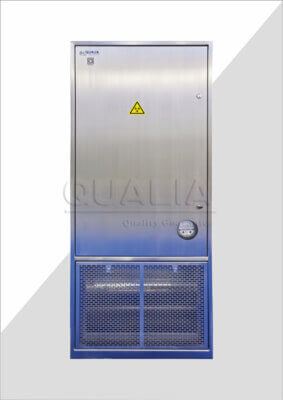
Filter maintenance requirements establish minimum clear space around the unit that must be allocated in the room layout. Pre-filters at roughly G4 grade typically need replacement on a six-month cycle; HEPA filters on a six-to-twelve-month cycle depending on loading. That is a physical access requirement, not an abstract maintenance note. If the pass box is installed flush in a corridor wall with no service-side clearance, filter access requires either partial disassembly of adjacent panels or a maintenance interruption that was not factored into the facility’s operating schedule. Neither outcome is necessary if access dimensions are confirmed during architectural coordination.
For dynamic pass boxes, HEPA integrity requires more than visual access — DOP or PAO test ports need to be physically accessible with test equipment, and a differential pressure gauge must be present and readable for ongoing monitoring. These are validation and compliance requirements that should be treated as mandatory features at specification, not optional add-ons reviewed at submittal. The WHO Laboratory Biosafety Manual (4th edition) frames ongoing monitoring of filtration performance as part of continuous containment assurance, which supports treating these features as inherent to the design intent rather than negotiable.
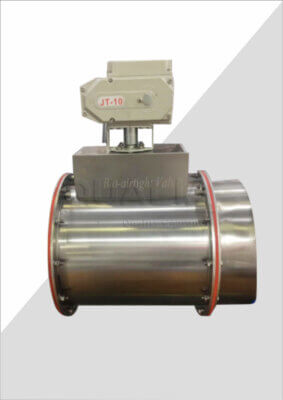
UV-C germicidal lamp replacement, where decontamination capability is part of the specification, follows a roughly 4,000-hour service interval. That interval needs to appear in the facility’s maintenance schedule before commissioning, not after the first lamp failure reveals it was never planned for. Power allocation follows a parallel logic: dynamic and active pass boxes require dedicated circuits for fan motors, and semi-active units require ducted HVAC connections. Both are utility commitments that must appear in the MEP design. When they are confirmed late — after panel schedules and duct routing are finalized — they require rework that is disproportionately expensive relative to early resolution.
| Coordination Item | Ce qu'il faut confirmer | Pourquoi c'est important |
|---|---|---|
| Filter maintenance access | Plan G4 pre-filter replacement every 6 months, HEPA every 6–12 months; ensure access space around pass box. | Avoids unplanned downtime and maintains continuous filtration performance. |
| HEPA integrity testing | Confirm dynamic pass boxes include DOP/PAO test ports and a differential pressure gauge. | Required for validation and ongoing compliance of containment. |
| UV-C lamp replacement | Schedule lamp replacement at approximately 4,000 operating hours. | Prevents loss of decontamination capability from unexpected lamp failure. |
| Raccordements aux services publics | Allocate dedicated power for dynamic/active fan motors; provide ducted HVAC supply for semi-active units. | Prevents utility mismatch at installation that causes delays and rework. |
| Optional features | Specify door interlock timers, LED lights, magnehelic gauges, ATEX-rated versions early in design. | Late specification triggers coordination changes and potential integration issues. |
Optional features — interlock timers, magnehelic gauges, LED lighting, ATEX-rated construction — should be specified at the beginning of the design phase, before the equipment is quoted. Not because they are difficult to add individually, but because each one affects integration scope. An ATEX-rated unit, for example, has different utility and installation requirements than a standard unit. Discovering that requirement after procurement produces a specification change, a new submittal cycle, and a coordination adjustment that will delay installation.
Boundary protection needs as the integration threshold
An interlocked pass box controls physical access to one door at a time. It does not manage pressure differentials, remove particles introduced during a transfer, or restore the chamber’s internal classification between uses. For transfers between rooms of identical cleanliness with short dwell times, that may be adequate. For transfers across differing ISO zones, it is not — and conflating the two scenarios is where the most consequential boundary-protection errors occur.
The interlock type is a related but distinct decision. Mechanical interlocks operate without power and maintain fail-safe integrity during power loss. They require no sensors or control logic, which means their maintenance burden is low and their failure mode — physical jamming — is immediately visible. Electronic interlocks enable timed sequencing, remote status monitoring, and integration with building management systems, but they require power and periodic testing of sensors, wiring, and control logic. If an electronic interlock fails open — allowing both doors to be operated simultaneously — the result is a direct pressure connection between adjacent zones, which can cause a cleanroom classification loss and trigger a facility shutdown until the event is investigated and the classification is re-verified. That failure mode should not be treated as a likely outcome, but it justifies treating interlock selection as a safety-critical decision rather than a hardware preference.
| Fonctionnalité | Verrouillage mécanique | Verrouillage électronique |
|---|---|---|
| Operation principle | Purely mechanical; one door physically blocks the other. Inherent fail-safe. | Electrically controlled; sensors and actuators sequence door opening. |
| Fail-safe characteristic | Fail-safe without power; interlock integrity maintained during power loss. | Requires power and programming; may need backup to achieve fail-safe state. |
| Maintenance requirement | Maintenance-free mechanical operation under normal use. | Requires periodic testing of sensors, wiring, and control logic. |
| Integration capability | No remote status or timed sequencing. | Enables timed sequencing, remote status, and BMS integration. |
| Risk if malfunction | Physical jamming may prevent door opening. | Sensor or logic failure could allow both doors to open, causing pressure loss and potential cleanroom shutdown. |
The threshold that changes the recommendation is a classification boundary with a differential pressure requirement. Once a transfer crosses between zones that must maintain a measurable pressure relationship — ISO 5 to ISO 7, for example, or a non-cleanroom anteroom to a classified space — a mechanical interlock alone is not a sufficient boundary. The pass box itself must maintain the differential, which requires recirculated HEPA filtration, a differential pressure gauge, and a design that holds the pressure relationship even with both doors closed. That is the design condition that makes a dynamic pass box with integrated monitoring the appropriate selection rather than an upgrade from a static unit. It is also the condition that makes interlock type and chamber type a combined boundary-protection decision: the interlock manages access sequencing, but the chamber design is what actually sustains the clean boundary between transfers.
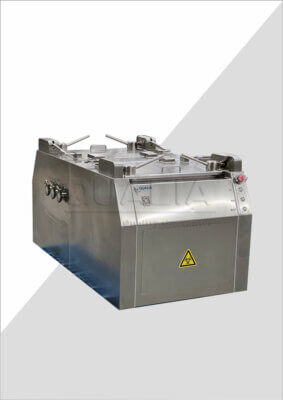
For applications at that threshold, the Boîte de sécurité biologique is a relevant equipment category — designed specifically for containment-critical boundaries where passive interlock alone is insufficient and differential pressure integrity must be maintained continuously. Additional context on how biosafety-rated pass boxes function in practice is available in this application overview.
The decisions in this article interact in a specific direction: position and transfer path define what the boundary condition actually is; the boundary condition determines whether active or dynamic filtration is required; filtration requirement drives utility allocation; and all of those dependencies need to be resolved before wall construction begins, because each one left open at that stage becomes a constraint that the next discipline discovers too late to absorb without rework. The most useful pre-procurement check is to confirm, in a single document, the ISO class on each side of each proposed pass box location, the transfer method and peak throughput, the HVAC availability at each location, and the maintenance access envelope available around each installed unit. If any of those four items cannot be answered before specification, the specification is premature — and the cost of that gap will appear somewhere later in the project, at a stage where it is harder and more expensive to correct.
Questions fréquemment posées
Q: What happens if the cleanroom uses a modular or demountable wall system instead of a fixed panel — does the integration approach change?
A: Yes, significantly. Demountable and modular wall systems typically cannot bear the static load of a mounted pass box without dedicated sub-framing, and their joint geometry may not accept a standard flange seal without custom adapter plates. The sleeve depth, flange bearing surface, and support structure all need to be designed around the specific modular system in use, not carried over from a fixed-panel specification. Confirming the wall system’s structural capacity and joint tolerances before the pass box is specified prevents the most common fit-up failure in modular cleanroom builds.
Q: Once the pass box is installed and qualified, what is the first operational failure to watch for?
A: Differential pressure drift is the earliest and most reliable indicator that something has changed — either a filter is loading, a seal has degraded, or an interlock is not cycling correctly. For dynamic pass boxes, the differential pressure gauge should be read and logged at a defined interval from the first week of operation, not only during scheduled maintenance visits. A gauge reading that shifts outside the validated range before the next scheduled filter service is a signal to investigate before classification integrity is compromised, rather than after a deviation event is filed.
Q: Is an air shower a reasonable alternative to a dynamic pass box when the transfer involves personnel carrying materials rather than an unaccompanied load?
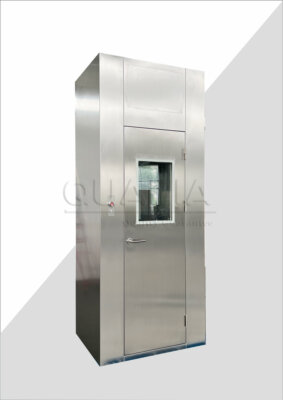
A: They address different contamination vectors and are not interchangeable. An douche à air removes surface particles from personnel and garments through high-velocity impingement — it is a personnel decontamination step, not a material transfer boundary. A dynamic pass box controls the air environment around the transferred material itself and maintains the pressure relationship between adjacent zones. When the transfer involves personnel carrying materials, both may be required in sequence: the air shower for the person, the pass box for the material. Substituting one for the other leaves either the personnel contamination pathway or the material transfer boundary uncontrolled.
Q: At what point does the project justify moving from a pass box solution to a full transfer isolator or airlock module?
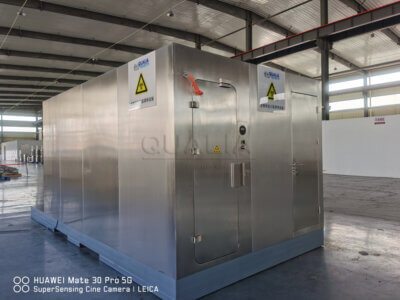
A: The threshold is when the transfer itself must remain within a controlled, unbroken containment envelope rather than crossing a boundary that is temporarily opened and resealed. A pass box, even a dynamic one with differential pressure monitoring, involves two doors and two boundary crossings within a single chamber. When the material being transferred is highly potent, capable of aerosolization, or classified at BSL-3 or BSL-4 containment levels, that sequential-door model is no longer sufficient — the transfer must occur within a sealed system that never allows the material to be exposed to an intermediate uncontrolled volume. At that threshold, a modular laboratory infrastructure designed for biosafety containment replaces the pass box as the transfer architecture.
Q: If the facility HVAC is rebalanced or extended after installation, does a semi-active pass box need to be re-qualified?
A: Yes. A semi-active pass box depends on the facility’s supply airflow to maintain its internal classification, so any change to the HVAC system serving that wall segment — rebalancing, added branch loads, or system extension — changes the flow conditions the pass box was qualified against. The original validation assumption ties cleanliness performance to a specific supply volume and pressure relationship. If those parameters shift, the unit’s ability to maintain its specified ISO class is no longer verified, and a re-qualification scope covering airflow, particle counts, and differential pressure should be initiated before the modified HVAC configuration is formally accepted.