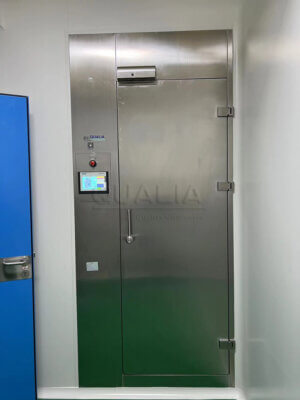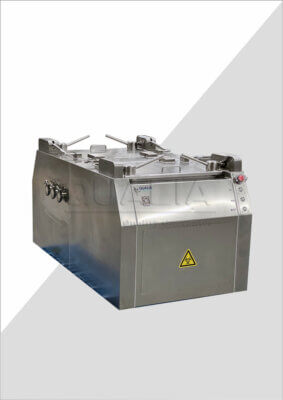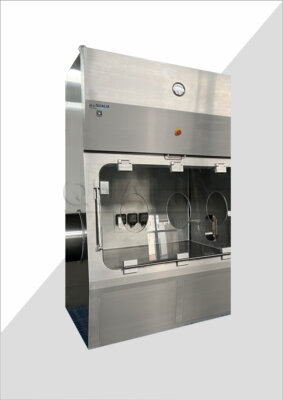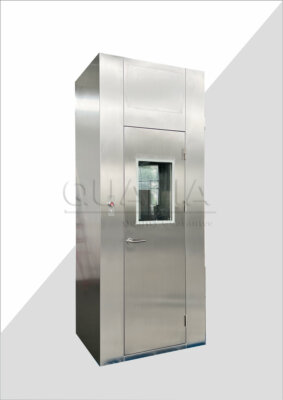

When a pass box interlock faults or a pressure alarm trips, the immediate question is not how to clear it but what the fault is actually telling you. Resetting the control before that question is answered can clear a nuisance signal, or it can release a load across a boundary that was never confirmed safe. The decision belongs to whoever is accountable for the material transfer, not to whoever reaches the panel first.
Secure the load and capture the alarm state before touching controls
The first judgment is whether to act on the alarm or to pause and record it. Repeated reset attempts compress the evidence a later investigation would need, because each reset can change door position, cycle state, or controller memory before anyone has written down what the equipment was doing when the fault occurred. Securing the load means leaving it in its current chamber or position rather than moving it in response to the alarm, since movement itself can be the action that converts an ambiguous signal into a real contamination or containment event.
The condition that changes this judgment is what the pass box is separating. Where the transfer sits between two spaces of differing cleanliness grade, an unresolved door or pressure fault raises a product-protection question about what crossed, or could cross, the boundary while the fault condition existed. Where the transfer involves a hazardous or biological boundary, the same fault raises a containment question about operator and environment exposure instead. Both situations call for the same first step — stop, record, do not reset — but the risk being protected against differs, and that difference will shape which stakeholders need to review the event before service resumes.
Recording the alarm state means noting what the display or log shows at the moment of failure: which door the alarm references, whether a pressure deviation or a lock/position fault is indicated, and what cycle step was active. This record becomes the input to every later check, because comparing a later reading to an unrecorded starting condition tells the investigator nothing. If the pass box integrates with a VHP decontamination cycle, the cycle status at the time of fault also matters, since a fault mid-cycle leaves open whether the decontamination step completed, which affects how the load is later dispositioned.
This stage produces no conclusion about whether the fault is instrument error or a genuine boundary upset. It only ensures that the evidence needed to distinguish the two is still intact when someone begins that diagnosis.
Confirm both door positions, lock feedback, cycle state, and release command
| State to check | Evidence to record | Diagnostic use |
|---|---|---|
| Door position | Actual position of each door and the position shown by the controls | Check position sensing or door-state feedback when they disagree |
| Lock feedback | Lock indication for each door compared with the observed door state | Check for a mechanical, sensor, or control-logic fault when they disagree |
| Cycle state | Displayed cycle status when the alarm occurred | Preserve the cycle context in which the interlock or alarm failed |
| Release command | Release command shown or issued compared with the corresponding door and lock response | Check the command, communication, control-logic, or mechanical response path |
Once the load and alarm state are secured, the next task is reconciling what the equipment is actually doing against what the controls report it is doing. A pass box interlock exists specifically to prevent both doors from opening together, so the starting assumption in any fault investigation is that one of four things has broken: the physical door state, the sensor that reports that state, the logic that interprets the sensor, or the command path that acts on the logic’s conclusion. These are different fault classes with different consequences, and conflating them leads to the wrong corrective action.
A door that is physically closed but reported open points toward a position-sensing or feedback problem rather than a mechanical interlock failure. A door that opens despite a closed-and-locked indication points the other way, toward a mechanical or control-logic fault that is more serious because it means the interlock itself did not perform its function. The distinction matters because the first case may allow continued use under compensating controls while the second does not, since an interlock that fails to prevent simultaneous opening has failed at its core purpose regardless of what any other display shows.
Lock feedback is a separate signal from door position, and the two should agree. Where they disagree, the fault could sit in the lock mechanism, in the sensor reporting lock state, or in the control logic reconciling the two signals — each requiring a different corrective path. Cycle state matters because an interlock or pressure fault that occurs during an active decontamination or transfer cycle has different implications than one occurring at idle; the cycle context tells the investigator what the equipment was attempting to do when the fault interrupted it.
The release command deserves separate scrutiny from the physical outcome. A command can be issued correctly by the controller and still fail to produce the correct door or lock response, which points to a mechanical or communication fault downstream of the logic. Or the command itself can be wrong, which points upstream to the control logic or to whatever input triggered it. Testing where the command was issued against where the response did or did not occur narrows the fault to a specific segment of the control chain rather than leaving the investigation to guess at the whole system.
Test pressure sensing, airflow, seals, utilities, and communications in sequence
| Check area | Evidence to compare or record | Decision boundary |
|---|---|---|
| Pressure sensing | Local gauge or status indication and the independent room or barrier monitor, where available | One failed signal alone does not establish that pressure is safe |
| Airflow | Available airflow indication and alarm state | Apply the site’s criteria rather than assuming a universal pressure setpoint |
| Door seals | Seal condition together with door position and lock feedback | Keep a seal-related boundary issue in the investigation until supported checks exclude it |
| Utilities | Utility status at the alarm and cycle state | A utility interruption remains a distinct possible fault class |
| Communications | Local indication compared with the communicated or controller status | A mismatch supports communication investigation but does not establish boundary safety |
With door and lock states reconciled, the investigation moves to the subsystems that could produce a pressure alarm independent of door behavior. Working through these in sequence, rather than jumping to whichever seems most likely, avoids the common error of fixing a sensor while a seal or utility issue remains the actual source of the pressure deviation.
Pressure sensing should never be judged from a single indication. Where the pass box or its surrounding room has an independent monitor separate from the local gauge or display, comparing the two tells the investigator whether the local reading can be trusted. A local sensor can fail while the independent monitor continues reporting correctly, and the reverse is also possible. Treating either single source as sufficient proof of safe pressure, without the comparison, risks releasing a load on the strength of a faulty instrument.
Airflow checks depend on what indication the installation actually provides; not every pass box has airflow instrumentation separate from pressure sensing, so the available evidence — and the criteria the site has defined for acceptable airflow — governs what conclusion can be drawn here, rather than an assumed universal figure.
Door seals interact directly with pressure behavior. A seal that is compressing unevenly, contaminated, or displaced can produce a pressure signature indistinguishable at first glance from a sensor fault, which is why seal condition should be checked alongside door position and lock feedback rather than treated as a separate, later concern. A seal-related cause should stay under consideration until the sensing and logic checks have positively excluded it, not simply because no one has looked.
Utility status — whatever services the pass box depends on for its decontamination or ventilation function — can produce a pressure or cycle fault that has nothing to do with the interlock hardware at all. An interruption at the exact moment of the cycle can present identically to a sensor fault on the display, so utility state at the time of the alarm is worth recording even when the immediate suspicion points elsewhere.
Communications checks close the sequence: where the local display disagrees with what a connected building management or monitoring system reports, that mismatch is itself diagnostic information pointing toward a communication fault, distinct from — and requiring separate resolution from — any of the mechanical or sensing issues above.
Distinguish a failed instrument from a real boundary upset
| Evidence pattern | Supported interpretation | Safe decision limit |
|---|---|---|
| Local pressure indication conflicts with the independent room or barrier monitor | An instrument, signal, or communication fault may be present | The disagreement does not prove that pressure is safe |
| Local and independent indications both show a condition outside the site-defined criteria | The evidence supports treating a real boundary upset as possible | Use the site’s applicable criteria and recovery process rather than a universal setpoint |
| Independent indication is unavailable or the evidence is inconclusive | Instrument failure and boundary upset cannot yet be distinguished | Missing evidence does not support reset, bypass, or manual release |
The checks above exist to answer one question: did the boundary actually fail, or did only the evidence about it fail? These are different outcomes requiring different responses, and the difference turns entirely on what the local and independent indications show when compared against each other.
Where a local pressure indication conflicts with an independent room or barrier monitor, the conflict itself is informative — it tells you an instrument, signal, or communication fault may exist somewhere in the chain — but it does not resolve which side is correct. Treating the independent monitor as automatically authoritative, without further investigation, assumes a reliability that the conflict itself calls into question. The disagreement needs resolution, not selection of whichever reading is more convenient.
Where both the local and independent indications agree that conditions sit outside the site’s defined acceptance criteria, the evidence supports treating this as a real boundary upset rather than an instrument artifact. This is the condition under which recovery steps, rather than simple sensor troubleshooting, become the appropriate response. The criteria that define “outside acceptable range” are the site’s own, established for that equipment and that application; there is no universal pressure setpoint that applies across aseptic and containment contexts alike, because the two objectives are protecting against different consequences.
The more difficult condition is when an independent monitor is unavailable, or when the comparison remains inconclusive even after the subsystem checks. In this case, the evidence does not support concluding either that the fault is purely instrumental or that a real boundary upset occurred. This is a genuinely open state, and the correct response to an open state is not to proceed as though the more convenient interpretation were established. Missing or inconclusive evidence does not justify reset, bypass, or manual release; it justifies treating the boundary as unconfirmed until further evidence — whether a secondary check, a different instrument, or an engineering assessment — resolves the ambiguity. Projects configuring pass boxes with independent monitoring in addition to local indication reduce how often this ambiguous condition arises, which is itself a configuration decision worth raising during project review rather than discovering during a fault.
Authorize bypass or manual release through the site’s deviation process
| Required element | Decision to document | Control before release |
|---|---|---|
| Authorized risk decision | Whether bypass or manual release is justified under the site’s deviation process | Record the authorized decision before action |
| Load disposition | How the secured load will be handled | Document the disposition rather than assuming the load remains acceptable |
| Boundary recovery | Which site-defined steps will restore the boundary after release | Define the recovery steps before manual release |
| Return-to-service test | Which functional checks and predefined acceptance criteria will govern restoration | Document the test and criteria before service is restored |
Once the investigation has characterized the fault, the question becomes whether to release the load without the interlock or alarm having cleared normally. This is not a technical decision alone; it is a risk decision that belongs to the site’s deviation process, because it involves accepting a defined risk in exchange for recovering the load or restoring equipment availability.
The authorization decision should be made and recorded separately from the technical diagnosis, even though the diagnosis informs it. A conclusion that the fault is instrument-related, reached through the comparisons described above, supports — but does not by itself constitute — authorization to bypass. The authorization step requires someone with the appropriate responsibility to weigh that technical conclusion against the specific consequences of being wrong, and to record that weighing explicitly.
Load disposition is a distinct decision from the bypass authorization itself. A load that has been secured during an unresolved fault may need to be rejected, re-processed, re-tested, or released, depending on what the fault investigation established about whether the boundary held during the fault window. This decision does not follow automatically from permission to bypass the interlock; bypassing the control to retrieve the load is a different question from what should then happen to that load, and treating them as the same decision risks skipping the disposition question entirely.
Boundary recovery steps need to be defined before the release occurs, not improvised afterward. What specifically restores the boundary — whatever actions the site has defined as applicable to the fault category identified — should be known and documented as part of the authorization, so that the bypass does not simply trade an unresolved alarm for an unresolved recovery.
Finally, the return-to-service test and its acceptance criteria should be defined at the point of authorization, not left for later. EudraLex Annex 15 frames predefined acceptance criteria and documented deviation investigation as the basis for concluding whether a system can return to service; applying that logic here means the criteria for functional recovery are set before the manual release occurs, not reverse-engineered afterward to match whatever the equipment happens to do. A deviation record that documents the risk decision, load disposition, recovery steps, and test criteria together — rather than only the fact that a bypass occurred — gives the next stage something to verify against.
Restore service only after functional checks and documented load disposition
| Release gate | Evidence to document | What the gate establishes |
|---|---|---|
| Failure investigation | Investigated fault category and conclusion | The failure has been investigated rather than cleared only by repeated reset attempts |
| Functional checks | Interlock and pressure-alarm results against predefined acceptance criteria | The tested functions meet the site-defined criteria |
| Boundary recovery | Completion of the authorized recovery steps | The planned boundary recovery has been carried out |
| Load disposition | Documented decision for the secured load | The load has an explicit disposition separate from equipment release |
| Deviation conclusion | Recorded deviation, investigation outcome, and conclusion against the criteria | The return-to-service decision has a documented basis |
Returning the pass box to normal operation is a distinct step from authorizing the bypass, and conflating the two risks treating permission to act as equivalent to confirmation that the system is fit for continued use. The gate for restoring service should require evidence, not simply the passage of time since the fault.
The failure investigation needs a stated conclusion, not just a cleared alarm. An interlock or pressure fault that disappears after a reset, without an identified cause, has not been investigated — it has been masked. Where the cause remains unidentified, the risk that produced the original fault remains present and can recur under the same conditions, which is why a documented investigated fault category, even a provisional one, is part of what justifies returning to service.
Functional checks of the interlock and pressure alarm against the site’s predefined acceptance criteria confirm that the specific function which faulted now performs correctly, rather than confirming only that the alarm is silent. These checks should test the actual function that failed — door interlocking, pressure alarming, or both — rather than a general operability check that could pass while the specific fault condition remains latent.
Boundary recovery, as planned during authorization, needs confirmation that it was actually completed, not just scheduled. And load disposition needs its own explicit, documented decision, separate from the equipment’s return to service; a load can require a different disposition than the equipment it passed through, and treating the two as a single sign-off risks losing track of which decision covers which risk.
The deviation record that ties these together — investigation conclusion, functional check results, recovery completion, and load disposition, each measured against the criteria the site defined for this fault — is what gives the return-to-service decision a documented basis rather than an assumed one. Where the pass box is a biosafety pass box protecting a containment boundary or a VHP pass box tied to a decontamination cycle, the specific acceptance criteria and recovery steps will differ according to which objective governs that equipment, which is why those criteria need to be defined for the specific unit and application during project configuration, not assumed generically across pass box types.
Frequently Asked Questions
Q: Should an operator keep resetting an interlock or pressure alarm to see whether it clears?
A: No. Secure the load and stop repeated reset attempts until the alarm state, actual door positions, pressure indications, and cycle status have been recorded. A cleared alarm alone does not replace failure investigation or establish that the transfer boundary is ready for use.
Q: What should be done when the pass box display and an independent room or barrier monitor disagree?
A: Treat the boundary condition as unresolved. Record both readings, then investigate the instrument, signal, and communication paths; neither indication by itself should be used as proof that pressure is safe.
Q: Can a manual release be used when the transfer is urgent?
A: Only after an authorized risk decision under the site’s deviation process. The decision should define the load disposition, boundary recovery steps, and the functional checks and predefined acceptance criteria required before return to service.
Q: Does fixing the equipment fault automatically release the material inside the pass box?
A: No. Equipment release and load disposition are separate decisions. Document how the load will be handled using the recorded cycle status, boundary evidence, and the site’s applicable deviation process.
Q: What information should be prepared before the fault is handed to maintenance or quality personnel?
A: Provide the original alarm state, actual and displayed door positions, lock feedback, cycle state, release command response, local and independent pressure indications, and the status of airflow, utilities, seals, and communications. This gives the investigation a defined starting point and helps identify where observed and reported states stop agreeing.
Q: Is there one pressure or alarm value that can be used for every recovery decision?
A: No universal value is supported for every biosafety or aseptic application. Apply the site’s predefined criteria for the relevant room, barrier, process, and qualification context, and document the conclusion against those criteria.