
Qualification failures in VHP validation rarely trace back to the generator itself. They trace back to decisions made weeks earlier — about packaging materials, utility connections, and protocol scope — that only surface as problems when an OQ run aborts mid-cycle or an auditor asks for a cycle interrupt test record that doesn’t exist. The cost is not just a failed run; it is a full protocol reset, repeat BI procurement, and, in regulated environments, a deviation event that requires quality unit review before any work can resume. Getting the IQ documentation right before commissioning begins, and understanding exactly which load and environmental variables must be controlled during OQ, is what separates a three-run qualification from a six-run one.
IQ: Generator Specification and Utility Verification
IQ is not a formality that precedes the real validation work — it is the document that makes every downstream OQ and PQ result defensible. If the generator installed on-site does not match the model and serial number in the approved specification, or if a utility connection falls outside tolerance, any qualification data collected before that discrepancy is corrected becomes suspect and may need to be voided.
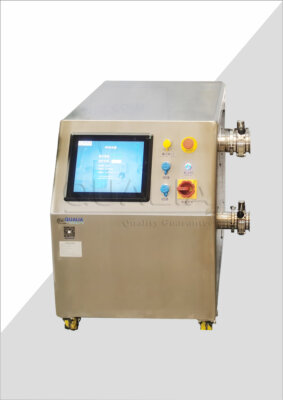
A VHP generator requires only four utility inputs to operate: electrical supply, compressed air, water, and sterilant. That simplicity makes single-skid installation practical, but it also means there are no redundant systems to absorb measurement errors. Each of those connections must be documented against a specific acceptance criterion before commissioning begins. Electrical supply voltage must be measured at the connection point and confirmed within ±5% of rated voltage. Compressed air pressure must be verified at the air inlet against the manufacturer’s specified range. Drain line material must be confirmed compatible with hydrogen peroxide — degradation or corrosion at the drain is a contamination and containment risk that can invalidate the installation.
The logic for verifying these connections before any cycle runs is not procedural caution. It is that OQ concentration data is only interpretable if the generator was operating within its specified utility envelope when that data was collected. An electrical supply running outside ±5% tolerance during OQ creates an ambiguity: was the concentration deviation a function of load configuration, or was it a function of generator performance under a non-conforming supply?
| Check Item | Verification Detail | Acceptance Criteria |
|---|---|---|
| Generator Specification | Confirm model and serial number match approved specification | Exact match to design documentation |
| Electrical Supply Voltage | Measure voltage at connection point | Within ±5% of rated voltage |
| Compressed Air Pressure | Verify pressure at air inlet | Within manufacturer-specified range |
| Drain Line Material | Confirm material of drain line | Compatible with hydrogen peroxide (no corrosion/degradation) |
Equipment-specific documentation at IQ also creates an audit anchor. When a quality unit reviewer examines a deviation logged during PQ, the first question is whether the system was correctly installed and operating within its design envelope throughout qualification. A complete IQ package answers that question before it becomes a finding.
OQ: Concentration Tolerance Across Replicate Runs
OQ must demonstrate that the VHP system delivers H₂O₂ concentration within ±10% of setpoint across three replicate runs — at minimum, maximum, and target load configurations — with sensor readings logged at intervals of no more than 30 seconds. That requirement sounds procedurally straightforward until you account for how many variables can shift the delivered concentration without any change to the generator’s programmed parameters.
Humidity is the variable most likely to be underestimated during protocol planning. Research data shows that even a modest increase in moisture content — from 0% to 10% — can reduce the maximum achievable H₂O₂ concentration from approximately 2,148 mg/L to 1,805 mg/L, a drop of roughly 340 mg/L. That reduction does not represent a regulatory limit; it is a design figure that quantifies why humidity control is a planning criterion rather than an optional step. If ambient humidity is not tightly controlled before and during OQ runs, concentration readings across replicate runs may not reproduce, and the ±10% tolerance becomes difficult to close. Deep vacuum preconditioning removes residual air and moisture from the chamber before the injection phase; shortening or skipping that step is the most common reason facilities discover humidity-driven instability only after OQ runs have already failed.
Load material composition is the second variable that contaminates OQ datasets, and the decision that drives it often happens outside the validation team. Liquids, powders, and cellulose-based materials absorb H₂O₂ during the cycle. Cardboard packaging absorbs enough to abort a cycle mid-run under certain load configurations, which means that a packaging decision made in procurement — choosing standard cardboard over Tyvek — can make it structurally impossible to maintain concentration within tolerance across all three OQ load runs. The substitution to Tyvek or another non-absorbent compatible material is not primarily a packaging specification decision; it is a precondition for OQ reproducibility. Teams that treat it as a procurement detail and revisit it after the first OQ abort lose two to three weeks of calendar time in regulated manufacturing environments.
| Factor | Impact on H₂O₂ Concentration | What to Clarify |
|---|---|---|
| Humidity (moisture content 0–10%) | Decreases maximum concentration from 2,148 mg/L to 1,805 mg/L | Confirm humidity control level required to stay within ±10% setpoint |
| Insufficient vacuum preconditioning | Residual air and humidity cause condensation, altering delivered concentration | Specify deep vacuum preconditioning step in OQ protocol |
| Absorbent load materials (liquids, powders, cellulose) | Absorb H₂O₂, can cause cycle abort | Define permissible load composition; exclude absorbent items |
| Cellulose-based packaging (e.g., cardboard) | Absorbs enough H₂O₂ to abort cycle | Require Tyvek or compatible non-absorbent packaging |
The upstream consequence of these variables is that OQ protocol development must include a pre-run checklist that confirms humidity control method, preconditioning cycle parameters, and load material compatibility before the first replicate run begins. Without that, concentration instability discovered during run two is ambiguous: it could reflect a generator performance issue requiring engineering investigation, or it could reflect a controlled variable that was never controlled.
For facilities evaluating portable versus fixed VHP generator configurations, the Portable VHP Generator Type II/III design is worth reviewing alongside cycle parameter documentation requirements, since load configuration flexibility in portable units can amplify the humidity and material compatibility variables described here if preconditioning steps are not explicitly fixed in the OQ protocol.
PQ: 6-Log Reduction with Biological Indicators
PQ must demonstrate a 6-log reduction using biological indicators placed at identified worst-case locations, across three consecutive successful runs. For healthcare VHP settings in the United States, FDA 510(k) requirements reference Geobacillus stearothermophilus as the biological indicator organism. Outside healthcare settings or in other jurisdictions, BI selection requires internal justification rather than simple reference to a single regulatory source — the appropriate organism for a given application should be confirmed against the specific regulatory context before PQ begins.
The overkill half-cycle approach is the accepted industry method for demonstrating 6-log reduction: the process is run at half the full validated cycle parameters, and BI survivors are counted. If the half-cycle kills all organisms on indicators with a known population, the full cycle provides the required sterility assurance level with an additional safety margin. This is industry practice, not a mandate from a harmonized standard, and that distinction matters for documentation.
The gap that most directly affects PQ documentation quality is the absence of any international standard specifying BI performance requirements for VHP. Under ISO 14937, processes are characterized using a general framework for sterilization by physical and chemical means, but there is no VHP-specific BI performance standard equivalent to what exists for steam sterilization. This regulatory gap does not eliminate the 6-log reduction requirement — it shifts the burden of justifying BI selection, placement rationale, and acceptance criteria onto the facility’s own process data and internal documentation rather than onto an external harmonized reference. When a quality unit reviewer examines the PQ summary, they are looking for internal justification that stands without a citable standard to anchor it. Protocols that assume a harmonized BI reference exists and will serve as sufficient support are defensible on paper but fragile in an audit conversation.
| Consideration | Current Practice / Requirement | Regulatory Reference |
|---|---|---|
| BI organism | Geobacillus stearothermophilus | FDA 510(k) for healthcare VHP |
| Demonstration method | Overkill half-cycle approach to prove 6-log reduction | Industry practice; no VHP-specific standard |
| BI performance standard | No international standard for VHP; processes characterized per ISO 14937 | ISO 14937 |
Worst-case location identification for BI placement is a site-specific determination that must be documented as part of the PQ protocol, not retrospectively justified after runs are complete. Locations that are geometrically remote from the injection point, shielded by load items, or subject to airflow dead zones should be prioritized. If all three consecutive runs show full kill at those positions, the coverage argument is strong. If any run shows a survivor, the deviation must be logged and investigated before the protocol can be considered successful — partial success across three runs is not a basis for conditional PQ approval.
For facilities looking at the detailed cycle parameter documentation requirements that underpin a defensible PQ record, the Performance Qualification Testing for VHP Sterilizers: Cycle Parameter Documentation Requirements resource covers the specific data capture obligations that translate run records into auditable evidence.
Cycle Interrupt Test for Power Loss Scenarios
The cycle interrupt test is the qualification element most consistently absent from validation packages submitted for quality unit review. It is not formally mandated as a named test step under any authority referenced in most standard VHP protocols, but its absence creates a specific defensibility problem: without a documented demonstration that the system returns to a safe state when power is lost during the injection or dwell phase, there is no evidence base for how the system behaves in the most operationally likely failure scenario.
The test itself is procedurally simple. During a qualification cycle — not a live production cycle — power is interrupted intentionally during the injection phase and then during the dwell phase. The system response is observed, documented, and compared against the manufacturer’s specified fail-safe behavior. Acceptable outcomes typically include controlled venting, alarm activation, and prevention of door release or access until chamber conditions return to safe levels. Any deviation from that expected response is logged, investigated, and resolved before the validation package is considered complete.
The downstream consequence of omitting this test is not felt until it is needed. A real power loss during a production cycle in a facility without a documented interrupt response creates an immediate question: was the chamber exposed to a partial or uncontrolled VHP release? Was any personnel safety protocol triggered correctly? Was the load compromised? In the absence of a prior qualification test demonstrating safe-state return, none of those questions has a defensible answer grounded in validation data. An auditor reviewing a qualification package that lacks this test may accept it once — but a power event that occurs before the next audit cycle turns a documentation gap into a compliance event.
The practical recommendation is to include the cycle interrupt test as a discrete protocol section with its own acceptance criteria, independent of the IQ, OQ, and PQ stages. It should reference the manufacturer’s documented fail-safe specification as the basis for pass/fail determination. If the generator model in use does not have a formally published fail-safe specification, that gap should be identified and resolved with the manufacturer before the test is scheduled, not after.
Deviation Log and Quality Unit Sign-Off Requirements
A validation summary report that lacks a complete deviation log, or that carries quality unit sign-off without a corresponding review of every out-of-specification event across all three qualification stages, is not a defensible document under current expectations for aseptic processing environments. EU GMP Annex 1, which governs contamination control and aseptic processing requirements for pharmaceutical manufacturing, sets a general expectation for documented process control and review integrity that applies to VHP qualification in those environments. The deviation log is not optional process governance — it is the evidence that quality oversight functioned correctly throughout qualification.
Every out-of-specification event during IQ, OQ, or PQ must be captured in the deviation log at the time it occurs, not consolidated retrospectively at the report stage. The log entry should identify the event, the qualification stage at which it occurred, the parameter affected, the likely cause, the disposition decision, and whether the event required a protocol amendment or repeat run. Deviation events that are closed without a documented root cause and a clear impact assessment on the validity of preceding or subsequent runs create exactly the ambiguity that quality unit sign-off is meant to resolve — and a sign-off on a log entry that lacks impact assessment is a co-authorship of that ambiguity, not a resolution of it.
The quality unit sign-off requirement has a structural implication that teams sometimes miss: the validation lead and the quality unit reviewer should be reviewing the deviation log against the same protocol version. If protocol amendments were made after deviations occurred — changing load configurations, acceptance criteria, or test locations — those amendments must themselves be documented, version-controlled, and reflected in the summary report. A deviation log that references protocol version 1.2 but is signed against a summary report written to protocol version 1.4 creates a document chain that cannot be reconstructed in audit without explanation. That reconstruction burden falls on the quality unit reviewer at exactly the point when they want to be closing the qualification, not reopening it.
The validation lead’s role in the sign-off process is not just technical attestation. It is confirmation that the deviation log accurately represents every event that occurred and that no out-of-specification result was excluded from the record. If the quality unit cannot independently verify completeness — because raw run logs are not attached or referenced — the sign-off carries less evidentiary weight than it appears to.
A completed VHP validation package is only as strong as the weakest documented decision within it. The IQ establishes that the system was correctly installed before any cycle data was collected. The OQ demonstrates concentration reproducibility under controlled load and environmental conditions. The PQ confirms biological efficacy at worst-case positions. The cycle interrupt test documents system behavior in the failure scenario that matters most operationally. And the deviation log, with quality unit sign-off, is the thread that connects all four into a record that can withstand regulatory scrutiny.
The most productive pre-qualification review is not a checklist pass through each stage in sequence — it is a forward-looking assessment of which variables are most likely to generate a deviation event and whether those variables have been controlled in the protocol before runs begin. Humidity control method, load material compatibility, BI placement rationale, and interrupt test scope are the four planning decisions where teams most commonly discover, mid-qualification, that the protocol did not account for a real operating condition. Resolving those before the first IQ check is signed is faster and less expensive than resolving them after the first OQ abort.
Frequently Asked Questions
Q: Does this validation approach apply if the VHP system is being used for room or suite decontamination rather than chamber-based processing?
A: The IQ OQ PQ framework applies, but the boundary conditions shift significantly. Chamber-based validation assumes a controlled, enclosed volume with fixed injection points and measurable humidity management; room decontamination introduces variable air exchange rates, irregular geometries, and occupancy-dependent contamination patterns that make worst-case BI placement and concentration reproducibility harder to establish and defend. The ±10% concentration tolerance and 6-log reduction requirements remain as regulatory expectations, but the protocol design must explicitly account for room-specific airflow dead zones and decontamination area access controls that are not factors in a fixed chamber qualification. Treating a room decontamination protocol as a direct transfer of a chamber-based protocol without those adjustments is a common cause of PQ failures in facility-scale applications.
Q: Once the three-stage qualification is complete and the summary report is signed, what is required before the validated cycle can be used in routine operations?
A: The immediate next step is establishing a change control and requalification trigger framework before the first production cycle runs. A completed and signed validation package establishes a baseline — it does not automatically govern how subsequent changes to load configuration, packaging materials, generator components, or facility conditions are managed. Any change to a variable that was controlled during OQ or PQ, such as introducing a new load item or adjusting preconditioning parameters, requires a documented impact assessment to determine whether requalification is needed. Without that framework in place before routine use begins, the first uncontrolled change silently invalidates the qualification baseline without generating a deviation event to flag it.
Q: At what point does a deviation during PQ require scrapping the entire qualification rather than just repeating the affected run?
A: A single failed run that is fully explained by a documented, correctable cause — such as a confirmed preconditioning equipment malfunction or a BI with documented handling damage — typically supports a repeat run rather than a full protocol reset, provided the deviation is logged, root-caused, and reviewed by the quality unit before work resumes. The threshold for a full protocol reset is reached when the deviation implicates the validity of data already collected in prior stages: for example, if a PQ deviation reveals that humidity was uncontrolled in a way that also calls OQ concentration data into question, the problem is no longer confined to PQ. Similarly, three consecutive runs with any survivor at worst-case BI positions, absent a correctable and documented assignable cause, indicate a process capability issue that repeat runs alone will not resolve.
Q: How does the absence of a VHP-specific biological indicator standard affect the choice between using a commercial BI strip versus building a site-prepared indicator?
A: The absence of a harmonized VHP BI performance standard means neither option arrives with a pre-validated regulatory anchor, so the choice turns entirely on the facility’s ability to document the justification internally. Commercial BI strips manufactured for VHP applications typically carry manufacturer-supplied population counts and D-value characterization data, which gives the facility a documented starting point for demonstrating that the indicator is appropriately challenging for the target process. Site-prepared indicators carry a higher internal documentation burden because population count, organism viability, and carrier compatibility all require in-house verification with no external reference standard to cite. In a regulated environment where the quality unit sign-off must stand without a citable harmonized standard, commercial BI strips with traceable manufacturer data generally produce a more defensible PQ record for the same level of scientific rigor.
Q: Is a portable VHP generator subject to the same full IQ OQ PQ requirement each time it is moved to a new location, or does the original qualification transfer?
A: A portable generator requires a new IQ at each deployment location, and depending on how significantly the chamber geometry or load configuration differs, OQ and PQ requalification is typically necessary as well. The original qualification establishes performance at a specific installation with specific utility connections, a specific chamber, and specific load conditions — none of those transfer automatically when the unit moves. At minimum, utility connections at the new location must be reverified against the IQ acceptance criteria before any cycle data is used operationally. If the new location involves a different chamber volume, a different load type, or materially different ambient humidity conditions, running a full OQ and PQ is the defensible path. Relying on the original qualification record to cover a new deployment without documented bridging evidence is a common audit finding for portable unit users.