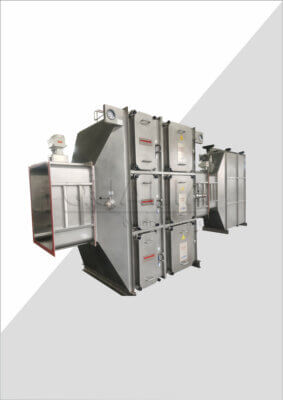

Selecting a housing size that looks right on day one can leave a system operating outside its stable range within months. The failure mode is predictable: teams complete initial sizing around clean-filter conditions, the design clears review, and the problem stays invisible until commissioning or the first full service cycle, when rising pressure drop narrows the fan’s operating band and room pressure relationships begin to drift. Recovering from that point often means replacing the fan assembly, rerouting ductwork, and reconfiguring controls—costs that can easily exceed the original equipment budget. The decisions that prevent it are not complex, but they require resolving face velocity limits, end-of-life pressure drop, and fan reserve together, as a connected stability envelope, before any housing geometry is fixed.
Airflow demand and process assumptions that drive initial sizing
Every calculation in a BIBO sizing exercise inherits its quality from the process assumptions made before a single number is entered. Design airflow is not a regulatory minimum that can be looked up and inserted directly—it is a figure derived from a specific set of process conditions: the room volume, the required air change rate for the biosafety level, the exhaust balance needed to maintain negative pressure differentials, and the actual number of supply and exhaust filter housings the system will serve. If any of those assumptions is wrong, or if they reflect a snapshot of current process activity rather than realistic peak operating demand, the resulting design airflow produces a housing and fan selection that is technically correct for the wrong scenario.
The more consequential risk is treating the design airflow figure as fixed when the process it describes is not. Biological containment facilities frequently evolve after procurement—additional work zones are added, BSL classification changes for a room, or throughput increases require more frequent air exchanges. Each of those changes increases airflow demand against a housing that was already selected. If the original sizing carried no margin above the process design point, even a modest increase can push the system toward the unstable portion of the fan curve under loaded-filter conditions. That instability does not produce a clear alarm; it produces slow drift in pressure differentials and erratic control response that is difficult to attribute cleanly to the filter system during troubleshooting.
Confirming design airflow before sizing begins means doing more than pulling ACH requirements from a published table. It means verifying that the assumed airflow is consistent with the pressure cascade the facility must maintain, that it accounts for duct losses between the housing and the fan, and that it reflects peak operating demand rather than average conditions. For facilities managing BSL-3 environments, the relationship between ACH targets, exhaust balance, and negative pressure cascade adds a layer of interdependency that makes unvalidated airflow assumptions especially risky—the air changes per hour requirements for BSL-2, BSL-3, and BSL-4 facilities established by CDC/NIH guidance should be used to anchor those inputs rather than as the sole sizing basis.
Face velocity limits and filter area selection
Face velocity is the parameter that connects airflow demand to physical filter area, and it operates within a bounded window that is narrower than many specifications acknowledge. Too low, and filtration efficiency may be inconsistent across the filter face because airflow distribution is uneven. Too high, and pressure drop across the filter increases non-linearly, accelerating loading and compressing the remaining margin for fan operation. The appropriate face velocity range for a given installation is not a universal regulatory figure—it is a design threshold specific to the filter media type, the contaminant loading expected, and the housing geometry that governs airflow uniformity.
HEPA filters used in containment applications are typically tested to the ranges defined under frameworks like ASME AG-1 and ANSI/ASHRAE/ASHE Standard 170, which establish testing conditions and acceptable performance bands rather than prescribing a single mandatory face velocity for every application. What those frameworks make clear is that validated performance depends on operating within defined bounds. Selecting a filter area that produces face velocity at or near the upper boundary of the validated range leaves no tolerance for the velocity increases that result when airflow demand rises or when duct resistance downstream changes during facility modifications.
The practical sizing decision is between a smaller filter area that meets the minimum face-velocity requirement with less housing cost, and a larger filter area that holds face velocity well within the middle of the acceptable window, reducing resistance and extending the period before replacement becomes necessary. The second option costs more upfront and requires a larger housing footprint. The first option is easier to justify in a budget review but produces a tighter operating band, which becomes a direct constraint on how much filter loading the system can tolerate before intervention is required. For facilities where filter changeouts involve complex decontamination procedures, extending the interval between replacements by selecting toward the lower end of the face velocity window often represents better lifecycle value than the initial cost difference suggests.
Clean-filter versus loaded-filter pressure drop across the service life
The most common and consequential sizing error is selecting housing size and fan duty around clean-filter pressure drop only. A new HEPA filter presents relatively low resistance, the fan operates well within its curve, and the system appears comfortable. That condition describes perhaps the first quarter of the filter’s service life under moderate loading. As particulate accumulates, resistance rises steadily. The fan must work harder to maintain setpoint airflow. At some point—often during the back half of service life—the fan is operating near the flat region of its curve, where small changes in system resistance produce large changes in airflow output. Room pressure relationships become difficult to hold, control systems begin hunting for a stable setpoint, and the maintenance team starts responding to pressure alarms rather than managing planned filter changes.
Leaving the gap between clean and end-of-life pressure drop unaddressed during design is not a conservative approach; it is a deferred risk. The relevant specification question is not “what is the pressure drop on a new filter” but “what pressure drop must the fan still manage at the defined end-of-service-life condition, and does the selected fan curve carry reserve above that point.” Clarifying that with the filter vendor before finalizing housing selection is a basic design step that is frequently skipped because it requires an explicit end-of-life criterion—one that is not always defined in initial specs.
| Condition | Risk if Unclear | What to Clarify with Vendor |
|---|---|---|
| Clean-Filter Only | System response to filter loading is not bounded, risking instability and unbounded output (e.g., uncontrollable pressure drop). | The expected pressure drop at the defined end-of-service-life for the filter. |
| Loaded-Filter (End-of-Life) | If the system’s impulse response to loading is not absolutely integrable, it can lead to operational instability. | The maximum allowable pressure drop that maintains stable room pressures and fan control. |
If an end-of-life pressure drop value is not available from the filter manufacturer, or if it has not been validated for the specific contaminant type expected in the application, that gap should be resolved before fan selection proceeds. Using a clean-filter figure with an arbitrary safety factor applied is not a substitute for a validated end-of-life number, because the actual pressure drop trajectory depends on particle size distribution, loading rate, and media depth in ways that a percentage adder cannot reliably model.
Fan reserve and control stability under peak resistance conditions
Fan reserve is the margin between the fan’s operating point under loaded-filter resistance and the point at which the fan curve flattens or becomes unstable. It is not a comfort margin—it is the mechanism by which the control system maintains stable airflow and pressure relationships when resistance is at its highest. A fan selected with adequate reserve will modulate smoothly across its operating range and hold room pressure setpoints even as filter loading increases toward the replacement threshold. A fan selected without that reserve will hold setpoints reasonably well during the first portion of service life and then progressively lose control authority as resistance increases toward end-of-life conditions.
The distinction between fan reserve validated against clean-filter conditions and fan reserve validated against loaded-filter conditions is not semantic. Fan and motor selections documented only against initial system resistance look adequate on paper but may be operating near the boundary of instability during the portion of service life when maintenance demand is highest and filter changeouts are being actively deferred. ANSI/ASHRAE/ASHE Standard 170 and the ASME AG-1 testing framework both treat system performance under sustained operational conditions as a design requirement, not an afterthought. Fan reserve must be confirmed against the peak resistance figure—the end-of-life pressure drop across the filter combined with all fixed duct and housing losses.
| Failure Behavior | Consequence | What to Confirm in Design |
|---|---|---|
| Signal Distortion | Inaccurate control of airflow and pressure relationships. | That the control system can maintain setpoints at the specified peak resistance. |
| Noise Amplification | Increased system variability and unpredictable performance. | The fan and motor selection includes margin to operate quietly and stably at peak load. |
| Component Damage | Physical failure of fans and motors, leading to downtime. | The fan curve provides adequate reserve above the calculated peak system resistance. |
Variable frequency drives and pressure-based control loops can partially compensate for increasing filter resistance, but they do not expand the fan’s physical operating envelope. If the selected fan cannot produce the required airflow at the loaded-filter pressure drop, no control configuration will recover that deficit. The confirmation step that prevents this is straightforward: plot the calculated peak system resistance on the fan performance curve and verify that the operating point at that resistance falls clearly within the stable, rising portion of the curve—not at or near the stall region.
How future capacity changes affect housing selection
Housing selection is often treated as a current-state engineering decision, when it functions more accurately as a long-term capacity commitment. The housing geometry, its rated maximum airflow, and its filter face dimensions define the upper boundary of what the system can deliver without physical modification. Unlike fan speed or control setpoints, the housing cannot be adjusted after installation without a physical replacement. If airflow demand increases after procurement—whether because a room is reclassified, a process is added, or regulatory guidance changes the required ACH—the housing becomes the constraint that forces everything else to change around it.
The cascade that follows an undersized housing is not limited to replacing the housing itself. A larger housing typically requires a larger fan or higher fan speed, which may exceed the existing motor rating. Larger duct connections may require resizing duct sections or modifying penetrations through containment barriers. Controls calibration needs to be repeated against the new operating range. If the containment system serves a validated environment, each of those changes triggers a requalification exercise. The total cost of that sequence routinely exceeds what a larger housing would have added to the original project budget.
| Planning Criterion | Risk if Unclear | What the Specification Should Address |
|---|---|---|
| Inherent System Dynamics (Pole Placement) | Poor initial sizing limits future adjustments and can prevent stable operation after capacity changes. | The housing’s maximum allowable airflow and face velocity, including a safety margin for future process growth. |
| Retrofit Cascade | Increasing airflow later requires changes to housing, fan, duct, and controls, escalating cost and complexity. | Whether the selected housing can be easily up-sized or if its selection necessitates a complete system redesign. |
The appropriate response is to define, explicitly and in writing before housing selection, what the realistic upper bound of airflow demand might be over the facility’s expected service period. That figure does not need to be precise. It needs to be enough to determine whether the selected housing carries meaningful headroom above current demand, or whether it will be at its rated limit before the first filter replacement cycle is complete. A housing selected with a realistic growth margin may cost more at procurement; it is considerably cheaper than a retrofit.
Sizing worksheet inputs that should be confirmed before vendor comparison
A sizing worksheet that reaches a vendor RFQ with unvalidated inputs does not produce competitive bids—it produces bids that cannot be meaningfully compared, because each vendor will fill the gaps in the specification differently. The most common unvalidated inputs are the ones that look like engineering data but have not been confirmed against the specific application: design airflow drawn from a standard table rather than a facility-specific calculation, face velocity derived from a generic industry reference rather than the actual filter media being specified, and end-of-life pressure drop taken from a datasheet for a different application type.
When those inputs are combined in a sizing model, the errors compound rather than cancel. An overstated design airflow combined with an underestimated end-of-life pressure drop can produce a fan selection that appears comfortable on both axes but is actually operating near its limits under realistic conditions. No vendor quote will identify that problem—the quote will simply reflect the numbers provided. The practitioner reviewing bids has no way to detect the compounding error unless the input assumptions are explicitly listed and reviewable alongside the proposed equipment.
| Subsystem Gain to Validate | Why Bounded Response Matters | What to Confirm |
|---|---|---|
| Filter Resistance Gain | Prevents the filter’s pressure drop response from causing overall system instability when combined with other inputs. | The published resistance curve and its validation for the specific contaminant load. |
| Fan Curve | Ensures the fan’s output response is predictable and sufficient across the entire expected operating range. | The fan performance data at both clean and loaded filter conditions, including the reserve margin. |
Two inputs deserve particular scrutiny before vendor comparison begins: the filter resistance curve for the specific contaminant load expected in the application, and the fan performance data at both clean and loaded conditions. If the filter vendor cannot provide a validated resistance curve for the contaminant type—rather than a general HEPA performance curve—that limitation should be documented as an assumption in the sizing model, not quietly resolved by using the nearest available figure. Validated inputs do not guarantee a correct sizing outcome, but they make the outcome defensible when questions arise during commissioning or qualification review.
For facilities where containment integrity depends on the entire filtration assembly—housing, filter, and fan system operating together within a defined pressure envelope—reviewing the sizing approach against the complete system specification before procurement provides a useful checkpoint. The HEPA filtration system specifications for modular biosafety laboratories guidance addresses how individual component specifications interact with system-level sizing in containment environments.
The practical output of a defensible sizing exercise is a stability envelope: a defined range within which design airflow, face velocity, end-of-life pressure drop, and fan reserve all coexist without any one parameter pushing the system toward its operating boundary. If that envelope has not been established before housing selection, the most consequential decisions—filter area, housing geometry, fan selection—are being made without knowing how much operating margin will remain during the back half of filter service life.
Before requesting vendor comparisons, confirm that the worksheet reflects peak process demand rather than average conditions, that end-of-life pressure drop is a validated figure rather than an estimate with a safety factor applied, and that the selected fan curve has been checked against loaded-filter resistance—not clean-filter resistance. A bag-in-bag-out housing selected against those confirmed inputs will perform predictably across its service life; one selected around unvalidated assumptions will create a maintenance and controls problem that becomes apparent only after the facility is operational.
Frequently Asked Questions
Q: What happens if the facility’s BSL classification changes after the housing has already been procured and installed?
A: A post-installation BSL reclassification almost always exceeds what the original housing can accommodate without physical replacement. Reclassification typically increases the required air change rate, which raises design airflow demand against a housing whose filter face dimensions and rated maximum airflow are fixed. If the original selection carried no growth margin, the reclassification triggers a cascade: a larger housing, a higher-capacity fan or motor, duct resizing at containment penetrations, and a full requalification of the validated environment. Defining the realistic upper boundary of BSL classification before housing selection—and sizing to that boundary rather than the current state—is the only way to avoid that sequence.
Q: Once the sizing worksheet is finalized and vendor bids are returned, what is the first check to run before accepting a proposed fan selection?
A: Plot the calculated peak system resistance—end-of-life filter pressure drop plus all fixed duct and housing losses—directly onto the fan performance curve the vendor has submitted, and confirm that the operating point at that resistance falls within the stable, rising portion of the curve. If the proposed operating point sits near the flat or stall region of the curve under loaded-filter conditions, the selection is inadequate regardless of how it performs against clean-filter figures. That single check, applied before acceptance, is what separates a fan selection that holds pressure relationships across the full service life from one that loses control authority precisely when maintenance demand is highest.
Q: Is a variable frequency drive sufficient to compensate if the fan was undersized against loaded-filter conditions?
A: No. A VFD and pressure-based control loop can modulate speed to compensate for gradually increasing filter resistance, but they cannot expand the fan’s physical operating envelope. If the selected fan is unable to produce the required airflow at loaded-filter pressure drop—meaning the required operating point falls outside the stable region of the fan curve—no control configuration recovers that deficit. The VFD extends the useful modulation range within the fan’s existing envelope; it does not enlarge it. Fan selection must be validated against peak resistance conditions before any control strategy is layered on top.
Q: When does prioritizing a smaller, lower-cost housing become the wrong trade-off even for a facility with a tight capital budget?
A: A smaller housing becomes the wrong choice whenever the facility uses a decontamination-dependent filter changeout procedure, expects any increase in airflow demand over its service period, or cannot absorb the cost of a mid-lifecycle fan and duct retrofit. In those conditions, the lower first cost is offset by a tighter operating band that compresses the interval between filter replacements, reduces the margin available for process growth, and increases the probability of a costly retrofit before the original equipment budget has been recovered. The threshold where the larger housing becomes cost-justified is not primarily about upfront price—it is about whether the facility can operationally and financially absorb what happens when the smaller unit reaches its limits.
Q: If the filter vendor cannot supply a validated resistance curve for the specific contaminant load expected in the application, how should that gap be handled in the sizing model?
A: The gap should be explicitly documented as an unvalidated assumption within the sizing model—not silently resolved by substituting the nearest available general HEPA performance curve. Using an unvalidated figure without flagging it means the compounding error it introduces cannot be detected during bid comparison or commissioning review. The documented assumption then becomes a specific item to resolve before fan selection is finalized: either by obtaining contaminant-specific test data from the filter manufacturer, or by applying a conservatively high end-of-life resistance estimate with the assumption clearly labeled so reviewers understand the basis. Undocumented substitutions are the mechanism by which sizing errors survive procurement and become commissioning problems.
Related Contents:
- What Causes Pressure Drop in Bio-safety Dampers?
- BIBO Housing Design for Negative Pressure Exhaust: What Engineers Must Define Early
- BIBO Housing Materials | Stainless Steel Specifications
- Bag In Bag Out Systems for BSL-3 Labs: How to Specify Safe Containment Changeout
- Essential BIBO System Maintenance Checklist
- Bag-In-Bag-Out Housing Applications in Pharmaceutical Manufacturing
- BIBO System Design Principles | Filter Housing Engineering
- BIBO Integrity Testing Requirements: DOP, Leak Checks, and Documentation Expectations
- HEPA Filter BIBO Systems | Containment Housing Solutions