A facility can have well-defined entry airlocks and a validated waste-treatment route and still create a transfer failure, because the failure point is rarely the equipment itself — it is the moment when a clean load, a sample awaiting dispatch, and a biological waste item rely on the same chamber, the same schedule, or the same handler judgment. Deciding how to separate these three routes is a design and operating question before it is an equipment question, and getting the objective wrong at the start changes what counts as acceptable evidence later.
Distinguish clean entry, sample dispatch, and waste exit objectives
| Material route | Primary objective | Boundary to preserve |
|---|---|---|
| Clean entry | Move incoming materials through a defined clean-side staging point before release. | Keep entry staging and release logic separate from sample and waste exits. |
| Sample dispatch | Preserve containment status, traceability, and transport packaging for the destination. | Transport controls do not establish the treatment route used for disposable biological waste. |
| Waste exit | Select containment, packaging, treatment, and release according to the hazard basis and treatment compatibility. | Keep waste decisions separate from sample dispatch and clean-entry release logic. |
Each of the three material routes answers a different question, and treating them as one problem obscures the decision a reader actually needs to make. Clean entry exists to move incoming materials into controlled space without compromising what is already inside; the relevant judgment is about staging and release before the material is used. Sample dispatch exists to move material that has been inside the controlled space back out while keeping its containment status and chain of custody intact for wherever it is going next. Waste exit exists to remove material that will not be reused, selecting a treatment and release path based on the hazard the material carries.
The reason these cannot share one decision logic is that each route answers to a different endpoint. Clean entry is judged against what happens after release into the working space. Sample dispatch is judged against the requirements of the receiving destination — a reference lab, a storage archive, another facility — which has its own expectations for packaging and traceability. Waste exit is judged against a treatment and discharge boundary, where the material’s hazard basis has to be matched to a compatible process before anything leaves the controlled area. When a facility uses one chamber, one procedure, or one set of status labels for more than one of these routes, it has not simplified the design — it has created a point where the boundary between objectives depends entirely on the discipline of whoever is operating it at that moment.
This matters early in a project because the clean-entry, sample-dispatch, and waste-exit objectives tend to get defined by different stakeholders — operations for incoming logistics, QA or the receiving destination for sample handling, biosafety or EHS for waste — and if those groups do not align before equipment is selected, the facility risks sizing or specifying a transfer system around only one of the three jobs it will actually need to do. Confirming early which objective governs which doorway, chamber, or piece of equipment keeps those downstream decisions from being made by default.
Classify each load by hazard, packaging, destination, and treatment tolerance
| Classification input | Question to resolve | Effect on the route decision |
|---|---|---|
| Hazard basis | What hazard basis applies to the load? | Use the site-specific risk basis to select proportionate containment and treatment controls. |
| Packaging | What containment or transport packaging status is needed? | For samples, transport packaging and traceability do not substitute for waste-treatment selection. |
| Destination | Is the load entering clean staging, leaving as a sample, or leaving as waste? | Direct the load to the corresponding staging, dispatch, or treatment-and-release logic. |
| Treatment tolerance | Which validated route is compatible with the load? | Screen autoclave, dunk tank, VHP transfer, or another route against load compatibility and the site’s validated process; no universal cycle is established here. |
Before a route can be chosen, each load needs to be classified against a small set of questions, and the answers determine which path is even eligible — not just which path is preferred. The first question is the hazard basis: what risk does this material carry, and what proportionate control does that risk justify? The WHO Laboratory Biosafety Manual, 4th Edition, frames this as a matter of risk assessment informing proportionate controls rather than a fixed universal rule, which means the hazard basis has to be established for the specific load and site rather than assumed from a general category.
The second question is packaging and containment status. A sample destined for an external laboratory needs packaging that will survive transport and preserve chain-of-custody evidence; a waste item destined for treatment needs packaging compatible with that treatment process, which is a different requirement even if the material originated in the same room. The third question is destination — is this load entering clean staging, leaving as a sample, or leaving as waste — because the destination determines which release logic applies downstream. The fourth is treatment tolerance: which validated process, if any, can this load pass through without damage to the equipment or failure of the treatment itself.
These four questions interact. A load with a hazard basis that permits one treatment route may still be excluded from it because its packaging is incompatible, or because the destination does not accept materials processed that way. Where a load’s classification is ambiguous — mixed waste streams, or samples carrying residual biological material — the classification decision itself, not the equipment, becomes the limiting step. A facility’s validated process defines which combinations are acceptable, and the WHO Decontamination and Waste Management Monograph is explicit that there is no universal cycle recipe or throughput figure that applies across sites; each site’s validated process, material compatibility limits, and discharge conditions have to be worked out locally rather than assumed from general guidance.
Route incoming materials through protected staging and release
Incoming materials need a defined clean-side entry point, and the design question is how that staging area holds material before release rather than simply how material gets through a door. The function of a protected staging step is to interpose a controlled pause between the outside and the working space, during which the material’s status can be verified and, if the project requires it, a transfer disinfection step can be applied before release.
The condition that changes this design is what the incoming material actually is. A packaged, externally clean item may need only a verification step before release. A load that must cross into an aseptic or containment boundary with higher assurance may need a validated transfer mechanism — EU GMP Annex 1 describes transfer controls, validated transfer disinfection, and suitable transfer systems in the context of sterile Grade A/B environments, where the standard applies to that specific sterile-grade context rather than establishing a universal transfer method for every facility type. A biosafety laboratory receiving the same category of incoming item may have an entirely different staging requirement driven by containment rather than sterility.
This is also where the entry route has to stay procedurally separate from the two exit routes, because a staging chamber that is reused for outgoing waste or outgoing samples inherits the ambiguity problem described earlier: the facility needs a way to know, without relying on memory or informal communication, whether the chamber currently holds an incoming clean load or an outgoing dirty one. Where a project shares a transfer chamber across directions, the staging and release logic has to include a positive status indication, not just a physical door position, because the door being closed does not tell an operator what is inside. Confirming the material classification before the load reaches the staging point — not after — keeps the release decision at entry from being made under time pressure or incomplete information.
Contain samples without confusing transport controls with waste treatment
A sample leaving a controlled area is not waste, even when it originated alongside waste and even when it looks similar in form. The distinction matters because the two routes are evaluated against different downstream requirements: a sample’s job is to arrive at its destination with its containment and identity intact, while waste’s job is to be rendered safe for disposal or further handling. Confusing the two routes does not just create a paperwork problem — it means the material might pass through a treatment process that destroys what the destination lab needs intact, or conversely, bypass a treatment step that the hazard basis requires.
The practical risk is that sample packaging and labeling controls can look, procedurally, like they satisfy a containment requirement, when transport packaging and traceability documentation do not by themselves establish that a treatment step has occurred. A sample can be fully traceable, correctly packaged for its carrier, and still require whatever hazard-based control the site’s risk assessment calls for before it leaves the facility boundary. Where the destination is external — another institution, a contract lab, a regulatory body — the receiving party’s own acceptance criteria for packaging and documentation become part of what the dispatch route has to satisfy, and those criteria are independent of whatever treatment logic governs the facility’s waste stream.
This separation has a direct consequence for shared equipment. If a sample-dispatch pathway and a waste pathway share any chamber, cart, or handling step, the facility needs a procedural way to prevent a sample from being treated as waste, and vice versa — a labeling or status system that distinguishes “leaving intact for transport” from “leaving for treatment” has to be visible at the point of handling, not only in paperwork that trails the load. Where the two routes stay physically and procedurally distinct from the start, this risk does not arise in the same way, which is part of why facility layout decisions early in a project reduce the burden on operating procedure later.
Select exit equipment for the actual load and validated process
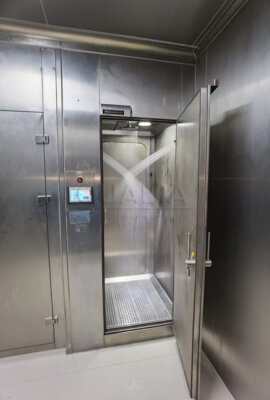
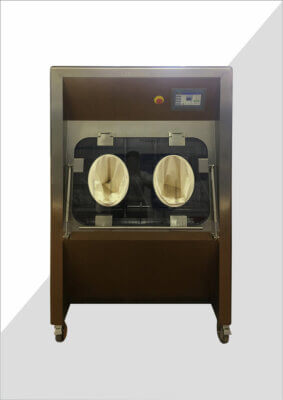
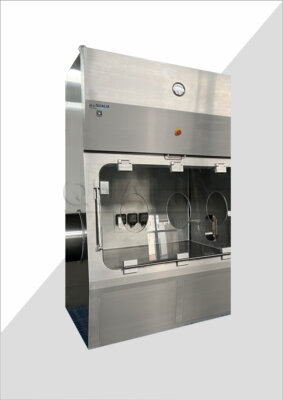
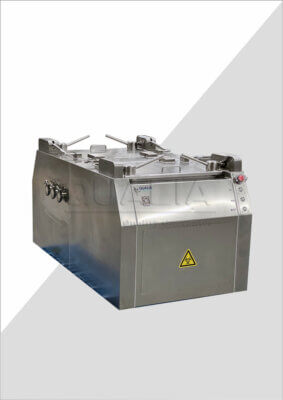
Exit equipment choice follows from the classification work done earlier, not the reverse — the load’s hazard basis, packaging, destination, and treatment tolerance should narrow the eligible equipment before cost, footprint, or throughput enter the conversation. An autoclave, a dunk tank, a VHP transfer system, or another exit route each represent a different treatment mechanism, and they are not interchangeable even where they serve the same general function of moving material out of a controlled space.
An autoclave applies heat and pressure and is suited to loads that can tolerate that process without damage to contents that need to survive, which is why it fits waste streams rather than samples intended for further analysis. A dunk tank applies a liquid disinfectant bath, which suits loads that can be submerged and are compatible with the chemical agent in use, and introduces its own considerations around the liquid’s compatibility with the load’s materials. A VHP transfer process applies a gas-phase decontamination step, which suits loads and surfaces compatible with that chemistry and is often selected where liquid immersion or heat would damage the material being transferred. None of these is a universal answer; each is validated against a specific load type and a specific site process, and the selection decision depends on matching the load’s treatment tolerance to the mechanism’s compatibility profile rather than defaulting to whichever equipment the facility already operates for a different purpose.
The condition that most changes this decision is what the load must preserve on the other side. Waste destined only for safe disposal has the most flexibility, since the treatment only needs to render it safe, not usable. A sample or reusable item destined for further work or external transport is far more constrained, since the treatment process cannot be allowed to compromise what the destination needs intact. Where the facility’s validated process already specifies an approved route for a given load category, that validated process — not a general preference for one mechanism over another — should govern the choice, because introducing an unvalidated exit route for a load, even one that seems compatible in principle, places the facility outside its documented control.
Control shared chambers with status, scheduling, interlocks, and exceptions
| Control | Distinct role when equipment is shared |
|---|---|
| Scheduling | Separate clean and dirty loads in time. |
| Physical segregation | Keep clean and dirty loads apart in the shared transfer area. |
| Status labels | Make the current load status visible before movement or release. |
| Interlocked access | Control access so clean and dirty loads do not meet. |
Where a facility cannot dedicate separate equipment to clean entry, sample dispatch, and waste exit — because of space, cost, or layout constraints — the controls that prevent those routes from colliding have to compensate for what separate equipment would otherwise provide automatically. Each control addresses a different point of failure, and none of them substitutes for the others.
Scheduling separates loads in time, which works when the facility can predict and control when clean and dirty movements occur, but fails if an unscheduled event forces an off-cycle load through the same chamber. Physical segregation — separate shelving, separate marked zones, separate paths through the same room — reduces the chance that a clean and dirty load are placed in proximity even when they share the general space, but it depends on operators consistently respecting zones that are not always physically forced. Status labeling makes the current condition of a load or chamber visible to whoever approaches it next, addressing the problem described earlier where a closed door gives no information about what is inside; this control matters most at the handoff point, where one operator’s knowledge needs to become another operator’s knowledge without relying on verbal communication. Interlocked access physically prevents movement that would violate the intended sequence, which is the only one of these controls that does not depend on an operator choosing correctly — it removes the choice at the moment it matters.
The condition that determines how many of these controls a shared chamber needs is the consequence of a mistake at that chamber. Where a clean and dirty load meeting would only create inconvenience, scheduling and labeling may be sufficient. Where a clean and dirty load meeting would compromise containment or product protection, interlocked access becomes the control that closes the gap the other three leave open, because scheduling, segregation, and labeling all depend on correct human action at the point of use. Exceptions — equipment failure, urgent loads, maintenance access — need their own defined path, because a control scheme that only works when every load is routine will fail at exactly the moment the facility can least afford it. Reviewing which of these controls a given shared chamber already has, and which exceptions it has never had to handle, is project information that feeds directly into how Qualia configures or specifies transfer equipment for that interface, since the equipment’s interlock and status logic has to match the facility’s actual operating sequence rather than a generic one.
Frequently Asked Questions
Q: What information should be prepared before assigning a material transfer route?
A: Define the load’s destination, hazard basis, packaging or containment status, treatment tolerance, and applicable validated process. These facts determine whether the load belongs in clean staging, sample dispatch, or a waste treatment and release route.
Q: Can returned samples follow the same exit process as disposable biological waste?
A: Do not assume they can. A sample may require traceability and transport packaging for its destination, while waste requires a separate decision on containment, treatment compatibility, and release.
Q: How should a team choose among an autoclave, dunk tank, VHP transfer, or another exit route?
A: Match the route to the specific load’s hazard basis, material compatibility, destination, and the site’s validated process. The equipment name alone does not establish a suitable process or a universal cycle.
Q: What should be done when clean and dirty loads must use the same transfer equipment?
A: Define how scheduling, physical segregation, status labels, and interlocked access will work together for that equipment. The operating sequence should keep the two load states from meeting and make the current status clear before movement or release.
Q: When is a transfer-route decision still unresolved?
A: It remains unresolved when the hazard basis, destination, packaging status, treatment tolerance, or applicable validated process is unknown. Identify that missing project fact before assigning the load to clean entry, sample dispatch, or waste exit logic.