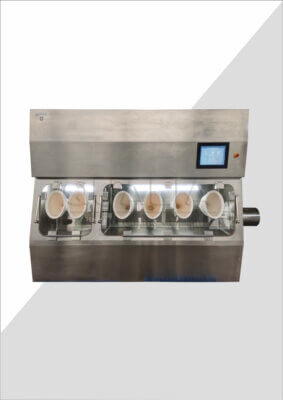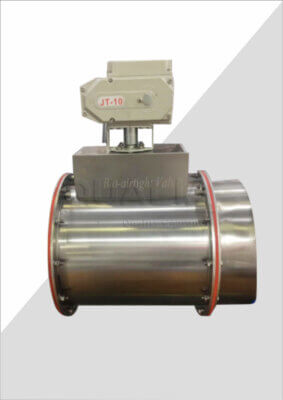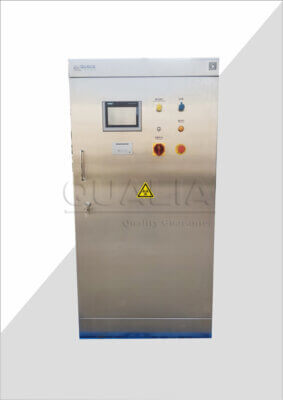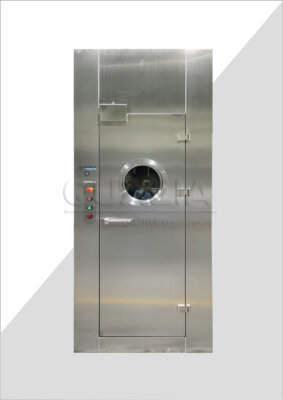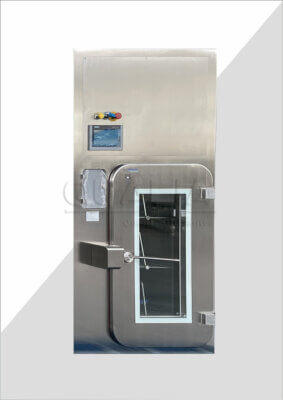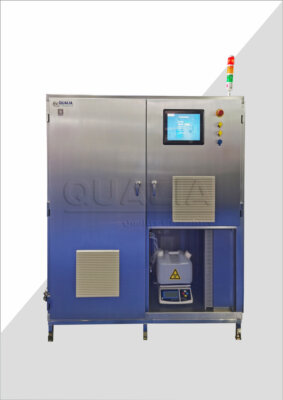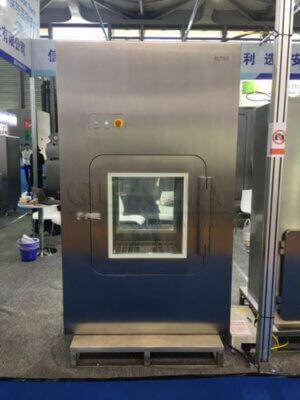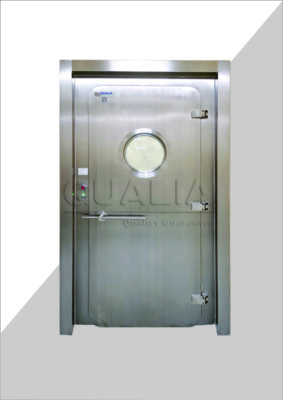
Specifying the wrong shower type for a containment suite rarely becomes visible at design review — it surfaces during commissioning, when chamber geometry is fixed, drain lines are in the slab, and chemical supply infrastructure either exists or it does not. Correcting a mismatched interlock sequence or undersized chamber at that stage carries real cost: structural rework, delayed qualification schedules, and in some cases a complete revision of the decontamination protocol to fit hardware that was never designed for the intended workflow. The underlying error is almost always the same — shower scope was inferred from BSL level alone, without documented agreement on user PPE, chemical supply, effluent route, and operating mode. Understanding where each of those decisions intersects will help biosafety officers, engineering teams, and QA leads define the right chamber type before layout is frozen.
BSL Level Sets Context But Not The Whole Scope
BSL level activates certain containment requirements, but it does not resolve shower selection on its own. Knowing that a facility operates at BSL-3 tells you that a shower-out capability is expected and that decontamination of the operator before exiting the inner zone is part of the containment strategy. It does not tell you whether that requirement is met by a simple water shower room, a mist shower step, or a full chemical shower chamber — and the gap between those options is not trivial in terms of infrastructure, chemical handling, validation effort, or operational burden.
The CDC BMBL and WHO Laboratory Biosafety Manual both establish containment tiers and describe general facility characteristics at each level, but neither document functions as a shower-selection specification. They define what containment outcomes are expected; the specific equipment configuration required to achieve those outcomes depends on factors that vary significantly between facilities — suit type, exit workflow, available utilities, and the decontamination agents in use. Treating BSL level as a proxy for shower type creates a false sense of resolution early in a project, which is precisely when the real variables are still undefined.
The practical implication is that BSL level should be used as a starting threshold — a signal that certain capabilities must be present — while shower scope is determined by a separate, documented process that addresses workflow, PPE, chemistry, and effluent independently. Projects that conflate these two steps tend to inherit mismatches that are difficult to defend during validation or regulatory review.
Suit Workflow Separates Chemical Shower Requirements
The clearest dividing line in shower scope is not between BSL-3 and BSL-4 in the abstract — it is between facilities where operators wear a self-contained positive-pressure suit and those where they do not. That distinction changes the shower requirement fundamentally, because a positive-pressure suit creates a sealed contaminated outer surface that must be chemically decontaminated before the operator can safely doff. A water-only or mist step is not designed to address that surface in the same way a chemical shower is.
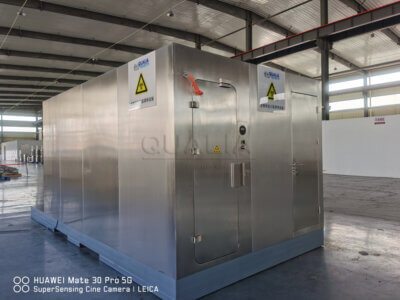
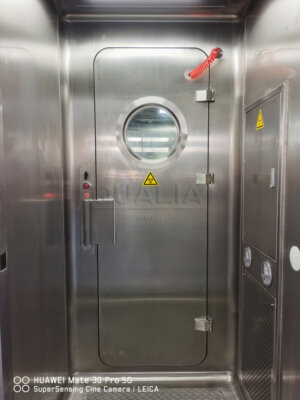
In a BSL-4 suit laboratory, the chemical shower chamber is a procedural requirement integrated into the exit sequence: the operator enters the chamber in the positive-pressure suit, completes a full chemical decontamination cycle, and only then proceeds to doffing and personnel shower steps. The integrity of that sequence — and confidence that it works — depends on both the chamber design and the ability to verify coverage across the suit surface. One operational method used in training contexts involves applying a colored cream as a visual pseudo-contaminant to the suit before the shower cycle, allowing staff to confirm that the chemical contact pattern is adequate and that no areas are consistently missed. This is not a formal compliance method, but it illustrates the kind of process-level verification demand that a suit-lab workflow generates — a demand that has no equivalent in a non-suit BSL-3 exit corridor.
For enhanced BSL-3 configurations, the picture is more variable. Some enhanced BSL-3 setups include a mist shower step as a precautionary decontamination measure, using a chemical mist applied to the operator’s outer PPE before exit. Others use a dedicated shower-out room with water and HEPA-filtered exhaust as the primary decontamination step. Neither approach carries the same infrastructure weight as a BSL-4 chemical shower chamber, but both require documented protocol, defined chemical or water supply parameters, and clear interlock logic. The mistake is assuming that an enhanced BSL-3 label automatically justifies specifying BSL-4-style chemical shower hardware — that decision must follow from the actual suit type and exit workflow, not from a containment tier designation alone.
Utilities And Waste Treatment Decide Practical Fit
Infrastructure feasibility is where scope ambitions collide with engineering reality. A chemical shower system — particularly one designed for BSL-4 suit workflow — requires dedicated supply and exhaust air handling, protected vacuum lines, and a reproducible decontamination delivery system. Those are not incidental add-ons; they are design requirements that must be resolved at the facility infrastructure level before chemical shower integration is viable. If those utility conditions do not exist or are not planned, the chemical shower cannot function as intended, and the gap will not be apparent until commissioning.
For BSL-3 facilities, the utility obligations are different in character but still consequential in practice. Drench showers, eyewash stations, hands-free sinks, and liquid effluent systems — including chemical shower drainage and neutralization — require annual verification of correct operation as part of decontamination system checks. That verification schedule is a recurring operational commitment, not a one-time commissioning item. It must be reflected in the facility’s maintenance planning, operational budget, and staffing for ongoing decontamination system oversight.
| Key Utility / Waste Treatment Aspect | Applicable BSL Level | Requirement / Verification Point |
|---|---|---|
| Dedicated supply and exhaust air, protected vacuum lines, reproducible decontamination systems | BSL-4 | Must be included in laboratory design to support chemical shower operation and waste treatment |
| Drench showers, eye wash stations, hands-free sinks | BSL-3 | Annual confirmation of proper operation |
| Liquid effluent systems (chemical shower drainage and neutralization) | BSL-3 | Annual verification as part of decontamination system checks |
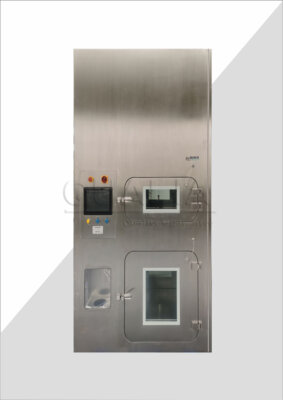
The effluent side deserves particular attention during scope definition. Chemical shower drainage that carries disinfectant or decontaminant residuals cannot be routed to a standard drain without waste treatment provisions in place. For BSL-4 or enhanced BSL-3 configurations using chemical agents, the drainage system must be designed to handle the expected chemical load — which means neutralization capacity, hold-and-treat provisions, or connection to an effluent decontamination system must be part of the scope from the outset. Retrofitting effluent treatment infrastructure after structural work is complete is disproportionately expensive and, in some facility configurations, physically constrained by slab depth and drain routing. The Chemical Shower and Mist Shower systems each carry different drainage and chemical supply profiles; confirming which matches your effluent infrastructure is a prerequisite to meaningful equipment selection.
Layout Freeze Can Lock In The Wrong Chamber Type
Chamber geometry and door interlock sequence are among the most difficult elements to revise once structural and mechanical work is underway. Once a shower chamber footprint is fixed in the floor plan — with airlock dimensions set, door penetrations located, and mechanical rough-ins placed — changing the chamber type, door count, or interlock logic requires reopening structural and HVAC coordination that may already be contracted or partially built. This is the point at which a scope error made during design becomes a rework problem during construction.
The specific failure mode is not that teams choose the wrong chamber type deliberately — it is that chamber size and door sequence get resolved as layout decisions before the decontamination protocol is agreed. A layout team working from a BSL level designation and a generic room program may assign a chamber footprint that fits a simple shower-out room while the biosafety team is still working through whether a mist step, a chemical cycle, or a full suit shower sequence will be required. By the time the protocol decision is finalized, the footprint is fixed — and if the required chamber needs a longer dwell time, a larger spray envelope, or a three-door interlock instead of two, the layout cannot accommodate it without significant revision.
The practical check at design development stage is to confirm that decontamination protocol parameters — chemical agent, contact time, coverage geometry, cycle mode, and emergency bypass routing — are documented and agreed before chamber dimensions and interlock configuration are submitted for structural coordination. That confirmation cannot be delegated to equipment suppliers at procurement stage; by then, the boundary conditions are already set. For teams considering a broader shower scope to accommodate future containment upgrades, the same logic applies with added weight: provisioning for a more capable chamber type means sizing the structural opening, drain stub, and utility rough-ins to the future requirement, not the current one — a decision that must be explicit and budgeted, not assumed.
Equipment Selection Needs PPE, Effluent And Mode Decisions
Equipment selection should be a convergence point, not a starting point. Arriving at equipment selection without documented decisions on user PPE, chemical or water supply, effluent route, and operating mode means the equipment specification will be built on assumptions — and assumptions in this context tend to surface as qualification findings, not design confirmations.
PPE compatibility sets the boundary condition for shower type. The spray pattern, nozzle arrangement, cycle duration, and chamber geometry required to decontaminate a positive-pressure suit are different from those required to rinse outer garments or provide emergency drench coverage. If the PPE type changes between design phases — for example, if a facility starts with enhanced respiratory protection at BSL-3 and is later upgraded to a positive-pressure suit program — the shower hardware may need to change with it. That substitution is straightforward if the structural envelope was sized accordingly; it is a significant problem if it was not.
Effluent route is a parallel constraint, not a downstream one. The choice between a water-only shower, a mist shower with chemical agent, and a full chemical shower cycle affects drain sizing, waste treatment requirements, and the complexity of the neutralization or hold-and-treat system. These variables interact: a facility that specifies a chemical shower but routes effluent to an undersized drain or an untreated connection has an unresolved containment interface, regardless of what the equipment itself is rated to do.
Operating mode — whether the shower runs on a fixed automated cycle, operator-initiated cycle, or emergency manual override — determines the interlock logic, control system interface, and failure-mode behavior. A chamber that enters a fixed decontamination cycle on entry cannot be interrupted without a defined emergency bypass procedure; that procedure must exist, be trained to, and be periodically tested. Specifying an automated chemical shower cycle for a facility whose operations team has not established that procedure creates an operational gap that is difficult to close after installation.
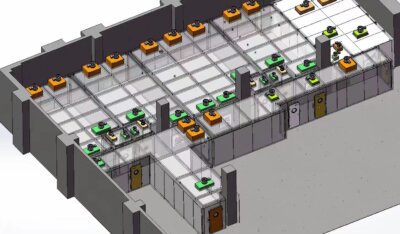
For facilities navigating the scope boundary between a standard BSL-3 shower-out configuration and an enhanced or BSL-4-capable system, the BSL-3/BSL-4 Module Laboratory approach can be relevant — particularly where infrastructure pre-coordination for future upgrade is part of the brief. The scope decisions described here, however, apply regardless of whether the facility is modular or stick-built; the equipment cannot resolve a protocol that has not been agreed.
The most productive moment to define shower scope is before layout is frozen, when chamber footprint, door sequence, and utility rough-ins can still be adjusted to match the decontamination protocol rather than constrain it. That window closes earlier than most teams expect — structural coordination moves faster than protocol consensus — and the cost of correction afterward is rarely proportional to what it would have taken to resolve the question at design development.
Before equipment selection proceeds, confirm that the following are documented: the BSL level and the specific containment classification of the suite; the PPE type worn by all operators who will use the shower; whether a chemical agent will be used and what neutralization or hold-and-treat capacity exists downstream; and the operating mode, including emergency bypass logic. These are not equipment specifications — they are the boundary conditions that make an equipment specification defensible. Teams that have those four inputs resolved before approaching a supplier will reach equipment selection with a cleaner scope and a shorter qualification path.
Frequently Asked Questions
Q: Our facility is classified as enhanced BSL-3 but does not use a positive-pressure suit — does a chemical shower still belong in the scope?
A: Not automatically. Enhanced BSL-3 without a positive-pressure suit does not require a BSL-4-style chemical shower chamber, and specifying one creates infrastructure obligations — dedicated air handling, chemical supply, effluent neutralization, emergency bypass procedures — that the actual workflow does not justify. The shower requirement should follow from the specific PPE type and exit protocol in use, which for a non-suit enhanced BSL-3 configuration is more likely resolved by a mist shower step or a water shower-out room than a full chemical cycle chamber.
Q: At what point in the design process is it too late to change the shower chamber type without triggering structural rework?
A: Once chamber footprint, door penetrations, and mechanical rough-ins are submitted for structural coordination, changing chamber type, door count, or interlock configuration will require reopening work that may already be contracted or partially built. In practice, this means the decontamination protocol — including chemical agent, contact time, coverage geometry, cycle mode, and emergency bypass routing — must be agreed and documented before design development closes, not at procurement stage. That window arrives earlier than most teams anticipate because structural coordination moves faster than protocol consensus.
Q: If a facility is scoped for BSL-3 now but may upgrade to BSL-4 in the future, should the shower infrastructure be built to the higher standard from the start?
A: Only if the decision is explicit, budgeted, and reflected in the structural envelope from the outset. Provisioning for a more capable chamber means sizing the structural opening, drain stub, chemical supply lines, and utility rough-ins to the future requirement — not the current one. Assuming that future capacity will be accommodated without formally building it into the design is a common error; the slab depth, drain routing, and room envelope set constraints that are disproportionately expensive to revise after construction. The benefit is genuine, but it must be treated as a discrete design decision with associated cost, not as a passive option held open by leaving space on a floor plan.
Q: How does the annual verification requirement for effluent systems affect the decision between a chemical shower and a mist shower for a BSL-3 configuration?
A: It adds a recurring operational commitment that scales with the complexity of the effluent system chosen. Both chemical shower drainage carrying disinfectant residuals and mist shower drainage require annual confirmation of correct operation as part of decontamination system verification for BSL-3 facilities. A chemical shower, however, carries greater neutralization and hold-and-treat demands downstream, meaning the annual maintenance scope — and the staffing and budget required to sustain it — is larger. For facilities where those operational resources are constrained, the difference in ongoing verification burden between a mist shower configuration and a full chemical cycle system is a meaningful selection criterion, not just an infrastructure footnote.
Q: What is the risk if operating mode — automated cycle versus manual override — is left unresolved at the time of equipment selection?
A: The risk is an operational gap that cannot be closed after installation. A chamber specified with a fixed automated decontamination cycle cannot be interrupted without a defined emergency bypass procedure; if that procedure does not exist, has not been trained to, and is not periodically tested, the facility has a containment interface that is incomplete regardless of the equipment’s rated capability. Operating mode determines interlock logic, control system interface, and failure-mode behavior — decisions that must be resolved and documented before the equipment specification is finalized, because the hardware will be built to those parameters and they cannot be meaningfully revised on-site.