
A cable or conduit penetration through a BSL-3 barrier wall is a small opening with a disproportionate role: it has to hold the room’s containment performance across every service line that passes through it, on the day of commissioning and after every later change to that service mix. Choosing between a compression transit and a field-applied sealant is not primarily a materials question. It is a question of how the opening will be used, altered, and re-verified over the life of the facility.
What the wall seal must accommodate now and after cable changes
The starting point is the actual cable and conduit schedule for the wall, not a generic assumption about what a penetration seal “usually” carries. Where the service mix is fixed and fully known before construction, the opening can be sized and sealed to that exact configuration. Where the mix is expected to change — additional instrumentation added later, a conduit removed and replaced, a spare cable pulled through for a future system — the seal method has to accommodate that change without compromising the barrier each time it happens.
This is where the two approaches diverge in what they ask of the project. A compression transit is a manufactured assembly built around defined module or block positions; its capacity to absorb change is set by how many spare positions exist and how the modules are configured, not by what the installer decides on site. A field-applied sealant is applied around whatever is in the opening at the time; its capacity to absorb change depends on whether the material and the installation method can be reopened, repaired, and resealed without degrading the surrounding seal.
Neither answer is correct in the abstract. If the wall is unlikely to see any change in penetrating services after commissioning, the practical difference between the two approaches narrows to installation and inspection considerations rather than future flexibility. If change is expected — and many BSL-3 facilities are designed with some allowance for evolving equipment and instrumentation — the seal method has to be selected with that future event already in view, because retrofitting containment integrity into an opening that was not designed for change is a materially different task than designing for it from the start.
| Project condition | Compression transit: what to check | Field-applied sealant: what to check |
|---|---|---|
| Current cable and conduit mix | Module or block fit against the actual service schedule | How the opening will be prepared and sealed around that service mix |
| Likely later cable additions or removals | Spare positions and module or block fit after the change | How access will be regained for a later repair |
| Wall opening geometry | Frame-to-wall detail at the actual opening | Opening preparation and sealant installation at the actual opening |
Compression transit fit for the service mix, spare positions and wall frame
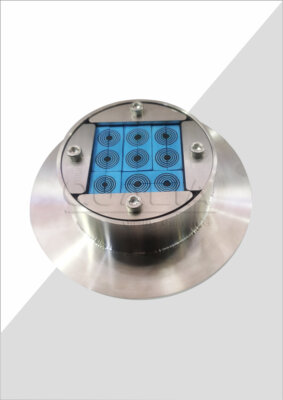
A compression transit works by clamping a set of modules or blocks around individual cables or conduits inside a frame, with the compression force sealing each service and the frame sealing to the wall. The performance of the assembly depends on every one of those interfaces being correctly matched: the module size to the cable or conduit diameter, the block configuration to the number and arrangement of services, and the frame to the wall opening and wall construction.
This means the product’s suitability cannot be judged from a specification sheet or a named model alone. A transit rated for a certain range of cable diameters and a certain number of positions still has to be checked against the specific schedule for that wall. Where the schedule includes services of different diameters, some modules or blocks may be undersized or oversized for their assigned position unless the configuration is deliberately matched. Where spare positions are included for future services, those positions need their own blanking modules or reserved blocks so the transit maintains its seal until they are used, rather than being left as an unsealed gap.
The frame-to-wall detail is a separate interface from the cable-to-module interface, and it deserves separate attention. A transit can be correctly configured for its cable schedule and still underperform if the frame is not properly bedded, fixed, and sealed into the wall opening — particularly at wall types or thicknesses the frame was not designed for. Where the wall construction varies from what the transit was designed around, the frame detail becomes the limiting factor rather than the module configuration.
The practical implication is that a compression transit should be evaluated as an assembly matched to a specific opening and a specific service schedule, not as a generic product that fits any BSL-3 wall penetration. Confirming module or block fit, spare-position provision, and frame-to-wall compatibility against the real opening is what turns a catalog listing into a project-appropriate solution.
Field-applied sealant fit for access, installation and later repair
A field-applied sealant works differently: instead of a manufactured assembly with defined positions, an installer prepares the opening and applies sealant material around whatever cables or conduits pass through it at the time of installation. The seal’s performance depends on surface preparation, the sealant’s ability to bond to and around irregular or mixed service types, and the skill and consistency of the application.
This dependence on installation quality is the central trade-off against a compression transit. A sealant can accommodate an irregular or mixed service mix that does not fit neatly into a modular block system, because it is formed around the actual services rather than fitted to predefined positions. But that flexibility shifts responsibility onto the installation process itself: how the opening is prepared, how thoroughly the sealant is worked around each service, and how consistently that is done across every penetration in the facility.
The later-repair question is where the sealant approach needs the most scrutiny before selection. Where a cable or conduit later needs to be added, removed, or replaced, the sealant around it has to be cut back, the service changed, and the opening resealed — and the quality of that repair depends on regaining proper access to the original substrate and re-establishing a bond that matches the original installation. Where the original sealant, backing material, or opening geometry make later access difficult, repairs risk being incomplete or inconsistent with the original seal, even where the initial installation was sound.
The buyer’s practical task is to ask the installer, before selection, how the opening will be prepared, how the sealant will be worked around the specific service mix on that wall, and what the repair sequence looks like when a service is added or changed later. Where those answers are vague or generic, the risk sits in execution rather than in the material itself.
Material exposure and cleanability questions for both approaches
Both approaches place a material — transit body, module, gasket, or sealant — permanently in a location that may be exposed to decontamination chemicals, cleaning agents, humidity, or other conditions specific to the facility’s operating environment. Material exposure is not a property of “compression transits” or “sealants” as categories; it is a property of the specific materials used in a specific product or formulation, evaluated against the specific exposure conditions of that project.
This means the comparison between the two approaches cannot be resolved by assuming one category is inherently more resistant or more cleanable than the other. A compression transit’s gasket and block materials may be well suited to one decontamination regime and poorly suited to another; a sealant formulation may resist one class of chemical exposure and degrade under a different one. Where the facility’s decontamination method, cleaning chemicals, or environmental conditions are unusual or aggressive, the material compatibility of either approach needs to be confirmed against that specific exposure profile rather than inferred from the general category.
Cleanability follows a similar logic. A surface that is smooth, continuous, and free of crevices supports easier cleaning and inspection than one with gaps, seams, or irregular geometry — and either a transit frame or a sealant bead can be detailed well or poorly in this respect, depending on the specific product and installation. The presence of multiple modules and block interfaces in a transit, or the presence of tooling marks and irregular sealant profiles in a field-applied joint, are installation-specific outcomes rather than fixed properties of the method.
The buyer’s task here is to define the project’s actual material-exposure and cleanability requirements first, then ask each candidate approach how its specific materials and installation details meet them, rather than assuming a category-level answer.
Installed-wall checks that keep the comparison on the same acceptance basis
| Check or claim | Scope supported by the supplied row | Comparison boundary |
|---|---|---|
| Penetration visual inspection | Cited by the Canadian standard for the penetration | Does not by itself establish whole-room tightness or rank the two approaches |
| Smoke-pencil seal check, where applicable | A local seal check in the Canadian context | A local smoke observation does not prove whole-room tightness |
| Room pressure-decay check | Has a narrower scope in the cited Canadian standard | Do not assume it applies to every penetration or infer its outcome from a local seal check |
| Component claim | Concerns the component rather than the installed wall | Does not prove whole-room tightness or replace project-defined installed-wall verification |
Once a seal method is installed, the question shifts from selection to verification, and this is where claims made about the product need to be kept separate from claims that can be made about the finished wall. A visual inspection of the penetration, as described in the Canadian Biosafety Standard, Third Edition, can confirm that a penetration has been sealed as installed, but that inspection addresses the individual penetration rather than the wall or room as a whole. A smoke-pencil seal check, where applicable under that same standard, can indicate whether a local seal appears to hold at that point, but a local smoke observation does not establish that the entire wall or room maintains its intended tightness.
Room pressure-decay testing, where it is used, sits at a different and narrower scope within that Canadian standard, and it should not be assumed to apply to every penetration or to be inferred from the result of a local seal check. A wall can pass a local visual or smoke check at a given penetration while the room as a whole has not been verified for pressure decay, and the reverse relationship does not hold either — a room-level result says nothing specific about any one penetration’s local seal quality.
The same separation applies to manufacturer claims about a transit or sealant product. A component-level claim about a compression transit’s sealing performance concerns that component under its own test conditions; it does not, on its own, establish that the installed wall meets the project’s containment requirement, because installation quality, wall construction, and interaction with adjacent penetrations all affect the outcome. The Swiss Expert Committee for Biosafety’s recommendation on structural and technical safety measures in BSL-3 laboratories addresses related considerations — including multi-service transits, reserve openings, and material resistance — as nonbinding engineering advice, and it does not rank compression products above sealants or the reverse.
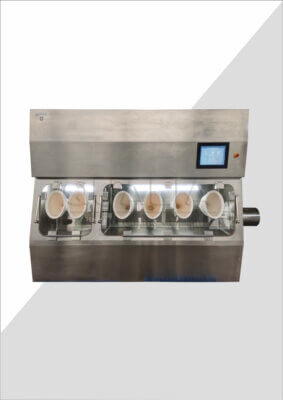
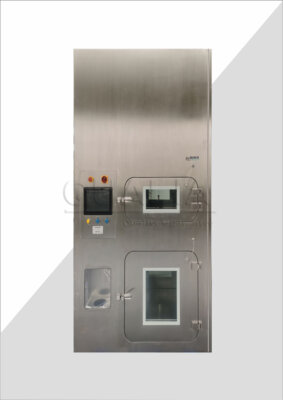
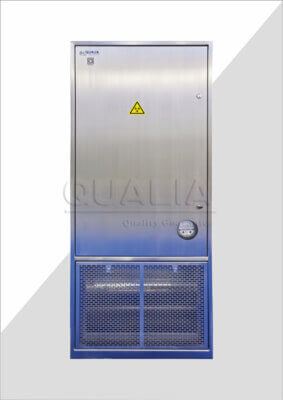
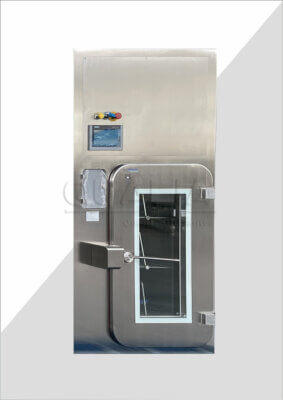
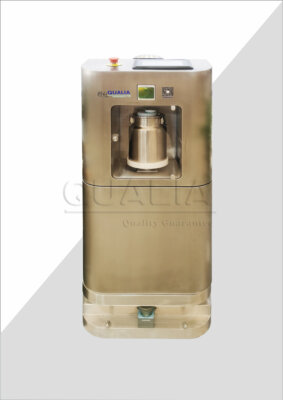
Keeping these distinctions in view matters because it is easy to substitute a passed local check or a product data sheet for the project-defined installed-wall verification the facility actually needs. Where QUALIA’s Vacu-Pass Cord and Cable Port or a comparable transit is being reviewed for a project, the cable and conduit schedule, spare-position requirements, and wall construction details the buyer supplies are what allow that configuration to be checked against the specific opening, rather than assumed suitable from the product listing alone. Confirming what verification the project requires — and at what scope, local or whole-room — before finalizing either approach keeps the comparison between compression transit and field-applied sealant on a basis the project can actually accept.
Frequently Asked Questions
Q: Which wall-seal approach is better if cables may be added or removed later?
A: Neither is automatically better. For a compression transit, check spare positions and module or block fit after the change; for field-applied sealant, establish how access will be regained for a later repair.
Q: Can a compression transit be specified by product name alone?
A: No. Check its module or block fit against the actual cable and conduit schedule, and confirm the frame-to-wall detail at the project opening.
Q: What should I ask an installer before choosing field-applied sealant?
A: Ask how the opening will be prepared, how the actual mix of services will be sealed, and how the installation can be accessed for a later repair.
Q: How should material exposure affect the comparison?
A: Compare both proposed approaches against the project’s material-exposure and cleanability needs. Neither approach has a universal fit independent of those conditions.
Q: Does a local smoke-pencil check prove that the whole room is tight?
A: No. Where applicable, it is a local seal check; it does not establish whole-room tightness. Define the installed-wall verification scope for the project rather than treating a component claim or local observation as room-level evidence.