

A retrofit inside a BSL-3 or BSL-4 facility rarely stays confined to the component that was physically touched. Before a project team can decide what to test, it has to decide what actually changed — and that boundary question, not the test method itself, determines whether the acceptance work is defensible. Getting that boundary wrong in either direction creates a real cost: too narrow, and an untested interface re-enters service with an unverified containment function; too broad, and the project re-tests systems that were never disturbed.
Retrofit Boundaries Must Include Physical and Functional Changes
| Retrofit interface | Boundary question | Acceptance-planning consequence |
|---|---|---|
| Penetrations and seals | Did the modification disturb a containment penetration or seal? | Include inspection and testing for the affected seal; do not infer a universal room-tightness test scope or limit. |
| Pressure zones | Did the change alter an affected pressure relationship? | Include directional-airflow verification for that relationship. |
| Exhaust paths | Did the retrofit change an exhaust path or its interface? | Include the affected exhaust function within the test boundary. |
| Controls, alarms, and interlocks | Did the control configuration, logic, or an interface state change? | Test the affected controls, alarms, and interlocks across the changed interface states. |
| Utilities, transfer equipment, and waste interfaces | Did the work change a physical connection or functional dependency at one of these interfaces? | Treat the affected function as part of the change boundary and select verification according to project risk. |
A containment retrofit is rarely a single isolated action. Work on one interface frequently touches others that share a physical connection or a functional dependency, even where no one intended that result. A cable or cord penetration added through a containment wall is a physical change, but it can also be a functional change if it alters the pressure differential across the barrier it passes through. A control logic update tied to a door or airlock is a functional change even where no hardware was replaced. The project team’s first task is not testing — it is mapping which physical boundaries and which functional relationships were disturbed by the retrofit work, independent of how small the intervention seemed at the time.
This matters because containment performance is relational. A penetration, a pressure zone, an exhaust path, a control point, a utility connection, and a waste interface do not function independently; each depends on the others holding their designed state. Where a retrofit changes one of these, the boundary of “what changed” has to extend to every function that depends on the altered condition, not just the component that was physically opened or replaced. A pressure-zone change driven by a new penetration is a functional consequence of a physical action, and both need to sit inside the same acceptance boundary.
The practical consequence for project planning is that the change boundary has to be defined before the test list is written, not derived from it. If the team starts by asking “what tests do we normally run after this kind of work,” it risks testing only the obvious physical change and missing the functional consequence that travels through the system. If it starts instead by asking “which interfaces — penetrations, pressure zones, exhaust paths, controls, utilities, transfer equipment, waste interfaces — were disturbed, physically or functionally, by this retrofit,” the test list follows from an evidence-based boundary rather than habit.
Where the retrofit is confined to a single, well-isolated component with no shared dependency, the boundary stays narrow and the acceptance work stays targeted. Where the retrofit touches a shared utility, a shared control system, or a function with downstream dependents, the boundary has to expand to include those dependents, even where the dependents themselves were not physically modified. Confirming which condition applies is the first judgment the project team has to make, and it has to be made explicitly, not assumed from the scope of the maintenance work order.
Existing Evidence Remains Usable Only for Unchanged Configurations
| Evidence condition | Permitted use | Acceptance implication |
|---|---|---|
| Configuration is unchanged and the evidence remains applicable | Retain the record as a baseline for that unchanged configuration. | The record does not establish acceptance of a changed interface. |
| A changed interface may affect a prior or adjacent result | Do not carry the result forward without reassessing its applicability. | Include the affected result in the re-verification scope. |
| Configuration match or evidence applicability is unclear | Treat applicability as a project-specific unknown. | Keep the related function within the review boundary until the relationship is established. |
Qualification and commissioning records from the original facility build or a prior retrofit represent evidence of a specific configuration at a specific point in time. That evidence remains valid only as long as the configuration it describes remains unchanged. The retrofit acceptance question is not whether the prior evidence was adequate when it was produced — it almost certainly was — but whether the configuration it describes still exists after the current work.
This is where retrofit acceptance differs from new-build commissioning. In a new build, all evidence is produced against the final, as-built configuration. In a retrofit, the project inherits a mix: some systems carry forward unchanged, others were directly modified, and some sit in between — not directly modified, but adjacent to or dependent on something that was. The project team has to sort each system into one of these categories before deciding what evidence applies to it.
The difficult category is the third one. A changed interface can invalidate an adjacent result even where the adjacent system was never opened, because the adjacent system’s prior qualification assumed a condition — a pressure relationship, an airflow path, a control state — that the retrofit may have altered. Carrying forward a qualification record without reassessing whether its underlying assumption still holds treats inherited evidence as if it were self-renewing, which it is not.
Where the configuration match between the retrofit’s as-built state and the qualification record’s described state is clear and unchanged, the existing record can serve as a baseline and does not need to be repeated. Where that match is unclear — where the team cannot confirm whether the retrofit touched an assumption the earlier evidence depended on — the honest position is to treat the applicability as an open question and keep the related function inside the review boundary until the relationship is established, rather than defaulting to either full acceptance or full re-testing. This is a documentation discipline as much as a technical one: the retrofit acceptance package has to show, for each inherited record, why it was judged still applicable, not merely that it exists.
Penetrations, Seals, and Pressure Relationships Need Targeted Checks
| Changed interface | Targeted evidence | What the check establishes | Evidence boundary |
|---|---|---|---|
| Cable or other wall penetration | Inspection and testing of the affected penetration seal after a change or repair | Evidence for the changed penetration and its seal | It does not establish a universal room-tightness scope, fixed limit, or product approval. |
| Pneumatic-seal door interface | Verification of the affected seal and any affected alarms or interlocks after seal replacement or a control update | Evidence for the changed door-interface functions | It does not accept unchanged systems elsewhere. |
| Pressure relationship between affected zones | Directional-airflow verification for the affected relationship | Evidence for the changed pressure-zone relationship | It does not validate adjacent untouched zones. |
Once the change boundary is defined, the acceptance work has to produce evidence that matches each specific interface rather than a generic test applied uniformly across the facility. Penetrations, seals, and pressure relationships behave differently from one another, and the evidence that establishes performance for one does not transfer to the others.
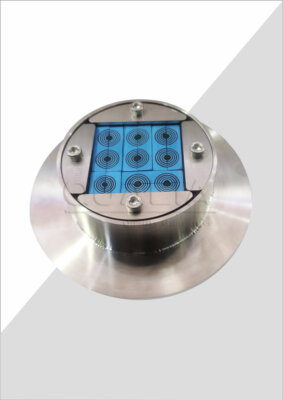
A wall penetration — for cables, cords, or other service pass-throughs — is evaluated through inspection and testing of that specific seal after the change or repair that affected it. This produces evidence for that penetration and its seal; it does not establish a room-wide tightness scope or a universal limit, and it does not speak to the condition of other penetrations in the same wall that were not disturbed. Where a facility uses a dedicated cord and cable port, as with a Vacu-Pass-type penetration device, the targeted check applies to that specific port and its seal interface, not to the wall assembly as a whole.
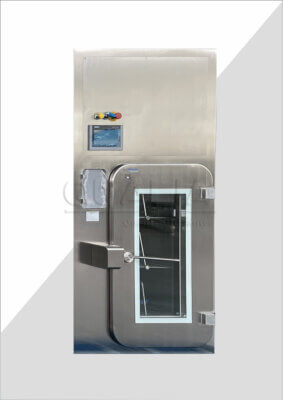
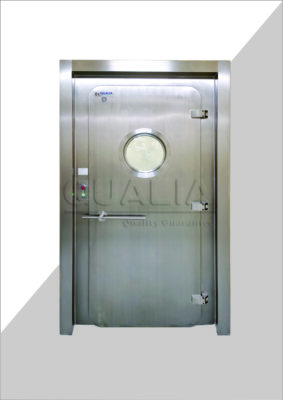
A pneumatic-seal door interface carries its own distinct verification need. Where a door seal was replaced or a control update changed how the door’s interlocks or alarms behave, the targeted check has to cover the seal itself and any alarm or interlock function tied to that seal’s new state. This evidence establishes the door-interface function; it does not accept unchanged systems elsewhere in the same airlock or suite, even where those systems share the same control platform.
A pressure relationship between two zones needs directional-airflow verification specific to that relationship. This is distinct from both the penetration check and the door check, because a pressure relationship is a dynamic, system-level condition rather than a static seal condition — it depends on the exhaust path, supply balance, and door state all behaving as designed simultaneously. Verifying the relationship for one affected zone pair establishes evidence for that pair; it says nothing about an adjacent, untouched zone pair, even where both pairs share the same exhaust branch upstream.
The practical implication is that a retrofit acceptance plan cannot rely on a single test type to cover multiple interface categories. Where the retrofit touched a penetration, a door seal, and a pressure relationship simultaneously, the project needs three distinct evidence sets, each scoped to its own interface, with the boundary of each result stated clearly enough that it cannot later be read as covering more than it does.
Controls and Interlocks Require Tests Across New Interface States
Controls and interlocks present a different acceptance challenge than seals or pressure zones, because their function is defined by behavior across states rather than by a single static condition. A control system or interlock that passes a check in one state — door closed, system at rest, normal operating pressure — has not been shown to behave correctly in every state the retrofit may have introduced or altered.
Where a retrofit changes a control configuration or its underlying logic, the new or modified logic has to be exercised across each interface state it governs, not just the state that happens to be convenient to test. A door interlock tied to a pressure differential, for example, has a design intent that spans at least the normal state, the transition state, and any fault or alarm state. If only the normal state is verified, the retrofit acceptance work has confirmed that the door behaves correctly when nothing is wrong, which is the state least likely to reveal a change-induced error.
This matters particularly where the retrofit was a control logic update rather than a hardware replacement. A logic change can alter how an alarm condition is evaluated, how an interlock responds to a boundary condition, or how two previously independent control loops now interact, without any visible physical change at all. Because the change is invisible at the hardware level, the only way to confirm it behaves as intended is to put the system through each state the new logic is meant to handle and confirm the response matches the intended design, including states that represent a deviation or a recovery condition rather than steady-state operation.
The project team’s judgment here is to identify, for each changed control or interlock, the full set of states the retrofit introduced or altered — not only the states the original design anticipated, but any new state created by the retrofit itself — and confirm that each state produces the intended response. Where the retrofit altered a shared control platform, this obligation extends to every interlock or alarm function that platform governs, even where only one specific function was the intended target of the change.
Repairs or Deviations Can Expand the Re-Verification Scope
| Trigger | Why the current scope may no longer be sufficient | Required treatment |
|---|---|---|
| Deviation during verification | The affected function no longer has an unqualified result for the tested configuration. | Record the deviation, determine the affected boundary, and document any repair and re-verification. |
| Repair to an affected interface | The configuration after the repair differs from the configuration that produced the earlier evidence. | Record the repair and re-verify the affected function. |
| Change that may affect an adjacent result | A changed interface can invalidate evidence for a connected function. | Reassess the adjacent record and expand the re-verification scope where it is no longer applicable. |
| Maintenance or decontamination recovery affecting a function | The recovery state is part of the affected functional boundary. | Verify the affected recovery function according to project risk and record the configuration and evidence. |
Acceptance testing itself can generate new information that changes the scope of what still needs to be verified. A deviation encountered during verification, or a repair performed on an interface as a result of that verification, is not a closed event once the immediate issue is resolved — it is a trigger that requires the project team to reconsider whether the original test boundary still describes the full scope of what needs evidence.
A deviation during verification means the affected function no longer has a qualified result for the configuration as tested. This is distinct from a successful test with no deviation: once a deviation occurs, the function sits in an unresolved state until it is either re-tested successfully or the deviation is otherwise dispositioned and documented. A repair performed on an affected interface changes the configuration itself — the system after the repair is not the same system the earlier evidence described, even where the repair was intended to restore the original design intent, because the as-built condition changed in the process of getting there.
The more consequential case is where a deviation or repair reveals that an adjacent, previously-assumed-unaffected result may no longer be applicable. This connects directly back to the boundary and evidence-applicability questions raised earlier: a repair on one interface can invalidate the assumption an adjacent qualification record depended on, even where the adjacent system was never directly touched by the retrofit or the repair. Recognizing this requires the project team to treat each deviation and repair as a prompt to re-examine the boundary, not merely to fix the immediate finding and move on.
Maintenance or decontamination recovery functions deserve the same treatment where the retrofit affected them. A recovery function — the system’s ability to return to its designed containment state after a maintenance or decontamination event — is part of the functional boundary the retrofit may have disturbed, even where it is not the first function a team thinks to test. Where the retrofit altered a recovery-related interface, the recovery function itself needs to be verified according to the affected risk, with the configuration and the resulting evidence recorded alongside the rest of the acceptance package.
Release Records Must Distinguish Tested Changes From Untouched Systems
| Release-record section | Required entry | Decision value |
|---|---|---|
| Tested configuration and change boundary | Identify the physical and functional configuration covered by the retrofit acceptance work. | Defines what the new evidence applies to. |
| Tested interfaces and functions | List the affected penetrations, seals, pressure relationships, exhaust paths, controls, alarms, interlocks, or recovery functions actually verified. | Shows which changed functions received targeted checks. |
| Existing evidence retained | Identify the earlier records used only for unchanged configurations where the evidence remains applicable. | Separates accepted baseline evidence from new retrofit testing. |
| Deviations, repairs, and re-verification | Record each deviation or repair and the evidence produced after it. | Shows how exceptions affected the final test scope and evidence set. |
| Untouched systems | Identify systems outside the tested change boundary. | Prevents the retrofit release from being read as new acceptance evidence for untouched systems. |
The final judgment in a BSL-3/4 retrofit acceptance is not a test result — it is how the release record represents the relationship between what was tested and what was not. A release record that simply states the facility passed its acceptance testing, without distinguishing tested changes from untouched systems, creates a documentation gap that the facility owner inherits indefinitely: anyone reading that record later has no way to know which systems the new evidence actually covers.
The record needs to identify the tested configuration and change boundary explicitly, so that anyone reviewing it later understands exactly what physical and functional scope the retrofit acceptance work addressed. It needs to list the specific interfaces and functions actually verified — the penetrations, seals, pressure relationships, exhaust paths, controls, alarms, interlocks, or recovery functions that received targeted checks — rather than describing the work in general terms that could be read as broader than what was done. It needs to identify which earlier qualification records were retained as baseline evidence, and for which unchanged configurations that evidence remains applicable, so the distinction between new testing and inherited evidence is traceable rather than implied.
Where a deviation or repair occurred during the acceptance process, the record needs to show how that event was resolved and what evidence was produced afterward, so a later reviewer can see how the final test scope was arrived at rather than assuming the original plan was executed without exception. Finally, the record needs to identify systems that sit outside the tested change boundary altogether — systems the retrofit did not touch, physically or functionally — so the release cannot later be misread as new acceptance evidence for those untouched systems.
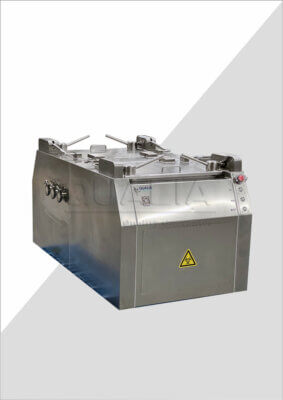
This structure serves the facility owner’s long-term interest more than it serves the immediate retrofit project: a future retrofit, audit, or inspection will depend on being able to tell, from the record alone, which systems carry currently applicable evidence and which carry evidence from an earlier configuration that may no longer hold. Where a project supplies QUALIA with the retrofit’s configuration details, affected interfaces, and risk basis as part of a quotation or project review, that same boundary information is what allows equipment such as APR doors, cord and cable ports, or in situ filtration components to be configured and documented against the actual change scope, rather than against a generic assumption of what the retrofit involved.
Frequently Asked Questions
Q: Does every BSL-3/4 retrofit require the entire facility to be retested?
A: The acceptance scope should start with the physical and functional change boundary, then expand wherever a changed interface could invalidate evidence for a connected function. Untouched systems can remain outside the new test scope only when their configuration is unchanged and the existing evidence remains applicable.
Q: What project information should be assembled before the retrofit acceptance plan is finalized?
A: Document the changed configuration, affected penetrations, pressure relationships, exhaust paths, controls, utilities, transfer equipment, and waste interfaces, together with the qualification records proposed as the baseline. Also identify known deviations, repairs, maintenance, and recovery activities so their effect on the test boundary can be assessed before release.
Q: Can an earlier qualification record be reused after a nearby interface changes?
A: Only after confirming that the recorded configuration is unchanged and that the evidence still applies. If the changed interface can affect the earlier result, keep that connected function within the review boundary until its applicability is established or it is re-verified.
Q: Does a successful test of a changed cable penetration or door seal accept the surrounding containment system?
A: It provides evidence for the affected penetration, seal, and any other functions actually tested, such as an affected alarm, interlock, or pressure relationship. It should not be treated as acceptance evidence for adjacent untouched zones or as proof of a universal room-tightness limit.
Q: When should the re-verification scope be expanded during acceptance work?
A: Expand it when a deviation, repair, changed interface, or affected maintenance or decontamination recovery state makes the original evidence uncertain for another function. Record the event, define the newly affected boundary, and link the resulting re-verification evidence to the final tested configuration.
Q: How can a buyer compare proposed retrofit acceptance plans?
A: Check whether each plan maps every disturbed interface to the function and evidence it will verify, explains how existing records will be screened for continued applicability, and defines how deviations or repairs will be handled. The release package should also separate newly tested changes, retained baseline evidence, resolved exceptions, and systems that were not retested.