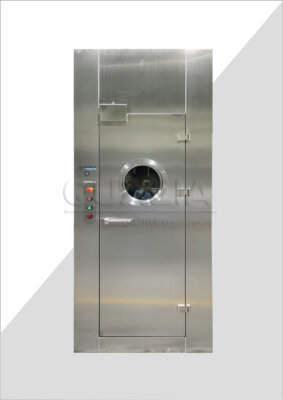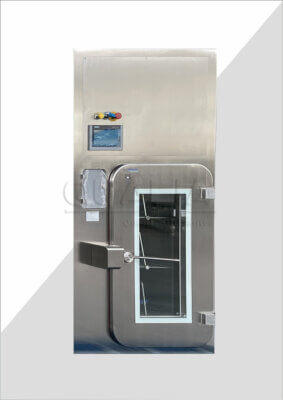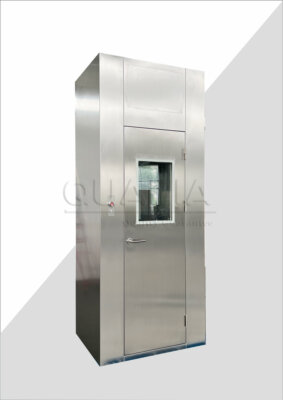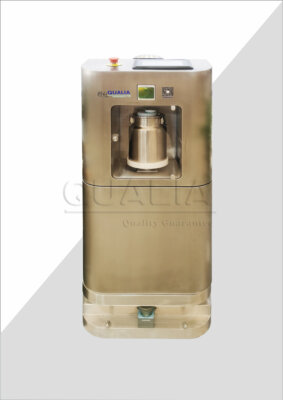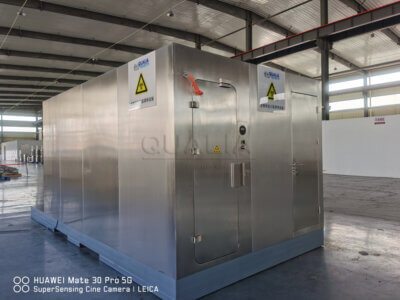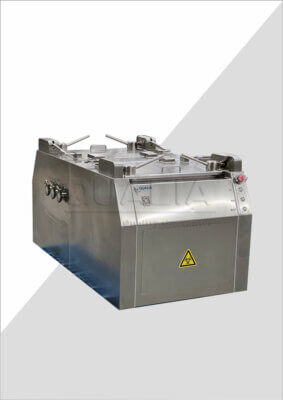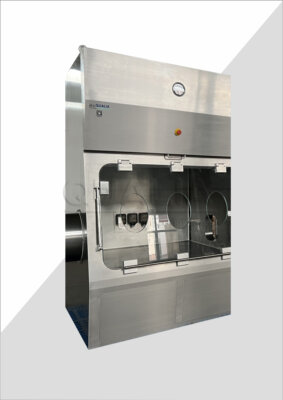
Specifying a dunk tank late in a BSL-3 or BSL-4 laboratory design often means discovering that the largest tray or container used in the lab does not fit through the access opening, or that the tank placement makes disinfectant drainage route directly across an uncontrolled boundary. Both problems are difficult to correct after construction. The cost shows up as rework to structural penetrations, re-qualification of the transfer point, or a revised risk assessment that delays commissioning. The decisions that prevent this are made at the intersection of containment level, physical load inventory, PPE constraints, and drainage pathway—not during equipment procurement alone. Readers of this article should leave better positioned to identify the questions that require answers before a dunk tank specification is finalized.
Tank Size for Largest Load and Manipulation Space
The tank interior must accommodate the largest item that will pass through it, but that is only the first dimension. The more often underestimated constraint is the manipulation clearance needed to fully submerge, orient, and retrieve that item while keeping hands and forearms inside the disinfectant bath without breaking containment. A tank sized around maximum load dimensions with no additional margin leaves an operator attempting to tip, rotate, or reorient a container against the tank walls—increasing the risk of splashing and reducing control during the most exposure-critical moment of the transfer.
The starting point for sizing is a physical inventory of the largest items transferred routinely: culture flasks, centrifuge rotors, secondary-packaged samples, and any sealed waste containers. The longest and widest dimensions drive the opening and interior plan, while the tallest item plus required submersion depth drives the liquid volume and interior depth. A container must clear the disinfectant surface to drain adequately before retrieval; oversizing the depth to allow this is less expensive than a redesign.
Downstream, tank volume directly affects disinfectant concentration management. A larger tank requires a proportionally larger chemical inventory, longer initial fill time, and a more demanding solution change procedure. If the design review does not fix both the load envelope and the operational volume at the same time, one will undermine the other.
Lid Seal and Access Opening Design
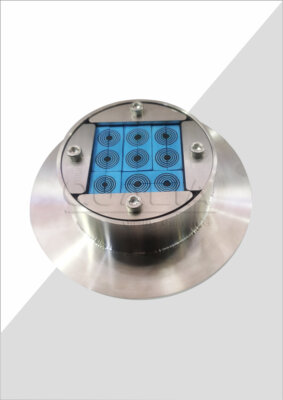
The lid seal is not an assembly convenience—it is part of the containment barrier. At BSL-4, the reference integrity target for a Class III biological safety cabinet is a gas-tight enclosure with sealed viewing windows that cannot be opened during operation. While a dunk tank is not a BSC, its lid seal must meet an equivalent standard when integrated with Class III cabinet infrastructure: aerosol release through a failed or partially seated lid seal during loading or retrieval is a direct exposure pathway for the operator and a potential contamination event in the surrounding airspace.
The access opening geometry creates a competing pressure on the design. The opening must be large enough to pass the load comfortably, but a larger opening places more sealing surface area under compression and increases the consequence of any local seal failure. Where BSL-3 or BSL-4 directional airflow controls are present, the lid seal must maintain negative pressure continuity across the tank. A seal that is adequate under static conditions but deforms under repeated manual opening force or loses compression after chemical exposure may not reliably hold under dynamic use conditions.
Seal material selection is closely connected to decontamination chemistry compatibility. Silicone and EPDM formulations differ in their resistance to chlorinated disinfectants, aldehydes, and oxidizing agents. Specifying a seal without confirming compatibility with the facility’s actual disinfectant protocol creates a maintenance problem that surfaces after installation, not before.
Drainage and Disinfectant Removal Controls
Drainage from a containment dunk tank cannot discharge without treatment. The disinfectant solution, once it has received contaminated items, must be treated as potentially hazardous liquid waste. The drainage pathway must route to an effluent decontamination system or a validated liquid waste collection point—not to a general floor drain or building sewer without explicit authorization in the facility’s risk assessment.
The valve or drain mechanism design matters for operator safety. A drain controlled from outside the tank—without requiring the operator to reach into the bath to open or reposition a plug—reduces exposure during solution change. Drain controls should also prevent accidental opening during operation; a valve that can be inadvertently actuated while manipulating a load creates an uncontrolled release pathway mid-transfer.
Where the facility uses a liquid effluent decontamination system, the dunk tank drainage connection must be confirmed against system capacity and flow rate. A large tank draining into an undersized EDS holding volume, or a drain line with no liquid level monitoring, creates a risk of overflow at the EDS or incomplete treatment of waste volume. This interface should be defined in the URS and confirmed during FAT and site-level IQ review. The WHO Laboratory Biosafety Manual, Decontamination and Waste Management monograph addresses the requirement for liquid effluent management at high-containment levels and provides a regulatory grounding for drainage pathway controls in the facility risk assessment.
Operator Reach With Realistic PPE and Load Weight
BSL-4 operators work in positive-pressure full-body suits with gloved-on hand interfaces and restricted peripheral vision. BSL-3 operators typically work in powered air-purifying respirators with double-gloved hands and limited wrist mobility. In both cases, the dexterity available for gripping a wet, heavy container submerged in liquid is considerably less than the dexterity available during a standard bench operation. This matters for lid operation, item orientation, and retrieval grip.
Operator reach should be tested against the actual tank geometry before installation is finalized—not modeled theoretically. The combination of tank depth, lid opening clearance, item weight when saturated with disinfectant, and body position while leaning over the tank creates ergonomic loading that is difficult to predict without a physical mockup. A load that weighs 2 kg dry may effectively weigh more under water due to drag and the awkward grip angle required, and a slip during retrieval is a contamination event, not merely an ergonomic incident.
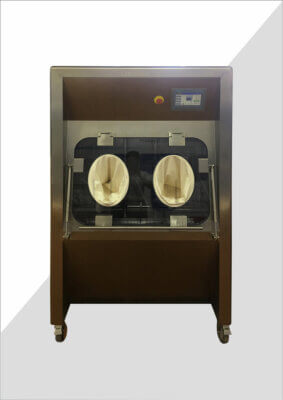
If the dunk tank is positioned at floor level for Class III cabinet integration, the reach geometry changes further: operators may need to access the tank through a cabinet floor aperture, which constrains both arm angle and visual confirmation of container placement. This configuration should be confirmed with the cabinet manufacturer and the lab layout team before the tank specification is written, not after structural work is complete.
Cleaning Solution Change and Seal Maintenance
Disinfectant solutions in containment dunk tanks degrade through dilution, organic loading, and photochemical breakdown. Concentration monitoring—using appropriate test methods for the specific disinfectant in use—should be part of the routine maintenance protocol, and the protocol should include clear criteria for solution replacement. A tank where solution change frequency is undefined or where concentration is not confirmed tends toward use at sub-efficacious levels, which creates a documented gap in the facility’s decontamination validation record.
The solution change procedure itself involves containment risk. Draining, rinsing, refilling, and verifying concentration all require access to a tank that has held contaminated material. The procedure should be written before commissioning, not improvised after. For BSL-3 and BSL-4 laboratories, the interior surfaces—including the tank body, lid, seal seat, and drain assembly—must withstand the full decontamination cycle used for the room, which may include VHP or formaldehyde fumigation. Material compatibility between tank components and room decontamination agents should be confirmed at specification and documented for IQ.
Seal inspection should be a scheduled maintenance activity, not a reactive one. A compressed elastomeric seal that has been cycled repeatedly through chemical exposure and mechanical loading will degrade, and the degradation may not be visible until a seal failure occurs during transfer. Inspection intervals and replacement criteria should be defined in the maintenance SOP and referenced in the OQ protocol so that the containment integrity claim remains defensible over the equipment’s operational life. WHO Laboratory Biosafety Manual, 4th Edition, Laboratory Design and Maintenance identifies ongoing maintenance and monitoring as essential elements of sustained containment integrity, which directly applies to seal and solution management in transfer points.
For details on how the Qualia Biosafety Dunk Tank is configured for these constraints, the product page covers tank specification and construction. Further context on transfer point decisions at BSL-3 is available in the pass box requirements by BSL level overview.
Design Questions for BSL-3/4 Transfer Points
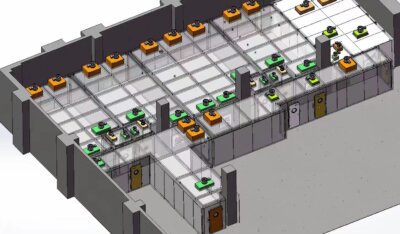
Dunk tank placement within a BSL-3 or BSL-4 suite is not only a spatial decision—it is a containment system integration decision. When the dunk tank is used in conjunction with a Class III biological safety cabinet, physical alignment between the cabinet floor and the tank access opening must be confirmed, including flange type, gasket material, and the structural load on the cabinet base. A misaligned or inadequately sealed connection between the cabinet and the tank is a containment gap that affects the cabinet’s integrity classification, not just the tank’s performance.
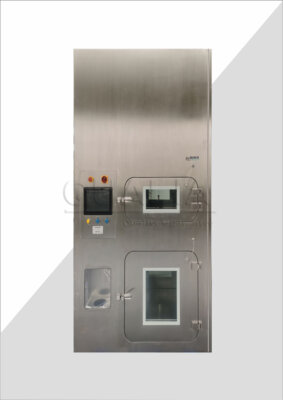
The choice between a dunk tank and a double-door pass-through interchange box—such as a through-the-wall autoclave—also requires a risk-based decision, not a default. The autoclave allows full decontamination between transfers and may be preferred where the transfer volume is compatible with autoclave cycle time and load size. The dunk tank is faster and continuous but requires active disinfectant management and offers no terminal sterilization. Where interim decontamination between every transfer is a regulatory or biosafety committee requirement, the interchange box may be the more defensible option even if it introduces cycle time constraints. This tradeoff should be explicit in the facility risk assessment.
The three structural questions that need answers before a dunk tank specification is finalized at a BSL-3/4 transfer point are summarized here:
| Design Question | Why It Matters | What to Clarify |
|---|---|---|
| How does the dunk tank physically integrate with Class III BSC floor to allow safe material removal? | Placement and sizing depend on mechanical alignment between containment levels to avoid exposure. | Confirm the required tank opening size, flange type, and gasket material that maintain cabinet floor integrity. |
| Should the transfer method be a dunk tank or a double‑door pass‑through interchange box (e.g., autoclave)? | The choice affects decontamination workflow, cycle timing, and the ability to fully decontaminate between uses. | Specify whether interim decontamination is needed and whether the interchange box can replace dunk tank in the risk assessment. |
| How does the dunk tank integrate with the lab’s controlled access and special ventilation systems? | Installation and maintenance access depend on room layout, ventilation negative pressure, and access control zones. | Define placement constraints, needed clearance for maintenance, and interface with the lab’s exhaust/ventilation system without disrupting directional airflow. |
Integration with the facility ventilation system adds a further constraint. The dunk tank must not disrupt the directional airflow pattern that maintains negative pressure in the laboratory zones it serves. Maintenance access for solution change, seal replacement, and drain servicing must be achievable without requiring personnel to cross containment boundaries or interrupt ventilation continuity. This access planning is easiest to resolve during design development and very difficult to retrofit after the ventilation system is commissioned.
The decisions that most often cause dunk tank problems in BSL-3/4 environments are not resolved by selecting a well-built unit. They are resolved by confirming load inventory before specifying interior dimensions, by connecting drainage to an appropriate effluent treatment pathway at the design stage, and by writing maintenance and decontamination procedures before the equipment is commissioned rather than after. Each of those decisions has a downstream consequence in qualification: a tank whose dimensions were not validated against the actual load inventory, or whose drainage pathway was not defined in the URS, will generate findings during IQ or OQ that require either procedure revision or physical modification.
Before procurement or URS finalization, the specific questions to confirm are: What is the largest item that will transfer through this tank, and has it been physically measured? What is the drainage destination and has the effluent treatment pathway been included in the facility risk assessment? What PPE configuration will operators wear, and has reach been tested against tank geometry? The answers to those three questions determine whether the installation will be qualified cleanly or revised under pressure.
Frequently Asked Questions
Q: What happens if our facility doesn’t have a Class III BSC — does the dunk tank specification change significantly?
A: Yes, the integration requirements change substantially. Without a Class III BSC, the physical alignment constraints between cabinet floor and tank access opening do not apply, but the containment boundary the dunk tank serves must still be defined explicitly in the facility risk assessment. The lid seal integrity target, drainage routing, and airflow continuity requirements remain, but the structural flange connection and cabinet load verification steps drop out of the specification checklist. The remaining design questions — load inventory, drainage destination, operator reach — apply regardless of whether a Class III cabinet is present.
Q: After the dunk tank is installed and commissioned, what is the first maintenance task that should be formally scheduled?
A: Seal inspection intervals and disinfectant concentration verification should be the first two scheduled maintenance activities, with written criteria in place before the equipment enters operational use. Both are time-sensitive: concentration drift can occur within days depending on organic loading and use frequency, and seal degradation under repeated chemical cycling may not be visually obvious until a failure occurs during transfer. Defining replacement criteria and inspection frequency in the maintenance SOP before commissioning keeps the containment integrity claim defensible from the first operational cycle onward.
Q: At what point does autoclave cycle time make the interchange box a better choice than a dunk tank?
A: When transfer frequency is high enough that autoclave cycle time creates a workflow bottleneck, the dunk tank’s continuous availability becomes the decisive advantage. The interchange box is more defensible where terminal decontamination between every transfer is a regulatory or biosafety committee requirement and transfer volume is low enough that cycle time does not interrupt operations. If the facility transfers material multiple times per shift and cannot absorb a 45-to-90-minute autoclave cycle between each pass, the dunk tank is the operationally viable option — provided active disinfectant management and concentration monitoring are resourced accordingly.
Q: Is a physical mockup of the tank geometry genuinely necessary, or is a CAD model sufficient for confirming operator reach in BSL-4 suits?
A: A physical mockup is necessary where BSL-4 full-body suit constraints are involved — a CAD model cannot replicate the combination of restricted peripheral vision, gloved-hand dexterity loss, and effective load weight increase from drag and awkward grip angle during retrieval. The failure mode is not a measurement error; it is an ergonomic condition that only becomes apparent when an operator in the actual PPE configuration attempts to reorient a saturated container at depth. Discovering this after structural installation forces either a procedural workaround that must be defended in the risk assessment or a physical modification to tank depth or access geometry.
Q: If the facility’s effluent decontamination system was sized before the dunk tank volume was finalized, is there a reliable way to assess whether it can handle the additional load?
A: Confirm the EDS holding volume and maximum flow rate against the dunk tank’s full drain volume and expected drain time, then check whether the combined peak load — including other connected sources draining simultaneously — exceeds the EDS capacity at any point in the cycle. If the EDS was sized without accounting for the dunk tank, the most common failure mode is overflow at the holding vessel during a full solution change, not during routine small-volume drainage. This interface should be revalidated in the URS and tested during FAT before site installation, since retrofitting EDS capacity after commissioning involves requalification of the entire effluent treatment system.