
Treating dunk tank transfer as a simple soak step is where most SOPs first go wrong. Teams define a contact time, verify initial disinfectant concentration, and assume the biology will follow — but the actual decontamination outcome depends on whether the disinfectant physically reaches every external surface of every container passing through the tank. When it does not, a compliant contact time means nothing, and the gap is almost never visible in the tank during normal operation. The practical cost surfaces later: at audit when an inspector asks how wetting of all external surfaces is confirmed, or after an incident when the SOP cannot demonstrate that the transfer boundary was ever fully controlled. What follows sets out the specific conditions — geometric, chemical, ergonomic, and procedural — that must be actively managed to make dunk tank transfer defensible as a containment method.
Complete Surface Contact as the Core Risk
Decontamination through liquid disinfectant is a contact chemistry event. If the disinfectant does not reach a surface, the concentration and contact time on the label are irrelevant for that surface — no inactivation can be claimed, regardless of what the surrounding liquid is doing.
This is the foundational logic behind every downstream dunk tank control. Concentration thresholds, fill levels, contact time requirements, and load preparation rules are not independent checklists; they are each a mechanism for achieving or protecting complete surface contact. When any one of them fails, the result is not a partial decontamination — it is an unverifiable decontamination, which in a BSL-2+ transfer context means the containment assumption at the outer boundary cannot be defended.
The practical implication for SOP design and audit readiness is that acceptance criteria cannot be written as time rules alone. A container that floated through a full recommended contact period still represents an uncontrolled transfer if its underside was never wetted. Inspectors asking about surface contact proof are asking the right question, and the absence of an answer is a finding regardless of whether the disinfectant concentration was correct.
Air Pocket Floating and Folded-Surface Hazards
Air entrapment and floating are not edge cases — they are predictable failure patterns in dunk tank transfer, and they occur precisely with the container types most commonly passed through biosafety tanks.
Secondary containers, transport bags, and lidded bottles all carry air. When placed on the disinfectant surface, they float rather than submerge. Even when pushed under manually, trapped air inside a sealed secondary container creates buoyancy that resists full submersion without active downward pressure. A container held at the surface or tilted during entry may appear submerged from above while an air pocket keeps a section of the base or a seam clear of liquid contact. Flexible bags present a different version of the same problem: folds and creases along the sealed edges can trap a thin dry layer against the bag surface, and the external liquid contact time on the folded section is effectively zero even when the outer surface appears wet.
These are load preparation and operator technique problems as much as equipment problems. Rigid secondary containers should be oriented on entry to allow air displacement from the highest point. Flexible bags should be smoothed before entry so that folds do not trap air against the sealed edges. Neither of these steps is difficult once identified, but neither appears in most generic contact-time SOPs. If the load preparation protocol does not address geometry, the contact time requirement provides false assurance.
Disinfectant Concentration Over Use and Organic Load
A correctly prepared tank at the start of a session does not remain at that concentration through a full day of transfers. Organic load from biological residues, dilution from wet containers entering the tank, and the normal chemical consumption of an active disinfectant all degrade working concentration over time.
The WHO LBM 4th Edition decontamination guidance supports the principle that disinfectant efficacy must be actively maintained rather than assumed from initial preparation — concentration must be treated as a dynamic condition, not a fixed property of the fill. The practical consequence is that a re-verification protocol is not optional equipment; it is part of the decontamination control. How frequently re-verification should occur depends on transfer volume and organic load, but the re-verification method and trigger must be defined in the SOP before commissioning, not added as a corrective action after an audit.
The concentration and fill-level criteria that anchor these checks are specific, verifiable conditions at each transfer event.
| Requirement | Threshold / Criterion | Verification Method |
|---|---|---|
| Disinfectant concentration | ≥5% (≥3,500 µS) | Conductivity meter |
| Fill level | Marked level | Regular inspection |
The conductivity meter approach provides an objective, on-site method for concentration verification without relying on visual inspection or titration. The fill level check is the companion condition: a tank with correct concentration but insufficient volume cannot fully submerge a load, and the two criteria must be confirmed together. Facilities that verify concentration at the start of a shift only — and do not track volume loss from carried-out disinfectant — should treat this as an open SOP gap with direct consequence for containment defensibility.
Operator Reach Lid Behavior and Safe Submersion
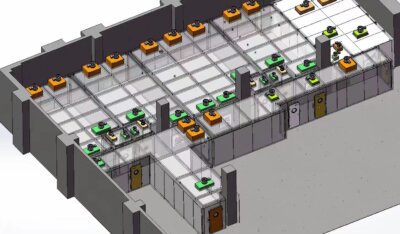
The physical relationship between the operator, the tank geometry, and the lid determines whether safe submersion is achievable under normal working conditions. This is a layout and ergonomics problem that gets resolved — or not — during facility design, and the consequences of getting it wrong only become visible once the space is commissioned.
A tank positioned against a wall or within a recessed pass-through creates a reach distance that operators must bridge to push containers to the far side or bottom of the tank. If that distance exceeds comfortable reach, operators will adapt: they lean, they use improvised tools, or they partially submerge containers and release them before full wetting is achieved. None of these adaptations will appear in the SOP, but they will be visible on observation during an audit or incident investigation. Lid behavior compounds the problem. A lid that must be held open while a container is being positioned occupies one hand, leaving only the other available for the submersion task. If the load requires two hands to control — because it is buoyant, oddly shaped, or in a flexible bag — the operator cannot safely complete the task without either releasing the lid or releasing the load.
These conditions should be evaluated during layout review and URS development, not after handover. Acceptance of the installed tank should confirm that a representative operator can fully submerge the maximum defined load size from the working position with the lid held open, without adopting a posture that compromises control or containment. If that check fails at the installed position, the fix is a layout change, not an operator instruction.
For facilities evaluating pass-through configurations where dunk tank transfer is one of several material transfer methods, reviewing the broader design context across BSL levels may be useful: Pass Box for Biosafety Laboratory: Requirements by BSL Level.
Load Limits Contact Time and Wetting Proof
Load limits and contact time are not universal figures. They are facility-specific operational thresholds that must be derived from the disinfectant product’s validated efficacy data, the container geometries and sizes in use, and the tank’s physical capacity to submerge those loads fully. No single regulatory source provides a single number applicable to all disinfectants, all container types, and all BSL levels. The facility’s own SOP is the defining document, and it must be defensible on the basis of the choices made in it.
The trade-off that is most often deferred is load limit definition. Specifying a maximum container size or maximum number of items per transfer event is unglamorous, but it directly affects whether full submersion is geometrically achievable. A tank filled to the marked level with a defined disinfectant concentration can still fail to submerge a load that displaces too much volume — either the liquid level rises and spills, or the container sits partly above the liquid surface. Load limits should be set based on the tank’s working volume and the buoyancy characteristics of the largest containers permitted through the tank, and they should be documented in the SOP as a hard boundary, not a guideline.
Wetting proof is the verification step that confirms contact conditions were actually met — not that a timer elapsed. In practice, wetting proof means confirming that all external surfaces of the container showed visible liquid contact after submersion, before transfer through the outer door is allowed. This is a review check, not a guaranteed outcome of following the time rule. Operators who cannot confirm complete wetting for a given load should be able to return the load for re-preparation — smooth the bag, reorient the container, adjust the volume in the tank — rather than proceed on elapsed time alone. An SOP that does not provide a decision pathway for incomplete wetting has a gap that will produce either a containment shortfall or an improvised operator response.
More detail on how dunk tank design supports these operational checks is covered in Understanding the QUALIA Biosafety Dunk Tank: Features and Applications.
SOP Boundaries for BSL Dunk Tank Transfer
The containment logic of a dunk tank depends on three interdependent operational boundaries: how materials are packaged before entry, how the tank is positioned and used within the facility’s containment architecture, and how the door interlock sequence is enforced. Failure at any one of these does not merely reduce decontamination efficacy — it can break the containment boundary entirely, regardless of what the disinfectant is doing.
The packaging requirement exists because the dunk tank decontaminates external surfaces. Materials inside the container are not exposed to disinfectant during transfer; the inner primary container and its contents travel through the tank in the same biological state they entered. The dual-container requirement is therefore a containment control, not just a handling convenience: if the primary container leaks inside the secondary, the dunk tank receives a contaminated liquid rather than a sealed surface, and the transfer event becomes an uncontrolled release rather than a decontamination step. Leak-proof primary containment inside a non-breakable secondary container is the condition that makes the dunk tank’s chemistry relevant to the materials passing through it.
The pass-through design requirement reflects a specific use case. Dunk tank transfer is defined as the appropriate method for materials that cannot be autoclaved, and the tank must maintain containment integrity throughout the transfer — it is not a sanitization aid or a supplementary step applied after containment has been relaxed. ISO 35001:2019 frames biorisk management as a structured and documented system in which each control measure must be purposeful, verified, and traceable; a dunk tank SOP that cannot articulate why this method was selected, how it maintains containment, and under what conditions it fails does not meet that standard of defensibility.
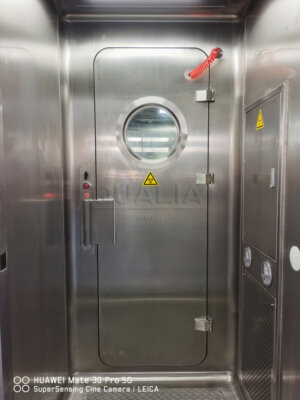
The door interlock sequence is the physical enforcement of the pass-through principle. The inner door must be secured before the outer door opens, and this sequence must not be available for manual override during normal operation. If the sequence is skippable, the pass-through function is optional rather than enforced, and the containment value of the boundary becomes dependent on operator discipline rather than system design.
| SOP Boundary | What It Specifies | Containment Purpose |
|---|---|---|
| Container packaging layers | Use a leak-proof sealed primary container inside a non-breakable sealed secondary container | Prevents release of biological materials during transfer |
| Tank design requirement | Must be a pass‑through decontamination method for non‑autoclavable materials, maintaining containment at all times | Preserves BSL integrity for heat‑sensitive items |
| Door interlock sequence | Inner door must be secured before the outer door can be opened | Prevents cross‑contamination between containment zones |
The three SOP boundaries in the table are interdependent. A correctly packaged load entering through a properly sequenced interlock still represents an uncontrolled transfer if the tank was not designed as a maintained containment boundary. Reviewing these three elements together — during SOP development, FAT/SAT, and IQ/OQ — is more productive than treating them as separate checklist items that can be validated independently.
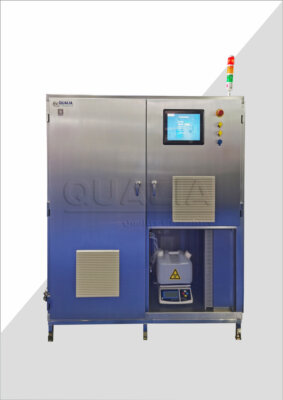
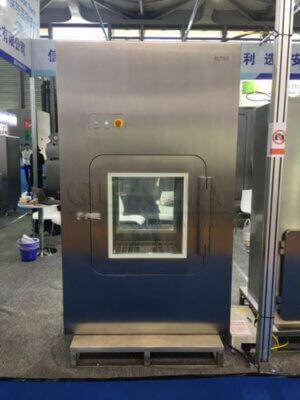
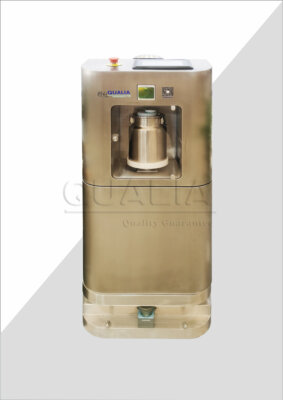
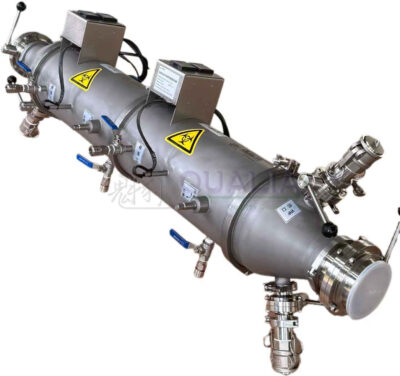
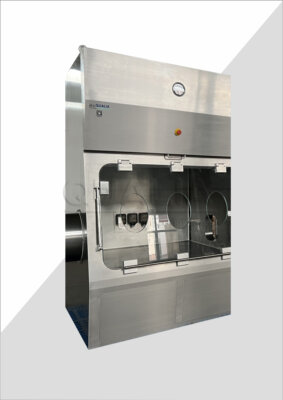
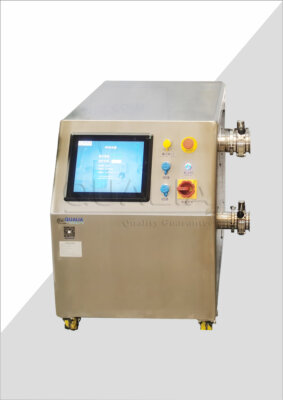
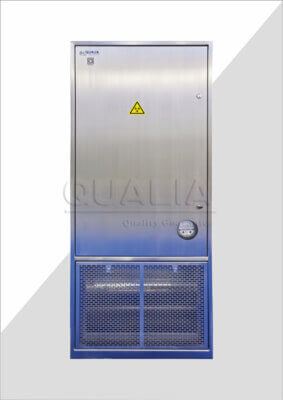
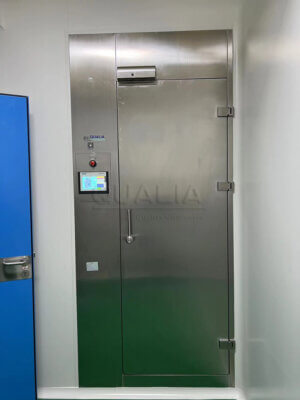
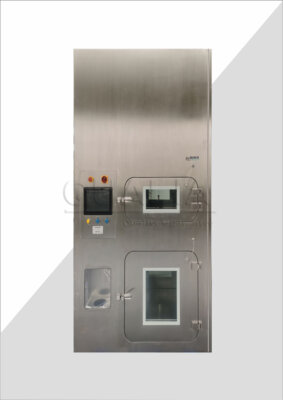
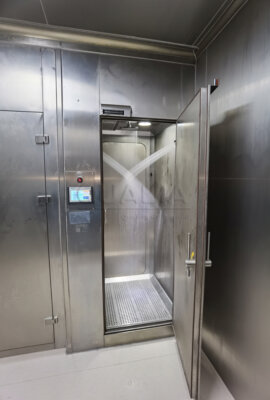
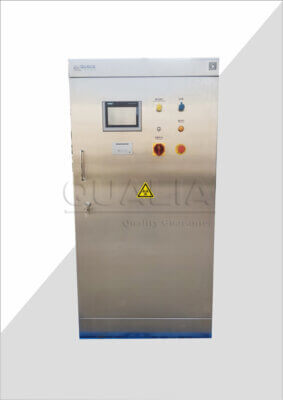
The Biosafety Dunk Tank is designed to support pass-through decontamination within a maintained containment architecture, including the door interlock behavior and fill-level design that the SOP boundaries described here depend on.
The core judgment that dunk tank transfer requires is not about disinfectant selection or contact time — it is about whether the physical conditions for complete surface contact were actually present at every transfer event. Concentration, fill level, container preparation, operator reach, and load limits are each a mechanism for achieving that condition, and each one can degrade independently without making the failure visible in the tank. A concentration that passed at the start of a shift, a load that floated during transfer, and an operator who could not safely submerge an awkward container all produce the same audit-time problem: an inability to demonstrate that decontamination occurred.
Before commissioning a dunk tank installation or revising an existing SOP, the questions worth confirming are: what is the re-verification trigger for concentration during a shift, what is the maximum container size and load permitted per transfer, how does the SOP define wetting proof and what does the operator do when it is not achieved, and has the installed position been evaluated for operator reach with a representative load. These are not documentation refinements — they are the conditions under which the pass-through boundary either holds or does not.
Frequently Asked Questions
Q: Does a dunk tank remain a valid transfer method if the materials being passed through can tolerate autoclaving?
A: No — dunk tank transfer is specifically defined as the appropriate method for materials that cannot be autoclaved, not as an interchangeable alternative. Using it for autoclavable materials does not make the transfer invalid, but it does mean the SOP must still justify the method selection and demonstrate that the containment conditions described — dual packaging, door interlock sequence, maintained disinfectant concentration — are all met. If autoclave capacity is simply unavailable at a given moment, that is an operational constraint, not a design basis, and the SOP should reflect which method is primary and under what conditions the dunk tank is used instead.
Q: How often should disinfectant concentration be re-verified during a shift, and what triggers an out-of-use decision?
A: The re-verification frequency must be defined in the SOP before commissioning based on transfer volume and organic load — there is no universal interval that applies across facilities. The trigger for an out-of-use decision is a conductivity reading below 3,500 µS (equivalent to 5%), at which point the tank cannot be used for further transfers until concentration is restored and re-verified. Facilities that only check concentration at shift start and do not account for volume loss from wet containers exiting the tank should treat this as an open SOP gap.
Q: What should an operator do when complete wetting of all external surfaces cannot be confirmed before the outer door is opened?
A: The operator should return the load for re-preparation rather than proceed on elapsed contact time alone. Acceptable corrective actions include smoothing a folded flexible bag, reorienting a rigid container to allow air displacement, or adjusting the tank fill volume — then re-submerging and re-timing from the start of confirmed submersion. An SOP that does not provide a defined decision pathway for this scenario leaves the operator without a compliant option, which in practice produces either an unverified transfer or an improvised response that will not survive audit scrutiny.
Q: At what point does a pass box become a more appropriate transfer method than a dunk tank?
A: A pass box becomes preferable when the materials to be transferred are incompatible with liquid disinfectant immersion — whether because of container material sensitivity, label or device integrity, or because the load cannot be reliably submerged without safety risk from the working position. A VHP pass box extends this to heat- or moisture-sensitive materials requiring vapor-phase decontamination. The dunk tank’s value is specifically in external surface decontamination through direct liquid contact; when that contact cannot be safely or completely achieved for a given load type, the method is not fit for that transfer regardless of contact time compliance.
Q: Is a dunk tank installation adequate for BSL-3 material transfer, or does BSL-3 require additional containment controls beyond what a dunk tank SOP typically addresses?
A: A dunk tank can be used within a BSL-3 containment architecture, but it is not sufficient on its own — it must be integrated into a facility design that maintains the containment boundary throughout the transfer sequence. At BSL-3, the door interlock must enforce the pass-through sequence without operator override capability, the tank must be positioned so the full transfer can be completed without breaching the containment zone, and the SOP must be validated as part of the facility’s overall biorisk management system in line with ISO 35001:2019. The tank’s chemistry is only one element; the containment value of the installation depends equally on the surrounding design, interlock enforcement, and documented SOP boundaries.