Selecting the wrong filter changeout strategy for an OEB5 isolator rarely surfaces as an obvious specification error — it surfaces during commissioning, when SMEPAC testing reveals operator exposure exceedances that no one traced back to contaminated filter removal, or during a campaign ramp-up, when increased maintenance frequency turns a manageable push-push procedure into a cumulative exposure problem. The cost is not just a retrofit budget item; it is a delayed product release, a qualification restart, and the organizational friction of realigning EH&S, production, and procurement around a risk criterion they should have agreed on before the equipment order. The decision that resolves this is not simply “upgrade to BIBO” — it is a structured evaluation of compound potency, campaign frequency, and waste-handling pathway against a single shared OEL, conducted before layout is fixed. What follows gives you the analytical structure to make that evaluation defensibly, not retrospectively.
Containment objectives that separate OEB5 changeout strategies
Push-push and BIBO are not interchangeable terms for the same level of protection. They represent different engineering answers to the same underlying question: how much residual containment uncertainty is acceptable at the moment a contaminated filter leaves the isolator housing?
Push-push operates on a sequential pressure-relief principle. The upstream filter is pushed forward into a clean housing position while the downstream filter simultaneously shifts to the exhaust position, allowing removal without breaking the containment envelope under positive or neutral conditions. It is a mechanically straightforward system and, for OEB5 applications, it functions as a well-established baseline. Compounds at or near the OEB5 boundary — occupational exposure limits at or below 50 ng/m³ — can be handled within this configuration when the process is stable, campaigns are infrequent, and waste-handling downstream is controlled. This is why push-push appears as a standard feature rather than a minimum regulatory floor: it is sufficient for a defined set of operating conditions, not for every configuration within the OEB5 band.
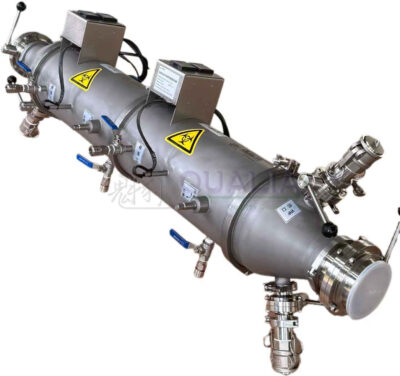
BIBO adds a physical containment sleeve — a continuous bag — around the filter housing during removal, so that the filter never contacts the room environment and any residual powder migration is captured inside the bag before it is sealed and removed. The critical distinction is that BIBO externalizes the exposure risk from the changeout step itself, whereas push-push manages that risk through pressure engineering. When those pressure controls function as designed, the difference is modest. When they do not — due to a momentary pressure loss, a sticky valve, or an operator error on timing — the exposure profile between the two strategies diverges sharply, and that divergence occurs at exactly the point where containment evidence is hardest to generate in real time.
| Strategy | Core Containment Objective | Typical Role in OEB5 Design |
|---|---|---|
| Push-Push | Provides a sufficient baseline for OEB5 containment. | Standard, accepted feature for handling compounds at OEB5 potency levels. |
| BIBO | Offered as an optional upgrade for enhanced containment. | Targeted addition for higher-risk scenarios within the OEB5 band. |
The implication is not that BIBO is always necessary, but that push-push’s adequacy depends on conditions that need to be explicitly confirmed — not assumed — for each process. Teams that treat push-push as a guaranteed OEB5 solution without evaluating those conditions are accepting an untested margin.
Operator exposure control under BIBO and push-push layouts
Both strategies depend on sustained negative pressure differentials to maintain inward airflow and prevent powder migration toward the operator. In a typical OEB5 isolator reference configuration, the dispensing chamber operates at a significantly more negative pressure than the pre-chamber — the staged differential ensures that any air movement at an interface flows inward, not outward. These specific values reflect engineering design choices for a particular isolator architecture, not universally mandated setpoints, and actual values should be confirmed against the equipment specification and facility HVAC design.
Where the strategies diverge is in what happens when that pressure envelope is briefly compromised. During a push-push changeout, the pressure cascade is the primary and often only barrier preventing powder escape at the filter face. An operator working through gloveports has limited ability to visually confirm that the upstream filter face is fully sealed before the housing shifts. In practice, this means that training rigor and procedural adherence carry more of the containment burden than they do in a BIBO configuration, where the physical bag provides a secondary barrier regardless of momentary pressure variation.
BIBO introduces its own operator exposure window — the moment when the bag must be sealed, tied, and removed while still connected to the housing. This step requires deliberate technique and correctly specified bag material for the compound in question. A bag breach at this stage, while less likely than an open filter exposure event, produces a concentrated release. The practical implication is that BIBO shifts exposure risk from the filter removal moment to the bag-sealing moment, and that shift is only a net safety gain if the bag-sealing procedure is properly validated and operators are trained specifically for it.
For high-potency campaigns within OEB5 — particularly where the compound OEL sits at the lower end of the band, closer to 1 ng/m³ than to 50 ng/m³ — the margin available for procedural variability narrows considerably. At those potency levels, neither strategy should be evaluated on engineering design alone; both require surrogate testing or direct air monitoring to confirm that operator exposure during changeout remains within the site limit under realistic working conditions.
Cleaning burden, consumables, and turnaround-time differences
The operational cost of BIBO is real and should be quantified before the equipment decision is finalized, because teams that evaluate it only in terms of capital cost consistently underestimate its impact on campaign throughput.
A push-push changeout can typically be completed by a trained operator in a single procedure cycle: the filter shifts, the housing is closed, and a brief integrity check confirms the system is back in service. The consumables are limited to the replacement filter itself. Total downtime per changeout is short, and the procedure is repeatable with low variability — which matters for campaign scheduling and maintenance planning.
A BIBO changeout adds bagging materials, tie-off hardware, secondary containment for waste, and additional procedural steps that extend the total changeout time. Each of those steps is a potential failure point in both the containment sense and the scheduling sense. For a process that requires filter changes every two to four weeks, the cumulative difference in turnaround time is manageable. For a process running daily or near-daily campaigns with high powder throughput, that difference compounds — and the consumables budget reflects it.
The mistake is treating this as a procurement cost comparison rather than a total cost of operations question. BIBO’s higher consumables spend and longer changeout time are incurred at exactly the highest-risk moments — when filters are loaded with potent compound and operator exposure is most consequential. That is not a coincidence; it is the engineering rationale for the added steps. The relevant question is whether the exposure margin that BIBO provides during those moments is worth the operational overhead, given the compound’s potency, the campaign frequency, and the downstream waste-handling pathway. When teams skip that analysis and default to push-push on the grounds that it is simpler and cheaper, the oversight often surfaces later as a preventive maintenance interval that is too aggressive for the operational schedule or a SMEPAC result that requires a corrective action plan before production can resume.
Cleaning verification also differs between the two approaches. With push-push, the housing interior and filter face area are accessible for swab sampling after each changeout cycle, and cleaning validation can follow a relatively standard protocol. With BIBO, the physical geometry of the bag-enclosed housing limits accessible sampling surfaces, and cleaning verification procedures need to account for areas that are not directly reachable. This is not a disqualifying constraint, but it is one that cleaning validation teams should evaluate before commissioning, not during.
SMEPAC and surrogate-testing implications for each option
Containment performance claims for an OEB5 isolator are only as strong as the evidence behind them, and the nature of that evidence changes depending on which changeout strategy is in place.
The ISPE SMEPAC methodology provides a standardized approach to evaluating airborne containment performance using surrogate compounds, generating data that can be used to characterize operator exposure during representative operations including filter changeout. For both push-push and BIBO configurations, isolator chamber integrity testing — typically evaluated against a pressure drop threshold of less than 8 Pa per minute over a five-minute hold — establishes baseline enclosure performance. HEPA filters in both configurations are generally equipped with provisions for integrity testing such as DOP or PAO challenge, confirming that the filter system itself can be validated independently of the changeout mechanism.
Where the two strategies generate different validation burdens is in the changeout procedure itself. Push-push changeout is a standardized mechanical operation with a relatively predictable exposure profile, and surrogate test data for the filter-shift sequence can often be generated within a structured commissioning protocol. BIBO introduces procedural variability at the bag-sealing step that surrogate testing must specifically capture, because the bag-sealing technique directly determines whether containment is maintained or compromised at the point of highest residual contamination. A surrogate test protocol for BIBO that does not include the bag-sealing and waste-removal sequence does not provide adequate evidence for the exposure claim.
| Testing Aspect | Measurable Standard / Provision | Why It Matters for Validation |
|---|---|---|
| Isolator Chamber Integrity Leak Rate | Pressure drop <8 Pa/min for 5 minutes. | Defines the acceptable leak threshold for the containment barrier. |
| HEPA Filter Integrity Testing | Filters equipped with connections for standard testing (e.g., DOP). | Ensures the filter system can be validated for containment performance. |
The downstream consequence of this difference appears at qualification. A push-push system with strong SMEPAC data for the filter-shift sequence provides a defensible basis for operator exposure modeling. A BIBO system with SMEPAC data that omits the bag-sealing step leaves a gap that regulators and internal audit teams will identify — and that gap typically requires a supplementary study before the system can be released to full production. Teams selecting BIBO should treat the bag-sealing procedure as a distinct validation target, not an assumed extension of the filter changeout data. For further background on how surrogate powder testing is structured for OEB4-5 containment verification, the Surrogate Powder Testing Methods for OEB 4-5 Containment Performance Verification overview provides useful context on methodology selection.
Facility conditions where BIBO provides a stronger safety margin
BIBO’s safety margin is not uniform across all OEB5 applications. It is most meaningful in a specific set of facility and process conditions where the residual containment uncertainty of push-push becomes difficult to manage.
The first condition is compound potency at the lower end of the OEB5 band. OEB5 encompasses compounds with OELs at or below 50 ng/m³, but the engineering margin available to the operator differs significantly between a compound at 40 ng/m³ and one at 1 ng/m³. At the lower end, any uncharacterized exposure event during filter changeout — even a brief pressure transient, a momentary gloveport pressure loss, or powder resuspension during filter handling — can push cumulative operator exposure toward the site limit. Push-push manages that risk through pressure engineering; BIBO adds a physical barrier that remains effective even if pressure control is momentarily imperfect. For compounds at or below roughly 1 ng/m³, the additional physical margin of BIBO is difficult to justify omitting without direct exposure evidence.
The second condition is high campaign frequency. A process running multiple campaigns per week loads filters faster, increases the frequency of changeouts, and raises the cumulative maintenance exposure burden. Even if a single push-push changeout produces acceptable operator exposure, the cumulative exposure across a high-frequency schedule may not. BIBO’s advantage in this scenario is not that each individual changeout is dramatically safer, but that the physical bag barrier prevents the compounding effect of residual powder accumulation on filter faces from translating into repeated operator exposure events.
The third condition is downstream waste-handling uncertainty. A contaminated filter removed via push-push must be contained, bagged, and transferred to waste handling without contaminating the room environment. If the waste-handling pathway downstream of the isolator is not fully characterized — different operators, variable technique, shared disposal areas — that step introduces exposure risk that the isolator’s containment strategy cannot compensate for. BIBO partially addresses this by enclosing the filter in a bag before it leaves the housing, so that the downstream waste-handling burden is reduced. Using a bag-out liner to transfer used containers without requiring decontamination of the primary container extends this logic: it reduces the number of open-container moments in the waste stream.
A hybrid configuration — BIBO for material transfer ports and push-push for exhaust air filtration — is one engineering approach that targets BIBO’s higher containment at the specific interfaces where powder migration risk is greatest, while preserving push-push’s operational simplicity for the air-handling path. This is an engineering trade-off rather than a formally recommended configuration, and its suitability depends on the facility layout, waste-handling workflow, and the compound’s specific exposure profile. EU GMP Annex 1’s contamination control principles provide useful framing for evaluating where physical barriers add the most value in a multi-interface containment system, though the specific interface decision remains a facility-level engineering judgment.
Decision framework by potency, campaign frequency, and waste-handling risk
The organizational friction that delays this decision — EH&S, production, and procurement each applying a different risk threshold — does not resolve itself through better information alone. It resolves when the team agrees on a single exposure criterion before evaluating either strategy. Without that alignment, push-push looks adequate to production because it is simpler, BIBO looks excessive to procurement because it costs more, and EH&S cannot force a resolution because the OEL has not been formally established as the binding design constraint. That impasse typically breaks only when a project milestone forces it, often late enough that changing the equipment specification carries a layout or schedule penalty.
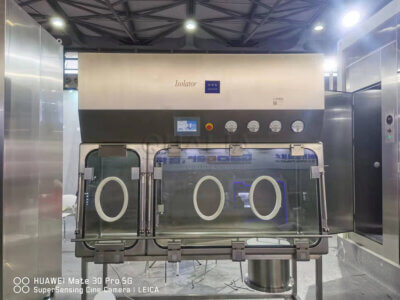
The practical starting point is confirming the compound’s OEL and agreeing that it — not a general OEB classification — is the criterion against which both strategies are evaluated. OEB5 equipment is designed for compounds with OELs at or below 50 ng/m³, but within that band, the defensible strategy shifts based on where the compound sits and how much uncertainty surrounds its handling behavior. A compound at 30 ng/m³ with well-characterized handling properties and infrequent campaigns may be manageable under push-push with strong SMEPAC data. A compound at 2 ng/m³ with variable powder behavior and weekly campaigns is a different risk profile that warrants a harder look at BIBO before the equipment order is placed. Qualia Bio’s OEB4 / OEB5 Isolator platform supports both configurations, which makes the selection a design decision rather than an equipment availability constraint.
| Decision Factor | Threshold / Key Consideration | What to Clarify for Your Process |
|---|---|---|
| Potency (OEL) | Equipment is designed for compounds with OEL ≤ 50 ng/m³. | Whether the specific compound’s potency and handling uncertainty justify the extra containment of BIBO. |
| Waste-Handling Risk | Use of a bag-out liner to transfer used containers without decontaminating the primary container. | If downstream waste handling procedures maintain containment or introduce exposure points the isolator strategy must mitigate. |
The waste-handling pathway deserves more structured attention than it typically receives during equipment specification. Using a bag-out liner for used container transfer is one method that reduces open-container exposure steps, but it does not eliminate downstream handling risk entirely. The relevant question is whether the entire pathway from filter removal to final waste disposal has been mapped for exposure events, and whether any of those events occur outside the containment boundary established by the isolator. If the answer is yes — if there are downstream steps that depend on operator technique rather than engineered containment — that gap should be reflected in the changeout strategy decision, not handled as a separate SOP issue after the equipment is installed.
For teams still working through the broader equipment selection question before isolator specification, the comparison of Isolators vs RABS vs Downflow Booths for OEB 4-5 Applications addresses the upstream decision that determines whether an isolator is the right platform before the BIBO versus push-push question becomes relevant. And for teams that have not yet worked through the full OEB classification for their compound, the OEB 3 vs OEB 4 vs OEB 5 equipment requirements overview provides a useful foundation for grounding the potency-band discussion in specific equipment expectations.
The most durable version of this decision is one where the choice between push-push and BIBO is documented against a specific OEL, a specific campaign frequency, and a mapped waste-handling pathway — not against a general OEB classification or a vendor feature list. Push-push is a legitimate baseline for a defined set of OEB5 conditions; BIBO provides a physical margin that becomes increasingly difficult to forgo as potency increases, campaigns become more frequent, or downstream waste handling introduces uncontrolled exposure moments.
Before finalizing the equipment specification, confirm three things: the compound’s OEL as an agreed design constraint rather than a planning estimate, the expected changeout frequency under realistic campaign scheduling, and whether the waste-handling pathway from filter removal to disposal is fully characterized for exposure risk. Those three inputs, taken together, determine whether push-push’s engineering controls are sufficient or whether BIBO’s physical containment margin is the more defensible choice — and that determination is far less costly to make during specification than during commissioning.
Frequently Asked Questions
Q: What happens if our team hasn’t formally established the compound’s OEL before the equipment order is placed?
A: The equipment decision should be paused until the OEL is agreed upon as a binding design constraint, not a planning estimate. Without it, EH&S, production, and procurement will each apply a different risk threshold, and the strategy selection — push-push or BIBO — cannot be made defensibly. A general OEB5 classification is not a sufficient substitute, because the engineering margin available to the operator differs significantly across the OEB5 band. Establishing the OEL first is the step that makes every subsequent evaluation tractable.
Q: After selecting BIBO, what is the first validation step teams typically overlook before commissioning?
A: The bag-sealing and waste-removal sequence must be treated as a distinct SMEPAC surrogate-test target, not assumed to be covered by the broader filter changeout data. A surrogate test protocol that captures the filter-shift procedure but omits the bag-sealing step leaves a gap that regulators and internal audit teams will identify — and closing it after commissioning typically requires a supplementary study that delays release to full production.
Q: Does push-push remain a defensible strategy if campaign frequency increases significantly after the isolator is installed?
A: Not automatically. Push-push’s adequacy was evaluated against the original campaign schedule, and a meaningful increase in changeout frequency raises cumulative operator exposure in ways the initial strategy assessment did not account for. Even if each individual push-push changeout produced acceptable exposure data, the compounding effect of higher-frequency maintenance cycles may push cumulative exposure toward the site limit. A revised exposure assessment against the new schedule is warranted before continuing under the original push-push configuration.
Q: Is a hybrid BIBO-and-push-push configuration meaningfully safer than either strategy alone, or does it just add complexity?
A: It depends on where powder migration risk is actually concentrated in the specific facility layout. A hybrid approach — BIBO at material transfer ports, push-push for exhaust air filtration — can target the physical bag barrier at the highest-risk interfaces while preserving push-push’s operational simplicity elsewhere. However, it only improves the overall safety profile if the risk mapping has identified those interfaces correctly. Applied without that analysis, it adds consumables cost and procedural steps without a corresponding reduction in operator exposure uncertainty.
Q: At what point does the operational overhead of BIBO outweigh its containment benefit for an OEB5 process?
A: When the compound OEL sits in the upper portion of the OEB5 band, campaigns are infrequent, waste-handling downstream is fully characterized, and SMEPAC data for the push-push changeout sequence confirms exposure remains well within the site limit — at that point, BIBO’s physical margin is harder to justify against its added consumables cost and longer changeout time. The overhead of BIBO becomes a net liability only when the exposure evidence for push-push is strong and the process conditions are stable. Absent that evidence, the overhead is the price of a defensible margin, not an unnecessary cost.
Related Contents:
- In the realm of pharmaceutical manufacturing and laboratory research, maintaining a sterile and safe environment is paramount. The OEB4/OEB5 Isolator stands at the forefront of containment technology, utilizing advanced filtration systems to ensure the highest levels of safety and sterility. This article delves into the comparison between two cutting-edge filtration systems: PUSH-PUSH and BIBO (Bag-In Bag-Out), exploring their roles in creating optimal conditions within these critical containment units.
- What Containment Level Does an OEB5 Isolator Provide?
- Safe Hazardous Material Handling with BIBO
- Emerging Trends: The Future of BIBO Technology
- Bag-in Bag-out System Market Trends 2025 – Biosafety Integration Data
- Bag-In-Bag-Out Housing Applications in Pharmaceutical Manufacturing
- Ensuring Compliance: BIBO and Industry Standards
- Ensuring Compliance: OEB4 and OEB5 Isolator Standards
- Bag-In-Bag-Out Containment for Biopharmaceutical Processing – 27 CFR Compliance