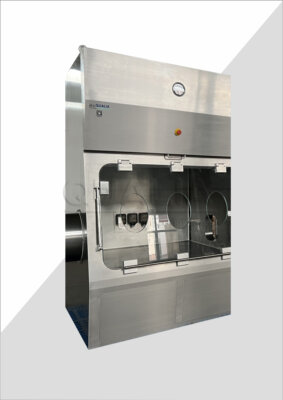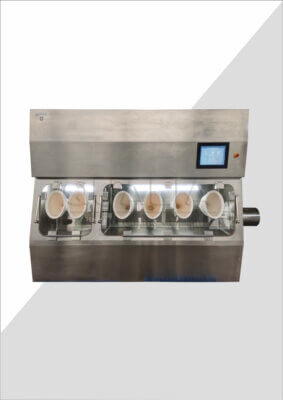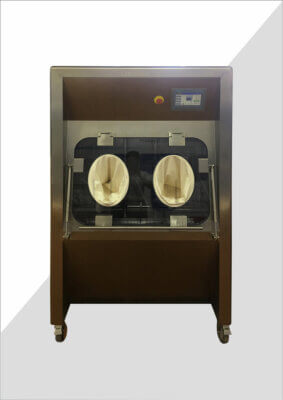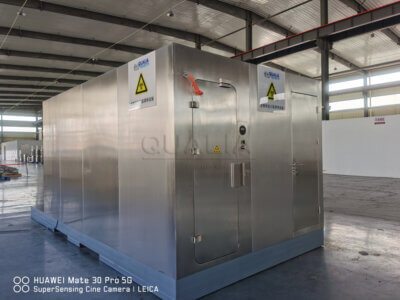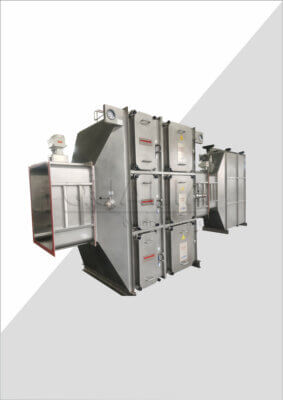
Specifying HEPA filtration for a BSL-3 exhaust system looks straightforward until the first filter change becomes a live containment event. A single tear in a containment bag, a housing positioned too close to the ceiling to allow full sleeve deployment, or a decontamination port that was never included in the HVAC routing can convert a routine maintenance task into a viable aerosol exposure. The decision that prevents all three of those failure modes is made at specification, not during the changeout itself. Understanding the precise placement, geometry, pressure, and verification requirements for bag-in-bag-out systems lets procurement and biosafety teams lock in a safe design before HVAC routing is frozen.
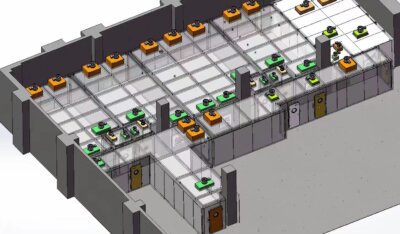
Where BIBO sits in the BSL-3 containment boundary
The right position for a BIBO housing is as close to the containment boundary as the duct geometry allows, on the exhaust path leaving the controlled zone. This is not simply a best-practice preference — it is a containment-minimization principle. The further downstream a contaminated filter sits, the longer the duct run between the source zone and the housing, and the greater the volume of potentially contaminated space that must be managed before any maintenance activity can safely begin.
Placing BIBO housings at or near the containment boundary keeps that contaminated duct run short. It also means that decontamination ports — injection points for gaseous decontaminants such as hydrogen peroxide vapor — remain physically accessible from a service corridor or interstitial space, rather than buried inside a finished ceiling void. This matters operationally: a port that exists on paper but cannot be reached without removing building elements is not a functional safety control.
The common planning mistake is treating BIBO placement as an HVAC coordination problem rather than a biosafety-boundary problem. Mechanical engineers optimizing duct routing will often move a housing to a more convenient structural bay. If that decision is made without biosafety review, the result is a housing that sits further into the exhaust duct run, serves a longer contaminated segment, and may be adjacent to surfaces that were never designed for decontamination access. Biosafety reviewers frequently raise these concerns late in design development, after routing is already committed — a friction point that experienced teams avoid by treating BIBO location as a first-tier containment decision, reviewed alongside room pressure mapping rather than after mechanical design is complete.
For teams working within a modular or purpose-built containment structure, this placement logic integrates directly with the broader BSL-3 negative pressure cascade design, where exhaust filtration is an active component of the differential pressure boundary, not a passive add-on downstream.
Exposure pathways created during contaminated filter changeout
The BIBO concept controls exposure by ensuring that the contaminated filter is bagged out and sealed before it is withdrawn from the housing, and that no bare-hand contact occurs with any contaminated surface throughout the sequence. In practice, the exposure pathways that break this sequence are more specific than general guidance implies.
Bag rupture during deployment or withdrawal is the most direct failure mode. The mechanism is straightforward: if the housing porthole has sharp edges, machining burrs, or poorly finished weld seams at the opening, the bag sleeve can tear as it is pushed through or pulled back. A torn bag during the removal phase — when the filter is already dislodged and the bag is under tension — creates an immediate exposure pathway with no reliable recovery option short of emergency containment procedures. Specifying a housing porthole with radiused, smooth-finished edges is therefore a direct structural control, not an aesthetic specification.
A second exposure pathway that receives less attention is improper bag-sleeve length. If the sleeve is too short relative to the filter depth and housing geometry, the technician must extend reach into the housing to grip the filter, placing hands and forearms inside the containment zone without adequate barrier protection. This is not a procedure problem; it is a specification problem. The sleeve length must be matched to the actual filter depth at procurement, not improvised in the field.
There is also a sequence-dependent exposure risk when the housing is decontaminated inadequately before bagging begins. Even with a nominally sealed filter in place, residual contamination on the housing interior walls, guide rails, or clamping surfaces can transfer to the outside of the bag during manipulation. This is why internal surface finish — smooth, fully welded, without ledges or recesses — is both a construction specification and a direct contributor to exposure control.
Housing access, bagging geometry, and service-clearance requirements
Service clearance is the specification item most commonly sacrificed to save mechanical-room space, and it is the one that most directly affects whether a BIBO changeout remains a controlled procedure or becomes an improvised one.
A fully deployed bag sleeve needs unobstructed linear space in front of the housing porthole — enough to accept the filter element as it is withdrawn into the bag, plus additional working length for the technician’s arms. When a housing is positioned against a wall, above a duct crossing, or immediately below a ceiling soffit, the sleeve cannot be extended to its functional length. The technician then has to compress the bag, fold it around the filter, or reach into a partially retracted sleeve, each of which increases contact force on the bag material and raises the probability of a tear. The controlled changeout described in the specification document becomes, in practice, a high-dexterity reach-in task performed under pressure.
The minimum clearance requirement should be established during schematic design, before mechanical coordination begins, and should be specified explicitly in the equipment schedule. It cannot be determined from the housing footprint alone — it depends on the filter element depth, the bag sleeve length, and whether a technician in PPE can maintain stable footing and controlled hand position throughout the full withdrawal motion.
For multi-filter housings, the reach problem is compounded. Filters positioned in rows or stacks may not all be accessible through a single porthole at a comfortable working angle. Specifying filter removal rods for elements that are not in the primary reach zone is the standard solution, and it should appear in the procurement document rather than being retrofitted after installation when technicians discover the problem during the first practice changeout.
The broader trade-off is real and worth acknowledging directly: tighter mechanical-room layouts reduce construction cost and facility footprint, but they create service conditions that make safe BIBO procedure harder to execute correctly under time pressure. A layout that looks acceptable in plan view may present significant clearance problems in three dimensions, particularly around structural members, pipe runs, or access ladder positioning. Three-dimensional coordination review of the BIBO service zone, specifically including the bag-deployment envelope, is not optional on a BSL-3 project.
Pressure cascade and isolation controls around the BIBO section
A BIBO housing in a BSL-3 exhaust system is not just a filter holder — it is a pressure-rated containment component that must maintain integrity under the same differential pressures that govern the rest of the containment boundary. Specifying the housing to generic commercial HVAC standards is a procurement error with direct safety implications.
BSL-3 exhaust systems operate with significant static pressure, and the BIBO housing sits within that pressure environment continuously, not only during maintenance. A housing rated for standard commercial duct pressures may deform, leak at weld seams, or fail at clamping surfaces under the conditions present in a high-negative-pressure exhaust system. The structural and leakage requirements for the housing should be established as containment specifications, not HVAC specifications. Housing tightness certification per ISO 10648-2, and factory leak-testing against a verifiable standard such as ASME N510 at a maximum permissible leakage rate of 0.2% of housing volume per hour, provides a concrete, auditable standard that biosafety reviewers can evaluate during design review rather than after commissioning.
Isolation dampers are the second critical control layer. Bubble-tight isolation dampers (BTDs) positioned upstream and downstream of the BIBO housing allow the filter section to be isolated from the rest of the exhaust system before any maintenance access begins. Without BTDs, the housing cannot be reliably isolated for gaseous decontamination, and any maintenance activity requires the entire exhaust system to be taken offline — a significant operational disruption that also increases pressure on teams to abbreviate the decontamination and verification sequence. The isolation dampers are what make a staged, verified, and documented changeout procedure operationally achievable rather than theoretically described.
These specifications are not independent — housing pressure rating, tightness class, leak test standard, and damper specification interact to define the containment function of the BIBO section as a whole.
| What to Specify | Key Threshold/Standard | Why It Matters |
|---|---|---|
| Housing Pressure Rating | 20″ w.g. positive and negative | Ensures housing integrity under BSL-3 pressure differentials. |
| Housing Tightness Class | Class 3 per ISO 10648-2 at +/- 6000Pa | Validates the housing’s containment integrity under pressure. |
| Factory Leak-Testing Standard | ASME N510, max 0.2% of housing volume per hour | Provides a concrete, verifiable integrity standard for procurement. |
| Isolation Dampers | Bubble-tight isolation dampers (BTDs) upstream and downstream | Creates a sealed, isolated volume for safe maintenance or decontamination. |
The tightness class and leak rate thresholds in that summary represent minimum verifiable standards, not targets to negotiate down for cost reasons. A housing that passes visual inspection but has not been factory leak-tested to ASME N510 provides no documented basis for the claim that it meets containment-grade integrity requirements.
Decontamination and integrity-verification steps before release to maintenance
No filter changeout in a BSL-3 exhaust system should begin from a live containment state. The decontamination sequence that precedes physical access is where a significant portion of exposure risk is either controlled or lost, and the ability to execute that sequence depends entirely on whether the right hardware was specified and installed during construction.
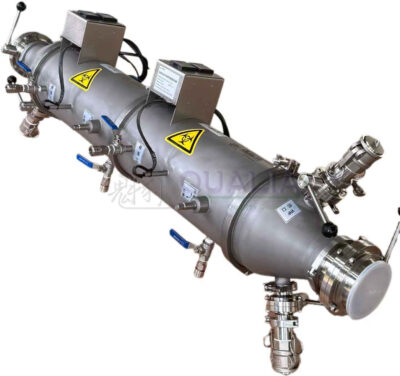
The functional prerequisite is a housing that can be isolated, sealed, and internally decontaminated as a discrete volume. That requires bubble-tight isolation dampers on both the dirty and clean sides of the filter housing — the same dampers described in the pressure cascade section, now serving their second critical function. Once the dampers are closed, the housing interior becomes a bounded space that can receive a gaseous decontaminant such as vaporized hydrogen peroxide, dwell at the required concentration and contact time, and then be verified for completion before any bag manipulation begins.
A decontamination port — a valved penetration in the housing wall — is required to introduce and exhaust the decontaminant. This port must be included in the housing specification at procurement. It cannot be added in the field without compromising the welded, gas-tight housing construction that makes the decontamination cycle effective in the first place. Projects that freeze the HVAC design before the decontamination port location is confirmed by both the mechanical engineer and the biosafety officer often discover this problem when the housing arrives on site, leading to either field modifications that compromise integrity or decontamination procedures that rely on inadequate diffusion through the bag port alone.
Integrity verification of the filter element itself is a separate step that follows decontamination and precedes the changeout. Integrated filter scanning capability — the ability to perform an on-site aerosol challenge test and leak scan of the installed HEPA filter — provides documented proof of filter performance status before the element is removed. This documentation serves two functions: it establishes whether the filter that was in service was performing to specification, and it provides a baseline for the replacement filter after installation. Biosafety reviewers and regulatory auditors increasingly expect this documentation as part of a complete maintenance record, not as an optional supplemental test. The CDC BMBL 6th Edition establishes the design and operational principles under which BSL-3 exhaust HEPA systems must demonstrate containment performance, and filter integrity testing is a practical expression of that requirement.
Specification checklist for BSL-3 BIBO procurement
The most common procurement failure for BIBO systems is treating the housing as a commodity item and leaving critical parameters unspecified, with the expectation that a standard product will be adequate. In a BSL-3 exhaust application, unspecified items default to the manufacturer’s standard offering, which may be built to commercial or pharmaceutical cleanroom standards rather than biocontainment standards. The gap between those standards is where exposure risk accumulates.
Housing construction sets the foundation. Stainless steel, fully welded construction with smooth internal surfaces is a non-negotiable starting point for a biosafety application. Welded construction eliminates the gasket and fastener interfaces that characterize bolted assemblies, which are difficult to decontaminate reliably and represent long-term leak risk as gaskets age and compress. Smooth internal surfaces — no ledges, no exposed fastener heads, no recesses — allow decontaminants to contact all internal surfaces without obstruction and allow post-decontamination wipe-down before bag manipulation.
The filter clamping mechanism is a decision with long-term maintenance implications that is often resolved at the last minute without adequate analysis. Gasket-seal mechanisms are generally easier to service but depend on gasket condition for their integrity, meaning gasket inspection and replacement become part of the maintenance cycle. Knife-edge seal mechanisms can provide a more reliable long-term seal but require precise filter seating and may be less forgiving of dimensional variation in replacement filter elements. Neither choice is universally correct — the right selection depends on the filter replacement frequency, the qualification level of the maintenance staff, and the access geometry of the specific housing installation.
Factory testing scope is frequently underspecified. Testing the housing for structural integrity and leakage is necessary but not sufficient. The critical interface between the filter element and the housing clamping surface is a separate potential leak path that requires its own pressure decay test. A housing that passes factory testing but does not include filter-to-housing seal verification has a documented gap in its qualification record that will need to be resolved before the system can be commissioned as a containment-grade component.
For facilities in seismic zones, seismic analysis and testing per applicable standards such as ASME N510 is a compliance requirement, not an optional enhancement. A housing that is not seismically qualified for its installation location presents a containment integrity failure risk under the precise conditions — a seismic event — when the consequences of a breach would be most difficult to manage.
| Checklist Item | What to Clarify/Specify | Risk if Unclear or Omitted |
|---|---|---|
| Housing Construction | Stainless steel, fully welded, smooth internal surfaces | May compromise gas-tightness, durability, or effective decontamination. |
| Filter Clamping Mechanism | Type (e.g., Gasket Seal or Knife-Edge Seal) and maintenance implications | Can lead to difficult filter changes, unreliable seals, or higher long-term maintenance. |
| Factory Testing Scope | Pressure decay testing of the filter element sealing surface, not just housing | A critical leak path between filter and housing may go undetected. |
| Seismic Requirements | Need for seismic testing/analysis per standards like ASME N510 | May fail to ensure containment integrity during an earthquake in seismic zones. |
| Integrated Filter Testing | Inclusion of on-site HEPA filter scanning technology | Lacks documented proof of filter integrity before and after maintenance. |
Teams procuring a BIBO housing for a BSL-3 application should treat each row in that checklist as a required deliverable in the purchase specification, not a post-award clarification item. Leaving any of these open at contract execution transfers the specification risk to the manufacturer’s default standard.
Safe filter changeout in a BSL-3 exhaust system is the product of a series of interconnected decisions made at specification, not a procedure that can be reliably improvised on site regardless of how experienced the maintenance team is. Placement close to the containment boundary, adequate service clearance for full bag-sleeve deployment, housing construction and pressure rating that match the actual containment environment, verifiable isolation and decontamination capability, and factory-tested filter-to-housing sealing all need to appear in the procurement document before design is frozen. Each item that is left unspecified becomes either a negotiation point with the manufacturer or a field problem during commissioning.
The projects that avoid expensive late-stage redesign are those where biosafety requirements, mechanical design, and equipment specification are coordinated as a single containment problem from schematic design onward. For teams building or upgrading a BSL-3 facility, that coordination starts with a precise BIBO specification that defines every parameter the manufacturer needs to produce a housing that can be safely serviced for the life of the facility.
Frequently Asked Questions
Q: At what point in a BSL-3 project should BIBO housing location and service clearance be locked into the design?
A: Both must be resolved before HVAC routing is frozen — not during commissioning or biosafety review. Once duct runs are fixed, relocating a housing or adding service clearance requires structural changes that are often impossible without significant cost and schedule impact. Biosafety reviewers routinely request proof that decontamination access and bag-sleeve deployment are physically viable; if those answers aren’t already embedded in the design documentation, the project is in a reactive position at the worst possible moment.
Q: Does every BSL-3 exhaust HEPA filter position require a BIBO housing, or only certain ones?
A: BIBO becomes mandatory when a filter changeout could expose staff to viable or potent residue that cannot be reduced to an acceptable level through standard shutdown procedures and PPE alone. Not every exhaust position automatically meets that threshold — the risk determination depends on what the lab handles, the airflow path, and what decontamination controls exist upstream. The practical test is whether a technician performing a standard change would have a credible exposure to material that cannot be otherwise controlled; if the answer is yes, BIBO is the required control, not an optional upgrade.
Q: Is a gasket seal or knife-edge seal the better choice for BSL-3 BIBO filter housings?
A: Neither is universally superior — the correct choice depends on the specific housing configuration, filter type, and the validation protocol the facility intends to use. Gasket seal configurations tend to be more tolerant of minor seating variation but require the gasket condition to be monitored and replaced over time. Knife-edge seals can provide a more repeatable, verifiable interface but are less forgiving of incorrect filter seating. The decision should be made explicitly during specification and documented, because the maintenance implications — how the seal is reestablished after each change and how correct seating is confirmed — differ between the two and will affect long-term procedure reliability.
Q: What is the risk if bubble-tight isolation dampers are specified correctly but the decontamination hold procedure is not validated to match the actual sealed volume?
A: The decontamination cannot be considered complete, regardless of hardware performance. A gaseous or vapor-phase decontaminant must achieve validated concentration and contact time within the specific bounded volume created by the closed dampers. If the hold procedure was validated on a different volume, with different port geometry, or at a different concentration, the contact time achieved in the actual installation may fall short of the validated kill claim. This means the release-to-maintenance decision is being made without a verified basis — the hardware is correct, but the procedure is not matched to it, and that gap is what auditors and biosafety reviewers will flag.
Q: If a facility already has a BSL-3 exhaust system with HEPA housings installed but without BIBO, what does retrofitting actually involve?
A: Retrofitting is rarely straightforward and frequently reveals why the original specification matters. Adding BIBO capability to an existing housing typically requires replacing the housing entirely, because the bag porthole, smooth internal geometry, and structural ratings for bubble-tight damper connections are not features that can be added to a standard HEPA housing after installation. Beyond the housing itself, the duct sections adjacent to it may need modification to accommodate damper flanges and decontamination port connections. If service clearance is also inadequate — which is common when BIBO was not part of the original design intent — the mechanical room layout may need to change as well. The cumulative scope is often larger than the original cost difference between a standard housing and a purpose-built BIBO system.
Related Contents:
- Bag-In-Bag-Out Housing Applications in Pharmaceutical Manufacturing
- Safe Hazardous Material Handling with BIBO
- Essential BIBO System Maintenance Checklist
- Emerging Trends: The Future of BIBO Technology
- Bag-In-Bag-Out Housing Systems – ISO 14644 Compliant Filtration Specifications
- Bag-in Bag-out System Market Trends 2025 – Biosafety Integration Data
- Ensuring Compliance: BIBO and Industry Standards
- BIBO System Design Principles | Filter Housing Engineering
- 7 Essential Steps for Proper BIBO Procedure