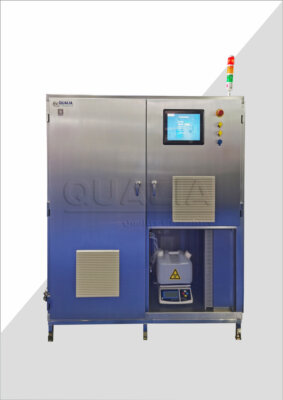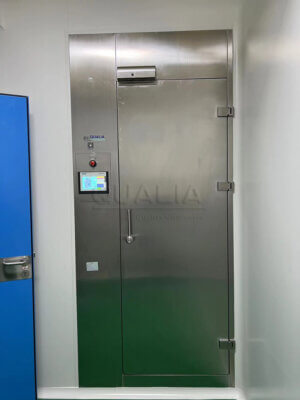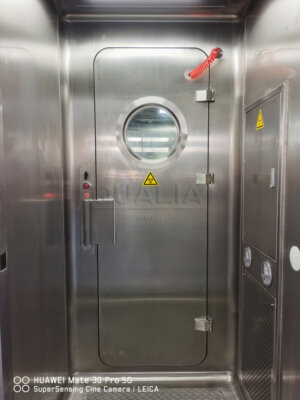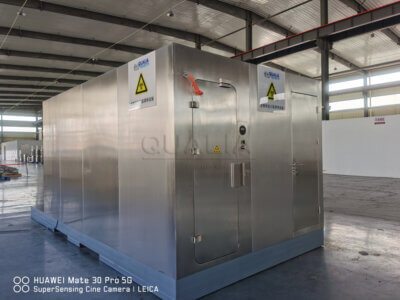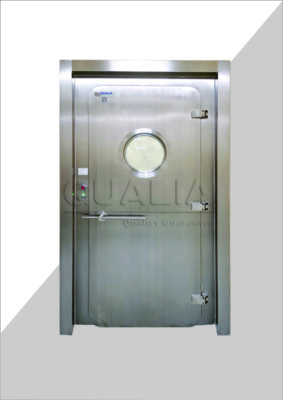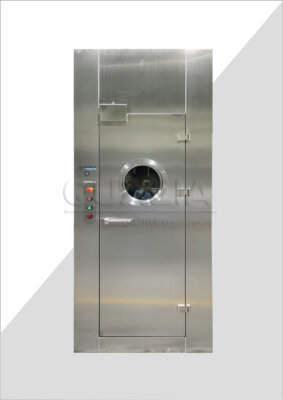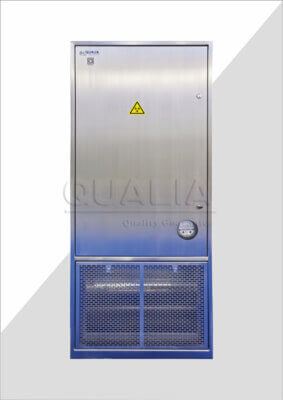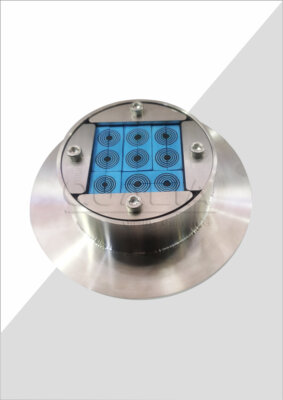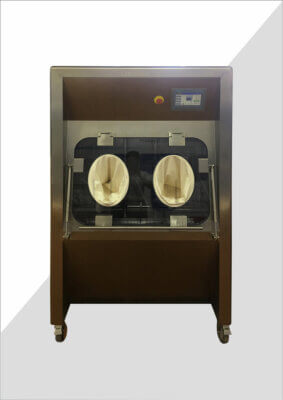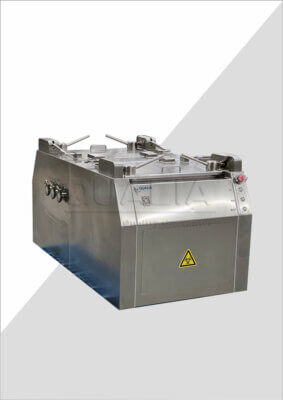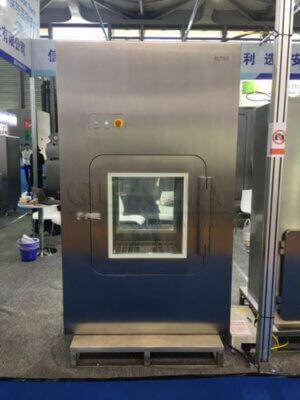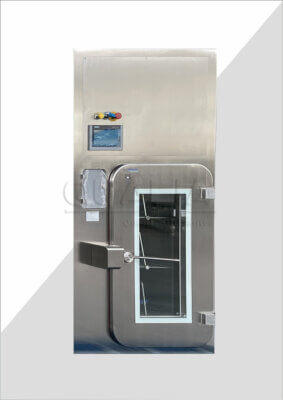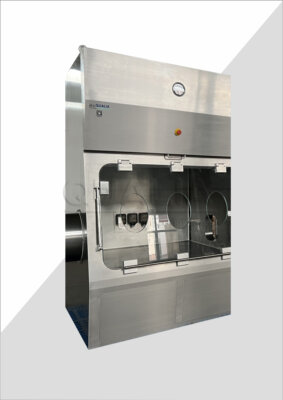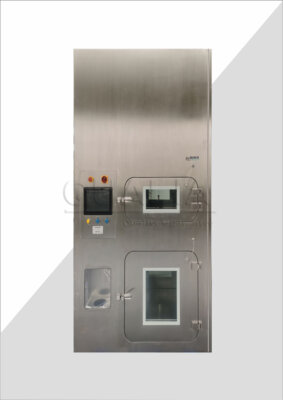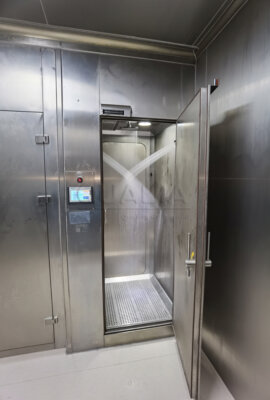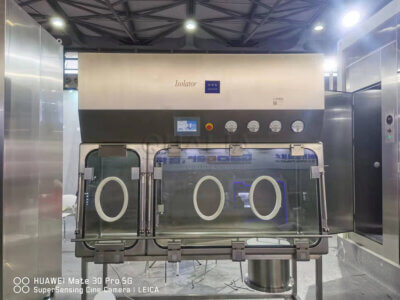

A maintenance crew replaces what they log as a “routine door seal” on a VHP pass box between an OEB5 processing suite and a clean airlock. Nobody raises a change control—it is a like-for-like replacement. The next scheduled annual requalification is still four months away. Within weeks, the nightly bio-decontamination cycles begin showing anomalous humidity ramps, but the drift is subtle enough that no single alarm trips. By the time QA discovers the loss of cycle lethality during a pre-inspection review, the gap has already become a containment observation that delays a product release and forces an unplanned shutdown.
The failure was not in the seal material. It was in a lifecycle logic that treated the calendar as the only trigger for requalification while leaving over a dozen high-impact change events invisible to the qualification program. Biosafety officers, QA/validation teams, and engineering leads in high-containment facilities need a different decision framework: one that defines when annual review is sufficient, when an event demands immediate retest, and how to make the call between full, partial, or no-impact requalification under the pressure of an active operating schedule. What follows provides the risk-based logic to build that framework for isolators, BIBO systems, pass boxes, and GMP critical equipment where containment integrity cannot be left to a periodic guess.
Annual Testing for Drift and Record Review
Annual requalification should not default to repeating the original qualification test scripts. EU GMP Annex 15 frames periodic requalification as a review of routine operational data, deviations, and logbooks, not an automatic repetition of full testing [1]. For high-containment assets—BSL‑3/4 directional airflow arrays, OEB5 isolator glove ports, VHP decontamination units—this shift in focus is operationally critical because physical tests repeated on a fixed calendar can confirm a snapshot while completely missing a slow degradation that the operational record would have surfaced months earlier.
The planning criterion that follows is straightforward: design the annual review scope to exhaust the available routine data before deciding whether any hands‑on test is necessary. That means the review must interrogate BMS trend logs for pressure-cascade erosion, cycle‑report data for VHP injection rate shifts, isolator leak‑test histories for creeping decay values, and deviation reports for repeating alarm rationalizations. When the review relies only on retesting HEPA integrity or repeating a pressure‑hold test against the original acceptance criteria, it often becomes a checkbox exercise that validates the equipment at the moment of test while leaving the operational gap that developed between tests unexamined.
A failure pattern seen repeatedly in OEB4/OEB5 facilities is the annual review that reproduces the IQ/OQ smoke study and filter scan but never correlates those findings with the 11 months of trend data showing a gradual drop in room‑to‑room differential pressure. By the time the pressure cascade falls below the alert limit, the root cause—perhaps a BIBO housing gasket cold‑set after a decontamination cycle—has already been acting on the system for half a year. Swapping the default test‑heavy script for a data‑review‑first approach converts the annual review from a backward‑looking compliance ritual into a live diagnostic that can catch drift while it is still a maintenance action, not a containment incident.
Event Triggers That Cannot Wait for Calendar Testing
GMP expects requalification to be performed after any change that could influence the qualified state of a system [1]. That principle does not grant a grace period based on the next scheduled calendar event. For high‑containment equipment—where a shift in seal compression, a sensor recalibration, or a procedure revision can directly alter the primary containment barrier—waiting for the annual window is both a biosafety risk and an increasingly difficult position to defend during a regulatory inspection.
The immediate‑trigger logic applies whether the change is physical, procedural, or instrument‑related. The following categories represent practical planning criteria drawn from commercial qualification guidance; they should be treated as a checklist for local risk‑assessment, not as a universal regulatory enumeration.
| Trigger Event | Category |
|---|---|
| Major equipment repair | Equipment |
| Component replacement | Equipment |
| Relocation | Equipment / Logistics |
| Changes to operating procedures or process parameters | Procedural |
| Equipment modification or upgrade | Equipment |
| Calibration failure of a critical instrument | Instrumentation |
| Trend of increasing out-of-specification results | Process Performance |
| Regulatory inspection finding related to the equipment | Regulatory |
What makes these triggers difficult to operationalize is not the rule itself but the fact that many of them happen inside maintenance rounds, calibration cycles, or SOP revisions without automatically generating a change‑control record. In facilities operating BSL‑3/4 HVAC systems or VHP pass boxes, a component replacement such as a BIBO filter exchange or a door‑seal swap is one of the most consequential events for containment integrity, yet it is still too often treated as a maintenance close‑out rather than a requalification trigger. The result is a risk window that stays open until either a noticeable deviation occurs or the next scheduled test dates arrive. Embedding these triggers into the maintenance work order flow—so that a seal change on an aseptic isolator automatically generates a risk‑assessment for a partial leak test and a VHP cycle efficacy check—closes that operational gap before it becomes an audit finding or a contamination event.
Full Partial and No-Impact Requalification Decisions
The demand to react quickly to a trigger event forces a risk‑based judgment that many organizations are not structured to make under time pressure: should the response be a complete requalification, a targeted partial test, or a documented no‑impact justification? The wrong call either wastes production capacity through over‑testing or leaves an underestimated vulnerability in the containment chain.
| Decision Level | When Applied | Typical Testing Scope | Documentation Required |
|---|---|---|---|
| Full Requalification | Change poses a risk to the whole system (e.g., tank size change) | Repeat all qualification tests | Full protocol and risk assessment |
| Partial Requalification | Only part of the system is affected (e.g., one additional valve) | Tests limited to the affected portion | Risk assessment and rationale for abbreviated scope |
| No-Impact Documentation | Change does not affect the qualified state | No testing | Documented rationale and risk assessment |
The logic is not simply a matter of complexity. A single filter re‑seating inside a BIBO housing may affect only the local pressure boundary of that housing, warranting a partial leak test and a downstream particle verification rather than a full cascade re‑mapping of every room in the suite. Conversely, a modification that alters the rotational speed of an isolator’s recirculation fan can shift airflow patterns and pressure differentials across the entire work zone, requiring a near‑complete operational qualification. The distinction hinges on the system boundaries and on which qualified parameters could realistically be disturbed.
To make that judgment defensible, QA and biosafety teams need to assess the change against a clear set of contamination‑control factors.
| Factor to Review | Key Question to Assess |
|---|---|
| Airflow | Could the change alter airflow patterns or velocities? |
| Pressure cascade | Could the change affect pressure differentials between areas? |
| Filtration | Could filtration efficiency or integrity be compromised? |
| Environmental control | Could temperature, humidity, or cleanliness class be impacted? |
| Process conditions | Could processing parameters be altered? |
| Contamination risk | Could the change introduce new contamination vectors? |
| Documentation status | Does the change require updates to SOPs, drawings, or records? |
Where the assessment concludes that no requalification testing is required, the rationale and risk evaluation must still be documented—not as a shortcut, but as evidence that the decision was science‑based. The same expectation applies to an abbreviated test scope. An undocumented rationale for partial testing is routinely challenged during an audit as arbitrary scope reduction. A documented assessment that links the change to the specific qualified attributes that remain undisturbed—for example, demonstrating that a door‑seal replacement on a VHP pass box does not affect the pressure‑cascade mapping of the adjacent cleanroom—transforms the decision from a judgment call into a traceable lifecycle record.
Annual Review of Prior Change Assessments
Even when every trigger event captures a change, the annual review has a second function that is often missed: it must check whether the risk assessments that were made during the previous year were correct. Annex 15 explicitly includes changes and deviations from the period under review as part of the periodic reevaluation [1]. That expectation transforms the annual review from a passive data‑read into an active audit of the site’s engineering judgment.
A change that was classified as no‑impact ten months ago—a replacement of a non‑critical sensor, a slight adjustment of a door interlock sequence—may have produced a cascade of small effects that only become visible in the long‑term record. The annual review is the moment to cross‑examine those earlier decisions. If the BMS data now shows a pressure fluctuation pattern that started shortly after that sensor swap, the original no‑impact classification may need to be re‑opened, and a partial or full requalification may be required retroactively. Leaving the review to simply repeat a fixed set of physical tests will miss this mis‑assessment entirely, and the error will compound as more changes accumulate on top of a flawed assumption.
The practical implication is that the annual review agenda must reserve time for a structured walkthrough of every logged change event, comparing the projected impact against the actual operational history that followed it. That review itself becomes a key piece of evidence for the next inspection cycle, demonstrating that the site does not just record changes—it verifies the validity of the risk assessments that were supposed to control them.
Equipment Register Linking Changes and Evidence
During an inspection, an auditor will not accept a containment lifecycle story told across three different systems—a CMMS for maintenance events, a separate validation binder for test reports, and an isolated change‑control log with no link to requalification outcomes. The chain of custody from equipment specification to current release status needs to be traceable in a single controlled register. While no regulation mandates a specific format, ICH Q10’s emphasis on knowledge management and documented change history supports the expectation that a site can demonstrate coherent traceability for its high‑containment assets [2].
| Register Element | What It Captures | Links To / Provides Traceability For |
|---|---|---|
| Equipment Specifications | Design, materials, performance requirements | Change events and test protocols |
| Test Protocols | Procedures and acceptance criteria | Qualify test results and specifications |
| Acceptance Criteria | Defined pass/fail limits | Test results and release status |
| Change Events | Description, date, and impact assessment of each change | Requalification evidence |
| Requalification Evidence | Test reports, data, and evaluation from requalification | Release status and equipment history |
| Release Status | Current qualified state (released, pending) | Overall compliance and active status |
The register becomes the primary audit‑defensibility tool when it ties a component replacement—such as a motor swap on an aseptic isolator’s air handler—to the risk assessment that justified a partial requalification, the test report that verified the airflow and vibration parameters, and the release status that returned the isolator to operation. When that link is missing, the auditor is forced to reconstruct the evidence across fragmented records, and gaps that are actually documentation failures can be misinterpreted as qualification gaps.
The register’s value is not in its structure but in the discipline it enforces. Once a site commits to maintaining a single, living record for each equipment item, it becomes immediately visible when a change event has occurred without a corresponding requalification entry. That visibility is what keeps the lifecycle program from drifting into the very fragmentation that creates inspection risk in the first place.
Risk-Based Lifecycle Plan for High-Containment Assets
A risk‑based lifecycle plan does not set the same requalification frequency and depth for every asset. EU GMP Annex 15 requires that these decisions be system‑related and risk‑based, not applied uniformly across all equipment [1]. For high‑containment operations, that means the plan must be calibrated to the specific containment consequence of a failure: the BSL‑3 directional airflow envelope demands a different rigor than a terminal sterile filtration skid, and an OEB5 split‑flap isolator presents different failure modes than a VHP pass box used for material transfer between classification grades.
| Trigger Type | Timing | Focus | Examples |
|---|---|---|---|
| Annual (Calendar-Based) Review | Scheduled interval (e.g., annually) | Review of routine data, deviations, logbook; detect drift | Periodic review of prior change assessments, no automatic repetition of full tests |
| Event-Based Triggers | As changes occur | Immediate assessment of the specific change impact | Major repair, relocation, procedure change, calibration failure |
| Trend-Based Triggers | When performance signals indicate drift | Investigation of gradual degradation | Increasing out-of-specification results, shift in environmental monitoring trends |
The practical design task is to integrate the three trigger streams into a single living document that directly feeds the equipment register. The annual review stream scans aggregate data and prior change‑assessment accuracy. The event‑based stream forces immediate evaluation of defined change types, with the decision logic of full/partial/no‑impact already mapped to the equipment’s known vulnerability points. The trend‑based stream monitors performance signals—pressure decay rates, VHP concentration decay, particle excursion frequency—and escalates to a partial retest when statistical thresholds are crossed, even if no single change event has been logged.
The friction that causes plans to unravel is not the absence of these elements but the failure to assign them to equipment classes with real containment consequences. A generic plan that lists trigger types but does not link “seal replacement” to “partial isolator leak test” for a specific model, or that fails to define the trend threshold that would trigger a BIBO housing retest, will collapse into a schedule‑only system the moment production pressure conflicts with risk management. The plan earns its keep only when it pre‑defines the decision thresholds for each containment asset class, so that the response to a trigger event is not a negotiation but a pre‑authorized lifecycle action.
A defensible high‑containment requalification program ultimately rests on the ability to demonstrate three things during any audit: every change was captured, every risk‑assessment decision was traceable to its operational evidence, and the annual review verified that prior judgments were correct rather than simply repeating a predetermined test list. Without a single equipment register that ties these threads together, even frequent physical testing will not close the gaps that inspectors and biosafety officers are trained to find.
The next practical steps are to walk through the current equipment register and identify every component replacement, calibration failure, or procedure revision from the last twelve months that should have triggered a requalification decision—and to compare those decisions against the operational data that followed them. That gap‑analysis will surface where the lifecycle plan needs to tighten its trigger definitions and where the annual review needs to shift from a test‑heavy calendar exercise to a genuine health check on the integrity of containment systems and the engineering judgments that protect them.
Frequently Asked Questions
Q: Our facility lacks a BMS or automated trend data for high-containment equipment. Can we still shift from test-heavy annual requalification to a data-first review?
A: Yes. The review can operate on whatever data exists—manual shift logs, maintenance work orders, paper chart recordings, and periodic manual differential‑pressure readings. The core principle remains: exhaust available operational history for signs of drift before committing to physical tests. Without automation, the review simply requires a more disciplined gathering of manual records and may need a slightly longer analysis window to compensate for lower data density.
Q: How do we get maintenance technicians to consistently flag routine component swaps (such as door seals) as requalification triggers?
A: Embed a brief, unambiguous list of high‑consequence components directly into the CMMS work‑order template so the technician is prompted to indicate if the replacement involves a containment‑critical item. Pair that prompt with a short decision flowchart that links a flagged replacement to a predefined risk assessment and, when necessary, a partial test protocol. The trigger becomes part of the work close‑out routine rather than an extra compliance step.
Q: At BSL‑4, is there still room for partial requalification after a minor seal change, or must every event trigger a full retest?
A: Partial requalification remains possible even at maximum containment, but the risk assessment must demonstrate with high confidence that the change affects only a defined subsystem and does not challenge the primary containment barrier. In practice, many BSL‑4 sites impose a stricter default—such as mandatory biosafety committee review for any less‑than‑full retest decision—but the underlying risk‑based logic and documented justification are the same.
Q: Which approach is actually less resource‑intensive: a fixed annual retest calendar or an event‑driven program?
A: An event‑driven program is not inherently less resource‑intensive; it trades predictable, scheduled testing for a continuous need to evaluate changes, document risk assessments, and run targeted tests when indicated. The total effort can be comparable, but the risk coverage improves significantly because testing is cued by real state changes rather than arbitrary dates. Facilities often find they eliminate unnecessary full‑suite requalifications while investing more time in smaller, change‑focused tests.
Q: We operate only one Aseptic Isolator and two VHP Pass Boxes. Is maintaining a full equipment register and lifecycle plan overkill?
A: No. Even a minimal register—a controlled spreadsheet linking each asset’s change events, risk assessments, and test reports—provides audit‑ready traceability that prevents inspection findings far more costly than the time invested. The same lifecycle logic scales down proportionally: fewer assets mean fewer rows, but the risk of undocumented change and slow drift does not shrink with inventory size.