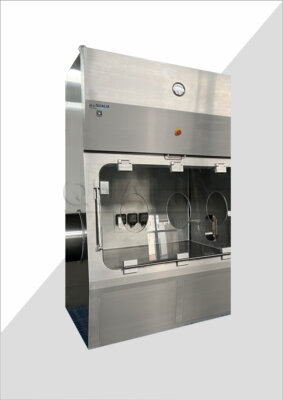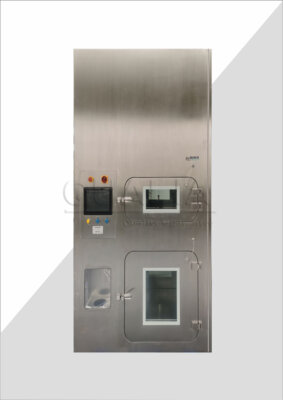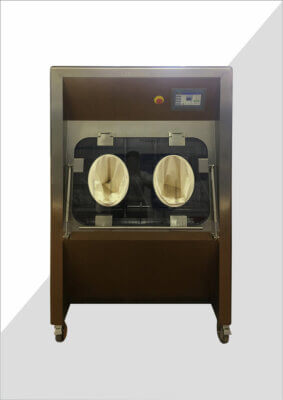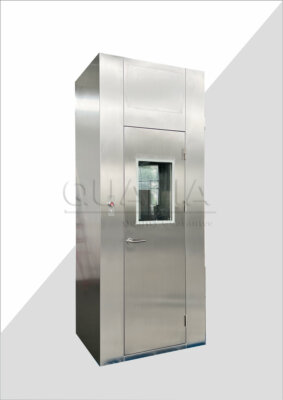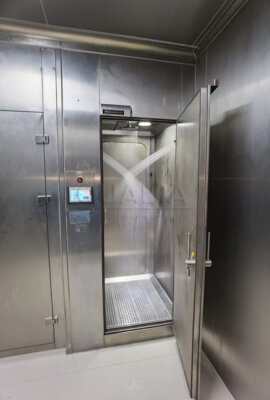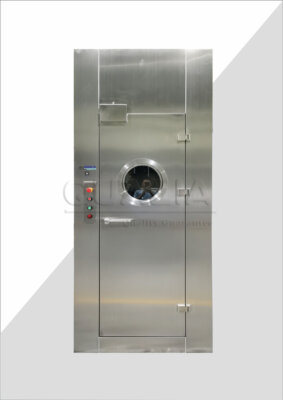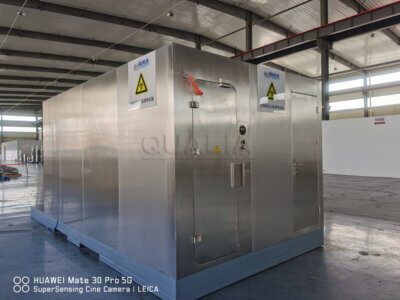


The load envelope and the handling method together determine the clear-opening specification for a biosafety pass box. If the controlled item arrives in a tray, sits in secondary packaging, or requires a tool to move it through the door, those outer dimensions govern the opening—not the unpackaged product dimension. The common project pain point is that dimensions are gathered too late, forcing either a reorder or a workaround that compromises the transfer sequence.
Clear opening refers to the unobstructed passage available once a door is fully open: the daylight dimension measured at the most restrictive point in the installed frame, gasket, and door-leaf assembly.
Describe the Load Envelope and Handling State
The first task is to characterize what actually crosses the biosafety pass box boundary, in the condition and orientation it will be in at the moment of transfer.
Start with the outer transfer form—not the product inside. A glass vial is rarely carried as a loose vial; it arrives in a tray, inside a secondary bag, or nested in a carrier. The supplier sizing the opening needs the envelope of the handled item as it is presented at the door. A common mistake is to send product dimensions from a materials-data sheet and assume the supplier will infer the packaging. They cannot, and they should not.
Related Products
- Biosafety Pass Box — Use the relevant assembly listing to start a configuration-specific RFQ; seal type, hardware, utilities, spares and service scope require an itemized response.
Orientation matters as much as size. A long, narrow tray that fits upright may not fit on its side, and a container designed to stay level cannot be tilted to clear a reduced height. If the load has a constrained orientation—because it is liquid-filled, labeled on one face, or stacked in a fixed rack—that constraint needs to be part of the description. An unlabeled dimensional list leaves the intended presentation ambiguous, and a supplier working from ambiguous data will often assume the most convenient orientation, which may not be the one the operator can actually use.
The transfer form presented at the door—not the unpackaged product—is the controlling envelope for a pass box opening specification.
When handling aids are involved, they belong in the description too. A tray that an operator slides with both hands, a small cart that rolls through, or forceps used to position a container all add to the envelope that must clear the opening. If a cart enters the transfer zone, its width, height, and handle position determine whether the opening is workable, not just whether the cart itself fits. Projects sometimes define the handling aid separately and exclude it from the door specification by interface agreement, but that exclusion should be explicit. If it is not stated, include the aid’s relevant envelope in what you send for supplier review.
Identifying the representative load families is worth doing before the first supplier contact. A single project may involve several distinct transfer types—bulk containers on one shift, sample tubes in a secondary bag on another—and each family may impose different constraints. Describing them as a list of envelopes with their orientations and handling states gives the supplier something they can actually check against an offered configuration.
Distinguish Clear Opening from Nominal Size
A catalogue chamber size and an unobstructed transfer opening are different purchase items, and conflating them produces the most common specification gap in pass box procurement.
Distinguish Clear Opening from Nominal Size: Buyer Review Matrix
| Dimension description | What it represents | RFQ clarification |
|---|---|---|
| Nominal chamber size | Named chamber dimension | Request the offered usable opening drawing |
| Packaged load envelope | Outer transfer form at the door | Identify tray and secondary packaging |
| Restricted orientation | Required presentation of the load | Label the orientation condition |
| Handling aid envelope | Additional item entering the interface | State whether included or explicitly excluded |
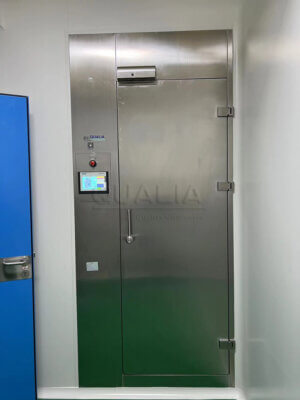
Nominal size typically describes the chamber interior—the space inside the box. The clear opening is what the operator can actually pass through. The difference arises because the door leaf, the frame, the seal, and in pneumatic-seal designs the inflatable gasket, all reduce the daylight available when the door is open. That reduction varies by design and by configuration; it is not constant across suppliers or even across product lines from the same supplier.
Pneumatic-seal doors tend to impose a frame geometry that the buyer does not always see clearly in a catalogue drawing. When the gasket deflates to allow opening, the leaf swings or slides away, but the frame profile that holds the seal in its closed state may still project into the opening. The usable passage can be meaningfully smaller than the interior chamber dimension.
Mechanical-seal doors present their own geometry. Depending on hinge placement, swing arc, and whether the door opens inward or outward relative to the pressure boundary, the accessible opening profile can differ from what the frame dimension implies.
Neither door type is inherently more generous—both can be engineered to suit a given load—but the buyer who relies on a chamber label without requesting the opening drawing may find the offered unit cannot accept the actual load. The correct request is a configuration drawing that identifies the offered usable opening and its dimensional basis: where the measurement is taken, whether it accounts for the gasket at rest, and whether the door hardware reduces any edge of the opening.
Always request the usable-opening drawing, not just the nominal chamber dimension, and confirm which configuration it represents.
This distinction also surfaces when comparing quotations from different suppliers. A chamber described as the same nominal size may offer materially different clear openings depending on door geometry. The offered assembly, as drawn and dimensioned, needs to be the basis of the comparison—not the label on the datasheet.
Coordinate Transfer and Door-Access Drawings
The clear opening is only part of the question; the approach path on each side of the pass box must also accommodate the load and the operator in the conditions that will actually occur.
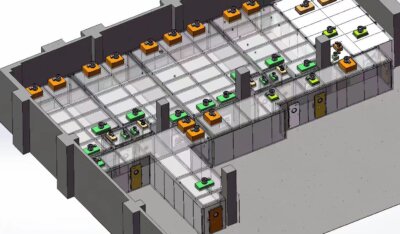
Consider a project where the biosafety pass box is built into a wall between a BSL-3 corridor and a laboratory. The opening dimension may pass review, but if the corridor side has a door that swings across the approach, or if the laboratory side has a bench that restricts the operator’s lateral movement, the specified opening may be physically workable while the transfer sequence is not. Coordinating the pass box door drawing with the room-layout drawing catches that conflict before installation.
The access drawing should capture at least three things: the sill height relative to the working surface on each side, the door swing or slide direction and its clearance arc, and the approach distance available for the operator and load together. For rolling loads, the sill detail matters—a threshold lip that suits a manual hand-carry may stop a cart.
For loads with restricted orientation, the drawing should show the item entering the opening in its constrained attitude. A flat tray entering at a fixed height needs the vertical center of the opening to coincide with the tray’s handling height; if the two are misaligned, the operator either tilts the tray (which may not be acceptable) or adjusts the working surface on one side. Catching that mismatch in a drawing review costs nothing; catching it after installation is expensive.
Pass box door drawings and room-layout drawings are often managed by different teams on a project. The person specifying the pass box may have the load data; the architect or facility designer has the room geometry. The productive step is to bring both documents into the same review before the opening specification is confirmed with the supplier. QUALIA’s design coordination scope is intended to support exactly that alignment, connecting the pass box configuration to the facility drawings before dimensions are fixed.
Where exhaust filter housings, interlock panels, or other ancillary components are part of the pass box assembly, their position on the frame can affect the approach geometry on the clean or dirty side. Those components belong in the same spatial review.
Related Reading
- VHP Pass Box RFQ Checklist: Chamber Size Door Interlocks Cycle Data and Documentation — Use an adjacent pass box RFQ discussion to prepare dimensional and document questions; VHP functions are a separate scope.
- BSL-3 Pass Box and Dunk Tank Selection for High-Risk Material Transfer — Review the earlier transfer-equipment choice before finalizing one opening requirement.
- Installation Qualification for Containment Equipment: Drawings, Utilities, Calibration and As-Built Checks — Plan how the offered and final drawing references will be retained.
Make Dimensional Assumptions Visible in the RFQ
A well-prepared request for quotation makes every assumption about load size, orientation, and handling explicit, so the supplier’s offer either confirms fit or flags the gap before purchase.
The most direct way to do this is to state the controlling load envelope as a set of conditions: outer dimensions in the transfer orientation, handling state (bagged, trayed, carried, rolled), and any orientation restriction. Where multiple load families exist, list them. Where a handling aid is included, give its relevant envelope. Where a load is excluded from the specification by design—because it will be transferred by a different route—say so.
Anticipated future loads deserve their own entry. If the project team knows that a larger container format will be introduced in a later phase but cannot define its envelope yet, that uncertainty should appear in the RFQ as an unresolved expansion requirement rather than a gap. A supplier who sees an unresolved requirement can flag whether the offered configuration has headroom, while a supplier who does not know about it cannot. If the anticipated load can be bounded—a future tray will not exceed a given width—a conditional offer based on that boundary is a legitimate response and gives the project team something to work with. An open-ended “future use” label, without any dimensional basis, cannot support a fit commitment on either side.
The RFQ should also ask the supplier to identify any door, frame, or hardware feature that reduces the offered usable opening below the stated nominal size, and to provide the relevant drawing with those reductions dimensioned. That request costs nothing to make and prevents a category of specification gap that is otherwise only discovered during delivery review or, worse, commissioning.
State all load envelopes, orientations, and handling conditions in the RFQ, and ask the supplier to confirm usable opening against each one.
The practical outcome of a well-structured RFQ is that the supplier’s response either confirms fit against each listed condition or states the condition under which fit cannot be confirmed and what modification would address it. That is a reviewable document. A response to a vague RFQ may appear to confirm fit while leaving the controlling assumptions unstated—and those unstated assumptions are where specification gaps live.
Before approaching a supplier, have ready: the outer envelope of each load family in its transfer orientation, the handling state and any orientation restrictions, the approach geometry on each side of the pass box, any handling aids that enter the transfer zone, and a note on future loads with whatever dimensional bound can be established.
References
- EU GMP Annex 1 – Manufacture of Sterile Medicinal Products (2022) — Use the sterile-manufacturing contamination-control context to identify equipment and site interfaces for review; it supplies no project-specific pass box or cRABS acceptance values.
- EudraLex Volume 4 Annex 15 – Qualification and Validation — Distinguish supplier documentation from project qualification and acceptance decisions; reported conditions and deviations remain specific to the represented system.
- ISO 14644-7:2004 Separative Devices — Frame separative-device requirements and customer–supplier questions within the standard’s verified summary scope; detailed clauses and equipment limits are outside this summary.
- WHO Laboratory Biosafety Manual 4th Edition (Core Document) — Put the laboratory use and risk-assessment basis ahead of a generic equipment label; this summary is not a door specification or a facility approval.
Frequently Asked Questions
Q: Should future loads be included in the initial purchase?
A: Include them only as a defined requirement or an explicit conditional scenario. An undefined future-use statement cannot tell bidders what additional envelope they are expected to accommodate.
Q: Can a representative load replace a list of every item?
A: Yes, when the represented family and any orientation or handling exceptions are stated. Keep an item separate when it raises a different fit question for the opening.
Q: What if suppliers use different dimensional terminology?
A: Request marked drawings and match each term to the feature it measures. Comparing labels alone can confuse chamber dimensions, opening dimensions and the outer load envelope.