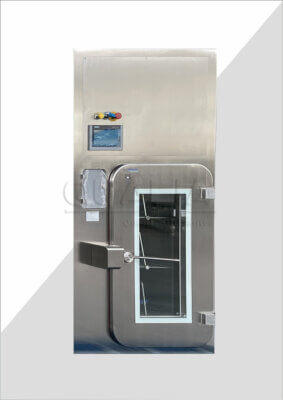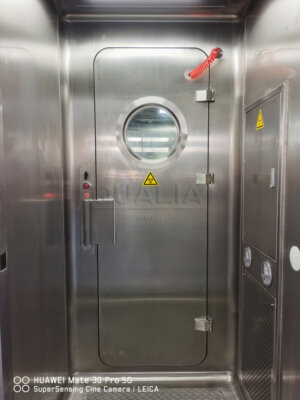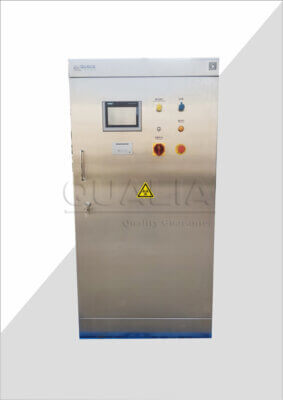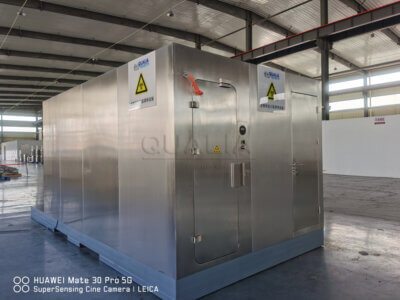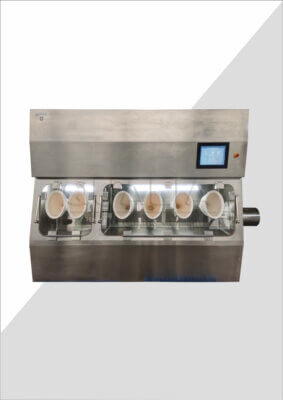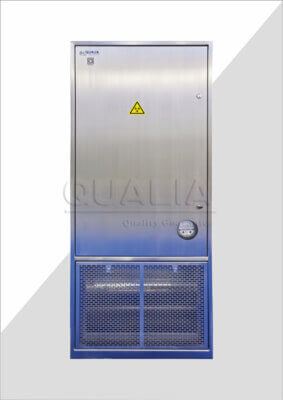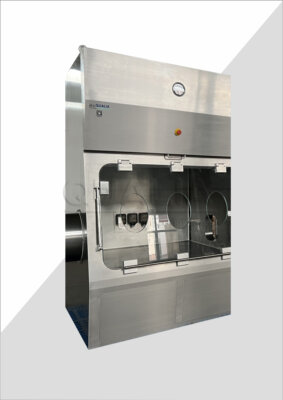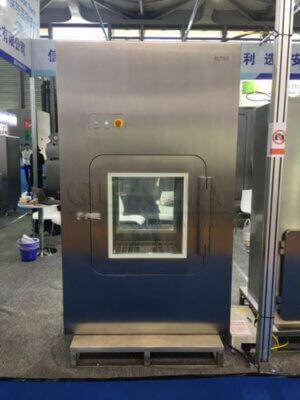
A cleanroom that already supports GMP production is rarely available for a greenfield build-out, yet many sites eventually need fixed vaporized hydrogen peroxide decontamination capability inside a space that was designed before that requirement existed. The question is not whether a fixed VHP generator can be installed into an existing room, but what the room’s actual construction, utilities, and control architecture will permit without compromising the qualified state the facility already depends on.
Feasibility Starts with the Actual Room and Utility Condition
A retrofit decision begins with a basic asymmetry: new construction lets the room be designed around the decontamination process, while a retrofit must fit the decontamination process into a room whose seals, dampers, control points, and service routing were fixed by an earlier design intent. That earlier intent may have had nothing to do with VHP exposure. The room may have been built for particulate control, for pressure cascade management, or for a different utility layout entirely. None of those original design goals guarantee that the enclosure will hold a peroxide-compatible seal, that the HVAC dampers will isolate predictably during a cycle, or that there is spare conduit or panel space for the new instrumentation a generator requires.
This is why feasibility work cannot rely on the as-built drawing set alone. Drawings describe intent at the time of construction, not the condition of the room after years of maintenance, modification, or wear. Seals degrade. Dampers get serviced or replaced with units that behave differently under isolation. Control points get rewired during unrelated upgrades and may no longer map to the schematic. Where the project team treats the drawing as the source of truth, the retrofit plan risks being built on assumptions the physical room does not support. Where the team instead verifies the room as it currently stands, the plan reflects what is actually achievable, and the scope of work reflects real constraints rather than theoretical ones.
The consequence for project planning is direct: feasibility should be confirmed before configuration decisions are made, not after. A generator selected or configured against assumed room conditions may need to be reconfigured once the as-built condition is known, which affects both the quotation and the installation schedule. Where the project owner can supply accurate as-built information early, equipment configuration and quotation review can proceed against real constraints rather than provisional ones. This is the point at which a supplier such as Qualia can only configure a fixed VHP generator meaningfully once the governing room conditions are established, because the generator’s control strategy, aeration path, and service interface all depend on what the existing enclosure actually permits.
Survey Seals, Dampers, Penetrations and Available Routing
| Survey area | What to verify in the existing room | Retrofit decision informed |
|---|---|---|
| Room seals | Actual seal condition and enclosure leakage | Whether room changes are needed for the proposed retrofit |
| Amortizoare | Actual damper behavior and the available HVAC isolation | HVAC isolation feasibility and its effect on shutdown scope |
| Penetrations and routing | Existing penetrations, available routing and whether new penetrations are needed | Installation route and shutdown scope |
| Control points | Existing control points rather than drawing assumptions | Control integration scope |
| Service space | Space available for routing and safe maintenance access | Whether installation and maintenance access can be accommodated |
Once the room’s general condition is acknowledged as uncertain until verified, the survey itself becomes the controlling activity. Each element surveyed answers a different retrofit question, and the answers interact with each other rather than standing alone.
Room seal condition determines whether the enclosure can hold the distribution and exposure behavior a fixed cycle depends on. A room that leaks air at an uncontrolled rate during an isolation period behaves differently from one that holds pressure cleanly, and that difference changes whether the room can be used as configured or whether sealing work becomes part of the retrofit scope. Damper behavior matters for a related but distinct reason: the dampers govern how completely the room’s HVAC system can be isolated during a decontamination cycle, and if actual damper behavior does not match the assumed isolation sequence, the shutdown plan built around that sequence will not hold.
Penetrations and routing determine whether the generator’s connections can reach the room using existing pathways or whether new penetrations must be cut. This is not purely a mechanical question; every new penetration into a qualified enclosure is also a question for the room’s sealing integrity and for the shutdown window needed to make and verify that penetration safely. Control points matter for a parallel reason: the actual location and function of existing control points, rather than what the drawing shows, determines how much new control wiring or logic integration the retrofit requires. Finally, available service space determines whether the installed generator and its connections can be reached safely for ongoing maintenance, which is a different concern from whether they can be installed at all. A route that is reachable during installation under controlled conditions is not automatically reachable for routine service once the room returns to production use.
Confirm Material and Instrument Compatibility for the Proposed Exposure
Compatibility is governed by one principle that applies across every surface, seal, instrument, and piece of exposed equipment in the room: the planned VH2O2 exposure must be tolerable to everything that will be inside the room while that exposure occurs, not only to the generator and its own components. This principle holds regardless of which materials are present, but what it requires in practice changes completely depending on what the room contains.
A room built with peroxide-tolerant finishes and instrumentation rated for oxidative exposure presents a narrow compatibility question. A room furnished with legacy instruments, gaskets, or exposed materials selected for an earlier, different process presents a much broader one, because each material and instrument type may have a different tolerance boundary, and some may have none established at all. Where the existing instrumentation was never evaluated against hydrogen peroxide vapor exposure, the retrofit cannot proceed on the assumption that it will tolerate the cycle; that assumption has to be replaced with evidence.
This is where supplier compatibility data and site trials become the operative tools rather than general references. Compatibility data describes how specific materials and instruments behave under defined exposure conditions, and site trials test that behavior under the room’s actual configuration rather than a laboratory approximation of it. Concentration and cycle parameters are not a fixed, one-size input here; how concentration and cycle duration interact with material response is itself a variable the project must confirm for its own exposure plan, since a cycle designed for one concentration and duration profile does not automatically validate a different one. The practical implication is that compatibility confirmation is not a single pass/fail check performed once. It is a boundary-setting exercise: what exposure can this specific room, with its specific contents, tolerate, and does the cycle the project intends to run sit inside that boundary or outside it. Where it sits outside, either the cycle parameters or the room’s exposed materials and instruments need to change before the retrofit proceeds.
Integrate Controls, Aeration and Maintenance Without Creating Hidden Interfaces
| Interfață | Project input to confirm | Decision affected |
|---|---|---|
| Routing and penetrations | Available routing, existing penetrations and any need for new penetrations | Installation path and shutdown scope |
| Valves and sensors | New valves and sensors needed for the proposed retrofit | Installation and control integration scope |
| Power and peroxide handling | Power and peroxide handling needs | Utility and shutdown scope |
| Controls and aeration | Existing control points and planned control changes for the proposed integration | Installed-performance assessment and qualification-life-cycle scope |
| Acces pentru întreținere | Available service space and safe maintenance access | Whether the proposed arrangement remains accessible for maintenance |
A fixed VHP generator does not operate as an isolated device; it becomes one more system sharing the room’s power, control logic, and physical access routes. The risk in a retrofit, more than in new construction, is that some of these shared interfaces are easy to overlook because they already exist in another form and simply need to be extended, rather than designed from nothing.
Routing and penetrations carry forward the same installation-path question raised during survey, but here the decision is what to do about it: use existing routing where it is adequate, or create new penetrations where it is not, with each choice carrying a different shutdown scope. Valves and sensors needed for the retrofit raise a related but separate question, because new valves and sensors mean new control points that must be integrated into the room’s existing logic rather than running as a parallel, disconnected system. Power supply and peroxide handling needs are a further interface: the generator’s power draw and the handling requirements for peroxide delivery and aeration must be accommodated within utility capacity that was sized for the room’s original purpose, not for this addition.
Controls and aeration integration is where hidden interfaces are most likely to form, because control changes made to accommodate the generator can alter how the room behaves outside the decontamination cycle itself, affecting pressure control, airflow balance, or alarm logic that the room’s normal operation depends on. This is a direct link to the facility’s air-handling scope: where the room’s HVAC and control boundary is not clearly separated from the generator’s own control logic, responsibility for a fault in either system becomes ambiguous. Maintenance access closes the loop: the arrangement that was reachable during installation must remain reachable for the servicing the generator will need over its operating life, under the room’s normal operating configuration rather than a temporarily opened one.
Requalification Scope Determines the Retrofit Handover
| Handover question | Available reference point | Boundary to define for the project |
|---|---|---|
| How do room or control changes affect the existing cleanroom? | Assess their effects on installed performance and the qualification life cycle before re-entry | The affected scope and resulting requalification stages |
| How should cleanroom performance be tested? | ISO 14644-3 provides test methods for as-built, at-rest and operational states | The applicable test context and site-specific acceptance values |
| How should design intent remain connected to qualification? | EU GMP Annex 15 treats the URS as a validation-life-cycle reference and uses DQ to verify design compliance with URS requirements | Exact stages and acceptance criteria remain project-specific |
| What does the cleanroom-level framework establish? | ISO 14644-4 covers design, construction, start-up and verification, with requirement and life-cycle maintenance checklists | It does not prescribe a specific technology, process or contractual delivery method |
The retrofit is not complete when the generator is installed and running a cycle; it is complete when the project has defined what re-entry into qualified production status requires, and that definition depends entirely on what was actually changed. A generator added with minimal disturbance to existing seals, dampers, and controls raises a narrower requalification question than one that required new penetrations, control logic changes, or materials replacement to achieve compatibility.
The governing instruction is to assess how room or control changes affect installed performance and the qualification life cycle before re-entry, which means the requalification scope is a direct output of the integration decisions made earlier, not a separate afterthought. Where cleanroom performance needs to be tested as part of that assessment, ISO 14644-3 provides recognized test methods across as-built, at-rest, and operational states, but applying it requires the project to determine which test context and which site-specific acceptance values apply to this particular change, since the standard does not set those values itself. Where the broader design and verification framework is in question, ISO 14644-4 covers cleanroom design, construction, start-up, and verification with life-cycle maintenance checklists, but it remains a cleanroom-level framework that does not prescribe a specific technology or delivery method, so it cannot by itself resolve what a VHP retrofit specifically requires.
Where the facility operates under GMP, EudraLex Volumul 4 Anexa 15 treats the User Requirements Specification as a reference point carried through the validation life cycle, and uses Design Qualification to verify that the design complies with those requirements. For a retrofit, this means the original URS for the room, or a revised one reflecting the retrofit’s intent, becomes the benchmark against which the changed design is checked, even though the exact qualification stages and acceptance criteria remain specific to the project rather than fixed by the standard. This is also the stage at which Qualia’s role as equipment supplier connects to the facility’s own requalification planning: the generator’s documented configuration and interface points feed into the project’s qualification and maintenance records, but the scope, sequence, and acceptance of that requalification remain the project team’s determination, built on the room and control changes actually made.
Întrebări frecvente
Q: Can a fixed VHP retrofit be planned from the existing cleanroom drawings alone?
A: No. Begin with an as-built survey because legacy drawings may not show the current condition of seals, penetrations, dampers, control points, or service space. Use the verified room condition to define feasibility, installation scope, and shutdown assumptions.
Q: What project information should be prepared before comparing fixed VHP retrofit proposals?
A: Prepare the verified enclosure and HVAC isolation conditions, available routing and utilities, existing control points, proposed exposure, compatibility evidence, and maintenance-access constraints. This gives each proposal a common basis and exposes scope gaps before equipment and facility responsibilities are assigned.
Q: How should material and instrument compatibility be assessed for the proposed VHP exposure?
A: Match the proposed exposure against the surfaces, seals, instruments, and exposed equipment in the actual room. Use relevant supplier compatibility data and site trials to establish the project boundary rather than assuming that every installed item will tolerate the same exposure.
Q: What usually defines the shutdown scope for this type of retrofit?
A: The shutdown scope follows from the changes needed in the existing facility: new penetrations or routing, valves, sensors, power, peroxide handling, controls, aeration integration, and safe maintenance access. Confirm these interfaces together with the affected qualification work before setting a shutdown plan.
Q: How should the qualification plan be connected to the retrofit design?
A: Keep the user requirements specification tied to the retrofit throughout the qualification life cycle, and use design qualification to check the design against those requirements. Before re-entry, define which installed-performance tests and requalification stages apply, including the test context and project-specific acceptance values.