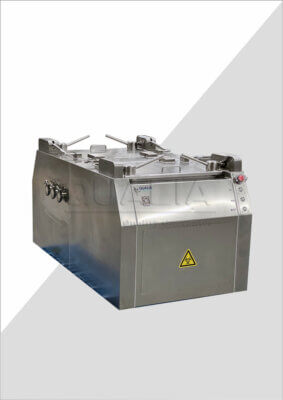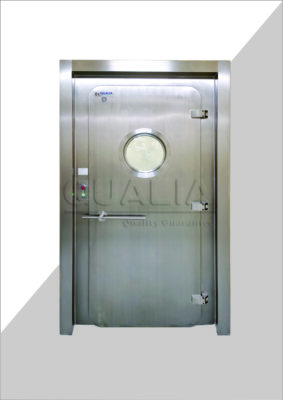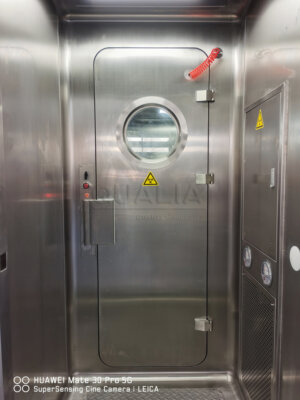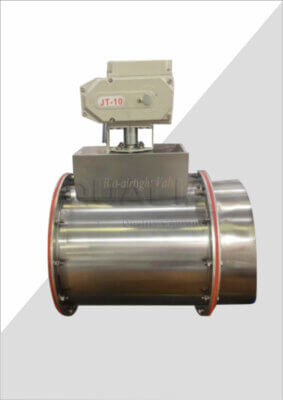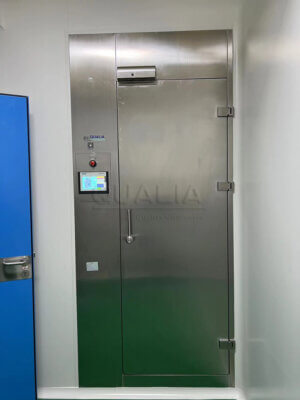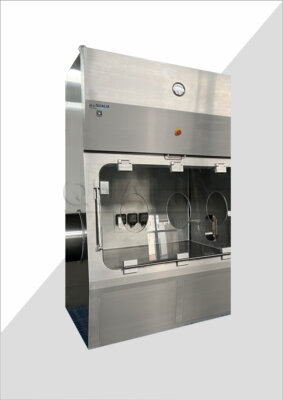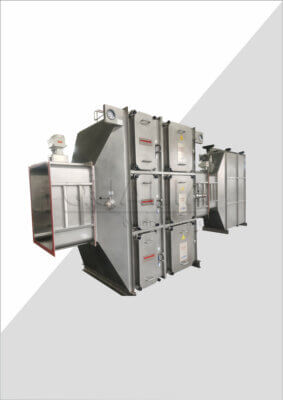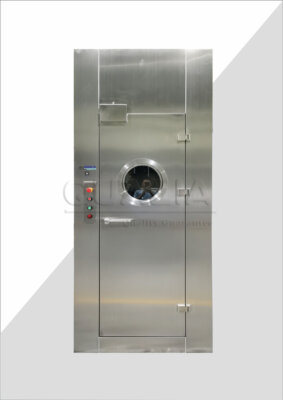

Inflatable-seal biosafety pass box site readiness depends on four parallel workstreams: air supply, seal monitoring, controls integration, and the wall interface. Each workstream carries its own information gaps, and the gaps compound when the offer is reviewed before the facility data is assembled. The practical starting point is to treat the quotation as a prompt for a structured information request, not as a construction-ready specification.
Identify the Offered Pass Box Configuration
The quotation itself is the first place to look, and it should describe more than a category.
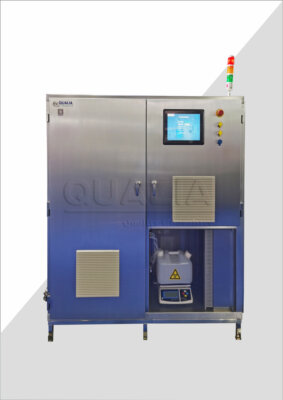
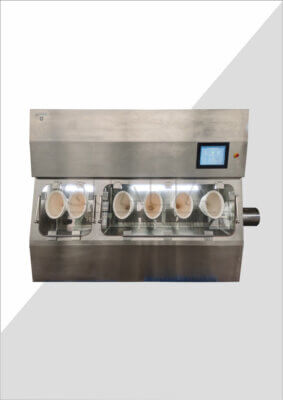
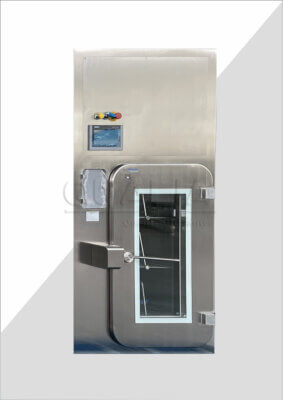
An inflatable seal on a biosafety pass box performs a specific job: when the door closes, compressed air expands a elastomeric gasket into the door frame, forming a pressure-resistant boundary between two rooms or between a room and a transfer corridor. That boundary is what allows one side to be opened while the other remains sealed, maintaining the pressure differential that the room classification requires. But a quotation that describes this as “inflatable seal pass box” without further detail leaves the utility interfaces, the actuation logic, and the interlock assumptions undefined.
Produtos relacionados
- Caixa de passagem de biossegurança — Use the relevant assembly listing to start a configuration-specific RFQ; seal type, hardware, utilities, spares and service scope require an itemized response.
Before treating the quote as a site document, request the offered configuration explicitly. The supplier should be able to identify the seal geometry, the actuation method, the door sequencing logic, and the declared utility connection points. These are not refinements to be resolved during installation; they are the inputs against which site readiness is assessed.
Site readiness should be checked against the assembly being purchased, not against a generic category description.
This matters in practice because a biosafety pass box may be supplied as a standalone unit with local controls and simple compressed-air fittings, or as a system-integrated assembly with remote status signals, supervisory handshaking, and engineered utility interfaces. The site preparation differs substantially between these. A project that assumes the simpler configuration and receives the integrated one—or vice versa—will find the mismatch at installation, when repositioning services or rerunning cable is expensive and may affect qualification timelines.
If the quotation is ambiguous, raise a formal configuration clarification before layout or utility commitments are made. The supplier’s response will anchor every downstream readiness check.
Allocate Air and Utility Information
Compressed air is the utility that makes the inflatable seal work, and the supply requirements are specific enough that they need to be traced to a named information owner before the site brief closes.
When a supplier lists a compressed-air connection in the offer, the natural response is to note it and move on. The problem is that “compressed-air connection” does not resolve pressure, flow rate, air quality class, or connection size. Matching these values to what the facility can actually deliver at the pass box location requires the supplier’s input schedule—the document that lists exactly what the equipment needs at each interface—and a facility representative who can confirm whether that supply is available, or what modification is needed to provide it.
Seal actuation typically requires clean, dry instrument-grade air. Moisture or particulate contamination can degrade the elastomeric seal over its service life and introduce variability in the inflation pressure, which is precisely what the interlock monitors. Confirming air quality class against the supplier’s declared requirement, rather than assuming the facility compressed-air ring main is adequate, is a readiness step that frequently exposes a gap.
The responsibility question is easy to defer and expensive to leave open. Someone owns the connection from the facility ring main to the pass box utility stub. That party may be the facilities contractor, the mechanical subcontractor, or in some projects a contracted utility package that includes the connection in the supplier’s scope. If the offer includes a utility package, verify what it covers and where the handoff point sits. If the connection is in site scope, identify the information owner and confirm the facility data before the supplier finalises drawings.
Electrical supply follows the same logic. The control enclosure, door actuators, and any interlock outputs each have declared electrical requirements. Gather them from the supplier’s input schedule and map them against available panel capacity and cable routes before the layout is fixed.
Consider a project where the pass box is positioned on a wall between a BSL-2 corridor and a BSL-3 processing room. The BSL-3 side operates at negative pressure. The compressed-air supply point is in the corridor ceiling, feeding a ring main shared with HVAC valve actuators. The pass box requires instrument-quality air at a declared minimum inlet pressure. Without the supplier’s input schedule, the facility team cannot confirm whether the shared ring main maintains that pressure under simultaneous demand, or whether a local pressure regulator and filter-regulator-lubricator assembly is needed in scope. That question belongs in the site brief, not in a commissioning punch list.
Define Monitoring and Control Deliverables
Seal monitoring is frequently included in an offer as a named feature, and the name covers a range of implementations that differ in what they tell the operator and what they hand to the facility’s supervisory systems.
When seal monitoring appears in the offer, the first action is to request the function description: what is actually measured, how the measurement is taken, what indication is available locally, and what output signal—if any—is provided for integration. A pressure switch on the seal inflation circuit confirms that the seal has reached a set pressure; a continuous transducer provides a live reading that can be trended and alarmed at thresholds; a simple indicator light confirms an inflate/deflate state without transmitting a value. Each of these is legitimately described as “seal monitoring,” and each has different implications for integration and for the evidence available during qualification.
Document deliverables are part of the monitoring scope, not an afterthought. For a biosafety pass box in a classified or regulated space, the qualification package will need to demonstrate that the seal performs as intended. That means the supplier should be able to identify which documents are in scope: at minimum, the functional description and the declared actuation parameters; where qualification support is included, the installation qualification and operational qualification protocols and reports. Requesting this list before the contract closes is easier than negotiating it afterward.
The monitoring label describes a function; the function description, available indication, and document list describe what is actually being delivered.
Control responsibilities require the same partitioning. In a biosafety pass box, control logic typically spans the equipment boundary: the supplier provides door sequencing, seal interlock, and local indication; the facility provides room pressure signals, BMS integration, and supervisory alarm routing; and a building automation or safety system may require handshaking signals that neither party can define alone. When these responsibilities cross the equipment boundary, they need to be listed separately—supplier deliverables, facility deliverables, and supervisory-system deliverables—and each party needs to agree on who provides each side of the connection point.
A common mistake is to leave the interface definition to the installation phase, treating it as a site coordination task. By that point, panel design is complete, cable routes are built, and changes carry cost and schedule impact. The interface agreement belongs in the project brief, before engineering is committed. If an accepted interface document already allocates responsibilities, verify that it reflects the current offer configuration, particularly if the offer has been revised since the agreement was written.
Leitura relacionada
- URS para equipamentos de alto nível de contenção: o que os departamentos de Garantia da Qualidade, Engenharia e Aquisições devem definir antes da solicitação de cotação — Prepare the site-input and responsibility questions before quotation.
- Requisitos de controles e intertravamentos em solicitações de cotação (RFQs) para equipamentos de alta contenção: PLC, HMI, BMS e comprovação de alarmes — Develop the documentation questions for the equipment-to-facility control boundary.
- Qualificação de instalação para equipamentos de contenção: desenhos, serviços de utilidades, calibração e verificações conforme a obra concluída — Carry confirmed site inputs into the installation-document discussion.
Coordinate the Wall Interface and Site Evidence
The wall opening is where the equipment drawing and the building drawing must refer to the same project version, and where unverified assumptions create the most persistent site problems.
Coordinate the Wall Interface and Site Evidence: Buyer Review Matrix
| Site interface | Information to obtain | Responsible party to name |
|---|---|---|
| Compressed-air connection | Offered utility input schedule | Facility information owner |
| Controls connection | Equipment and receiving-system deliverables | Owner of each side |
| Wall opening | Current drawing and equipment-to-wall detail | Wall and equipment drawing owners |
| Unverified site input | Missing record or survey dependency | Party supplying the confirmation |
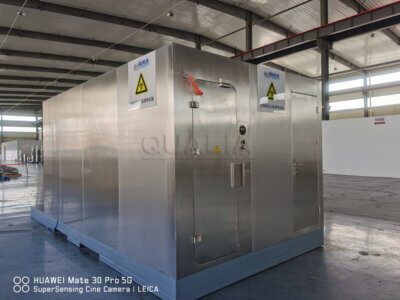
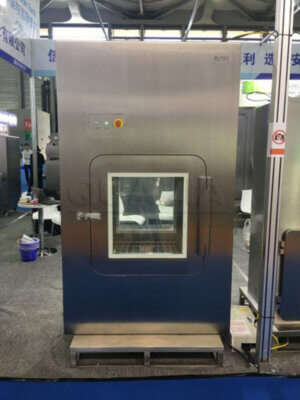
A biosafety pass box is set into a rated wall. The wall carries a biosafety or cleanroom classification, structural load ratings, and in many cases a fire rating. The pass box penetrates all of these. That means the opening size, the frame detail, the sealing method at the perimeter, and the support arrangement must be coordinated between the equipment supplier and the wall owner—the party responsible for the wall design and construction documentation.
Drawing revision control is the practical mechanism. The supplier’s installation drawing and the facility’s architectural or structural drawing must carry the same opening dimensions, at the same revision level, before site work begins. A mismatch found during construction—where the opening is built to an earlier drawing that the supplier subsequently revised—is a rework event in a wall that may be part of a pressure boundary. Confirming that the equipment-to-wall interface is current across both drawing sets is a readiness checkpoint, not a formality.
The proposed interface detail itself needs to be explicit. Biosafety pass boxes installed in containment walls are designed to maintain the wall’s pressure boundary at the perimeter. That typically means a closed-cell foam or elastomeric perimeter seal, possibly supplemented with a sealant bead, specified to both the wall construction and the equipment flange geometry. The supplier should identify the recommended interface detail; the wall owner or specifier confirms whether it is compatible with the wall type. Neither party should assume the other has resolved this.
Where readiness depends on site information that has not yet been confirmed—utility supply pressures, wall construction type, available panel capacity, supervisory system protocol—those gaps belong in the site brief as named open items, each with a responsible party and a date by which the information is needed. A readiness review that closes without identifying these items has not improved readiness; it has converted assumptions into acceptance.
QUALIA structures its pre-installation coordination around this principle: the site brief should expose what is not yet known, not ratify what has been assumed. For inflatable-seal pass box projects, the information the team should have ready before the layout is committed includes the compressed-air supply data at the proposed installation point, the wall construction detail and owner, the supervisory system interface requirements, and the qualification documentation scope expected from the supplier. With those inputs assembled, the installation and qualification sequence can be planned without the unresolved items that otherwise surface during commissioning.
Referências
- Anexo 1 das BPF da UE – Fabricação de Medicamentos Estéreis (2022) — Utilize o contexto de controle de contaminação em fabricação asséptica para identificar equipamentos e interfaces do local que devem ser analisados; ele não fornece valores de aceitação específicos para o projeto relativos a caixas de passagem ou cRABS.
- EudraLex, Volume 4, Anexo 15 – Qualificação e validação — Distinguir a documentação do fornecedor das decisões de qualificação e aceitação do projeto; as condições e os desvios relatados permanecem específicos ao sistema em questão.
- ISO 14644-7:2004 Dispositivos de separação — Os requisitos relativos aos dispositivos separadores de quadros e as questões entre cliente e fornecedor estão incluídos no escopo verificado deste resumo da norma; as cláusulas detalhadas e os limites dos equipamentos estão fora deste resumo.
- WHO Laboratory Biosafety Manual 4th Edition (Core Document) — Put the laboratory use and risk-assessment basis ahead of a generic equipment label; this summary is not a door specification or a facility approval.
Perguntas frequentes
Q: Does an equipment-ready statement mean the building is ready?
A: Only if the stated scope includes the relevant building interfaces. Keep supplier readiness and unresolved wall, utility or receiving-system inputs separate in the review record.
Q: Can the wall contractor receive information before the equipment drawing is final?
A: Yes, with the drawing status and open dimensions visible. Identify who will issue the confirmed detail so provisional information is not treated as the final installation basis.
Q: How should a quotation handle an unknown utility condition?
A: Name the missing facility input and its owner, then state the offer assumption explicitly. The unknown should remain a visible dependency rather than an invented utility specification.