

A decontamination procedure that documents the right contact time can still fail if that time starts before full immersion is achieved. That gap — between when an item enters solution and when its entire surface is actually wetted — is one of the more consequential variables in liquid decontamination practice, and it tends to surface late: during commissioning, during an audit of cycle records, or after a qualification team begins questioning whether claimed contact times are valid. The same logic applies to disinfectant concentration, which can fall below effective levels through dilution and organic load accumulation without triggering any visible indicator, leaving a facility with complete-looking records and an undefended decontamination history. Understanding how contact time, concentration, load geometry, and recordkeeping interact as a system — rather than as isolated parameters — is what allows biosafety officers, QA teams, and facility engineers to design procedures that hold up under review.
Contact Time Start Based on Full Wetting
Contact time begins when the required surface is submerged and wetted — not when the item enters the tank. That distinction matters operationally because irregular items, containers with recessed geometry, or materials that initially repel liquid may take time to achieve full surface contact, and any exposure elapsed before that point does not count toward the validated cycle duration.
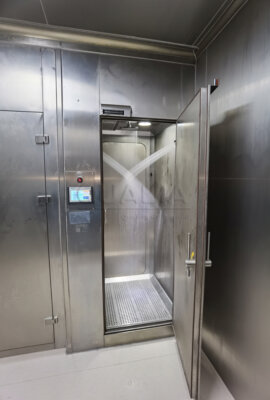
In BSL-4 settings, the principle is operationalized through a door interlock: the outer tank door remains locked until a verified decontamination cycle has fully elapsed, which removes the opportunity for an operator to retrieve an item prematurely based on estimated time. That mechanical control enforces the wetting condition indirectly — it makes cycle completion a confirmed state rather than an approximated one. Not all dunk tank configurations use this specific control, and facilities operating at lower containment levels may manage the same principle through procedural timing controls and SOP-defined immersion rules. The underlying requirement, however, is consistent: the clock starts at full wetting, and the SOP needs to define how that condition is established and verified for each load type.
The downstream implication for procedure development is that contact time validation cannot be performed on a generic basis. Items with different surface materials, coatings, or geometries may wet differently, and a procedure validated for one item family should not be assumed to cover items with substantially different surface characteristics. Defining the wetting trigger condition and building it into load-specific SOPs before qualification avoids the more disruptive alternative of discovering the gap during OQ review.
Concentration Loss From Dilution and Organic Load
Concentration loss is the failure mode most often underestimated at the procedure design stage. Disinfectant strength degrades through three distinct mechanisms — dilution from carry-over water or condensation, neutralization by biological soiling, and gradual chemical degradation from repeated use — and each requires its own verification response. Treating them as a single generic risk, addressed by a periodic calendar-based check, creates intervals that may not reflect actual tank use and leaves concentration drift undetected between scheduled measurements.
The consequence of uncontrolled concentration loss is not a visible process failure. A tank at sub-effective concentration looks identical to one operating within range, and the records will appear complete until an audit or validation event cross-references measured concentration against cycle logs and exposes the gap. At that point, the decontamination history tied to that solution batch becomes difficult or impossible to defend. The WHO Laboratory Biosafety Manual, 4th Edition, supports the principle that decontamination methods should be validated under realistic load conditions, including the effects of organic load on disinfectant efficacy — which reinforces the requirement for verification checks tied to actual use rather than elapsed time alone.
Each degradation mechanism carries its own verification requirement.
| Czynnik | Effect on Concentration | Wymagana weryfikacja |
|---|---|---|
| Dilution (carry‑over water, condensation) | Reduces active ingredient level | Defined concentration checks (chemical titration, test strips) before immersion |
| Obciążenie organiczne (biological soiling) | Neutralizes or consumes disinfectant | Viability testing under simulated organic load to confirm continued efficacy |
| Repeated Use (cycle fatigue) | Gradual chemical degradation and potency loss | Defined maximum solution age or cycle count; concentration monitoring at each cycle start |
A practical implication of this structure is that concentration monitoring intervals should be defined by cycle count or load volume, not by calendar schedule alone. A tank used infrequently may remain within concentration range well beyond its calendar check interval, while a tank used heavily may fall below effective levels before the next scheduled measurement. Aligning check frequency with actual use patterns is what makes the monitoring defensible.
Load Size Buoyancy and Safe Immersion
Buoyancy and load size are planning criteria that must be resolved before a decontamination cycle procedure is finalized, not field judgments made at the point of immersion. Items that float, shift during immersion, or resist full submersion create a variable that the SOP cannot manage in real time — and the most common point of discovery is commissioning, when an operator attempts to immerse a container that the tank and its current load configuration cannot accommodate without manual force.
Manual force to maintain immersion is a disqualifying condition, not a workaround. An operator applying sustained downward pressure on a container introduces an unpredictable and non-repeatable variable into the immersion state. If force is released — deliberately or accidentally — the item will surface, and any contact time accumulated during partial immersion does not satisfy the validated cycle requirement. There is also an injury risk where significant force is needed over an extended contact period, which becomes a separate concern for EHS review.
The resolution is pre-cycle load assessment: evaluating whether each item or container type can be reliably maintained in a fully submerged orientation without operator intervention. Where buoyancy is a consistent challenge for a specific item type, the fixture or load configuration needs to be redesigned before that item enters a formal decontamination procedure. Discovering this during SOP drafting is a minor planning revision; discovering it during OQ is a schedule problem.
Orientation Fixtures for Air Removal
Trapped air pockets are not a marginal concern for geometrically simple loads, but they are a systematic failure risk for containers with cavities, narrow necks, internal baffles, or any configuration that creates a closed airspace when submerged. Those air pockets prevent liquid contact with the enclosed surface for the duration of immersion, meaning that the claimed contact time does not apply to those areas regardless of how long the item remains in solution.
The engineering response is orientation control enforced by fixturing. If a container is positioned so that its cavity opens downward, or at an angle that allows air to escape as liquid displaces it, the trapped air risk is eliminated by design. The same result cannot be reliably achieved through procedural instruction alone — an operator managing multiple items in a cycle is unlikely to maintain consistent container orientation throughout the contact period without a physical constraint. Fixtures that lock orientation remove that variability and make the contact condition reproducible across operators and cycles.
The planning implication is that fixture requirements need to be identified during load characterization, before the tank configuration is finalized. A tank sized without knowledge of the fixturing hardware needed to accommodate the actual load types may not have the internal clearance or anchor points required. Retrofitting a tank to accommodate fixtures after fabrication is more complex than incorporating the requirement at the design stage, and it will affect qualification documentation if the fixture is added after IQ.
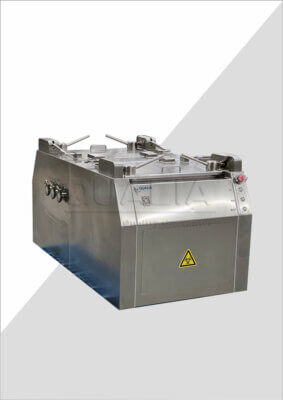
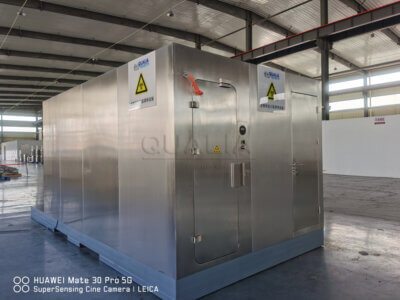
For facilities working through specific load configurations and tank sizing, the Zbiornik bezpieczeństwa biologicznego product page provides relevant configuration detail.
Solution Age and Monitoring Records
Records for liquid decontamination serve two functions simultaneously: they provide real-time process assurance that the solution is operating within effective parameters, and they create the auditable evidence trail that demonstrates compliance when reviewed retrospectively. A record set that documents exposure time and load identity but omits measured concentration or solution age satisfies neither function — it shows that an event occurred, not that the event constituted a valid decontamination cycle.
The WHO Laboratory Biosafety Manual, 4th Edition, identifies logbook documentation of solution age, concentration, and cycle parameters as a process requirement at high-containment facilities. That framing reflects the principle that solution effectiveness is time-dependent and use-dependent, and that the record needs to capture both dimensions to be defensible. A concentration value recorded at solution preparation with no subsequent checks is not a substitute for concentration monitoring at each cycle start — it documents what the solution was, not what it is at the point of use.
Each element of the cycle record serves a specific compliance function.
| Element rekordu | Purpose in Compliance | Co należy udokumentować |
|---|---|---|
| Stężenie środka dezynfekującego | Confirm effective level before each cycle | Measured concentration (ppm or %) |
| Czas ekspozycji | Ensure adequate contact time | Immersion start and end times, or total contact duration |
| Load identity | Enable traceability | Item description, ID, or load manifest |
| Solution age | Verify solution is within usable life | Date of preparation, expiration, or age at time of use |
| Cycle parameters | Demonstrate process was run to SOP | Relevant settings (e.g., temperature, agitation) as defined by the facility |
| Deviation from SOP | Support accountability and corrective action | Nature of deviation, immediate actions taken, and sign‑off |
The consequence of incomplete records extends beyond the individual cycle. If a deviation or containment concern is investigated and the records for the relevant period lack concentration data, load identity, or solution age, the entire decontamination history for that tank during that period becomes subject to challenge. Establishing which record elements are required, who documents them, and at what point in the cycle they are captured should be resolved during SOP development — not reconstructed after an audit finding.
Additional context on disinfectant concentration monitoring relevant to liquid decontamination systems is available in the post on disinfectant selection for mist showers, which covers concentration stability considerations applicable across liquid-phase decontamination applications.
Deviation Handling for Liquid Decontamination
A deviation in liquid decontamination is not limited to an obvious process failure. Immersion time cut short, concentration found below the required threshold at cycle start, an item retrieved before the outer door interlock confirmed cycle completion, a solution used past its defined age limit — each of these constitutes a deviation that affects the validity of the cycle and requires a documented response. The risk in treating these as minor procedural exceptions is that the record for that cycle appears to confirm successful decontamination when the process that generated it did not meet the validated parameters.
ISO 35001:2019 structures biorisk management through a framework that includes systematic evaluation, reporting, and corrective action for deviations — not as a prescriptive procedure, but as the accountability structure within which facility-specific deviation protocols operate. What that means practically is that the deviation response is not improvised at the point of discovery. The SOP should define the immediate containment actions, the evaluation pathway, the notification chain, and the documentation requirements before any deviation occurs, because the period immediately following a discovery is the worst moment to be making those decisions for the first time.
The record generated by a deviation response is also a compliance artifact. An investigation that concludes a decontamination cycle was not valid must document that conclusion, the basis for it, and the corrective action taken — including whether the load in question required re-processing, quarantine, or escalated review. A deviation record that documents the discovery of the problem without documenting its resolution is incomplete, and may be treated as an open finding during an inspection. Closing the loop between detection, evaluation, corrective action, and sign-off is what makes the deviation record defensible rather than simply present.
The parameters governing a dunk tank decontamination cycle — contact time, disinfectant concentration, load immersion, orientation, solution age, and deviation handling — are only independently manageable up to a point. In practice, a procedure that addresses each parameter in isolation without defining how they interact will produce records that look complete while carrying real gaps in decontamination assurance. The more consequential planning decisions involve resolving those interdependencies early: confirming that load geometry and buoyancy characteristics are compatible with the tank and fixturing before the cycle procedure is drafted, defining concentration monitoring intervals based on actual use patterns rather than calendar schedules, and specifying what each record element must capture before qualification begins.
Before finalizing any dunk tank decontamination procedure, the questions worth confirming are: at what point in the immersion sequence does the SOP define contact time as starting, does concentration monitoring frequency reflect actual cycle load rather than elapsed time, has buoyancy been assessed for each item type the procedure will cover, and does the deviation protocol define a closed-loop response from detection through corrective action sign-off. The answers to those questions determine whether the procedure is defensible under audit, not whether it looks procedurally complete on paper.
Często zadawane pytania
Q: What happens if a dunk tank decontamination procedure is used across multiple biosafety levels — does the same contact time and concentration apply?
A: No — validated parameters are containment-level and agent-specific, so a procedure validated for BSL-2 work should not be carried forward unchanged into a BSL-3 or BSL-4 context. Higher containment levels introduce different agent profiles, more stringent regulatory expectations, and in BSL-4 settings, mechanical controls such as door interlocks that enforce cycle completion in ways procedural SOPs at lower levels do not. Each containment context requires its own validation basis, and assuming transferability across levels creates an undefended gap in the decontamination record.
Q: After a dunk tank decontamination SOP is drafted, what is the immediate next step before it can be used for operational cycles?
A: The procedure needs to go through qualification before it governs operational cycles — specifically, the load types, wetting conditions, concentration check intervals, and fixture configurations defined in the SOP must be confirmed to perform as written under realistic conditions. Items with different surface geometries or buoyancy characteristics should be tested during that qualification phase, not assumed to behave like previously validated loads. Any fixture or orientation control specified in the procedure also needs to be in place and documented before OQ begins, since adding hardware after qualification affects the validity of the IQ record.
Q: Is a calendar-based concentration check schedule sufficient for tanks used across varying cycle frequencies?
A: No — calendar-based schedules alone are not sufficient when cycle frequency varies. A tank used heavily may fall below effective concentration before the next scheduled check, while a lightly used tank may remain within range well past it. Monitoring intervals tied to cycle count or total load volume processed reflect actual concentration depletion patterns more accurately than elapsed time. A calendar check may supplement that approach, but it should not be the sole trigger for concentration verification.
Q: How does the choice between a fixturing solution and a procedural orientation instruction affect qualification?
A: Using a fixture rather than a procedural instruction creates a physically enforceable, reproducible condition that can be documented and qualified — the fixture either holds the item in the correct orientation or it does not, and that state is verifiable. A procedural instruction requiring an operator to maintain a specific container angle throughout the contact period introduces operator variability that is difficult to qualify and impossible to confirm retroactively from cycle records alone. If orientation is critical to air removal for a specific container type, a fixture is the defensible approach; a procedural instruction is a risk to cycle validity that becomes visible only when records are scrutinized.
Q: At what point does an incomplete deviation record become a compliance liability rather than just an administrative gap?
A: An incomplete deviation record becomes a liability the moment the decontamination cycle it describes cannot be confirmed as valid — which is most critical when a containment concern, investigation, or external inspection references that period. A record that documents discovery of the deviation without documenting evaluation, corrective action, and sign-off leaves the resolution status open, and an open finding during inspection is treated as unresolved regardless of what actually occurred. The deviation record is only defensible when it shows a closed loop from detection through corrective action, and that structure needs to be defined in the SOP before any deviation occurs.