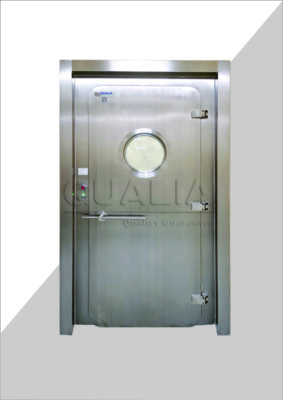


Specifying a mist shower for a BSL-3 facility looks straightforward until the commissioning engineer arrives and finds the interlock signal has nowhere to land in the BMS — because nobody decided at the design stage whether the unit would run on a standalone PLC or integrate into the building control architecture. That single unresolved question has derailed final commissioning on otherwise complete projects, triggering integration redesign that costs weeks and exposes the procurement timeline to regulatory qualification delays. The same pattern repeats with material selection: facilities that specify 304 stainless for chemical-wetted components and later switch to sodium hypochlorite at operational concentrations discover weld seam corrosion that requires full wetted-part replacement, not a surface repair. The specifications that follow address chamber geometry, nozzle output, material thresholds, dosing configuration, control interfaces, effluent volumes, and procurement verification — in enough detail to close those gaps before they become field problems.
Chamber geometry: minimum dimensions, headroom, and occupancy assumptions for BSL-3 compliance
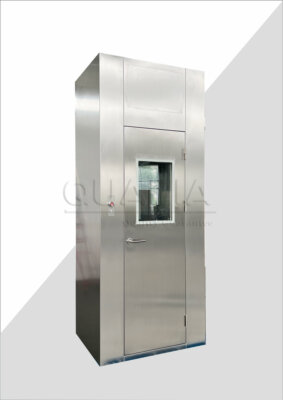
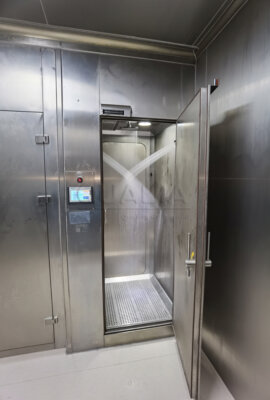
Undersizing a mist shower chamber is the one specification error that cannot be corrected in the field. Once a unit is installed within a facility’s structural envelope, the internal volume is fixed. If that volume is insufficient to produce validated PPE coverage across the full gown profile — from boot covers to the crown of a powered air-purifying respirator — the validation protocol fails, and the corrective path is physical replacement, not software adjustment.
For single-occupancy units, a 900 mm × 900 mm footprint with 2000–2100 mm clear internal height represents the practical minimum for reliable full-body coverage during gown profile validation. Facilities that have specified below this footprint consistently report coverage gaps at the shoulder and lower leg zones, where nozzle spray geometry cannot compensate for the compressed interior volume. These failures are not marginal — they show up during IQ/OQ as discrete validation failures, not as marginal performance data that can be argued past a reviewer.
Dual-occupancy chambers present a distinct planning problem, not simply a scaled-up version of the single-occupancy case. Extended chamber depth changes the nozzle array layout, spray overlap requirements, and the dwell-time calculation for effective decontamination. Validation protocols written for single-occupancy units cannot be directly applied, and the room layout implications — floor penetration, wall clearances, utility chase positions — all shift with an extended-depth chamber.
| Occupancy Type | Minimum Internal Dimensions (W x D x H) | Key Planning Consideration |
|---|---|---|
| Single Occupancy | 900 mm × 900 mm × 2000 mm | Ensures sufficient space for full PPE decontamination coverage during validation. Below these dimensions may lead to failed gown profile validation. |
| Dual Occupancy | 900 mm × [Extended Depth] × [Minimum Height] | Requires an extended chamber depth to accommodate two occupants, impacting room layout and validation protocols for simultaneous use. |
Occupancy assumption should be locked before floor planning begins, because retrofitting a deeper chamber into a space sized for single occupancy typically requires reconstruction of the surrounding containment boundary — a cost-of-error that dwarfs the original equipment price difference.
Nozzle specifications: output rate, operating pressure, and atomization method comparison
The choice between pneumatic and hydraulic nozzle systems is not primarily an equipment preference — it is an engineering decision with direct downstream consequences for utility connections, chemical consumption, effluent volume, and EDS sizing. Treating it as a secondary configuration detail resolved late in procurement is how projects arrive at drain design conflicts during construction.
Pneumatic systems require a compressed air supply at 5–7 bar and deliver approximately 1.5–3.0 L/min per nozzle at droplet sizes at or below 10 µm. The fine atomization at that particle size is what produces reliable surface contact on fabric surfaces, seams, and glove-to-sleeve interfaces — areas where coarser droplets deflect rather than wet. The utility requirement is the trade-off: compressed air connection and compressor capacity have to be sized into the facility utility design, and that connection point needs to be coordinated with mechanical engineering during the design phase, not resolved during installation.
Hydraulic systems connect directly to the building water supply, which simplifies the utility connection considerably. The operational penalty is output volume: hydraulic nozzles typically produce 4–6 L/min per nozzle due to less efficient atomization, and that increase in flow rate carries through to chemical consumption per cycle and total effluent volume per cycle. In a facility where the EDS inlet capacity is already constrained, that difference is not a minor efficiency gap — it is a system compatibility question.
| Spécifications | Pneumatic Nozzle System | Hydraulic Nozzle System |
|---|---|---|
| Pression de fonctionnement | 5–7 bar (compressed air supply required) | Building water supply pressure (no compressed air needed) |
| Typical Output Rate per Nozzle | 1.5–3.0 L/min | 4–6 L/min |
| Atomization Performance | High efficiency, produces droplet size ≤10µm | Lower efficiency due to less effective atomization |
| Key Utility Impact | Requires compressed air connection and compressor sizing | Increases water, chemical, and wastewater volumes |
A rated output of ≥200 g/min at ≤10 µm represents a meaningful performance threshold for pneumatic system specification. When evaluating competing pneumatic systems, these figures provide a basis for comparing atomization performance in specification review — but they should be understood as design-reference figures, not as regulatory minimums applicable to all nozzle configurations. The practical consequence of specifying below these thresholds is reduced surface contact efficiency, which maps directly to decontamination coverage gaps during validation.
Wetted surface material requirements: when 304 is insufficient and 316L becomes mandatory
Material grade selection for chemical-wetted components is a triggered decision, not a default. The trigger is the disinfectant chemistry in use. In the absence of chlorine-based chemistry, 304 stainless steel performs adequately across the component set. When sodium hypochlorite or other chlorine-based disinfectants are part of the decontamination protocol — particularly at concentrations at or above 0.5% in continuous-use applications — 304 is an inadequate specification for any surface in direct chemical contact.
The failure mode is specific: corrosion initiates at weld seams, not on flat sheet surfaces. This matters because weld seams are where internal chamber joints, nozzle manifold connections, and drain fittings concentrate stress and surface discontinuity. Pitting and crevice corrosion at these points develops under continuous chlorine exposure and is typically not visible during routine inspection until the corrosion has progressed far enough to compromise the joint integrity. By that stage, replacement of wetted components is the only remediation path.
316L stainless steel provides the molybdenum content that resists chloride-induced corrosion at these concentrations. The initial material cost is higher, but the comparison that matters is not 304 versus 316L at purchase — it is 316L at specification versus 304 plus wetted-part replacement plus revalidation after replacement. Facilities that have made that substitution reactively, rather than at specification, consistently report that the total cost of the corrective cycle far exceeds the original material upgrade cost.
| Qualité des matériaux | Cas d'utilisation principal | Risk if Misapplied | When Specification is Mandatory |
|---|---|---|---|
| Acier inoxydable 304 | General use, non-corrosive or low-concentration chemical environments | Corrosion at weld seams when exposed to sodium hypochlorite ≥0.5% concentration | When chlorine-based disinfectants are not used. |
| Acier inoxydable 316L | Chemical wetted components and surfaces | Higher initial material cost, but necessary for long-term integrity | For any surface in direct contact with chlorine-based disinfectants. |
The specification decision point is straightforward once the disinfectant chemistry is confirmed: if the facility’s SOP includes any chlorine-based agent at or near 0.5% concentration as an operational disinfectant, 316L must be specified for all wetted surfaces. If the chemistry is exclusively non-chlorinated and the operating concentration is low, 304 remains technically adequate — but that determination should be made explicitly and documented in the specification, not assumed by default.
Chemical dosing unit specifications: reservoir capacity, pump type, and concentration accuracy
The dosing unit is where the designed decontamination outcome either holds or degrades in real operation. A system that produces reliable atomization at validated disinfectant concentrations during qualification can produce a different outcome six months later if the dosing unit drifts, the operator adjusts concentration informally, or the pump type does not support the precision required for a validated range.
Adjustable proportional dosing pumps are the configuration to specify when concentration repeatability is a validation requirement. Fixed-rate dosing pumps simplify the system but eliminate the ability to adapt concentration to cycle modifications, occupancy scenarios, or different disinfectant formulations without hardware changes. The procurement question to resolve is whether the dosing pump offered is proportional and adjustable — and if so, what the stated concentration accuracy range is. This is not a standard feature across all configurations; it needs to be confirmed and specified explicitly in the purchase document.
Reservoir capacity determines how many shower cycles can be completed before a refill event, and refill events carry contamination risk in high-containment environments if not managed within a defined protocol. Specify reservoir capacity relative to expected shift utilization, not just single-cycle volume, and confirm whether the reservoir is designed for in-place refill or requires removal. For BSL-3 applications, the refill access point and its relationship to the containment boundary should be reviewed at the design stage.
Concentration accuracy is operationally critical for validation defensibility. A dosing unit that cannot demonstrate consistent concentration output across the validated range introduces variability that is difficult to address during periodic review without system intervention. Where the facility’s quality system requires documented concentration verification, confirm whether the dosing unit provides integrated monitoring output or whether concentration verification is performed externally.
Electrical and control interface requirements: PLC vs BMS integration and interlock signal specifications
The control interface is the specification gap most likely to surface as a commissioning problem rather than a procurement problem — which means its cost is paid in delay, not in upfront budget. By the time integration redesign is identified during final commissioning, the equipment is installed, the facility schedule is committed, and the options for correction are limited to custom programming work under time pressure.
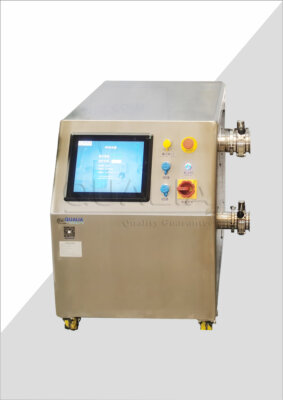
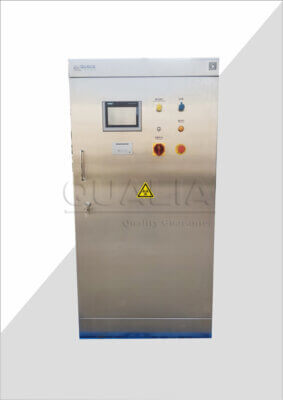
The decision that must be made before the purchase order is issued is whether the mist shower’s interlock signal connects to the facility Building Management System or operates through a standalone PLC supplied with the unit. These are not interchangeable paths. A unit supplied with a factory-tested Siemens or Allen-Bradley PLC has a defined integration footprint; connecting that unit to a facility BMS that runs on a different control platform requires compatibility verification and potentially custom interface development. Leaving this question open at procurement means the vendor configures a default, and the default may not match the facility’s control architecture.
Door interlock behavior on power failure is a separate but equally consequential detail. Standard configurations typically release the interlock automatically on power failure to allow emergency egress. This is the correct safety behavior in most scenarios, but it must be explicitly coordinated with the facility’s emergency egress protocol and its containment breach response procedures. In a BSL-3 environment, automatic release on power failure cannot be assumed to be universally acceptable without facility-specific review. The behavior should be confirmed with the vendor, documented in the specification, and verified during SAT.
| Specification Item | Ce qu'il faut confirmer | Risk if Unclear or Vague |
|---|---|---|
| PLC Brand/Model Compatibility | Which specific PLC brands/models (e.g., Siemens, Allen Bradley) are offered and tested? | Limits integration options with existing facility control systems, potentially requiring custom programming. |
| BMS vs. Standalone PLC Integration | Does the interlock signal connect to the facility Building Management System (BMS) or a standalone PLC? | Causes integration redesign and delays during final commissioning. |
| Door Interlock Behavior on Power Failure | Does the door interlock release automatically during a power failure? | Creates a safety hazard if not coordinated with facility emergency egress protocols. |
Resolving all three items in this table — PLC platform, BMS versus standalone integration, and power-failure interlock behavior — before the purchase order is issued converts potential commissioning rework into a documented pre-purchase decision. Leaving any of them open transfers the resolution cost to a project stage where correction options are significantly more constrained.
Effluent volume specifications: how system type affects drain sizing and EDS connection design
Mist shower systems generate substantially less wastewater than conventional spray shower configurations, and that characteristic is precisely why they are preferred in facilities with EDS infrastructure designed around minimum throughput volumes. The operational advantage disappears if the system type is selected without reference to the actual EDS inlet capacity — because even mist system effluent can exceed EDS inlet flow rates when nozzle count and cycle duration are not matched to the drain design.
The nozzle type drives the effluent volume per cycle more directly than any other system variable. Pneumatic nozzles at 1.5–3.0 L/min per nozzle produce a total effluent volume that is manageable within EDS systems sized for moderate throughput. Hydraulic nozzles at 4–6 L/min per nozzle can push total cycle effluent to levels that exceed EDS inlet flow rate capacity, particularly in multi-nozzle configurations with standard cycle durations. When this occurs, effluent backs up at the drain connection — a condition that creates both contamination risk and facility compliance exposure.
The practical threshold decision is straightforward: if the facility’s EDS inlet capacity per shower cycle is below 20 L, a hydraulic system should only be considered alongside a collection sump that buffers the effluent flow rate before the EDS connection. When EDS capacity exceeds 30 L per cycle, a pneumatic system’s lower effluent volume fits comfortably within that capacity while also delivering superior atomization performance.
| Facility EDS Inlet Capacity per Shower Cycle | Recommended System Type | Primary Rationale |
|---|---|---|
| Below 20 L | Hydraulic System with Collection Sump | Prevents exceeding the EDS inlet flow rate by managing the higher effluent volume (4–6 L/min per nozzle) via a buffer. |
| Above 30 L | Système pneumatique | Lower effluent volume (1.5–3.0 L/min per nozzle) is well within capacity, and superior atomization improves decontamination performance. |
EDS inlet capacity should be confirmed against actual system design documentation — not assumed from general facility specifications — before the nozzle type decision is finalized. The drain sizing review is a mechanical engineering coordination item that belongs in the design phase, not in the installation phase. Projects that defer this coordination often discover the mismatch when the shower is already positioned over a drain connection sized for a different flow assumption.
For more background on how mist shower systems approach contamination control at the system level, Qualia Bio’s overview of their mist shower solution covers the operational principles that underpin these design decisions.
Procurement checklist: the specification questions to resolve before issuing a purchase order
Every item on a procurement checklist for containment equipment has a project-stage cost attached to it. Items resolved at specification cost almost nothing. Items resolved during installation cost rework. Items resolved during commissioning or qualification cost delay and, in some cases, revalidation scope. The three items in this section represent the category that most frequently migrates from specification to commissioning without being formally resolved.
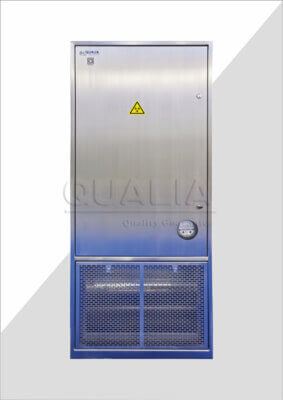
Control cabinet location — whether mounted above or alongside the shower — determines wall and ceiling clearance requirements, cable run lengths, and access constraints during maintenance. This is a spatial planning decision that must be locked before construction drawings are finalized. A cabinet position that looks acceptable on a schematic may conflict with ceiling services, HVAC distribution, or the containment boundary when translated to a real room. Confirm cabinet position, cable pre-wiring configuration, and access clearance requirements before the floor plan is committed.
FAT and SAT scope must be written into the contract, not assumed as included vendor services. Factory Acceptance Testing validates that the system performs to specification in the manufacturer’s facility before shipment. Site Acceptance Testing confirms that it performs to the same specification after installation in the actual facility environment. Both are required for qualification documentation that is defensible under GMP review frameworks and consistent with the operational verification principles outlined in resources such as the WHO Laboratory Biosafety Manual. If either is absent from the vendor’s scope of supply, the qualification documentation will carry a gap that cannot be closed retrospectively without re-testing — which means the gap surfaces at the worst possible moment, during audit.
Post-installation maintenance planning is a procurement decision, not a post-installation conversation. A Planned Preventative Maintenance schedule, service response commitments, and spare parts availability should all be confirmed and contracted before the purchase order is issued. For a containment-critical system in a BSL-3 environment, unplanned downtime is not a minor inconvenience — it is a facility operational constraint. Vendors who are unwilling to commit to a maintenance plan at the procurement stage represent a different category of long-term risk than the initial equipment price suggests.
| Élément de la liste de contrôle | Ce que le contrat doit spécifier | Why This Matters for Project Success |
|---|---|---|
| Control Cabinet Location | Whether the cabinet is mounted above or next to the shower, and confirmation of pre-wired cables for site installation. | Requires upfront spatial planning and ensures the installation matches facility layout. |
| Factory and Site Acceptance Tests (FAT/SAT) | That vendor-conducted FAT and SAT are included as part of the procurement agreement. | These are critical validation services necessary for system qualification and regulatory compliance. |
| Post-Installation Support & Maintenance Plan | Details of the offered Planned Preventative Maintenance and Servicing Plan, including after-sales support. | Ensures long-term system reliability and defines responsibility for ongoing servicing. |
The Qualia Bio mist shower product page provides configuration detail that supports several of these checklist items, including control options and available accessories, which can be useful as a reference when drafting vendor-specific specification questions.
The specifications that matter most in a mist shower procurement are not the ones that appear prominently in vendor datasheets — they are the ones that determine whether the system integrates with the facility’s control architecture, handles the facility’s disinfectant chemistry without accelerated corrosion, and produces an effluent volume the drain system can actually absorb. Those three constraints are defined by facility-side conditions, not by equipment defaults, which means they have to be resolved actively during specification rather than discovered during installation.
Before issuing a purchase order, confirm: the control interface path and PLC platform compatibility, the disinfectant chemistry and concentration driving the material grade requirement, the EDS inlet capacity against the nozzle type’s effluent output, and the FAT/SAT scope in the contract. These are not final-stage checks — they are the questions whose answers determine whether the commissioning and qualification process runs on schedule or absorbs weeks of correction work that could have been avoided at the design stage.
Questions fréquemment posées
Q: What happens if the facility’s compressed air supply cannot reach the 5–7 bar range required for a pneumatic nozzle system?
A: A hydraulic system becomes the only viable nozzle configuration in that scenario. Pneumatic systems depend on compressed air at that pressure range to achieve the atomization efficiency that keeps per-nozzle output low and droplet size at or below 10 µm — without it, the system cannot perform as specified. If compressed air capacity is constrained, the design response is to plan for a hydraulic system with a collection sump sized to buffer effluent before the EDS connection, particularly if the facility’s EDS inlet capacity falls below 20 L per shower cycle.
Q: If the disinfectant chemistry changes after installation — for example, switching from a non-chlorinated agent to sodium hypochlorite — does the entire wetted component set need to be replaced?
A: Yes, if the installed wetted components are 304 stainless steel and the new protocol introduces sodium hypochlorite at or above 0.5% concentration in continuous use. The corrosion mechanism is specific to weld seams under chloride exposure, and 304 provides no meaningful resistance at that threshold. Replacement of all wetted surfaces with 316L components — nozzle manifolds, internal chamber joints, drain fittings — is the only technically sound remediation path. This is why the disinfectant chemistry must be confirmed and documented at specification, not revisited operationally after installation.
Q: Once the nozzle type and chamber configuration are confirmed, what is the immediate next coordination step before construction drawings are finalized?
A: Control cabinet position and drain connection sizing must both be locked into the construction drawings before they are issued for construction. Cabinet location — above or alongside the shower — determines ceiling clearance, cable run lengths, and maintenance access constraints that directly affect surrounding room layout. Drain sizing must be verified against the confirmed nozzle type’s effluent output and the EDS inlet capacity. Both are mechanical and spatial engineering coordination items that belong in the design phase; if either is deferred, the mismatch surfaces during installation when correction options are significantly more expensive.
Q: Is a standalone PLC configuration preferable to BMS integration for a BSL-3 mist shower, or does it depend on the facility?
A: It depends entirely on the facility’s control architecture, and neither option is inherently superior. A standalone PLC supplied with the unit — on a platform such as Siemens or Allen-Bradley — offers a factory-tested, self-contained control environment with a defined integration footprint. BMS integration centralizes facility monitoring and alarm management but requires compatibility verification between the mist shower’s control platform and the BMS architecture already in place. The risk is not in choosing either path — it is in leaving the question unresolved at procurement, which means the vendor configures a default that may require custom interface development under commissioning time pressure.
Q: For a facility operating a mist shower on a constrained budget, is 316L specification always worth the additional material cost over 304?
A: Only if chlorine-based disinfectants are part of the facility’s SOP at concentrations at or near 0.5%. If the protocol uses exclusively non-chlorinated chemistry at low concentrations, 304 remains technically adequate and the material cost difference is not justified. However, when chlorine-based agents are in use — or even under consideration for future protocol changes — the relevant cost comparison is not 316L versus 304 at purchase. It is 316L at specification versus the combined cost of 304 plus wetted-part replacement, revalidation, and unplanned downtime after corrosion is discovered at weld seams. Facilities that have made that substitution reactively report that the corrective cycle consistently exceeds the original material upgrade cost.
Contenu connexe :
- Systèmes de douche à brouillard : Une référence technique pour la décontamination du personnel BSL-3 et BSL-4
- Comment fonctionnent les douches à brouillard : Mécanisme d'atomisation Temps de contact et distribution des gouttelettes dans les sorties de confinement
- BioSafe EDS : Systèmes thermiques pour le traitement des effluents
- Buses de douche à air comprimé : Nettoyage à grande vitesse
- BioSafe EDS : Systèmes de traitement discontinu et continu
- Refroidissement des effluents stériles : La technologie EDS de BioSafe
- Gestion des flux d'effluents : BioSafe EDS
- Essai de la douche à air : Vérification des performances
- Optimisation de l'EDS pour l'efficacité des salles blanches