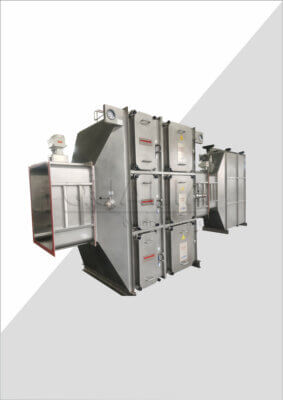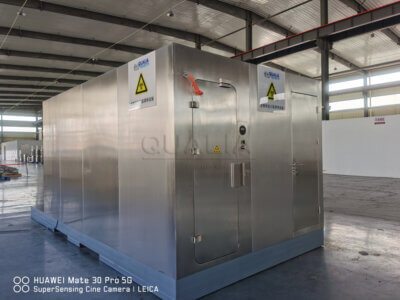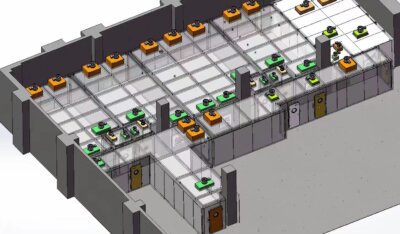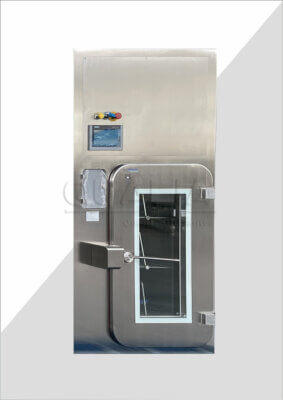
Accepting a BIBO system’s filter element efficiency certificate at handover without demanding housing-level pressure decay documentation is one of the most consequential procurement gaps in BSL exhaust infrastructure — and it is common. The risk does not announce itself at commissioning; it surfaces during the first filter change, when a poorly documented bag-change sequence, an unverified decontamination step, or an untrained technician turns a routine maintenance event into an uncontrolled containment test. The judgment that resolves this is not whether the filter itself meets specification, but whether the housing assembly, the service procedure, and the personnel handling it can together maintain containment integrity under real maintenance conditions. What follows helps buyers define exactly what evidence to request — and what its absence implies — before accepting system handover.
BIBO housing verification in installed systems
Filter element test certificates answer a narrow question: whether the filter media performed under controlled factory conditions. They do not answer whether the housing assembly maintains containment once installed. The distinction matters because bypass leakage — air moving around the filter rather than through it — is not detectable from element-level data alone.
The two verification methods that close this gap operate differently and catch different failure modes. A pressure decay test of the housing assembly as a sealed unit, using acceptance criteria traceable to the facility’s containment risk assessment, targets leakage through housing seals, welds, and access port interfaces. A ≤0.5 Pa leak rate aligned with ISO 10648-2 Class 3 is a commonly applied design-level benchmark for this type of assembly, though the facility’s own risk assessment should govern the specific acceptance criterion. An installed aerosol scan of the filter-to-housing perimeter at a scan speed of ≤5 cm/s per EN 1822-1 complements this by detecting gasket compression failures and weld defects that pressure decay testing alone may not resolve. Neither test substitutes for the other.
The procurement failure pattern here is specific: commodity BIBO housing suppliers frequently document filter element performance without providing any housing-level pressure decay results from factory acceptance. Buyers who do not explicitly require FAT-stage housing verification inherit a latent bypass leakage risk that becomes visible only during commissioning or, in worse cases, during the first maintenance cycle when the housing is opened and resealed. Requesting the factory documentation as a contractual deliverable — not a post-award request — is the decision that prevents this.
| Élément de vérification | Acceptance Criteria / Evidence | Pourquoi c'est important |
|---|---|---|
| Pressure decay test of housing assembly | Leak rate ≤0.5 Pa per ISO 10648-2 Class 3, traceable to containment risk assessment | Prevents bypass leakage from housing seals that filter-element testing alone overlooks |
| Installed aerosol scan of filter-to-housing perimeter | Scan speed ≤5 cm/s per EN 1822-1; detects gasket compression failures and weld defects | Catches seal defects that pressure decay may miss, ensuring full perimeter containment |
| Factory acceptance documentation for housing design verification | Verification that housing seals were tested at FAT, not just filter element certificates | Closes a common procurement gap where commodity suppliers fail to document, creating latent bypass risk |
The pattern of missing FAT-stage housing documentation is not universal, but it is common enough that the absence of these records should be treated as a red flag during supplier evaluation rather than an acceptable gap to resolve after installation.
In situ HEPA test access and records
A filter that passed factory testing can still fail containment in the installed configuration. Housing geometry, ductwork connections, access port alignment, and installation handling all introduce variables that factory certificates cannot address. In situ testing — performed on the filter as installed — is the only method that answers the question buyers actually need answered: does this system filter effectively in the location and condition in which it will operate?
The operationally accepted methodology for in situ HEPA integrity testing is aerosol challenge scanning per EN 1822-1, with a scan speed of ≤5 cm/s and a local penetration ceiling of no more than ten times the overall penetration limit. These parameters define what constitutes a credible installed-condition test; buyers should require them to be specified in the commissioning protocol, not left to the contractor’s discretion. Accepting a factory scan report as a substitute for an installed-condition scan is a different type of error than missing housing pressure decay data — it is the error of treating two different things as equivalent.
Testing frequency should also be a contractual requirement, not an assumption. BSL facility validation programs generally require integrity testing at installation, after any service event, and annually during operation. Buyers should understand that annual testing alone is the minimum baseline; any unplanned service event, housing reopening, or ductwork modification should trigger retesting. The operational pressure differential threshold — typically ≥250 Pa — functions as the trigger for filter replacement before airflow degradation compromises containment, and it should appear in both the commissioning documentation and the maintenance plan as an explicit, monitored criterion.
| Exigence | Specification / Threshold | Objectif |
|---|---|---|
| In situ HEPA integrity test method | Aerosol challenge scanning per EN 1822-1; scan speed ≤5 cm/s; local penetration ≤10× overall limit | Measures installed filter integrity accurately; catches bypass leakage that factory certificates alone miss |
| Testing frequency | At installation, after any service, and annually per BSL facility validation programs | Maintains containment confidence by establishing baseline and regular revalidation |
| Contrôle de la pression différentielle | Inspect every 6–12 months; replace filter when differential ≥250 Pa or airflow decreases significantly | Triggers filter replacement before performance degrades and compromises containment |
The practical consequence of relying on factory certificates without installed-condition data is not marginal. Bypass leakage that bypasses the filter media entirely can degrade effective system filtration by orders of magnitude while the certificate on file continues to show a compliant result. In BSL exhaust applications, that gap is not recoverable through documentation — it requires retesting, resealing, and potentially full recommissioning.
For more on where in the commissioning sequence these tests should appear, the Liste de contrôle pour la mise en service du BIBO : Les points FAT, SAT, IQ et OQ qui passent inaperçus covers which verification steps are commonly skipped and at what project stage.
Bag-change sequence before first maintenance
The first filter change in a BSL exhaust system is not a routine event — it is the first time the containment sequence is tested under live conditions. If the bag-change procedure has not been validated before that moment, the technician performing the change is effectively conducting a containment qualification while simultaneously performing maintenance. That is not an acceptable risk posture in a BSL-3 or higher facility.
The core sequence in a BIBO filter change-out involves attaching a pre-sterilized flexible containment bag to the housing docking port, removing the used filter inside the bag under full enclosure, and double-sealing the bag — typically with zip ties or heat sealing — before disposal. Each step in this sequence carries a containment dependency. The bag itself must be verified as airtight before it is relied upon; DOP/PAO integrity testing at installation is the method that confirms this. The bag must also be long enough to fully enclose the used filter during removal — a PVC bag of approximately 2700 mm length per access port is a commonly specified design figure for this purpose, but buyers should verify this dimension against their specific housing configuration and filter size rather than treating it as a universal standard.
Skipping documented change-out procedure validation before routine operation begins is the mistake with the highest downstream cost in this category. If exposure monitoring data from a simulated change-out is not in the handover package, the first real service event is both the procedure validation and the maintenance activity. Any exposure breach at that point requires incident response, personnel monitoring, potential decontamination of the surrounding area, and rejection of the maintenance record. Demanding validated procedure documentation with operator exposure monitoring data before handover closes is the decision that prevents this.
| Point de vérification | Specification / Evidence | Raison d'être |
|---|---|---|
| Containment bag sealing integrity | DOP/PAO integrity testing at installation | Ensures airtight seal so the bag can safely contain contaminants during filter change-out |
| Replacement bag dimensions | PVC replacement bag length 2700 mm per access port | Sufficient length to fully enclose the used filter during removal and disposal |
| Documented change-out procedure validation | Operator exposure monitoring data confirming no breach | Proves safe filter service before the first real maintenance event |
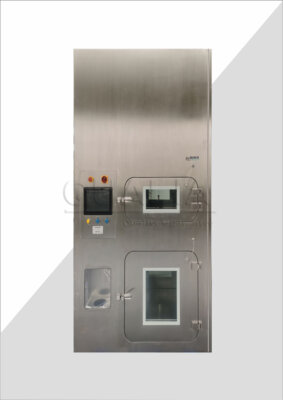
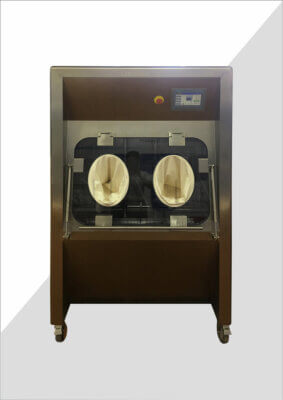
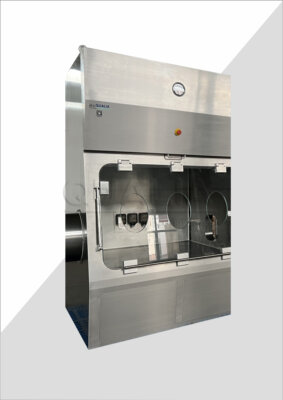
Le Entrée du sac Sortie du sac systems designed for containment-grade BSL exhaust applications should include housing access port specifications and compatible bag dimensions in their technical documentation — verifying that the supplied bag dimensions match the access port configuration is a review check buyers should perform before accepting the system.
Decontamination readiness for filter access
Filter access in a BSL exhaust system cannot be treated as a purely mechanical operation. Before any housing is opened, the surfaces, ducting, and filter media that have been in contact with exhaust air must be confirmed safe for technician contact. Decontamination readiness is a prerequisite for safe filter service — not a parallel activity.
The design features to confirm are compatibility with the decontamination agents the facility will use — commonly hydrogen peroxide vapor, IPA, or UV sterilization — and the presence of in-situ disinfection capability that does not require the housing to be opened first. These are planning criteria buyers must verify are specified in the system design before procurement, not features assumed to be present in any BIBO housing. A system that cannot be decontaminated through its closed configuration before access is opened creates a procedural gap that no training protocol can fully compensate for.
Ongoing readiness is a separate problem from initial capability. A decontamination system that was functional at commissioning may degrade over time — UV lamp output decreases, injection nozzle geometry changes with scale buildup, and H₂O₂ concentration delivery can drift. Annual verification that includes biological indicator testing is the operationally accepted method for confirming that decontamination effectiveness is maintained over the system’s service life. This is a planning criterion, not a codified regulatory interval, but facilities operating under select agent or BSL-3/4 programs will typically find it maps directly to their internal validation schedules.
After any filter replacement, recommissioning the decontamination system is not optional. Airflow testing, filter integrity testing, and pressure differential verification following service are the minimum steps to confirm that containment has been fully restored and that the decontamination circuit itself has not been disrupted by the filter change-out.
Training evidence for service personnel
Procedure documentation without trained personnel is not containment — it is paperwork. The gap between a validated change-out procedure and a safe maintenance event is whether the technician performing the change understands the sequence, the failure modes, and the protective measures well enough to execute without improvisation.
Well-implemented bag-change training with proper protective measures can reduce exposure risk substantially during filter replacement — the indicative performance improvement cited in containment training literature is significant, though actual outcomes depend on procedure design, PPE selection, and facility-specific conditions. The value of this figure is not as a guaranteed metric but as a planning rationale: the investment in training documentation is justified by the exposure reduction it delivers, and the cost of skipping it is not just regulatory — it is the cost of a contamination incident during what should have been a routine service event.
Regulatory accountability for training takes different forms depending on jurisdiction and facility type. Facilities handling select agents under federal regulations are required to maintain a written biosafety plan that includes maintenance procedures and training records as a formal documentation obligation. More broadly, any facility operating at BSL-3 or above should treat training records as part of the audit package, not as internal administrative files. The WHO Laboratory Biosafety Manual (4th edition) reinforces the principle that laboratory safety procedures must be documented and personnel must demonstrate competence before performing high-risk tasks — applying this directly to BIBO filter service means training evidence should precede, not follow, the first live maintenance event.
The practical review check at handover is straightforward: ask for the names of trained personnel, the procedure they were trained on, the date of training, and the exposure monitoring data from the procedure validation. If any of these are missing, the system is not maintenance-ready regardless of how the filter integrity results look.
Handover threshold for safe HEPA replacement
System handover is the point at which the buyer accepts operational and safety responsibility. For BIBO exhaust systems in BSL facilities, accepting handover without a complete evidence package does not transfer risk abstractly — it transfers it to the next maintenance event, which may occur under time pressure, with personnel who were not present at commissioning, and without easy access to documentation that was never assembled in the first place.
The IQ/OQ/PQ (3Q) validation package is the regulatory baseline that confirms installation and operational parameters are met. But for BIBO systems specifically, the 3Q package alone is not sufficient evidence that the first filter replacement will be safe. The additional evidence layer — housing pressure decay test results from an accredited testing center, installed-condition aerosol scan reports for both FAT and SAT, validated bag-change procedure documentation with operator exposure data, and individual HEPA filter scan certificates per element — is what makes the handover audit-defensible under any future inspection. Buyers who accept the 3Q package without this supplementary evidence layer have accepted a system whose containment performance during maintenance is unproven.
HVAC operational verification adds a further dimension. Air pressure cascade maintenance at ≥15 Pa — a design threshold traceable to BSL containment planning practice — must be documented under both normal and failure conditions before initial operation and after any major change. This is not simply a commissioning metric; it defines whether the facility’s containment architecture will hold during the conditions most likely to stress it, including the period during and immediately after a filter change when airflow patterns are disrupted.
The third-party pressure decay report requirement deserves specific attention. Independent reports from accredited national testing centers are what make housing integrity claims defensible in an audit rather than dependent on supplier self-certification. Requiring this as a contractual handover deliverable, not a post-handover request, is the procurement decision that closes the gap between supplier assertion and verified performance.
| Evidence / Document to Request | Key Requirement or Threshold | Why It Closes a Gap |
|---|---|---|
| Individual HEPA filter scan test certificates | EN 1822-1 scan test per element | Verifies filter-media integrity element by element, not just factory averages |
| Installed-condition aerosol leak test (FAT & SAT) | Filter-housing assembly scan, scan speed ≤5 cm/s, leakage within limits | Confirms no bypass leakage under real installed conditions |
| BIBO change-out procedure validation with operator exposure data | Documented procedure validation showing zero exposure during simulated change-out | Proves the bag-change process will be safe before labour enters routine operation |
| BIBO housing pressure-decay test (third-party) | Pressure decay as a sealed unit independent of the filter; criteria traceable to risk assessment; report from accredited testing centre | Independently verifies housing integrity, closing the gap left by filter-only testing |
| Complete IQ/OQ/PQ (3Q) validation package | Full installation, operational, and performance qualification | Regulatory baseline confirming all installation and operational parameters are met |
| HVAC operational verification | Failure-condition testing and air pressure cascade maintenance ≥15 Pa documented before initial operation and after major changes | Ensures containment pressure differentials hold under normal and failure conditions |
No single item in this evidence package is redundant. The absence of any one — the housing pressure decay report, the installed-condition scan, the change-out procedure validation — leaves a specific gap in the containment assurance chain that cannot be backfilled by the presence of the others.
The practical implication of this evidence framework is that handover should not close on schedule if the documentation is incomplete. A BIBO system with strong filter element certificates but no housing-level pressure decay report, no validated bag-change procedure, and no trained personnel record is not a system with minor paperwork gaps — it is a system whose first maintenance event is an uncontrolled test of containment integrity. The cost of deferring handover to collect this evidence is a schedule delay. The cost of accepting handover without it is an exposure incident, a failed maintenance approval, or a full recommissioning event triggered by a breach during routine service.
Buyers entering final procurement or pre-handover review should treat each evidence item in the handover package as a binary: present with traceable acceptance criteria, or not present. The items that are absent define what risks the buyer is accepting on behalf of the personnel who will eventually perform that first filter change. Defining which items are non-negotiable before the contract is signed — not at site acceptance — is the decision that determines whether the system is genuinely ready for safe operation or only appears to be.
Questions fréquemment posées
Q: What happens if a supplier refuses to provide FAT-stage housing pressure decay results as a contractual deliverable?
A: Treat the refusal as disqualifying, not negotiable. A supplier who cannot produce factory acceptance pressure decay documentation for the housing assembly either did not perform the test or cannot trace the results to the installed unit — both conditions mean the buyer has no verified baseline for housing integrity before the first filter change. Requesting third-party pressure decay reports from an accredited national testing center as a named contractual deliverable, not a post-award expectation, is the procurement mechanism that resolves this before it becomes a site problem.
Q: If the bag-change procedure has been validated for one BSL-3 facility, can that documentation be reused as evidence for a different installation?
A: No — procedure validation is installation-specific and cannot transfer between sites. Operator exposure monitoring data from a validated change-out is tied to a specific housing geometry, bag dimension, access port configuration, and technician workflow. A different installation introduces different variables: housing orientation, ductwork connections, local PPE protocols, and technician reach distances all affect whether the sequence prevents exposure. Each site requires its own validated procedure with exposure monitoring results before the first live maintenance event.
Q: At what point in the project timeline should decontamination compatibility be specified — design, procurement, or commissioning?
A: Decontamination compatibility must be resolved at the design stage, before procurement. Whether the housing supports hydrogen peroxide vapor, IPA, or UV sterilization in a closed configuration determines which decontamination agents are permissible in the facility’s standard operating procedure. Discovering at commissioning that the installed housing lacks in-situ disinfection capability — or is incompatible with the facility’s selected agent — requires either a system modification or a procedural workaround that no training protocol can fully compensate for. It is a design specification, not a commissioning adjustment.
Q: Is annual HEPA integrity testing sufficient if no unplanned service events occur, or should the interval be shorter for high-throughput BSL exhaust systems?
A: Annual testing is the minimum baseline, not a ceiling, and it is not calibrated to exhaust volume or facility throughput. High-throughput BSL exhaust systems that process larger volumes of contaminated air will load filter media faster and create more frequent pressure differential fluctuations — both conditions increase the probability of reaching the ≥250 Pa replacement threshold before the annual test interval. For these systems, the operationally sound approach is to monitor pressure differential continuously and treat any unplanned service event, housing reopening, or ductwork modification as an automatic retest trigger, independent of the scheduled annual cycle.
Q: How should a buyer weigh the added training and documentation burden of full maintenance evidence against a supplier offering a lower-cost system with minimal handover documentation?
A: The cost comparison only holds if the buyer accounts for the full downstream cost of the documentation gap, not just the upfront price difference. A lower-cost BIBO system with incomplete handover evidence — missing housing pressure decay reports, no validated bag-change procedure, no trained personnel records — transfers an unquantified liability to the buyer’s first maintenance event. The recoverable costs of a containment breach during that event — incident response, personnel monitoring, area decontamination, failed maintenance approval, and potential recommissioning — will typically exceed the procurement savings by a significant margin. The training and documentation burden is a one-time investment; the exposure from skipping it is an open-ended risk carried by every subsequent filter change.