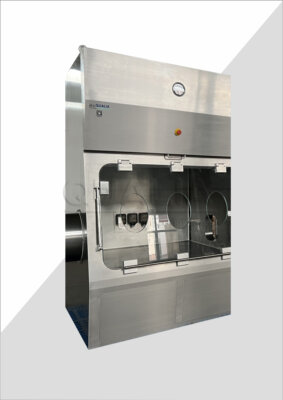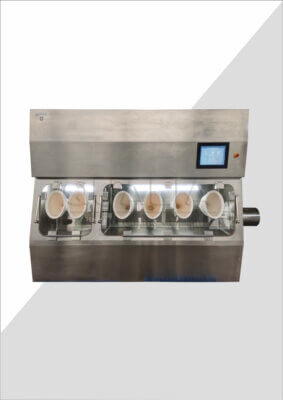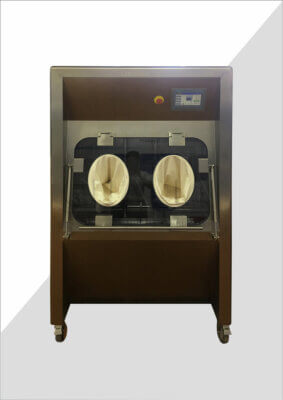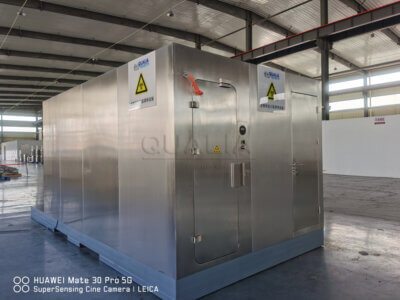
BSL-3 and BSL-4 facility managers face a procurement decision with decades of operational consequences. The effluent decontamination system you select determines daily workflow patterns, annual operating budgets, validation complexity, and regulatory compliance risk. Thermal, chemical, and thermochemical technologies each claim superiority, yet their performance diverges dramatically under real-world containment laboratory conditions.
The stakes extend beyond capital expenditure. Your EDS choice affects energy consumption patterns for the facility’s operational lifespan, shapes laboratory workflow efficiency, dictates chemical handling protocols, and determines secondary waste disposal obligations. Selection errors surface only after installation—when cycle times disrupt research schedules, when chemical costs exceed projections, or when validation failures delay facility commissioning. Understanding the technical performance boundaries of each approach prevents costly misalignment between system capabilities and operational requirements.
Operational Principle and Pathogen Inactivation Mechanism
Thermal Inactivation Through Protein Denaturation
Thermal decontamination applies moist heat as saturated steam under pressure. Operating temperatures range from 121°C to 160°C. The mechanism targets structural proteins and enzymes through irreversible coagulation and denaturation. Steam penetrates cellular structures and disrupts biochemical function at the molecular level.
Validation standards require 6-log reduction of Geobacillus stearothermophilus spores. This biological indicator represents one of the most heat-resistant organisms. Temperature uniformity throughout the treatment chamber determines efficacy. Dead zones or temperature gradients create inactivation failures even when bulk temperature meets specifications.
Continuous flow thermal systems achieve sterilization in seconds at 140-150°C. Batch systems require 30 minutes or longer at 121°C. The temperature-time relationship follows logarithmic kinetics—higher temperatures enable shorter exposure periods while maintaining equivalent lethality.
Chemical Oxidation Pathways
Chemical decontamination employs oxidizing agents, typically sodium hypochlorite. Free chlorine concentrations of ≥5700 ppm with 2-hour contact time achieve >10^6 spore inactivation. The oxidation mechanism attacks cellular components through electron transfer reactions. Chlorine disrupts cell membranes, damages nucleic acids, and inactivates enzymes.
Bacillus atrophaeus spores serve as the validation biological indicator for chemical systems. Testing must demonstrate efficacy in complex matrices representative of actual effluent. Laboratory-prepared spore packets embedded in treatment tanks verify chemical penetration and contact time adequacy. I’ve reviewed validation protocols where inconsistent mixing patterns caused localized failures despite adequate bulk chlorine concentrations.
Organic matter represents the primary limitation. Proteins, fats, and cellular debris consume available chlorine. This chlorine demand reduces effective disinfectant concentration. Turbidity shields microorganisms from chemical contact. ASTM standards provide methodology for evaluating disinfectant efficacy in complex matrices that simulate real effluent conditions.
Thermochemical Dual-Mechanism Synergy
Thermochemical systems combine heat and chemical treatment at reduced intensities. Operating temperatures remain below 98°C while achieving sterility validation at 93°C in BSL-4 facilities. The dual mechanism provides redundancy—if heat generation fails, increased chemical concentration compensates. If chemical feed interrupts, elevated temperature maintains inactivation.
This flexible redundancy delivers operational reliability. The system automatically adjusts treatment parameters based on real-time monitoring. Chemical usage decreases compared to pure chemical approaches. Energy consumption remains lower than high-temperature thermal systems.
Pathogen Inactivation Mechanisms and Operating Parameters
| Technology Type | Inactivation Mechanism | Operating Temperature | Validation Standard |
|---|---|---|---|
| Thermal | Irreversible coagulation and denaturation of enzymes and structural proteins via saturated steam | 121°C to 160°C | 6-log reduction of Geobacillus stearothermophilus |
| Chemical | Chemical oxidation of cellular components via oxidizing agents | Ambient to 40°C | ≥5700 ppm free chlorine, 2-hour contact time, >10^6 spore inactivation |
| Thermochemical | Dual mechanism: heat and chemical synergy at reduced intensity | Below 98°C (validated at 93°C for BSL-4) | 6-log reduction using combined validation surrogates |
Source: Biosafety in Microbiological and Biomedical Laboratories (BMBL), ASTM International Standards.
Throughput, Cycle Time and Operational Workflow
Batch System Processing Characteristics
Batch systems accumulate effluent in sterilization tanks. Treatment begins when tanks reach capacity or predetermined volume. A typical cycle requires 30 minutes at 121°C, excluding heating and cooling periods. Total cycle duration extends to several hours depending on tank size and heating capacity.
Operational workflow follows a collect-treat-discharge pattern. Laboratories generate effluent continuously, but treatment occurs intermittently. Tank sizing must accommodate peak flow periods. Undersized tanks force laboratory workflow interruptions when holding capacity reaches limits.
Chemical batch systems achieve faster turnaround. Two complete cycles per hour represent typical capability. Rapid chemical contact enables higher processing frequency compared to thermal batch approaches. However, each cycle still requires full tank treatment—partial loads waste chemical resources and extend effective cycle times.
Continuous Flow Real-Time Processing
Continuous flow systems process effluent in real-time through heated pipe configurations. Sterilization occurs in seconds at 140-150°C. Capacities range from 4 LPM to 250 LPM (1-66 gpm), equivalent to 660-50,200 gallons per day. Flow rates match laboratory generation patterns without accumulation delays.
Pilot-scale validation demonstrated continuous processing at 140°C and 7 bar with 200 L/h flow rate. The 10-minute residence time achieved complete inactivation. Continuous operation eliminates the workflow interruptions characteristic of batch systems. Researchers discharge effluent on demand without concern for holding tank capacity.
Temperature control precision determines efficacy. The system must maintain target temperature throughout the residence time under variable flow conditions. Automated flow modulation adjusts processing rate to maintain thermal parameters during flow surges.
Processing Capacity and Cycle Time Specifications
| System Configuration | Cycle Time | Throughput Capacity | Operational Mode |
|---|---|---|---|
| Thermal Batch | 30 minutes to several hours at 121°C | Variable batch volumes | Intermittent: collect, treat, discharge |
| Thermal Continuous Flow | Seconds at 140-150°C | 4-250 LPM (1-66 gpm); 660-50,200 gpd | Continuous: real-time processing |
| Chemical Batch | 30 minutes per cycle | Two complete cycles per hour | Intermittent: rapid turnaround capability |
Note: Continuous flow residence time of 10 minutes achieved at 140°C, 7 bar in pilot-scale validation.
Source: CDC Award Terms & Federal Regulations, Biosafety in Microbiological and Biomedical Laboratories.
Factory Acceptance Testing and Validation Requirements
Factory acceptance testing (FAT) precedes shipment and installation. Biosafety in Microbiological and Biomedical Laboratories guidelines require biological validation using appropriate surrogates for all EDS systems in containment facilities. Testing must replicate actual operating conditions and effluent characteristics.
Site acceptance testing (SAT) follows installation. Biological indicators placed at critical locations verify treatment uniformity. Temperature mapping identifies cold spots in thermal systems. Chemical concentration gradients reveal mixing inadequacies in chemical systems. Validation failures at this stage trigger costly remediation and delay facility commissioning.
Operational Cost Analysis and Energy Consumption
Thermal Batch Energy Requirements
Thermal batch systems consume substantial energy heating effluent to sterilization temperature. Each cycle requires raising tank contents from ambient to 121-160°C. Heat loss to surroundings during treatment further increases energy demand. Cooling treated effluent before discharge adds time and may require additional energy input for active cooling.
Limited heat recovery capability characterizes most batch configurations. Each cycle dissipates thermal energy during discharge and cooling. The next cycle begins from ambient temperature, repeating the full energy input requirement. This thermal inefficiency translates directly to operational expense.
Steam generation infrastructure adds capital and maintenance costs. Boiler operation, water treatment, and condensate return systems require dedicated equipment and oversight. Electrical heating alternatives minimize infrastructure complexity but concentrate energy demand into high-power electrical loads.
Continuous Flow Energy Recovery
Continuous flow thermal systems incorporate heat exchangers achieving up to 95% energy recovery. Incoming cold effluent passes through heat exchangers where treated hot effluent transfers thermal energy. This regenerative heating reduces primary energy input to a small fraction of non-recovery designs.
Pilot-scale testing measured energy consumption at approximately 10 W·h/L. Heat recovery systems reduce energy consumption by up to 80% in continuous flow configurations. Two-tank regeneration arrangements achieve thermal energy savings of 75% compared to single-pass designs. I’ve analyzed facility energy profiles where continuous flow EDS with heat recovery consumed less energy than the chemical feed pumps for equivalent-capacity chemical systems.
The energy efficiency advantage compounds over decades of operation. A continuous flow system treating 3,000 gallons daily with 80% heat recovery saves substantial energy compared to batch processing. This operational expense reduction often justifies higher capital costs within 3-5 years.
Chemical System Energy and Material Costs
Chemical systems require minimal energy input. Ambient temperature operation eliminates heating requirements. No cooling cycle extends process duration. Pumps and mixers represent the primary electrical loads—orders of magnitude lower than thermal heating demands.
Chemical procurement dominates operational expense. A system treating 3,000 gallons daily consumes approximately 330-gallon totes of sodium hypochlorite per day. At 12.5% concentration and typical industrial pricing, chemical costs exceed $200,000 annually. These expenses continue throughout facility operation with exposure to commodity price volatility.
Specialized water treatment equipment designed for high-containment laboratories balances capital expense, operational costs, and validation reliability across thermal, chemical, and thermochemical approaches.
Energy Consumption and Recovery Efficiency Comparison
| Technology Type | Energy Consumption | Heat Recovery Capability | OPEX Drivers |
|---|---|---|---|
| Thermal Batch | High baseline requirement | Limited to none | Steam generation, maintenance |
| Thermal Continuous Flow | Small fraction of batch systems; ~10 W·h/L | Up to 95% through heat exchangers; 75-80% energy reduction | Electrical heating, minimal maintenance |
| Chemical | Lowest energy consumption | Not applicable; no cooling required | Chemical procurement, neutralization agents |
Note: Heat recovery in continuous flow configurations reduces thermal energy requirements by up to 80% compared to non-regenerative systems.
Source: EPA Guidelines for Human Exposure Assessment, ASTM International.
Chemical Usage, Residues and Secondary Waste
Sodium Hypochlorite Consumption Rates
Chemical EDS systems consume approximately 57 L of bleach per cycle at 12.5% sodium hypochlorite concentration. A facility processing 3,000 gallons daily requires multiple cycles, scaling to 330-gallon totes daily. Chemical storage infrastructure must accommodate bulk quantities with appropriate containment and material compatibility.
Free chlorine concentrations of ≥5700 ppm throughout the 2-hour contact period ensure spore inactivation. Maintaining target concentrations requires accounting for chlorine demand from organic matter. Initial dosing must exceed final target concentration by the expected consumption amount. Underestimating chlorine demand causes validation failures and release of inadequately treated effluent.
Chemical shelf life and storage stability affect procurement logistics. Sodium hypochlorite degrades over time, particularly at elevated temperatures. Concentration drift requires periodic verification. Degraded hypochlorite loses efficacy and generates harmful decomposition products.
Neutralization Requirements and Byproducts
Treated effluent contains residual free chlorine requiring neutralization before discharge. Local sewer regulations dictate acceptable chlorine concentrations, typically well below treatment levels. Neutralization chemistry introduces additional chemical handling and potential hazards.
Some facilities faced challenges where neutralization was deemed too hazardous due to chemicals required and byproducts produced. Sodium thiosulfate or sodium bisulfite serve as common neutralizing agents. The reactions generate heat and produce salts increasing effluent conductivity and total dissolved solids.
Hydrochloric acid emerges as a byproduct in some neutralization pathways. This corrosive substance requires specialized handling, containment, and disposal. I’ve encountered facilities that abandoned on-site neutralization entirely—instead collecting treated waste in storage silos for pickup and disposal by contract companies. This approach converts operational complexity into ongoing disposal costs and introduces third-party dependency.
Thermal System Chemical Independence
Thermal systems produce no chemical residues. The treatment mechanism relies entirely on physical heat transfer. Discharged effluent contains only the original dissolved constituents at their pre-treatment concentrations. No neutralization step extends cycle time or introduces secondary chemistry.
Dechlorination may be necessary if chlorinated municipal water supplies contribute to effluent. This requirement applies regardless of decontamination method—it addresses input water chemistry, not treatment byproducts. Activated carbon filtration removes residual chlorine without generating hazardous byproducts.
Thermochemical systems use reduced chemical quantities compared to pure chemical approaches. Lower operating temperatures require chemical supplementation, but at concentrations below standalone chemical systems. Minimal neutralization requirements simplify discharge chemistry.
Chemical Consumption and Secondary Waste Generation
| System Type | Chemical Requirements | Neutralization Needs | Secondary Waste Products |
|---|---|---|---|
| Thermal | None; dechlorination only if chlorinated water source | Not required | No chemical residues |
| Chemical | 57 L bleach per cycle (12.5% sodium hypochlorite); 330-gallon totes per day for 3000 gpd | Must reduce free chlorine to discharge limits | Hydrochloric acid byproduct; spent neutralization agents |
| Thermochemical | Reduced chemical usage vs. pure chemical systems | Minimal neutralization required | Reduced byproduct generation |
Note: Some facilities collect chemically treated waste in storage silos for contract disposal due to neutralization hazards.
Source: EPA Guidelines for Bioaccumulation Models, Biosafety in Microbiological and Biomedical Laboratories.
Decontamination Efficacy for Complex Loads and Surfaces
Thermal Performance Independence from Matrix Effects
Thermal treatment effectiveness remains constant across varying effluent characteristics. Turbidity, natural organic matter, water hardness, and chemical pollutants do not impede heat transfer or reduce inactivation rates. Testing demonstrated log 8 microbial inactivation with influent turbidity as high as 100 NTU—far exceeding typical laboratory effluent conditions.
Temperature uniformity alone determines efficacy. Every volume element reaching target temperature for specified duration achieves equivalent lethality. The treatment mechanism operates through direct molecular disruption—no chemical must penetrate biofilms, contact shielded organisms, or overcome mass transfer limitations.
Solid materials present in effluent receive equivalent treatment. Particulates, tissue fragments, and cellular debris reach thermal equilibrium with surrounding liquid. Steam penetration ensures internal temperature matches bulk conditions. This capability eliminates concerns about protected organisms surviving within solid matrices.
Chemical Disinfection Limitations in Complex Matrices
Organic matter impedes chemical disinfection through two mechanisms. First, proteins and other organics react with chlorine, consuming available disinfectant. The chlorine demand reduces effective concentration below target levels. Second, particulates physically shield microorganisms from chemical contact. Organisms within biofilms or embedded in solid material experience reduced disinfectant exposure.
Validation testing using laboratory-prepared spore packets addresses this limitation. Spore carriers placed in representative effluent matrices verify chemical penetration and contact adequacy. Failure to replicate actual effluent complexity during validation leads to false confidence in system performance. I’ve reviewed post-installation validations that failed because testing used clean water instead of representative complex loads.
Chemical concentration monitoring at multiple locations reveals mixing and contact uniformity. Dead zones or stratification patterns create localized under-treatment. Turbulence and mixing energy overcome density gradients, but increase mechanical complexity and energy consumption.
Thermochemical Flexible Redundancy
Thermochemical systems automatically adjust treatment parameters based on real-time monitoring. If heat generation capacity drops, the system increases chemical concentration to maintain lethality. If chemical feed interrupts, elevated temperature compensates. This automatic flexible redundancy prevents treatment failures from single-point equipment malfunctions.
The dual mechanism provides validation advantages. Testing demonstrates 6-log reduction using combined thermal and chemical biological indicators. The system meets BSL-4 validation standards at 93°C—substantially below pure thermal requirements. Chemical concentrations remain below pure chemical system levels. This reduced-intensity approach delivers equivalent efficacy through synergistic mechanisms.
WHO guidelines recommend effluent from prion research facilities achieve 6-log reduction in infectivity. CDC policies require validation demonstrating 6-log kill of bacterial spores for EDS systems. EPA standards mandate 6-log reduction for disinfection process validation. All three technologies can meet these requirements when properly designed and validated, but their reliability under off-normal conditions differs substantially.
Efficacy Against Complex Matrices and Biological Indicators
| Technology Type | Performance with Organic Load | Log Reduction Achievement | Validation Biological Indicator |
|---|---|---|---|
| Thermal | Unaffected by turbidity, NOM, hardness, pollutants; log 8 reduction at 100 NTU | 6-log minimum; achieves log 8 in field testing | Geobacillus stearothermophilus spores |
| Chemical | Impeded by organic matter consuming available chlorine and shielding microorganisms | 6-log minimum at ≥5700 ppm, 2-hour contact | Bacillus atrophaeus spores |
| Thermochemical | Automatic flexible redundancy; compensates for heat or chemical source failure | 6-log validated for BSL-4 applications | Combined thermal and chemical surrogates |
Note: WHO requires 6-log reduction in infectivity for prion research facility effluent; EPA and CDC mandate 6-log spore kill validation.
Source: CDC Biosafety Standards, EPA Risk Assessment Guidelines.
Footprint, Integration and Facility Design Impact
Point-of-Use Compact Configurations
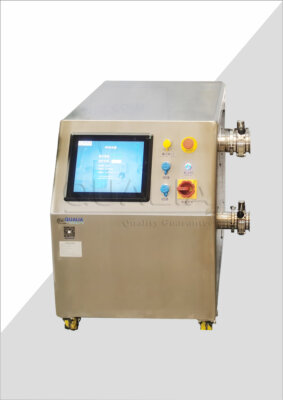
Point-of-use sink EDS units integrate wash-basin, kill tank, and autoclave components in bench-top footprint. Dimensions of 600 × 700 mm with 1300 mm height enable installation within individual laboratory rooms. This distributed approach treats effluent at generation points, eliminating collection piping and central processing infrastructure.
Room-level treatment provides containment advantages. Effluent never leaves the laboratory space before decontamination. Piping failures or leaks cannot distribute contaminated liquid beyond the immediate work area. Maintenance and validation occur on accessible bench-top equipment rather than confined basement locations.
Capacity limitations define appropriate applications. Point-of-use systems suit individual sinks or small workstations. Laboratories with multiple discharge points require multiple units. Equipment count and distributed maintenance multiply operational complexity compared to centralized processing.
Continuous Flow Compact Skid Designs
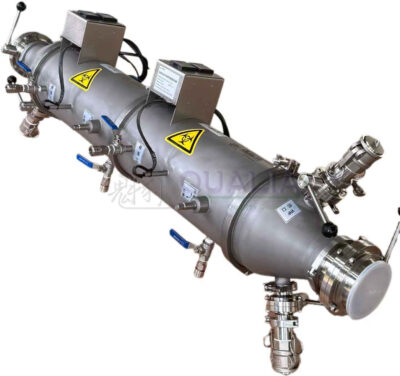
Continuous flow systems mount all component parts on compact one-piece skids. Heat exchangers, heating elements, control systems, and instrumentation integrate into space-efficient configurations. The absence of large holding tanks reduces footprint compared to equivalent-capacity batch systems.
Containerized designs enable flexible installation locations. Self-contained units with integral utility connections simplify building integration. Basement installation remains typical for gravity flow from laboratory levels, but equipment access and maintenance benefit from compact modular construction.
Vertical pipe configurations minimize floor space. Treatment occurs in heated pipe sections oriented vertically or routed along walls. The small cross-sectional area of pipe-based systems contrasts sharply with large-diameter batch tanks occupying substantial floor area.
Batch System Dual-Tank Redundancy
Batch systems require multiple tanks for continuous operation. While one tank undergoes treatment cycle, the second accumulates incoming effluent. Dual-tank configurations provide operational redundancy—equipment maintenance on one tank does not halt laboratory effluent acceptance.
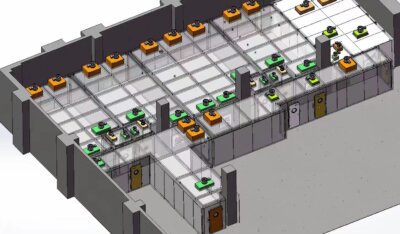
Space requirements multiply with redundancy. Two complete treatment tanks, each sized for peak flow accumulation, occupy significant floor area. Associated piping, valves, and control systems add equipment density. BSL-3 and BSL-4 facilities typically locate batch EDS in basement areas where space allocation competes with building systems and utilities.
The redundancy provides operational reliability advantages. Tank rotation enables maintenance without workflow disruption. Validation and biological indicator testing proceeds on one tank while the other maintains service. This built-in backup capability justifies increased footprint for critical facilities where downtime causes research delays or safety concerns.
Spatial Requirements and Installation Configurations
| System Configuration | Footprint Dimensions | Installation Format | Operational Redundancy |
|---|---|---|---|
| Point-of-Use Sink EDS | 600 × 700 mm × 1300 mm height | Bench-top integrated unit: wash-basin, kill tank, autoclave | Single-room coverage |
| Continuous Flow | Compact one-piece skid | Containerized or basement installation for gravity flow | Inherent through continuous operation |
| Dual-Tank Batch | Multiple tanks for continuous operation | Requires significant floor space; basement typical for BSL-3/4 | Built-in redundancy via alternating tanks |
Note: Containment requirements and gravity flow needs typically dictate basement placement in BSL-3 and BSL-4 facilities.
Source: Biosafety in Microbiological and Biomedical Laboratories 6th Edition, CDC Biosafety Guidelines.
Your effluent decontamination system selection hinges on three decision priorities. First, determine whether operational expense or capital cost drives your facility economics—chemical systems minimize upfront investment but generate perpetual consumable costs, while continuous flow thermal systems with heat recovery reduce lifecycle expenses despite higher capital outlay. Second, assess your effluent characteristics and variability—complex loads with high organic content favor thermal independence from matrix effects over chemical approaches requiring consistent conditions. Third, evaluate space constraints and redundancy requirements—point-of-use systems distribute treatment but multiply equipment count, while centralized dual-tank configurations consolidate operations at the cost of footprint.
High-containment facilities demand proven decontamination technology backed by rigorous validation and regulatory compliance. Need effluent treatment solutions engineered specifically for BSL-3 and BSL-4 applications? QUALIA delivers validated systems combining operational reliability with documented performance across thermal, chemical, and thermochemical technologies.
Questions about system selection, validation protocols, or facility integration? Contact us for technical consultation tailored to your containment laboratory requirements.
Frequently Asked Questions
Q: What validation standards must effluent decontamination systems meet for BSL-4 facility compliance?
A: All EDS systems in containment facilities require biological validation demonstrating a 6-log reduction of bacterial spores, as mandated by CDC policies. Validation uses specific biological indicators: Geobacillus stearothermophilus for thermal systems and Bacillus atrophaeus for chemical systems. This requirement is aligned with guidelines in the Biosafety in Microbiological and Biomedical Laboratories (BMBL), which governs effluent treatment in high-containment labs.
Q: How does organic matter in waste streams impact the efficacy of chemical versus thermal decontamination?
A: Organic matter significantly impedes chemical disinfectants by consuming available chlorine and shielding microorganisms, requiring higher concentrations for efficacy. Thermal treatment effectiveness remains unaffected by turbidity, natural organic matter, or water hardness. Testing confirms thermal disinfection achieves log 8 microbial inactivation even with influent turbidity as high as 100 NTU.
Q: What are the primary operational cost drivers for chemical-based effluent decontamination systems?
A: The dominant operational cost is chemical consumption; a system processing 3000 gallons daily can require approximately 330 gallons of 12.5% sodium hypochlorite solution. While energy consumption is low, significant secondary costs arise from neutralizing spent disinfectant to meet EPA guidelines for discharge, a process that can generate hazardous byproducts like hydrochloric acid.
Q: How does the footprint of a continuous flow thermal system compare to a batch processing system?
A: Continuous flow systems offer a significantly reduced footprint with all component parts assembled on compact, one-piece skids. Batch systems require multiple tanks for continuous operation, increasing space requirements, especially in dual-tank configurations that provide operational redundancy. For point-of-use applications, sink EDS units can have a footprint as small as 600 × 700 mm.
Q: What are the key advantages of thermochemical decontamination regarding system redundancy?
A: Thermochemical systems provide automatic flexible redundancy by recognizing if the heat or chemical source fails and automatically modifying the cycle to maintain sterility. This dual-mechanism approach operates at lower temperatures (below 98°C) than pure thermal systems while generating fewer chemical byproducts, ensuring reliable pathogen inactivation even with a single operational component.
Q: What throughput capabilities can be expected from a continuous flow thermal EDS?
A: Continuous flow thermal systems process effluent from 4 LPM to 250 LPM (1-66 gpm), capable of treating from 660 to over 50,200 gallons per day. They achieve sterilization in seconds at temperatures up to 150°C, with pilot-scale systems operating at 140°C and a 200 L/h flow rate. Their design incorporates heat exchangers that can recover up to 95% of energy, drastically reducing operational costs compared to batch thermal systems.
Related Contents:
- BioSafe EDS: Thermal Systems for Effluent Treatment
- BioSafe EDS: Batch-Continuous Treatment Systems
- Thermal Treatment: Revolutionizing Effluent Decontamination Systems
- BioSafe EDS: Innovative Heat Recovery Systems
- Safeguarding Health: Advanced Effluent Decontamination Systems
- Streamlining Effluent Decontamination: Continuous vs. Batch Processing
- Thermal Effluent Decontamination: Protecting Our Environment
- Maximizing Efficiency in Effluent Decontamination Systems
- How Effluent Decontamination Systems Work | Process Overview | 2025