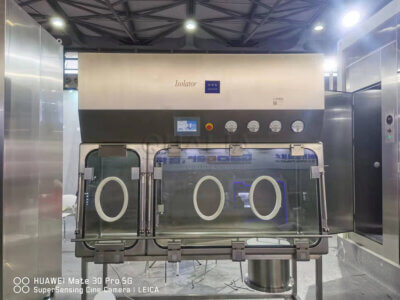

Containment test reports that show clean breathing-zone data while surface wipes reveal residue on glove port surrounds and transfer valve interfaces have a specific failure origin: the sampling map was built around what was easy to mount rather than where release actually occurs. That mismatch means the dataset defends the isolator rather than interrogates it, and when a biosafety officer or QA auditor traces the sampling rationale, positions that lack a documented tie to a task, a release pathway, or a post-test cleaning decision are the first to be challenged. The practical consequence is a test that must be repeated — or one that stands only because nobody looked closely enough. The judgment that prevents this is made before field execution, when every sampler position is assigned a specific interpretive function and the map is frozen against actual operating conditions.
Breathing-Zone, Near-Source and Background Sampling Roles
Airborne sampling during SMEPAC-based containment testing serves at least three distinct purposes, and treating any single position as sufficient for all of them produces an incomplete evidentiary record. Each role generates data that answers a different question: the breathing zone answers the inhalation exposure question, near-source positions answer the containment performance question at a specific release point, and background positions answer the ambient condition question that makes task-related data interpretable.
The practical consequence of conflating these roles appears at the reporting stage. Breathing-zone data does not substitute for near-source data when the goal is to characterize the emission strength of a valve disconnect or a glove port transition — the sampler is positioned for the operator’s airway, not for the release point, and the concentration at those two locations can differ substantially depending on airflow patterns within the room and the isolator’s local exhaust configuration. Equally, near-source data cannot stand in for breathing-zone data when inhalation risk conclusions need to be drawn, because proximity to a release point does not reflect what the operator actually inhales during a representative task. Omitting background sampling removes the baseline that distinguishes task-generated contamination from pre-existing room levels, which matters particularly in multi-suite facilities or rooms with shared HVAC returns.
Each zone’s primary function and its interpretation use are defined differently in practice.
| Sampling Zone | Primary Function | Interpretation Use |
|---|---|---|
| Breathing-Zone | Captures airborne concentration near the operator’s airway | Supports worker inhalation exposure assessment |
| Near-Source | Records release at a specific critical point (e.g., valve, glove port) | Identifies source strength and containment performance |
| Background | Measures ambient room concentration away from the source | Provides baseline for comparison with task-related levels |
The three-zone framework drawn from SMEPAC methodology is a testing design principle, not an enumerated regulatory requirement, but the logic behind it is sound enough that a sampling plan that omits one category will ordinarily need a documented rationale explaining what interpretive gap that omission creates and why it is acceptable for the specific scenario.
Surface Wipe Zones That Reveal Residue Migration
Airborne sampling measures what is released into the workspace during a task. Surface wipe sampling measures where material travels after it is released — and the two datasets will not always point in the same direction.
Wipe zones that matter most for containment assessment are those where residue migration would indicate a failure in a containment barrier rather than an incidental deposition. Glove port surrounds are a primary example: residue accumulation on the outer face of a glove port suggests that material is tracking through the port interface during glove changes or manipulation, which is a different failure mode from airborne dispersion and one that wipe sampling can detect even when airborne concentrations remain low. Transfer valve external surfaces — particularly stem interfaces and quick-connect landing zones — are another zone where wipe results carry diagnostic weight, because residue at those points indicates that the valve’s containment function is not performing as intended during connection or disconnection events.
The planning implication is that surface wipe zones should be selected before field execution based on where residue migration would change a cleaning protocol or trigger a maintenance review, not after the test as a secondary check on airborne results. When breathing-zone data shows low airborne concentrations but wipe results show residue migration on contact surfaces near glove ports or transfer interfaces, the two datasets are not contradictory — they are measuring different phenomena. The interpretive risk is treating low airborne data as sufficient evidence of containment without examining what the surface data reveals about barrier integrity. Wipe data should be treated as evidence of residue migration pathways rather than as a direct measure of inhalation exposure; the two should inform each other but not be used interchangeably when drawing conclusions about operator risk or equipment cleaning burden.
Release Pathways Around Gloves, Valves and Bags
Before samplers are positioned, the release pathways that the test is designed to detect need to be analytically traced. This step — identifying critical points, potential leakage points, expected transfers, and device configurations — is the foundation of a defensible sampling map, and it is where many plans go wrong by defaulting to positions that are physically accessible rather than positions that correspond to actual emission events.
The analytical logic is that every release pathway has a characteristic timing, location, and physical mechanism. Sampling positions derived from that analysis will be placed where concentration is elevated at the moment of release, rather than at a point that is convenient for clamp mounting but downstream of the event by enough distance to dilute the plume before the sampler sees it. For complex isolator configurations involving rapid transfer ports, integrated BIBO housings, or multi-stage valve assemblies, component-level emission analysis matters: each interface has its own release potential, and the combined system may produce interactions between plumes that a component-by-component map would not anticipate. Rapid Transfer Ports for OEB4/OEB5 Isolators Explained covers the interface mechanics that inform this kind of pathway analysis for transfer port configurations.
| Release Pathway | Critical Point Examples | Sampling Consideration |
|---|---|---|
| Gloves | Glove port seams, gauntlet flex areas | Monitor during movements that stress glove containment |
| Valves | Valve stem, quick‑connect interface | Position samplers near disconnect points where aerosol may be released |
| Bags | Bag neck, closure tie points | Capture emissions during filling, tying, and bag removal |
The sampling consideration column in the table reflects a timing and positioning logic: emissions from these pathways are event-driven, which means a sampler positioned correctly in space but running outside the event window may record ambient background rather than the release it was meant to capture. Task duration mapping and sampler activation timing are therefore part of pathway analysis, not a separate planning step.
For OEB4/OEB5 isolator configurations where multiple transfer interfaces are active in a single test run, the interference between component plumes should be explicitly noted in the sampling map — an unaccounted interaction between a valve disconnect event and a concurrent bag handling step can produce a combined concentration that neither pathway analysis alone would have predicted, and attributing that result to a single source without documentation creates an interpretation problem that may not surface until audit review.
Sampler Placement Without Distorting the Task
Positioning a sampler correctly in principle and positioning it in a way that leaves operator behavior unchanged are two different engineering problems, and confusing them produces data that reflects the sampled condition rather than the actual working condition.
The risk is that adding hardware near a glove port or at shoulder height — precisely where near-source sampling is most informative — can cause an operator to shift posture, slow a transfer step, or avoid a natural arm movement to work around the sampler. Each of those behavioral changes alters the airflow pattern around the isolator’s glove ports and modifies the task duration simultaneously. The resulting dataset captures a cleaner or more careful operation than would occur in routine use, and the exposure assessment based on it will be optimistic in a way that is difficult to detect without video documentation of the task. This is a failure risk rather than a guaranteed outcome, but it is common enough in practice that it should be treated as a planning criterion during sampler placement review rather than a post-test footnote.
The ergonomic consideration of glove position and operator reach relative to the sampler mount is part of SMEPAC planning guidance for good reason. A sampler that a trained operator can work around without changing posture or slowing the task provides valid data; one that requires the operator to accommodate it does not. Practically, this means sampler placement decisions should be reviewed by someone who has observed the task being performed at normal pace, not only by someone who has read the procedure. Photographs or video of representative task execution during protocol development — before samplers are placed — give the placement team enough information to identify conflicts between mounting geometry and natural operator movement before they compromise the test.
The trade-off between measurement proximity and operator naturalism has no universal resolution. Near-source positions near valve disconnects and glove port transitions will always be physically awkward to mount, and that awkwardness is precisely why they tend to be omitted during planning. Accepting a modest reduction in measurement proximity to preserve task naturalism may produce more representative data than placing the optimal sampler in a location that changes the operation. That judgment should be documented, not assumed.
Sampling Map Signoff Before Field Execution
A sampling map that has been carefully constructed against a planned test scenario becomes invalid the moment the actual test conditions diverge from it. The mechanism is simple: if the API type or quantity handled during the test differs from the planned scenario, the release potential differs; if the equipment configuration differs — different valve assembly, different BIBO unit, different connection sequence — the release points and pathways differ; if run duration differs, the total collected mass may not reflect the full task length. Any one of these mismatches means the resulting data cannot be interpreted against the intended scenario, and a dataset that cannot be cleanly interpreted against its own sampling rationale is difficult to defend at audit without a documented deviation explanation.
The pre-commitment review check function of sampling map signoff is therefore substantive, not procedural. It is the last point at which a mismatch between the map and actual conditions can be resolved without invalidating the dataset. The consequence logic is that a single unresolved mismatch — one component whose emissions were not mapped, one interference between plumes that was not accounted for — can compromise the interpretive integrity of the entire test, not just the sampler position nearest to the gap. Complex integrated systems involving isolators with transfer valves, pass-through connections, and exhaust filtration housings require component-level emission review precisely because the integrated plume profile is not predictable from component analysis alone.
| Verification Checkpoint | What to Confirm | Risk if Mismatched |
|---|---|---|
| API type and amount | Amount handled equals planned scenario | Exposure data not representative of actual operation |
| Equipment configuration | Same isolator, valves, and connections as the test plan | Release points and pathways differ from the map |
| Run duration | Process duration matches the planned sampling period | Total collected mass may not reflect full task length |
| Component‑level emissions | Emission potential and disturbance effects for each component noted | Overlooked component emission invalidates the integrated picture |
| Interference between components | How combined plumes and interactions are accounted for | Unaccounted cross‑interference distorts containment assessment |
Signoff authority for the sampling map should rest with whoever is accountable for the containment performance claim the test is intended to support — typically the QA or validation team lead, with input from the biosafety officer where inhalation exposure conclusions will be drawn. A map signed off by engineering alone, without review by the team responsible for interpreting the exposure results, risks gaps between what was measured and what the post-test report needs to demonstrate. Freezing the map under that joint review, against verified operating conditions, is the control that closes the planning risk before field execution begins.
The most durable containment test datasets are those where every sampler position has a documented reason that would survive the question: “What release pathway, task event, or post-test cleaning decision does this position serve?” Positions that cannot answer that question are the ones that will be challenged first — and if they represent the majority of the sampling map, the challenge is not just to individual data points but to the test’s overall interpretive validity.
Before field execution, the concrete next step is to trace the sampling map against actual equipment configuration, task sequence, and run duration, and to confirm that near-source positions covering glove port transitions, valve disconnects, and bag handling events are present alongside breathing-zone and background positions — not as alternatives to them, but as a separate layer of evidence that the airborne data alone cannot provide. Reviewing surrogate powder testing methods for the specific containment category being tested will inform how sampler sensitivity and detection limits interact with the release magnitudes expected at each position, which is a practical input to placement decisions that sampling map signoff should confirm before any hardware is mounted.
Frequently Asked Questions
Q: Does SMEPAC sampling map logic still apply if the isolator is used for a single low-potency compound rather than OEB4/OEB5 materials?
A: Yes, the map logic applies regardless of potency band, though the interpretive stakes differ. Release pathway analysis, near-source positioning, and breathing-zone separation remain valid planning disciplines even at lower OELs — what changes is the detection limit requirement for the analytical method and the threshold at which surface wipe data triggers a cleaning protocol review. Omitting structured placement rationale at lower potency bands creates the same audit vulnerability; the dataset still needs documented ties between sampler positions and release events to be defensible.
Q: Once the sampling map is signed off and field execution is complete, what is the immediate next step before writing the containment report?
A: Cross-reference the as-run conditions against the signed map before any data interpretation begins. Confirm that API quantity handled, equipment configuration, valve assembly sequence, and run duration all matched the planned scenario exactly. Any deviation — even a minor one, such as a different connection sequence or a shortened task step — should be documented as a formal deviation before results are attributed to the intended scenario, because an undocumented mismatch discovered during audit will require the interpretation to be re-justified or the test to be repeated.
Q: At what point does sampler proximity to a release event matter less than preserving natural operator behavior?
A: When mounting at the optimal near-source position demonstrably changes how the operator performs the task, measurement proximity should yield to task naturalism. A sampler recording a cleaner, slower, or more careful operation than routine practice produces optimistic exposure data that cannot be corrected after the fact. The practical threshold is whether a trained operator can complete the task at normal pace without adjusting posture or avoiding a natural movement — if they cannot, the sampler position needs to be adjusted and the reduction in proximity documented with a rationale, rather than left as an unacknowledged limitation in the report.
Q: How should a team decide between investing in additional near-source samplers versus investing in higher-sensitivity analytical methods for the same test budget?
A: Additional near-source samplers are the higher-priority investment when the release pathway map identifies multiple discrete emission events — such as a valve disconnect, a concurrent bag handling step, and a glove port transition — that cannot be covered by a single position. Higher analytical sensitivity matters more when the expected release magnitude is close to the method detection limit regardless of position. The two decisions interact: a sampler placed correctly near a valve disconnect provides interpretable data only if the analytical method can detect the concentration present at that location during the event window. Resolving placement first, then confirming that method sensitivity matches expected release magnitude at each position, is the correct sequencing.
Q: What makes a sampling map genuinely invalid versus merely incomplete, and does the distinction affect whether a retest is required?
A: A map is invalid — and typically requires retest — when actual test conditions diverged from the planned scenario in ways that change the release potential or exposure interpretation: different API quantity, unplanned equipment substitution, or run duration that did not cover the full task. A map that is incomplete — for example, a documented decision to omit one wipe zone with an accepted rationale — may still produce a defensible dataset if the omission was deliberate, bounded, and recorded before field execution. The distinction matters because an incomplete map with transparent documentation can be assessed at audit; an invalid map with undocumented deviations cannot be defended without repeating the test under conditions that actually match the sampling rationale.