Commissioning milestones routinely push testing windows earlier than the site can actually support them. When a BSL-3 or BSL-4 equipment package is tested before exhaust balance is confirmed, before penetrations are sealed, or before backup power has been proven stable, the test results reflect room deficiencies rather than equipment behavior — and the record that emerges is difficult to defend during a regulatory review or a subsequent OQ anomaly investigation. The downstream cost is not just a repeated test; it is an audit trail where failures cannot be cleanly attributed to equipment versus site, which can force requalification of both. Understanding which conditions must be in place before SAT begins, and which interfaces SAT must formally close before IQ starts, is where most project teams either protect or lose validation integrity.
Installed utilities that SAT must verify
Utility verification during SAT is not a checkbox exercise — it is the only stage where containment-critical site conditions are formally documented against the installed equipment package in operating context. The distinction matters because factory acceptance testing confirms equipment function under controlled supply conditions. SAT must confirm that the same equipment functions correctly against the actual utility quality, stability, and configuration present in the built room.
The two highest-stakes utility conditions in a BSL-3 or BSL-4 SAT are directional airflow and exhaust recirculation path. Both are widely treated as pass/fail conditions in frameworks such as the WHO Laboratory Biosafety Manual and CDC BMBL guidance: inward airflow from non-laboratory to laboratory areas must be sustained and measurable, and no exhaust recirculation path back into the lab or into the general building supply can exist. These are not design aspirations — they are conditions that, if unconfirmed at SAT, leave the core containment premise of the room unverified before biological work begins.
The less obvious failure point is the interaction between BSC exhaust connection and room pressure balance. A thimble connection — rather than a hard duct connection — is specifically used to prevent the BSC exhaust path from disturbing room air balance when HVAC fluctuates. If SAT does not verify this connection type and confirm that the as-installed configuration matches design intent, the room’s pressure stability may degrade under realistic operating conditions rather than test conditions. This is a failure that appears only after SAT is complete, during operational cycling, and by then it is attributed to equipment performance rather than installation error.
Backup power stability deserves explicit attention, though it should be framed accurately: it is a documented failure risk rather than a universally codified requirement. Power interruptions affecting containment systems have occurred at regulated BSL-4 facilities, and the consequence is not a minor inconvenience — it is a potential containment excursion. SAT should confirm that backup power maintains HVAC, exhaust, and access control systems without interruption during a simulated transfer, and that confirmation should be recorded, not assumed.
Each utility condition has a defined verification requirement and a clear consequence if the check is skipped or fails.
| SAT Check | Verification Requirement | Consequence of Failure |
|---|---|---|
| Directional airflow | Sustained and stable inward airflow from non‑lab to BSL‑3/4 areas | Unstable airflow compromises containment |
| Exhaust air recirculation | No exhaust recirculation path into lab or building | Violates biosafety requirements; clear pass/fail |
| BSC placement | Verified away from doors, supply louvers, heavily‑traveled areas | Improper placement disrupts BSC airflow, reduces containment |
| BSC exhaust connection | Thimble connection to building exhaust system | Hard ducted connection risks room pressure disturbance, interferes with air balance |
| Hands‑free sink and eyewash | Located at controlled area exit, operational | Ensures decontamination access without touching surfaces |
| Backup power stability | Confirm backup power maintains containment systems without interruption | Power outage risk documented (e.g., CDC BSL‑4); unstable supply causes false failures and IQ delays |
Utility checks that cannot be completed because the supply is unstable — exhaust not balanced, compressed air not at operating pressure, drains not connected — should not be deferred silently. Deferral without formal risk assessment produces a record gap that will be visible during IQ review, and any anomaly found later becomes harder to attribute cleanly.
Interlock and alarm checks in the real room context
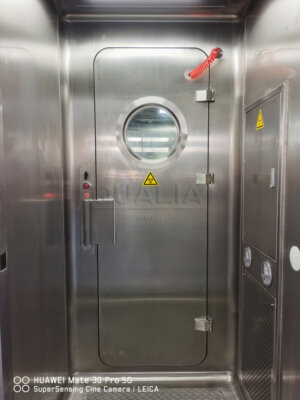
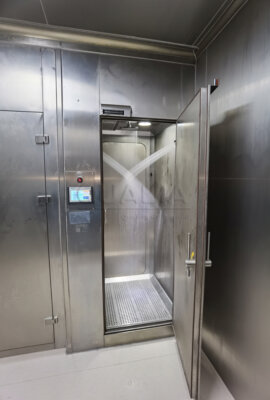
Design-stage interlock logic and factory-tested interlock function are not equivalent to interlock performance in the installed room. The distinction is not theoretical: door interlock sequencing that works correctly on a test bench can fail in the room because the physical door weight, pneumatic seal actuation timing, and access control signal latency interact differently than the component-level test anticipated. SAT in the real room context is the first point where these interactions are observable under actual operating conditions.
The critical judgment here is that SAT interlock checks are not re-running FAT. They are confirming that as-designed logic has translated correctly into the built containment envelope. For a BSL-3 or BSL-4 anteroom configuration, the self-closing interlocked door sequence must prevent simultaneous opening of both doors — a functional test in the installed room, under the actual door hardware, pneumatic seals, and access control integration, is the only credible evidence that this is working as designed. A reference to a passed FAT record does not substitute for this test, because FAT did not include the room.
Electronic access control integration presents a similar verification gap. The question SAT must answer is not whether the access control system works in isolation, but whether its lock status signals correctly with the door interlock logic and whether alarm escalation triggers correctly when the sequence is violated. This wiring and signal verification only becomes meaningful in the installed context, where the actual cable runs, signal conditioning, and BMS handoff are present.
Emergency alarm, eyewash, and shower functionality checks serve a different purpose: they confirm that emergency response infrastructure is operational and correctly located relative to the controlled area exit before the room is declared ready for IQ. These checks are not primarily about the alarm hardware — they are about confirming that emergency decontamination access is possible without touching contaminated surfaces, which is an operational readiness condition with biosafety consequences.
| System/Component | Site SAT Check | Containment Objective |
|---|---|---|
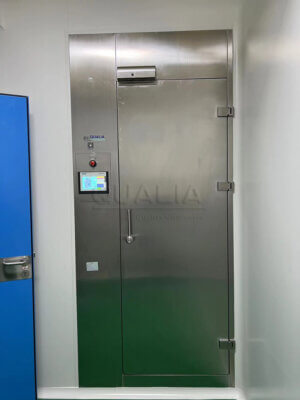
| Self‑closing interlocked doors | Functional test of interlock logic and door closure sequence | Preserves containment envelope integrity during entry/exit |
| Electronic access control | Verify integration of locking systems with room interlocks and alarms | Interlock and security function as designed |
| Emergency alarms, eyewash stations, showers | Functional test and location verification near exit | Regulatory compliance and emergency decontamination readiness |
A common omission is testing interlock and alarm behavior under simulated fault conditions rather than only under normal operating sequences. Fault condition testing — a door held open, an access card failure, a pressure alarm trigger — is where interlock gaps typically surface and where the SAT record provides the most useful evidence for later OQ deviation analysis.
For projects involving pneumatic seal doors as part of the containment envelope, verifying seal actuation timing and the interlocked relationship between seal inflation and door interlock signal is part of this check, not a separate commissioning task. See the BSL inflatable seal door design guidance for the design basis that informs what the as-installed verification should confirm.
BMS and facility interface evidence
BMS signal verification sits at the intersection of equipment SAT and facility commissioning — which is precisely why it is frequently incomplete at the point where the IQ team expects it to be done. The equipment supplier may have verified that the equipment generates the correct alarm signals at FAT. The BMS integrator may have confirmed that the BMS receives signals from a test source. Neither verification confirms that the installed wiring from the equipment to the BMS is correctly mapped, that signal logic is correct for the specific pressure zone, or that alarm escalation behaves as designed in the room context.
SAT must close this gap by verifying, on the installed system, that BMS pressure and airflow alarm signals for the BSL-3 or BSL-4 zone are correctly wired, that signal polarities and thresholds match the validated design, and that a simulated alarm condition at the equipment level produces the correct BMS response. WHO LBM and CDC BMBL guidance both support the principle that negative pressure monitoring in containment zones must be actively verified, not assumed — and BMS signal mapping is the mechanism through which that monitoring is confirmed to function.
The practical consequence of incomplete BMS interface verification is that pressure excursions may not trigger alarms as designed, or may trigger them with incorrect severity classifications. Either failure is serious: a missed alarm creates an undetected containment breach window; an incorrectly classified alarm erodes operator response confidence. Neither failure is visible until a real excursion occurs, which is not the appropriate discovery point.
A further interface consideration is the relationship between BMS alarm logging and the electronic audit trail. For GMP-adjacent BSL-3/4 programs, BMS alarm records form part of the environmental monitoring history. If SAT does not confirm that timestamp, zone identification, and alarm categorization are recorded correctly, that gap will surface during audit. Closing it at SAT is straightforward; retrofitting it after IQ completion is not.
Readiness conditions before IQ starts
IQ cannot be started on a room that has not passed SAT, but SAT itself cannot be run validly on a room that has not reached a defined physical readiness state. This sequencing dependency is consistently underestimated on project timelines, particularly because the readiness conditions for SAT belong to construction closeout, not to equipment installation — and construction closeout is rarely completed to the same deadline as equipment delivery.
The two conditions that most commonly produce false SAT failures are unsealed surface penetrations and unconfirmed construction material compliance. Penetrations through walls, floors, and ceilings that have not been sealed before testing will produce airflow leakage that distorts pressure readings and may prevent the room from reaching or sustaining the negative pressure differential required for the SAT check to be valid. These failures are not equipment failures — but without formal pre-SAT inspection documentation, the SAT record will show a failed pressure check with no clear cause attribution. That ambiguity creates audit problems and forces repeat testing after the room is sealed, which costs schedule time that was not budgeted.
Construction material verification — confirming that surfaces are non-porous and capable of withstanding the decontamination agents that will be used in the room — is a planning criterion drawn from WHO LBM guidance, not a universal regulatory threshold with a single governing standard. Its practical implication for SAT readiness is that porous or incompatible surfaces discovered after equipment installation can require rework that repositions or damages the installed equipment package. The efficient review point is before installation, which requires a formal pre-SAT room readiness checklist signed off by both the facility team and the biosafety reviewer.
A formal readiness gate before SAT begins — documented, signed, and referenced in the SAT protocol — also simplifies failure attribution during the test itself. If a utility check fails after the room has been declared ready, the failure more reliably reflects an installation or connection issue rather than a room deficiency. That clarity is valuable when a supplier technician and a facility engineer are both on site and the question of responsibility for the failure needs a fast answer.
For projects using modular BSL-3/4 laboratory systems, the readiness conditions are partially controlled by the module design, but interface points — utility connections, exhaust duct connections, access control wiring — still require the same pre-SAT verification. Explore how the BSL-3/4 Module Laboratory approach defines utility interface responsibilities between the module supplier and the site.
Coordination window for supplier and site teams
The most consistently underestimated risk in BSL-3/4 SAT execution is not technical — it is scheduling. SAT for high-containment equipment requires the simultaneous availability of supplier commissioning technicians, facility mechanical and electrical engineers, the biosafety officer, and in some programs a QA reviewer. Each party has independent scheduling constraints. A single absent party typically does not result in a partial test; it results in the entire test window being voided, because containment interface checks require all parties to be present to observe, troubleshoot, and sign the record in real time.
This coordination window is difficult to compress after the fact. Supplier technicians may be travelling from another country or supporting parallel commissioning at another site. Biosafety officers at institutions with regulated select agent programs may not be substitutable — their sign-off on specific test observations may be required by the oversight framework governing that program. Facility engineers may have competing commissioning priorities on the same project. The practical implication is that SAT scheduling should be treated as a multi-stakeholder alignment event with advance notice requirements, not as a date set by the equipment delivery timeline.
Real-world regulated programs have experienced situations where commissioning completion is directly tied to formal licensing approval — analogous to the tight coordination windows observed when CDC registers BSL-4 facilities. The lesson from that analogy is not regulatory; it is operational: when SAT completion is a gating event for formal program approval, the cost of a voided test window includes not just the rescheduling delay but the downstream delay to the entire program approval timeline.
Pre-planning actions that reduce coordination friction include: agreeing on test witness requirements in the SAT protocol before mobilization; confirming supplier technician travel and availability dates in the project schedule rather than via informal communication; and establishing a defined partial-test policy that identifies which checks can proceed with a biosafety observer absent and which cannot. A risk assessment supporting that partial-test policy should be prepared in advance, not improvised on the test day.
The broader commissioning sequence — where SAT sits relative to system commissioning, room certification, and IQ — is covered in the BSL-3 lab commissioning step-by-step guide.
SAT closure threshold for critical containment interfaces
SAT closure is not a binary pass/fail event for most BSL-3/4 equipment packages. It is a conditional state: some items may be formally closed, some may be open with an accepted risk assessment, and some may be flagged as prerequisites that must be resolved before IQ starts. The error pattern to avoid is treating SAT closure as a documentation formality — signing the SAT record while critical interface checks remain unresolved because schedule pressure has made deferral seem acceptable.
The specific interfaces that should not be deferred are those where an unresolved condition directly affects the validity of IQ evidence. BMS pressure alarm signal mapping, door interlock sequencing, and backup power confirmation all belong in this category. If any of these remain open when IQ begins, then any anomaly observed during IQ or OQ cannot be cleanly attributed to equipment versus site — the audit trail is compromised from the outset, and requalification of both may be required to restore a defensible record.
The practical standard for SAT closure should be: all containment-critical interfaces are either formally verified and closed, or any open item has a documented risk assessment accepted by the biosafety officer and QA reviewer, with a defined resolution timeline and a formal hold on the IQ activities that depend on that interface. This is a planning criterion and a recommended practice, not a codified rule from any single standard. But it reflects the logic that regulatory reviewers apply when they examine the gap between SAT completion and IQ start: they will ask whether the equipment was installed into a verified containment environment, and the SAT record is the primary evidence available to answer that question.
Where regulatory approval or select agent registration is linked to commissioning completion — as it is in certain national-level frameworks — SAT closure should be formally aligned with the documentation package submitted for approval. Treating SAT completion as an internal milestone only, without connecting it to the approval documentation, creates a record discrepancy that may require clarification or supplementation under time pressure. Building that alignment into the SAT protocol structure in advance is a straightforward mitigation that is frequently overlooked.
For EDS-integrated BSL-3/4 programs, SAT closure should also confirm that effluent decontamination system interlocks, drain valve sequencing, and BMS fault signals are verified in the installed configuration — these interfaces are often scoped separately but represent critical containment dependencies. See the BSL-4 EDS redundancy and fail-safe controls documentation for the technical basis that informs what installed verification should confirm.
SAT for BSL-3 and BSL-4 equipment packages functions as the formal boundary between installation and qualification — and the quality of what passes through that boundary determines how defensible the entire downstream validation record will be. The teams that protect their IQ and OQ audit trails are the ones that treat SAT as a containment verification event, not an install completion sign-off, and that resist pressure to begin IQ before the site-to-equipment interfaces are genuinely confirmed.
Before closing SAT, the responsible question is not whether the test was witnessed and signed. It is whether each containment-critical interface — exhaust connection, door interlock sequencing, BMS signal mapping, backup power continuity, and access control integration — has a test record that would satisfy an external reviewer who was not present. If any of those records are absent or rely on deferred resolution without a formal risk assessment, the SAT closure is incomplete regardless of what the sign-off page says.
Frequently Asked Questions
Q: Can SAT proceed if only some utilities are stable — for example, if compressed air is confirmed but exhaust balance is still being adjusted?
A: No — partial utility stability is not a valid SAT start condition for containment-critical checks. Exhaust balance directly determines whether airflow direction and pressure differential readings reflect equipment behavior or room deficiency. Running pressure and airflow checks against an unbalanced exhaust system produces results that cannot be attributed to equipment versus site, which compromises the entire SAT record. Utilities that remain unstable at the planned SAT window should trigger a formal hold with a documented risk assessment, not a partial test that proceeds and hopes the open item resolves quietly.
Q: What is the right thing to do immediately after SAT is signed off — can the IQ protocol be initiated the same day?
A: IQ can begin the same day only if every containment-critical interface is formally closed with no open items, or any open items carry a documented risk assessment accepted by both the biosafety officer and QA reviewer with a defined resolution timeline and a corresponding IQ hold on dependent activities. In practice, the safer sequence is to allow a short structured review of the SAT record before IQ mobilization — specifically to confirm that BMS signal mapping, door interlock sequencing, and backup power confirmation are all in a closed state. Starting IQ with unresolved SAT items converts every subsequent OQ anomaly into an attribution problem that may force requalification of both equipment and site.
Q: Does the SAT scope shrink when a modular BSL-3/4 laboratory system is used, since much of the integration is controlled by the module design?
A: The scope narrows for internal module interfaces but does not shrink for site connection points. Modular systems control construction material compliance and some internal utility routing, which reduces certain readiness conditions — but exhaust duct connection, utility supply quality at the interface, BMS signal wiring from the module to the facility system, and access control integration with site infrastructure all require the same installed verification as a stick-built room. The boundary between what the module supplier owns and what the site team owns at each interface must be defined in the SAT protocol before testing begins, not resolved by assumption on test day.
Q: How does SAT for a BSL-3/4 package compare to the room certification that the HVAC commissioning team may have already completed — is there overlap that can be used to reduce the SAT scope?
A: Room certification and equipment SAT address different questions and neither substitutes for the other. HVAC commissioning confirms that the room’s air handling system meets design specifications in an unoccupied, unequipped state. SAT confirms that the installed equipment package — including BSC exhaust connection, door interlocks, BMS signal handoff, and access control — functions correctly against the room’s as-commissioned utility conditions. The interaction effects between the two systems, such as BSC thimble connection behavior under HVAC fluctuation or door interlock timing under actual pneumatic seal actuation loads, are only observable after equipment installation and are not captured by HVAC commissioning records alone.
Q: At what point does deferring a SAT open item become a regulatory risk rather than just a project management risk?
A: The threshold is when the unresolved item is a containment-critical interface — BMS alarm signal mapping, door interlock sequencing, or backup power continuity — and IQ proceeds without a formally accepted risk assessment covering that gap. At that point, the downstream IQ and OQ records cannot demonstrate that equipment was qualified into a verified containment environment, which is the question regulatory reviewers and select agent oversight bodies will ask when examining the validation package. A deferred item with a documented risk assessment, biosafety officer acceptance, and a defined resolution deadline remains a project management risk. The same item deferred silently, with only a SAT sign-off page to show, becomes a regulatory exposure that may require requalification to resolve.