Personnel decontamination exits fail compliance audits most often not because the wrong system was selected, but because the right system was sized, positioned, or chemically configured for a condition that does not match actual operational use. A chamber dimensioned for a single occupant, a drain gradient that conflicts with the facility effluent decontamination system, or a disinfectant concentration locked in during procurement without accounting for pathogen classification — any one of these can halt commissioning or produce a finding that is expensive to correct after installation. The decisions that matter most are made during design and procurement, not during validation, which is why the questions a facility asks its equipment supplier before purchase determine more about audit readiness than any single equipment feature. The sections below are structured to help biosafety officers, facility engineers, and procurement leads define the right specification before a purchase order is placed.
What BMBL defines as an acceptable personnel decontamination exit: the threshold between a chemical shower and a full mist shower requirement
The BMBL 6th Edition establishes personnel decontamination requirements according to the biosafety level and the nature of the agent being handled. The threshold that matters most for procurement decisions is where the guidance moves from recommending decontamination procedures to requiring a water-based shower system as a formal exit control. For BSL-3 facilities — particularly those handling Risk Group 3 agents where exposure consequences are severe — BMBL defines a mandatory water shower system as the minimum acceptable exit mechanism at the boundary between the contaminated zone and clean areas. This is the point at which a chemical shower or a portable spray-down arrangement is no longer a defensible substitute.
The distinction between a chemical shower and a mist shower system is not just semantic. A portable chemical shower can deliver a disinfectant spray, but it cannot enforce the one-door-open-at-a-time interlock sequence that BMBL requires for BSL-3 containment. That sequential door control is what makes a mist shower a containment device rather than a hygiene aid. Portable configurations eliminate the plumbing integration cost and are faster to install, but they create an audit liability at BSL-3 because the interlock requirement cannot be satisfied without a fixed, hardware-enforced system. Choosing a portable unit to reduce installation scope is a procurement shortcut with a compliance ceiling that may not become visible until an external audit.
For facilities that are genuinely at BSL-3 with standard Risk Group 3 agents and no exceptional pathogen classification, a fixed mist shower system with a validated chemical dosing unit and an electronically enforced door interlock is the baseline specification. For any facility considering whether a lower-tier option is acceptable, the practical question is not whether a portable unit can do the job but whether it can satisfy an auditor reviewing the exit protocol against BMBL’s containment requirements for the specific agent class in use.
Core system components: atomization nozzle configuration, chemical dosing unit, and door interlock sequencing
The function of a mist shower system depends on three interdependent subsystems, and a specification weakness in any one of them undermines the others. Atomization quality, chemical delivery accuracy, and interlock sequencing must be treated as a system, not as a list of individual features.
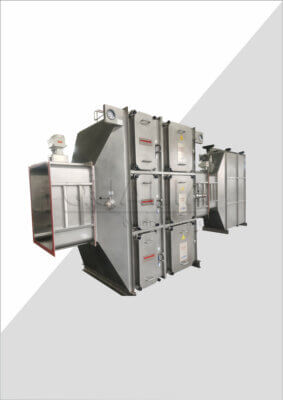
Atomization in fixed mist shower installations is typically achieved through a high-pressure pump driving solution through copper nozzles configured to generate a fine mist. The objective is complete surface wetting of PPE — including areas that are difficult to reach by hand, such as boot soles, glove cuffs, and back surfaces of the suit. Fine mist atomization is what enables this coverage without requiring the wearer to physically maneuver through the spray path; the nozzle arrangement does the coverage work. When evaluating supplier specifications, confirm that nozzle placement has been validated to reach all PPE surfaces, not just the frontal plane. A system that achieves 80% surface coverage is not equivalent to one validated for full-body contact, and this distinction affects whether the stated contact time is meaningful.
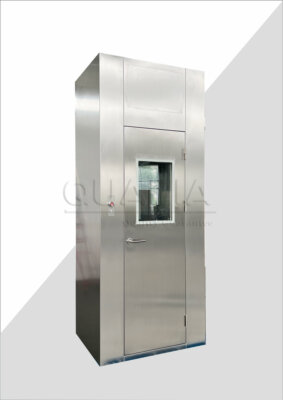
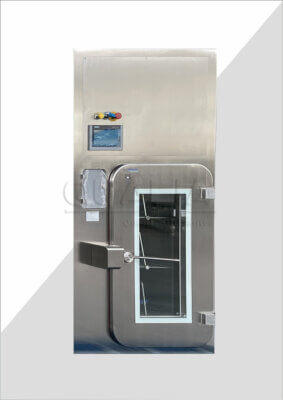
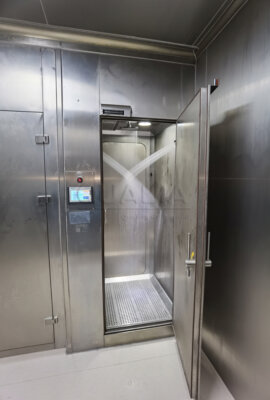
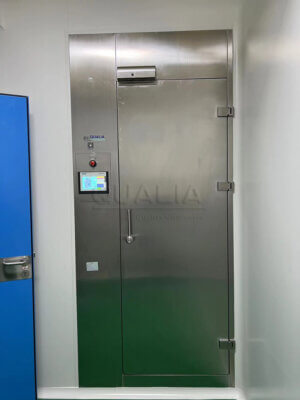
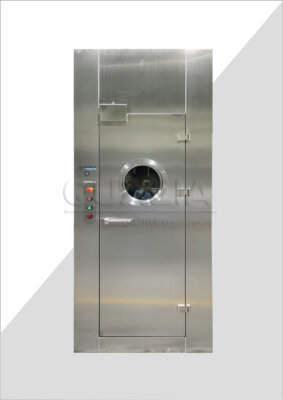
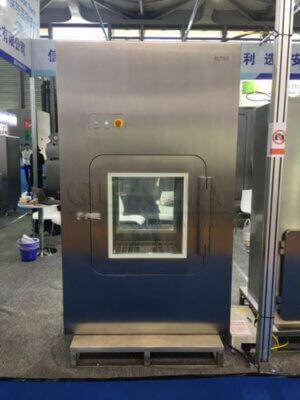
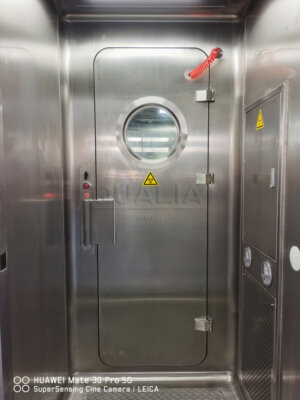
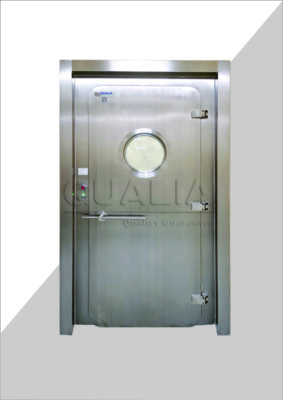
The door interlock system is the containment component. Inflated seal doors with an electronic interlock prevent both the entry-side and exit-side doors from being open simultaneously, functioning as a personnel airlock. The control system driving this interlock logic matters for validation purposes — industrial PLC platforms from established manufacturers provide the audit trail and programmable logic stability that qualification protocols require. A proprietary or undocumented control architecture may be functional but creates significant IQ/OQ documentation risk. Confirming the PLC platform before purchase is a straightforward procurement checkpoint that prevents a qualification obstacle downstream.
Each of these components creates a specific specification risk if left underspecified at procurement.
| Component | Key Specification | Why It Matters |
|---|---|---|
| Atomization Nozzle | High-pressure pump and copper nozzles to generate a fine mist. | Defines the core mechanism for wetting PPE surfaces to enable effective decontamination. |
| Door Interlock System | Inflated seal doors with an electronic interlock preventing both doors from opening simultaneously. | Fundamental protocol for maintaining containment by acting as an airlock. |
| Control System | Uses a specific industrial PLC interface panel (e.g., Siemens) for sequencing. | Ensures robust interlock logic and is a concrete procurement and validation checkpoint. |
Disinfectant selection for mist showers: free chlorine concentration, contact time, and agent compatibility with PPE materials
Disinfectant concentration is a threshold decision, not a default. The most common assumption in early-stage specification is that sodium hypochlorite at a standard concentration covers all BSL-3 scenarios. In practice, the appropriate free chlorine concentration depends on the pathogen classification and the institutional biosafety committee’s assessment of residual risk.
For BSL-3 facilities handling standard Risk Group 3 agents — where vaccines or effective treatments exist — sodium hypochlorite at 0.5% free chlorine is generally defensible as the working concentration, provided contact time is validated at the PPE surface. The practitioner threshold for contact time is a minimum of 30 seconds at the nozzle surface, with spray coverage confirmed to reach all PPE surface areas including boot soles and glove cuffs. These are validation requirements, not assumptions; a system whose documentation states a 30-second cycle time without confirming surface coverage has not established effective decontamination.
When the facility handles Risk Group 3 agents with no available vaccine or no effective treatment, the risk profile changes enough that 0.5% free chlorine should be reassessed. Upgrading to 1% free chlorine, or transitioning to a vaporized hydrogen peroxide (VHP) protocol, is consistent with what institutional biosafety committees apply in higher-consequence scenarios. Locking in the lower concentration during procurement and discovering later that the IBC requires a higher standard means revalidating the chemical dosing unit — a cost that is avoidable if the agent classification is confirmed before the dosing system is specified.
PPE material compatibility is a second constraint that procurement teams frequently underweight. Sodium hypochlorite at elevated concentrations can degrade nitrile, certain elastomers, and some suit materials over repeated exposure cycles. If the facility’s PPE inventory includes materials with documented hypochlorite sensitivity, the disinfectant selection and contact time must be reconciled with the PPE manufacturer’s guidance before the dosing parameters are finalized. A disinfectant protocol that compromises suit integrity over time is not a compliant protocol regardless of the concentration used.
Chamber sizing and spatial requirements for BSL-3 versus BSL-4 exit zones
Chamber sizing is where concept-stage decisions most reliably produce installation-stage failures. A standard mist shower chamber — typically around 800mm × 900mm × 1950mm — provides a functional baseline for single-occupant use, but this dimension is a starting point for specification, not a finished design parameter.
The compliance risk is specific: facilities that dimension the chamber for single-occupant use routinely encounter BMBL audit findings when the exit protocol for their particular lab zone requires two personnel to pass through simultaneously. This is not an edge case. Many BSL-3 facilities operate buddy-system protocols, require escort procedures, or have workflow conditions that produce concurrent occupancy at the exit. If the chamber cannot physically accommodate the maximum concurrent occupancy defined by the lab’s own operational protocol, the system is undersized relative to the compliance requirement — regardless of what the equipment datasheet says. Correcting this after installation means either procuring a replacement unit or permanently constraining the exit workflow, both of which are outcomes that a correct specification at procurement would have prevented.
Door threshold type is a secondary sizing decision with real operational consequences. Mechanically sealed doors with a raised threshold are standard on most fixed mist shower installations because they provide reliable inflated seal performance. However, in lab zones where wheeled cart traffic — specimen transport, equipment movement, waste removal — is part of the routine workflow, a raised threshold creates a physical bottleneck that affects operational efficiency and may force unsafe workarounds. Confirming the threshold configuration against the facility’s actual material flow is a pre-installation check, not a post-commissioning adaptation.
| Design Aspect | Standard or Example | Risk if Overlooked |
|---|---|---|
| Chamber Dimensions | 800mm x 900mm x 1950mm (standard baseline). | May not accommodate maximum concurrent lab occupancy, leading to failed compliance audits. |
| Door Threshold Type | Mechanically sealed doors with a raised threshold. | Creates access bottlenecks and operational inefficiencies in lab zones requiring wheeled cart traffic. |
For BSL-4 exit zones, the spatial and door configuration requirements are substantially more demanding. BSL-4 exits typically involve full suit or positive-pressure suit protocols, chemical shower procedures that may include full immersion cycles, and stricter effluent handling requirements. Chamber dimensions appropriate for BSL-3 single-occupant exit are unlikely to be sufficient for BSL-4 positive-pressure suit doffing, and the interlock architecture must account for the more complex exit sequence. If a facility is designing for BSL-4 from the outset, the chamber sizing discussion should begin with the suit type and doffing protocol, not with a standard catalog dimension.
Drain and effluent routing: connection to facility EDS and chemical neutralization requirements
The mist shower drain is the most disruptive coordination problem in a mist shower installation, and it is nearly invisible at the design review stage. The floor drain must connect to the facility’s effluent decontamination system, and that connection depends on the EDS inlet position relative to the shower’s installed location and the gradient of the shower floor drain.
The failure pattern is consistent across projects: the EDS inlet position is finalized during facility infrastructure design, the mist shower unit is positioned based on lab layout requirements, and the two are assumed to be compatible without explicit confirmation of drain gradient alignment. During commissioning, the mismatch becomes visible — the shower drain cannot gravity-feed to the EDS inlet without re-routing pipework that was not in the original installation scope. The consequence is a three-to-six week delay in the commissioning timeline, and sometimes additional civil work if the drain path requires penetrating concrete or rerouting through occupied spaces.
The prevention is a single confirmed dimension: the distance and elevation difference between the shower floor drain outlet and the EDS inlet, verified during the design phase before the shower unit position is fixed. This check is not technically complex, but it requires the mechanical engineer, the biosafety officer, and the equipment supplier to share drawings at the same point in the project timeline. Projects that treat this as a contractor coordination problem rather than an engineering design confirmation are the ones that discover the misalignment during installation.
Chemical neutralization is the second EDS consideration. Effluent from a mist shower system contains disinfectant at working concentration — hypochlorite solutions at 0.5% or higher require neutralization before discharge to the facility wastewater system. The EDS must be sized and configured to handle the chemical load and volume from a mist shower cycle, including worst-case scenarios where multiple cycles run in sequence. Confirming that the EDS design includes neutralization capacity for the mist shower’s anticipated disinfectant concentration and cycle frequency is a scope item that belongs in the facility design review, not the commissioning checklist.
Operational integration: APR door interlock protocols and control system requirements
A mist shower system’s containment function depends entirely on whether the door interlock logic executes correctly under operational conditions, including abnormal ones. The interlock protocol — entry door sealed before decontamination cycle initiates, cycle completes before exit door unlocks — is the mechanism that maintains the pressure and contamination boundary between the lab and clean zones. If that sequence can be bypassed, overridden, or interrupted without triggering an appropriate response, the system’s containment function is compromised.
Emergency controls are the integration element most often treated as a checklist item rather than a design requirement. Every fixed mist shower installation should include an emergency stop button accessible from inside the chamber and emergency exit controls on both doors. These controls exist to protect personnel when the system malfunctions — a stuck door, an unexpected chemical dosing error, a cycle that does not complete — and their placement, labeling, and function must be verified during operational qualification. An emergency stop that is mounted in an unreachable position, or an emergency exit that overrides the interlock without logging the event, is a safety gap that will be identified in an audit if not caught during OQ.
The PLC-based control system that drives interlock sequencing should provide a documented event log that captures cycle initiation, cycle completion, door state changes, and any manual overrides or emergency activations. This log serves two purposes: it gives operations staff a record for investigating anomalies, and it gives auditors the evidence that the interlock sequence executed as designed during validation and routine use. A control system that does not generate this record creates a documentation gap that is difficult to close retrospectively. Confirming log capability before purchase — not after the control system is installed and configured — is the correct sequence.
IQ/OQ/PQ qualification documentation: what BMBL and GMP auditors expect from a mist shower installation
A mist shower installation that cannot be fully qualified is not a compliant installation, and the documentation required to complete IQ, OQ, and PQ is not something that can be reconstructed after the fact. Auditors reviewing a BSL-3 or BSL-4 decontamination system will expect a complete qualification package: Design Qualification confirming that the system specification meets the user requirement, Installation Qualification confirming that the installed system matches the design, Operational Qualification confirming that the system performs its intended function under defined conditions, and Performance Qualification confirming that the system delivers consistent results under operational use conditions.
For a mist shower, OQ and PQ have specific content requirements that distinguish them from a generic equipment qualification. OQ must confirm that the door interlock sequence executes correctly — entry door closed and sealed before cycle start, cycle complete before exit door unlocks, emergency controls functional and logged. It must also confirm that the chemical dosing unit delivers the specified disinfectant concentration consistently across multiple cycles. PQ must confirm that the spray coverage reaches all defined PPE surface areas at the validated contact time, typically through challenge testing that demonstrates surface wetting under worst-case conditions such as maximum occupancy and minimum cycle time.
The practical implication for procurement is that qualification documentation must be a supplier deliverable, not an afterthought. Confirm before issuing a purchase order that the supplier will provide DQ, IQ, OQ, and PQ protocol templates — or completed documentation if the system is being supplied pre-qualified — and that the documentation is specific to the installed configuration, not a generic model-level document. A supplier who cannot provide system-specific qualification documents is creating a validation gap that the facility will have to close at its own cost, typically by engaging a third-party validation firm, which adds time and budget to a phase of the project where both are already constrained.
How to evaluate and specify a mist shower system: the questions to ask your equipment supplier before procurement
Supplier evaluation for a mist shower system should produce specific, verifiable answers, not general assurances. The questions that matter most are the ones that surface misalignments between what the supplier provides as standard and what the facility actually needs given its agent classification, spatial constraints, workflow, and qualification requirements.
The three areas where specification misalignment most often creates downstream problems are service scope, qualification documentation, and customization capability.
Service scope determines the project’s critical path. If field installation, commissioning, and operator training are not included in the supplier’s standard scope, those activities become the facility’s responsibility — which typically means engaging a separate contractor, extending the timeline, and creating a coordination interface that adds risk to the commissioning phase. Confirming whether installation and commissioning are included, and what the training protocol covers, is a question that belongs in the initial supplier conversation, not the purchase order negotiation.
Warranty terms set the baseline for early-life cost exposure. A one-year warranty on an installed mist shower system is a common industry term, but what matters as much as the period is what the warranty covers — parts, labor, travel, and whether it applies to wear components like nozzles and seal materials. A system that fails in month ten of a one-year warranty with a claim dispute over what is covered is a procurement outcome that due diligence should prevent.
Customization capability separates suppliers who can adapt to a facility’s specific requirements from those selling a catalog configuration. Facilities with unusual chamber dimension requirements, non-standard agent classifications requiring VHP protocols instead of hypochlorite, or integration requirements for existing facility control systems may find that a standard model creates an operational or compliance constraint. Asking explicitly whether the supplier can modify the system to meet requirements outside the standard specification — and getting a written answer — is the difference between discovering a limitation before purchase and after delivery.
| Question Topic | Risk if Unclear | What to Confirm |
|---|---|---|
| Scope of After-Sale Service | Project delays and increased costs if field installation, commissioning, and training are not provided. | Confirm if these services are included in the procurement scope. |
| Warranty Period | Increased long-term cost of ownership due to early component failures without coverage. | Verify the specific warranty period offered for the installed system (e.g., 1 year). |
| Customization Ability | Off-the-shelf system may not meet unique spatial, procedural, or hazard-specific lab requirements. | Determine if the supplier can customize equipment to meet requirements not in standard specifications. |
For facilities beginning this process, Qualia Bio’s mist shower product line and chemical shower options provide a useful comparison point for understanding the technical differences between fixed and alternative configurations. For a deeper look at how decontamination requirements differ across containment levels, this overview of BSL-3 versus BSL-4 differences covers the broader design implications that affect system selection.
The decision that prevents the most expensive project outcomes is not which supplier to choose — it is which specification parameters to lock in before procurement and which to leave open for confirmation. Chamber occupancy, EDS drain alignment, disinfectant concentration relative to agent classification, and qualification documentation scope are the four variables most likely to produce rework, delay, or audit findings if they are not resolved during design rather than during commissioning or validation. Each of them has a clear confirmation method: confirm maximum concurrent occupancy with the facility’s biosafety officer, confirm drain gradient alignment against mechanical drawings before fixing the unit location, confirm disinfectant concentration with the IBC based on the specific pathogen risk profile, and confirm qualification document scope in writing with the equipment supplier before the purchase order is issued. The cost of getting these confirmations wrong is not measured in specification revisions — it is measured in commissioning delays, failed audits, and system replacements.
Frequently Asked Questions
Q: Does a BSL-3 facility handling a Risk Group 3 agent with an available vaccine still require a fixed mist shower, or can a portable chemical shower satisfy the exit requirement?
A: A portable chemical shower cannot satisfy the BSL-3 exit requirement regardless of pathogen risk tier, because the compliance threshold is the door interlock, not the disinfectant delivery. BMBL requires a one-door-open-at-a-time sequential exit sequence, and that sequence must be hardware-enforced. A portable unit cannot enforce that logic. The consequence is an audit liability that exists independently of how effective the disinfectant application itself may be.
Q: If the facility’s institutional biosafety committee hasn’t yet confirmed the final agent classification, should procurement of the mist shower be delayed until that decision is made?
A: Yes — or at minimum, the chemical dosing unit specification should be left open until the IBC determination is final. The disinfectant concentration is set at the dosing unit level, and upgrading from 0.5% to 1% free chlorine, or switching to a VHP protocol, after the unit is installed and validated means revalidating the dosing system from the beginning. The chamber, interlock, and drain infrastructure can proceed, but locking in the dosing parameters before the pathogen risk profile is confirmed creates a revalidation cost that is entirely avoidable.
Q: After the mist shower passes OQ, what is the correct next step before the system can be used for actual personnel exit?
A: Performance Qualification must be completed before operational use begins. OQ confirms that the interlock sequences correctly and the dosing unit delivers the specified concentration — but PQ is what confirms that spray coverage actually reaches all defined PPE surface areas, including boot soles and glove cuffs, under worst-case conditions such as maximum chamber occupancy and minimum cycle time. Using the system for live personnel exit before PQ challenge testing is complete means the decontamination efficacy at the PPE surface has not been validated, which is the core compliance requirement.
Q: Where does a mist shower system sit relative to a full chemical shower for BSL-4 positive-pressure suit exit — is a mist shower ever sufficient at BSL-4?
A: For BSL-4 exits involving positive-pressure suits, a standard mist shower chamber is generally insufficient as a standalone solution. BSL-4 positive-pressure suit protocols typically require chemical shower procedures that include extended contact cycles and full suit-surface saturation not achievable through fine mist atomization alone, along with chamber dimensions that accommodate the suit’s physical profile during doffing. The appropriate starting point for BSL-4 specification is the suit type and doffing protocol, not the mist shower catalog dimension — the exit system must be designed around that sequence, not adapted to it afterward.
Q: For a facility building to BSL-3 for the first time, is there a meaningful cost or timeline difference between specifying a system with full qualification documentation included versus sourcing documentation separately?
A: Sourcing qualification documentation separately almost always costs more in both time and budget. When a supplier provides system-specific DQ, IQ, OQ, and PQ protocol templates as a deliverable, the facility’s validation team works from a document set that reflects the actual installed configuration. Engaging a third-party validation firm to generate equivalent documentation from scratch typically adds cost and extends the validation phase by several weeks — at a point in the project where schedule compression is already a pressure. The more consequential risk is that third-party-generated protocols may not capture system-specific interlock logic or dosing parameters with the same accuracy as supplier-originated documentation, which can produce OQ discrepancies that require additional test cycles to resolve.
Related Contents:
- Air Shower Interlocks: Contamination Prevention
- VHP Generator Supplier Selection | Vendor Assessment Criteria & Best Practices
- Air Shower Installation: Expert Guide
- Air Shower Maintenance: Preventive Care Tips
- Air Shower Safety: Regulatory Compliance
- Air Shower Validation: Ensuring Performance
- Air Shower Testing: Performance Verification
- BSL-4 Chemical Showers: Advanced Decon Systems
- BSL-4 Entry & Exit: Critical Safety Procedures