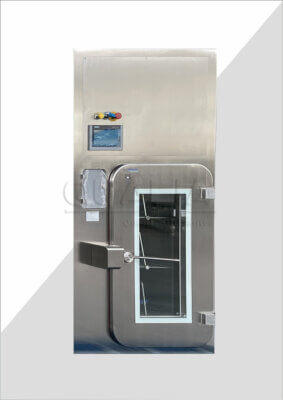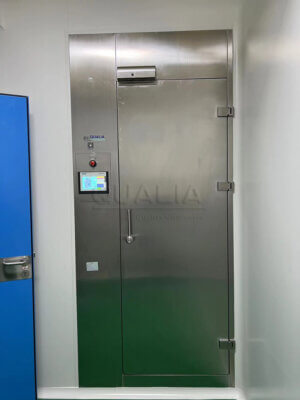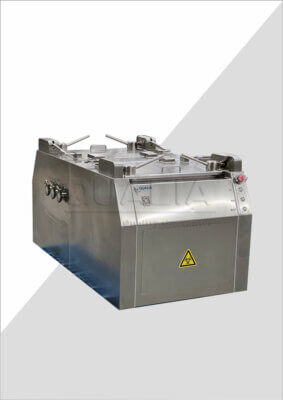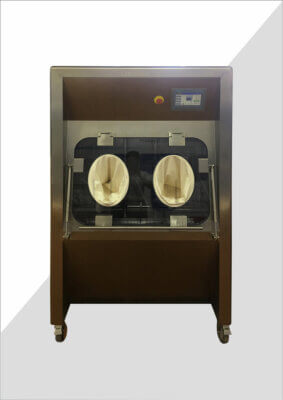

A door interlock system that only enforces a one-door-open rule can appear fully functional during a dry walk-through and then release the wrong door under a pressure transient during commissioning. The consequence is not just a failed test—it is a contamination boundary that was never actually closed, discovered only after personnel have moved through it. That gap traces back to a design stage decision to treat interlock logic as a hardware sequence rather than a pressure-aware, alarm-integrated control behavior. The judgment that matters is whether the interlock reads room state—not just door state—before permitting any release, and whether alarm and override behavior is defined with enough specificity to survive a regulatory review. What follows equips biosafety officers, validation engineers, and EHS leads to evaluate interlock logic at the level of detail that separates a defensible containment boundary from one that holds only under ideal conditions.
Door State Logic Across Containment Boundaries
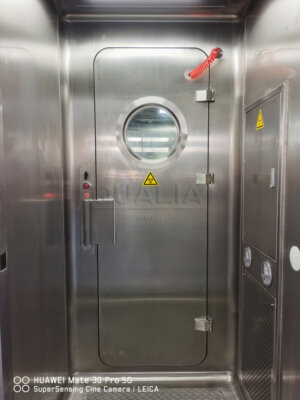
The fundamental logic question for a multi-door interlock is not whether one door can be open at a time, but which conditions must be satisfied before any release is permitted and what the system does when those conditions change mid-sequence. A four-door arrangement in which one door being unlocked prevents the remaining three from releasing is a common configuration, but the behavior of that arrangement depends on how each door’s standby state is configured—and that configuration choice has direct consequences for where the interlock check actually occurs.
In a locked standby configuration, a credential action—card swipe, PIN entry, or button press—precedes the unlock. That means the interlock check happens at the access request, before the door moves. In an unlocked standby configuration, the door can be pushed open directly, and the interlock engages only once the door sensor detects movement. The practical difference is that the locked standby mode allows the system to refuse entry before any breach occurs, while the unlocked standby mode detects a breach and then locks others out reactively. For containment boundaries with negative pressure cascades, that distinction matters: a reactive interlock accepts a brief window in which two doors may be open simultaneously if the first door’s sensor is slow or the second door’s push happens before the relay engages.
| Standby State | Unlock Method | Interlock Activation |
|---|---|---|
| Locked Standby | Personnel must swipe card or press button to unlock | When door is opened, other doors become locked (unlock prevented until door closed) |
| Unlocked Standby | Personnel can push the door open directly | When door is opened, other door locks engage |
The selection of standby mode should appear in the user requirements specification as a containment-tier decision, not a default inherited from the controller’s factory settings. At BSL-3 or equivalent containment levels, the case for locked standby at every controlled boundary is straightforward. Where unlocked standby is used—for example, on an inner door to support rapid egress—the transition logic and sensor response time should be explicitly validated, and the interlock window should be documented as an accepted and bounded risk, not an unexamined default.
Pressure Condition and Recovery Dependencies
A door interlock that reads door state alone cannot protect a pressure-dependent containment boundary. Negative pressure differentials between zones are maintained by active HVAC, and any door opening event creates a transient that may take seconds to recover. If the interlock releases a second door before the first has closed and pressure has stabilized, personnel movement through the airlock can carry contaminated air in the direction of the pressure gradient reversal—even if the door sequence itself was technically correct.
ISO 14644-4:2022 establishes pressure differential as a design parameter for cleanroom and controlled environment boundaries, and the same planning criterion applies to BSL-defined containment cascades. The engineering implication is that interlock release permission for a second door should be conditioned not just on the first door closing but on the differential pressure sensor confirming recovery to within an acceptable band. How tight that band must be, and what the recovery time threshold should be, depends on the room volume, the HVAC response rate, and the containment classification. These are facility-specific values that should be calculated during design and confirmed during commissioning—not defaulted to a controller’s standard timer.
The failure mode that appears repeatedly in commissioning is this: the interlock timer is set shorter than actual pressure recovery time because recovery was not measured under load conditions. Personnel learn to move quickly, the pressure never fully recovers between entries, and the differential that is supposed to protect the boundary degrades incrementally under operational patterns. The door sequence is followed. The containment boundary is not. Catching this requires that IQ and OQ test protocols include door-cycle pressure recovery measurement—not just door-open and door-close state confirmation.
Where the control system permits it, pressure signal integration into the interlock decision logic should be treated as a design requirement at the URS stage. Retrofitting pressure-conditional release logic after a controller has been installed is possible but often requires software changes that open a new validation cycle. Building the requirement in early avoids that cost.
Alarm Messages That Guide Operator Action
An alarm that activates without naming the specific boundary affected leaves the responding operator to interpret which door, which zone, and which action is appropriate. In a facility with multiple interlocked boundaries, a generic “door alarm” condition may produce the wrong response—or a delayed one—at exactly the moment when rapid, correct action matters most. WHO’s laboratory biosafety guidance identifies alarm systems as a core element of barrier management, and the intent is that alarm output should support a specific, trained response rather than require the operator to diagnose the fault before acting.
A door-open timeout alarm triggered after a defined duration—eight seconds is cited in at least one PLC manufacturer’s standard case as a design threshold, though the appropriate timer for any given boundary depends on the operational workflow—should present in the alarm message as a named boundary event with a clear permitted response. “Door A between anteroom and corridor has been open beyond threshold—close door to clear alarm” is actionable. “Door alarm active” is not. The difference becomes critical when the alarm fires during a gowning sequence or a materials transfer, when the operator has limited visibility and is already managing a procedure.
Alarm message design should be reviewed at the same stage as the interlock logic itself, not left to the SCADA or BMS configuration team as a display-layer task. The alarm text, the boundary identifier, the permitted operator response, and the escalation path if the door is not closed within a second time window should all be defined in the functional design specification. During OQ, each alarm condition should be triggered deliberately and the message content confirmed against the FDS—because what appears on the operator interface at the moment of an alarm is part of the containment system’s defense, not incidental.
One pattern worth flagging: alarm setpoints set conservatively short to avoid any open-boundary condition can create nuisance alarms during normal gowning or transfer operations, which operators learn to dismiss. The result is alarm fatigue at exactly the boundary where attention is most critical. Calibrating the timeout threshold to match the actual workflow—measured during commissioning rather than estimated during design—reduces nuisance events without extending the genuine exposure window.
Override Permission and Record Requirements
Override mechanisms exist because containment systems must be operable under emergency conditions, maintenance scenarios, and non-standard transfer events. The question is not whether overrides should be available, but who can authorize them, under what documented justification, and what the automatic record of that action looks like.
A role-based permission structure means that routine operators cannot release an override without a credentialed authorization from a biosafety officer, EHS lead, or another defined role. This is not primarily a security concern—it is a containment integrity control. An interlock that can be bypassed without role verification, reason capture, and automatic logging does not have a defensible audit trail, and that gap will surface during inspection. ISO 35001:2019 places biorisk management under a structured organizational accountability framework; override actions at a containment boundary fall squarely within that accountability scope.
The record that an override generates should include, at minimum: the identity of the authorizing individual, the door or boundary affected, the reason code or free-text justification, the timestamp, and the duration of the override condition. Whether that record is generated by the building management system, the interlock controller, or a separate electronic log depends on the facility’s system architecture—but the requirement for automatic generation, rather than manual documentation after the fact, should be explicit in the URS. Manual records of override events are difficult to defend as complete and contemporaneous during an audit. The simpler question from an inspector’s standpoint is whether the system prevented the action or captured it, and manual logging satisfies neither expectation reliably.
Emergency release behavior—where a fire alarm or evacuation signal releases all locks—should be treated as a distinct override category with its own record requirement. The fire alarm release is appropriate for life-safety scenarios, but the record of which doors were released, when, and under what trigger should be available for post-event review, particularly where biological containment may have been compromised during the event.
Failure Modes for Door Fault and Power Loss
Interlock failure modes fall into two categories: those the system detects and reports, and those that produce a silent failure—a condition where the door behaves as if the interlock is active but the boundary is not actually protected. The first category is manageable. The second is the audit and incident liability.
A forced door open event—where the door sensor reports open while the lock relay remains off—is a detectable fault. The system identifies the contradiction between sensor state and relay state and activates an alarm. A door-open timeout is similarly detectable once the timer threshold is crossed. These faults are recoverable with operator response, and they should be tested explicitly during validation. What is less often tested is the failure condition where a door sensor fails in the closed position—reporting the door as closed when it is physically open—or where a lock relay appears energized but the mechanical lock has not engaged. These silent faults do not trigger alarms under standard relay-detection logic because the system sees no contradiction. Detecting them requires either redundant sensing, periodic self-test routines, or maintenance inspection cycles that are formally documented in the preventive maintenance program.
Power loss behavior is a classification-level decision. Fail-secure means all locks engage on power loss, maintaining containment but potentially trapping personnel. Fail-safe means all locks release on power loss, allowing egress but compromising the containment boundary. For BSL-3 and above, a hybrid approach is common: egress-critical doors configured fail-safe for life-safety compliance, containment-critical doors configured fail-secure with battery backup or UPS to sustain the secure state for a defined minimum duration. The specification for which door falls into which category, and what the backup power duration requirement is, should be resolved at the URS stage and confirmed in the fire risk assessment and emergency response plan before detailed design is finalized.
| Failure Mode | Detection Logic | System Response |
|---|---|---|
| Forced Door Open | Door sensor indicates open while lock relay is off | Alarm relay activates |
| Door Open Too Long | Door remains open beyond 8-second timer | Alarm relay activates; alarm stops when door closes |
| Fire Alarm Input | Fire alarm input DIX16 closed (triggered) | All door lock relays release, overriding normal interlock |
Fire alarm input that releases all lock relays is a life-safety override, but it also represents a total loss of interlock control. Post-event containment recovery procedures—including personnel decontamination, boundary inspection, and resumption protocol—should be defined before commissioning, not improvised after an event. That recovery procedure is part of the biorisk management framework, not an afterthought to the fire emergency plan.
Validation Tests for Interlock Logic
Validation of interlock logic should challenge the system under the conditions that matter for containment integrity, not only the conditions that are convenient to test. A test protocol that confirms normal door sequence behavior but does not deliberately trigger pressure loss, power interruption, forced-open fault, or override activation is not a complete qualification of the interlock system.
The specific test structure will depend on the system configuration. Where a PLC-based interlock defines a door-open timeout alarm threshold—eight seconds is cited as a standard case in one manufacturer’s implementation—the validation test should confirm that the alarm activates at that threshold, not earlier and not later, under the actual sensor and relay conditions. The relay energization time, the sensor debounce setting, and any configured delay between door open detection and alarm output should all be understood and documented before the test is written, because they determine where the measurable acceptance criterion actually falls. Presenting an 8-second threshold as a universal regulatory requirement would misstate the evidence; what the validation team is actually confirming is that the system performs consistently with its own specification.
| Test Case | Test Procedure | Acceptance Criteria |
|---|---|---|
| Door Open Timeout Alarm | Open the door and keep it open; measure time until alarm | Alarm activates exactly 8 seconds after door opens (standard case) |
| Forced Door Open Alarm | With door lock relay off, force door sensor to open state; observe alarm output | Alarm relay DOY1 turns on when door sensor DIX1 is open and door relay DOY0 is off |
Beyond the fault-condition tests, validation should include reset behavior: after an alarm condition clears, does the system return to the correct ready state, or does a residual alarm or lock state persist that requires manual intervention? This matters operationally because a system that requires an engineering reset after every alarm event creates a maintenance dependency that is not always documented. If the reset action is not defined in the standard operating procedure, operators will develop informal reset habits that bypass the record requirement—and those informal habits are exactly what inspection teams ask about. The Validated APR Door Sealing Systems audit checklist framework provides a useful reference structure for confirming that sealing and interlock behavior are captured together within a single audit-ready document set, rather than in separate qualification files that are difficult to reconcile during review.
For facilities using pneumatic seal APR doors or mechanical seal APR doors, the interlock validation scope should include seal engagement confirmation as a discrete test condition—confirming that the door seal state is integrated into the interlock logic, not only the door latch or lock relay state. A door that reads as closed at the latch sensor but has not achieved seal pressure is a silent boundary failure under standard relay-detection logic.
Door interlock logic is defensible only when pressure condition, alarm clarity, and override accountability are treated as design requirements rather than commissioning details. The sequence of decisions that matters runs from URS—where standby mode, pressure-conditional release, and fail-state behavior must be explicitly specified—through FDS, where alarm messages and override permissions are defined at the content level, to OQ and PQ, where each fault condition is deliberately triggered and the system’s response is confirmed against a pre-defined acceptance criterion.
Before procurement or detailed design is finalized, the following should be resolvable from the specification documents: which doors are fail-secure and which are fail-safe, what the pressure recovery threshold is for second-door release, what alarm message text will appear for each fault condition, which roles can authorize an override, and what the automatic record of that override will contain. If those questions cannot be answered from the documents in hand, the interlock specification is not yet complete—and commissioning will make that visible at the worst possible time.
Frequently Asked Questions
Q: Our containment boundary relies on a biosafety pass box rather than a multi-door interlocked room. Do the alarm and logic principles in this article still apply?
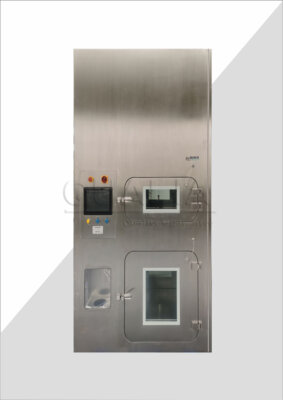
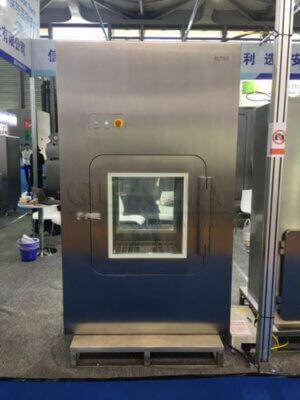
A: Yes, the same state logic, alarm clarity, and fault-detection expectations apply to pass boxes. A pass box creates a controlled boundary between zones, and its interlock should prevent both doors from being open simultaneously, trigger a clear alarm if a door remains open beyond the defined threshold, and detect forced-open or timeout faults. Validation should confirm seal engagement and interlock behavior together, not just door latch state. For facilities using biosafety pass boxes, these requirements are part of a defensible containment system, not optional additions.
Q: What is the first document I should update or review to ensure our interlock specification is complete after reading this article?
A: Review the User Requirements Specification (URS) and verify that it explicitly covers standby mode selection (locked vs. unlocked), pressure-conditional release logic, fail-safe/fail-secure assignments for each door, alarm message content and escalation paths, and override permission roles with automatic record generation. If these elements are absent or vague, the URS is not yet complete, and commissioning will expose the gaps.
Q: At what containment level does pressure-conditional interlock release become a regulatory expectation rather than an optional enhancement?
A: At BSL-3, ABSL-3, and equivalent high-containment levels, pressure-conditional release is a design expectation aligned with ISO 14644-4 and WHO biosafety guidance. For BSL-2 facilities, it is not universally mandated, but a documented risk assessment should determine whether pressure recovery limitations could permit directional airflow reversal during door cycling, and if so, pressure-conditional logic should be considered even at lower containment tiers.
Q: How do we decide whether a specific door in a BSL-3 airlock should use locked standby versus unlocked standby?
A: Use locked standby for doors that lead into areas of higher containment, so the interlock check occurs at the access request before any door movement. Unlocked standby may be acceptable for exit-only doors where rapid egress is a life-safety priority, provided the interlock sensor response time and the brief dual-open window are explicitly validated and documented as an accepted, bounded risk.
Q: Is the effort of defining custom alarm messages, override records, and pressure-dependent logic worth it for a facility that already passes its annual inspections?
A: Yes, because inspections can intensify or shift focus at any time, and a system that passes under ideal test conditions may still fail silently during real pressure transients or operator workarounds. Designing these elements into the specification upfront costs far less than retrofitting logic, revalidating, or managing an incident investigation after a containment boundary is found undefended.