Spray pattern qualification that passes on a stationary suit often fails when a real operator moves through the exit sequence. That gap — between a validated chamber specification and a validated procedure — is where BSL-4 suit laboratory projects most commonly lose time after installation, when re-testing forces schedule delays and can stall procedure approval before the facility accepts its first user. The design decision that resolves it is not selecting a better nozzle array; it is defining coverage requirements against the actual postures and movements that occur during exit, before the chamber is accepted. What follows is a basis for judging whether your chemical shower design, disinfectant specification, and doffing workflow are close enough to alignment to support defensible acceptance evidence.
Suit Exit Sequence Drives Chemical Shower Requirements
The chemical shower serves one direction of travel only. Operators entering a BSL-4 positive-pressure suit laboratory do not pass through a decontamination spray; the shower is an exit control, applied to the outer suit surface before the operator moves into the suit room for doffing. Understanding that asymmetry matters for chamber placement, SOP sequencing, and the scope of what the shower is required to accomplish.
The exit sequence that informs chamber design in CDC BMBL-referenced implementations involves a disinfectant spray phase — typically around three minutes — followed by a warm-water rinse of similar duration. The spray phase must achieve meaningful surface contact across the entire suit exterior under conditions that account for how the operator stands, turns, or raises their arms during the cycle. The rinse phase serves a different function: it removes disinfectant residue that would otherwise carry into the suit room and onto surfaces and personnel involved in doffing. Both phases must be reflected in the chamber’s hydraulic design, drain capacity, and nozzle placement; treating them as a single undifferentiated spray event is a common specification shortcut that creates downstream SOP conflicts.
Sole decontamination requires separate attention. Boot or overshoe soles present a coverage problem that overhead and side nozzle arrays may not reliably resolve, and some facilities address this with a dedicated dunk bath as a supplemental exit step. If your SOP includes this step, the chamber layout and the transition zone between the shower room and suit room must accommodate it without creating movement conflicts or drainage overlap issues. The doffing train — chemical shower, suit room, personal body shower before redressing — is a linked sequence, and the chamber cannot be designed in isolation from what follows it.
Coverage Zones Must Match Real Operator Movement
A spray nozzle array that achieves full envelope coverage in a static qualification run may leave unproven zones during actual use. The operator moves. Arms are raised. The body turns. Gloves are checked. Postures during a three-minute disinfectant cycle are not identical to the posture used to place a manikin for a spray pattern test, and the difference between those two conditions is where undetected coverage failures originate.
A practical method for revealing those gaps before acceptance is applying a colored cream as a pseudo-contaminant to the suit surface across representative body regions — including underarms, back of knees, suit closures, and the boot-suit interface — and running the operator through the full exit motion sequence rather than standing still. Areas where the cream persists after a full spray cycle indicate nozzle blind spots or posture-dependent shadowing that cannot be corrected after installation without re-engineering the nozzle layout. This is not a mandated protocol in the sense of a universal test standard, but it is a practitioner-level criterion that addresses the gap that stationary qualification misses. Facilities that skip this step during design acceptance and rely solely on static spray pattern documentation are accepting a risk that may not surface until procedure approval review — at which point the remediation cost is substantially higher.
Nozzle placement decisions that follow from this testing approach differ from those driven by envelope coverage alone. Zones around the back of the suit, lower leg surfaces, and the connection point between the suit and the air hose supply often require deliberate nozzle positioning that a standard chamber configuration may not include. Identifying those requirements before procurement avoids a situation where the chamber specification is closed before the coverage evidence is generated.
For facilities developing their BSL-4 suit laboratory infrastructure, integrating the chemical shower specification with the results of coverage testing — rather than treating them as sequential steps — is the cleaner path to a defensible acceptance package.
Disinfectant Exposure Adds Material And Residue Tradeoffs
Increasing disinfectant concentration or extending dwell time improves decontamination confidence, but the suit itself bears the consequence. Positive-pressure suits in BSL-4 facilities must be waterproof, tear-resistant, and chemically resistant precisely because they are exposed to repeated aggressive disinfection cycles across their operational lifetime. The material specification that meets that requirement on day one may not reflect what happens after a hundred exit cycles with a particular disinfectant formulation at a given concentration.
The trade-off is not obvious during commissioning. Suit material degradation is cumulative, and its effect on seam integrity, glove attachment points, and visor clarity may not be visible until the suit is well into service. If the disinfectant choice or concentration is made based on decontamination efficacy alone, without reference to the suit manufacturer’s compatibility data, the facility may find itself facing accelerated suit replacement cycles or, more critically, integrity concerns that the routine inspection protocol did not anticipate. This is a lifecycle cost that procurement teams often underestimate because the disinfectant and the suit are frequently sourced through separate processes.
Residue management adds an operator burden that compounds over time. If the rinse phase does not reliably remove disinfectant residue from suit surfaces — particularly from textured materials, closures, and glove cuffs — residue transfers into the suit room during doffing. This affects doffing personnel, surfaces, and equipment in ways that are difficult to attribute after the fact. The practical implication is that rinse nozzle placement and rinse flow rate warrant the same design attention as the spray phase, and that residue removal should be part of the coverage validation method rather than assumed from rinse duration alone.
SOP Fit Is More Important Than Standalone Chamber Features
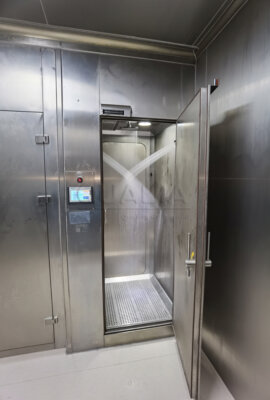
The chemical shower is embedded in a multi-room airlock sequence: suit room on the clean side, chemical shower chamber, and the BSL-4 laboratory space on the hot side. The chamber’s decontamination function depends on that sequence operating as designed — including pressure relationships between zones, the timing of door interlocks, and the physical layout that determines how an operator moves through the doffing train without re-contaminating surfaces or themselves. A chamber selected on the basis of internal features alone, without reference to where it sits in that sequence and what the SOP requires on either side, frequently creates spatial mismatches or workflow conflicts that cannot be resolved by modifying the chamber after installation.
A common version of this problem is a chamber that is specified with adequate spray coverage but sized or oriented in a way that makes the required operator movements during the spray cycle physically awkward or impossible. If the exit SOP requires the operator to rotate 360 degrees, raise both arms, and remain in position for a defined dwell period, the internal chamber dimensions and the position of the air hose connection point — if the suit is still pressurized during the shower — must accommodate that sequence. If those constraints are not defined in the user requirements before chamber procurement, the gap surfaces during installation and cannot be corrected without structural modification.
The relationship between the shower room drain and the facility’s effluent decontamination system is another SOP-fit dependency that is easy to defer and expensive to resolve late. Disinfectant-laden rinse water must be directed to an appropriate collection or treatment pathway; the drain specification, floor slope, and containment boundary at the shower room threshold must all be addressed in the facility design before the chamber is placed. More detail on how the full BSL-4 exit procedure fits together across the airlock sequence is covered in this overview of BSL-4 entry and exit critical safety procedures.
Design Acceptance Requires Coverage, Drainage And Doffing Evidence
A chamber specification document is not acceptance evidence. Acceptance requires demonstrated performance against the conditions that will govern actual use — coverage across representative operator postures and movements, chemical delivery at the concentration and flow rate specified in the SOP, drainage capacity sufficient to prevent pooling that could affect the exit path or the doffing threshold, and confirmed compatibility with the doffing sequence that follows. None of those confirmations can be substituted by manufacturer documentation alone.
Annual verification requirements under CDC BMBL guidance establish that decontamination system performance is not a fixed property confirmed at commissioning — it is a maintained condition that must be re-confirmed on a defined schedule and after any major system change. Critically, that re-confirmation must demonstrate that operational parameters have not drifted from the conditions under which the system was biologically validated. A spray nozzle that partially occludes over time, a pump that delivers lower flow at higher backpressure, or a conductivity monitor that has lost calibration can each produce parameter drift that the chamber’s physical appearance would not reveal.
| Verification Requirement | When to Perform | What to Confirm |
|---|---|---|
| Chemical shower delivery system (delivery components, conductivity, alarm monitoring) | Annually | System is operating as designed |
| Operational parameters vs. biologically validated conditions | Annually | No departure from previously validated conditions |
| Decontamination system documentation | Initially, annually, and after major changes | Facility verification documentation is maintained and reflects current status |
The consequence of undocumented drift is not just a compliance finding. If an incident occurs during or after an exit event, and the facility cannot demonstrate that the chemical shower was operating within validated parameters at the time, the investigation cannot establish whether the decontamination step was effective. That evidentiary gap is the practical meaning of the verification obligation — it is a defensibility requirement, not a documentation formality. Teams preparing initial acceptance packages should treat the annual verification scope as a preview of what the baseline documentation must establish, because the annual check can only confirm that parameters are unchanged if the initial conditions were recorded with sufficient specificity to allow that comparison.
Matching a chemical shower to a BSL-4 suit laboratory exit procedure is fundamentally a sequencing and interface problem, not a chamber specification problem. The decisions that determine whether the design is defensible at acceptance — and remains defensible over time — are made upstream: in how coverage zones are defined against real operator movement, how the disinfectant and rinse phases are specified in relation to suit material compatibility, and how the chamber fits the spatial and procedural logic of the full doffing train. Those decisions cannot be delegated to equipment selection alone.
Before closing the design, confirm that the acceptance package captures coverage evidence from representative movement conditions, documents chemical delivery and drainage performance against SOP parameters, and establishes a baseline specific enough to support annual re-verification. If any of those elements is deferred — with the expectation of addressing it after installation — the friction will appear at procedure approval or at the first annual verification, at a point where the cost of correction is substantially higher than resolving it during design.
Frequently Asked Questions
Q: Does this guidance apply if the facility uses a chemical shower integrated into a modular BSL-4 unit rather than a purpose-built fixed laboratory?
A: Yes, the same requirements apply regardless of whether the chamber is embedded in a modular or fixed facility — because the critical dependencies are procedural and spatial, not structural. The coverage validation logic, SOP sequencing, suit material compatibility checks, and doffing train layout must all be resolved against the actual operator workflow in either configuration. A modular BSL-4 build does not reduce the verification scope; it shifts where the interface decisions need to be made during procurement and layout planning.
Q: Once the initial acceptance package is complete, what should the team do first to prepare for annual re-verification?
A: Record the baseline operational parameters with enough specificity that future checks can confirm they are unchanged — not just that the system is functioning. This means documenting exact nozzle flow rates, disinfectant conductivity readings, pump delivery pressure, and alarm set points at the time of commissioning validation. Annual re-verification can only demonstrate parameter stability if the initial conditions were captured at that level of detail. Teams that document commissioning in general terms often find the first annual check generates ambiguous results with no reliable baseline to compare against.
Q: At what point does extending disinfectant dwell time stop improving decontamination outcomes and start creating more risk than it resolves?
A: There is no universal threshold, but the limiting factor shifts from microbial efficacy to suit material degradation and operator burden well before decontamination gains become marginal. Extending dwell beyond what is needed for the validated log-reduction target increases cumulative chemical exposure to suit seams, glove attachment points, and visor materials — accelerating integrity concerns that may not appear until the suit is deep in service. The practical boundary is set by the suit manufacturer’s compatibility data for the specific disinfectant formulation and concentration in use, not by a general confidence that longer exposure is safer.
Q: How does the chemical shower approach compare to vaporized hydrogen peroxide decontamination for BSL-4 suit exit?
A: Chemical shower and VHP serve different operational profiles, and the article’s guidance does not apply to VHP systems without significant modification. A chemical shower accommodates an occupied operator in real time, with coverage requirements driven by suit posture and movement during exit. VHP is typically applied to unoccupied spaces or equipment and requires full room evacuation and aeration cycles incompatible with a live exit sequence. For suit laboratory exit, the shower remains the dominant method precisely because it works with an operator present; VHP is more relevant to room decontamination between uses or to equipment passthrough chambers rather than to the doffing train itself.
Q: Is a chemical shower alone sufficient for a BSL-4 suit laboratory exit, or does the overall containment strategy require additional decontamination elements?
A: A chemical shower is a necessary component of the exit sequence but is not sufficient on its own. The article identifies sole decontamination as a coverage zone that nozzle arrays may not reliably address, requiring a supplemental dunk bath in some facilities. Beyond that, the personal body shower after suit doffing, pressure relationships between airlock zones, and door interlock sequencing are all part of the containment chain that a chemical shower sits within. Treating the chamber as a standalone decontamination event — rather than one step in a linked exit sequence — is the condition under which the overall strategy is most likely to develop undetected gaps.