
Many BIBO commissioning programs reach QA review with a clean aerosol penetration number and nothing else — no housing seal verification, no damper position records, no scan access protocol. When an auditor or biosafety reviewer asks why the documentation covers only filter media performance and not the full housing boundary, the answer is usually that those checks were assumed rather than performed. Recovering from that position means re-scoping the test, returning the system to a challengeable state, and repeating work under schedule pressure that was already tight. The judgment that prevents this is recognizing early that filter-level integrity and housing-level containment are two separate verification scopes, and that a defensible test record must cover both. Practitioners who understand where each component can independently fail — and what documentation QA will ask for at release — are in a materially better position to scope testing correctly before the first challenge aerosol is introduced.
Why filter-media testing alone does not prove full containment
A HEPA filter that passes aerosol penetration testing can still sit inside a housing that is actively leaking. The filter media may be physically intact and performing at rated efficiency, but if the frame-to-duct interface is unsealed, contaminated air has a direct bypass path that the downstream photometer never sees. A gap as small as 10 mm between filter frames can degrade effective system filtration from the MERV 15 range down to approximately MERV 8 — not because the filter failed, but because the housing was never part of the verification scope. That magnitude of performance loss would be clinically significant in any containment-critical application, and it produces no signal at the filter media level.
The second failure mode is subtler and embedded in the test method itself. Conventional manual scan testing requires a probe to penetrate the housing pressure boundary — an action that, if not tightly controlled in the protocol design, can create a new contaminant pathway at the exact moment the test is meant to verify that none exist. This does not make scan testing invalid, but it does mean that the test protocol is not a neutral instrument. A poorly specified scan procedure generates a containment risk concurrent with the challenge, which is why protocol design — including how scan access is managed and how pressure boundary integrity is maintained during the test — carries the same weight as the acceptance threshold itself.
The practical implication for scoping decisions is that housing-level integrity is a non-redundant verification scope. Passing filter media tests does not subsume it, and running the two checks sequentially without documenting both leaves the commissioning package incomplete in a way that is difficult to defend under GMP or biosafety review.
| Failure Risk | Why It Matters | What to Verify |
|---|---|---|
| 10 mm gap between filter frames | Can reduce effective filtration from MERV 15 to MERV 8, bypassing the HEPA media. | That housing and frame seals are included in the integrity test scope, not just the media. |
| Manual scan testing probe penetrating the housing | The testing method itself can become a pathway for contaminant escape, compromising containment. | That the testing protocol controls for or eliminates invasive probe pathways during the challenge. |
DOP and PAO challenge methods used for HEPA integrity verification
The core method for HEPA integrity verification — upstream aerosol challenge with downstream penetration measurement — is straightforward in concept but operationally sensitive in execution. A controlled aerosol, historically dioctyl phthalate (DOP) and now more commonly polyalphaolefin (PAO), is introduced upstream of the filter. A photometer or particle counter then measures what penetrates downstream. IEST-RP-CC001 provides the testing framework that governs how this method should be structured and what constitutes a valid challenge, and practitioners should treat it as the reference point for both method design and acceptance threshold selection.
DOP and PAO are not fully interchangeable without qualification. PAO has become the dominant choice in pharmaceutical and containment settings because it avoids the toxicological concerns associated with DOP, but the transition is a practical industry shift rather than a universal regulatory mandate. The more consequential distinction is concentration and instrument sensitivity: the aerosol must be introduced at sufficient concentration to be detectable downstream at the penetration levels the standard is testing for, and the photometer must be calibrated and confirmed sensitive at those levels before any challenge result is recorded as valid. A challenge run with an under-concentrated aerosol or an out-of-calibration instrument does not produce a defensible integrity result — it produces data that looks like a pass and is unusable for QA documentation purposes.
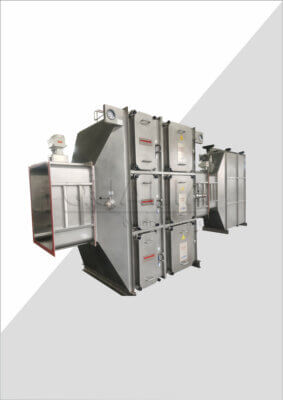
For BIBO systems, aerosol challenge introduces an additional procedural constraint: the upstream injection point and downstream sampling path must both be accessible without compromising the bag-in/bag-out boundary. Where that access is not designed into the housing, the test cannot be performed without intervention that itself creates a containment risk. Confirming that the housing design supports repeatable, boundary-preserving aerosol challenge should be a commissioning precondition, not a discovery made during first test setup.
It is also worth distinguishing the aerosol penetration test from operational particle monitoring. ISO 14644-3:2019 establishes test methods for cleanroom and clean air device classification, including airborne particle concentration measurements, and particle counting results produced during integrity testing must be comparable against its classification requirements for the documentation to be linkable to a formal standard. These are separate measurements serving separate purposes; running one does not substitute for the other.
Housing seals, scan access, and damper positions to verify during testing
Before the aerosol challenge begins, three categories of physical verification should be completed and documented: joint sealing, gasket condition and position, and damper isolation. Each creates an independent bypass pathway if left unverified, and each is capable of producing a false-pass result on filter media that is performing correctly. The consequence logic is straightforward — challenge aerosol that bypasses the test section entirely will not be detected downstream regardless of filter condition, and a clean photometer reading in that scenario reflects routing, not filtration.
Joint sealing between filter frame banks and ductwork is the highest-volume bypass risk. Unsealed or inadequately gasketed joints allow air to travel around the filter assembly rather than through it. Gasket checks are more specific: the gasket between the last filter and the filter bank door is a common point of bypass leakage when installation is rushed or the door is not seated under proper compression. Adjacent-filter gaskets within a bank carry the same risk at a smaller scale. Neither failure is visible during operation, and neither produces a pressure drop signal that would prompt investigation under normal monitoring.
Damper isolation is the most procedurally consequential check. If isolation dampers are not confirmed in the correct position before the aerosol challenge, the test section may not be properly bounded — challenge aerosol can travel into adjacent duct paths or return before reaching the downstream measurement point, producing concentration data that does not reflect the actual filter. Confirming damper position is not a secondary step; it is part of defining what the test is measuring.
| Component | Checkpoint | Why It Matters |
|---|---|---|
| Joints between filter frame banks and ductwork | Verify they are caulked or gasketed to provide a positive seal. | Unsealed joints are a primary air leakage path that can completely bypass the HEPA filter. |
| Gaskets | Check installation between the last filter and the filter bank door, and between adjacent filters in a bank. | These are specific, high-risk seal points where bypass leakage commonly occurs. |
| Isolation dampers | Confirm positions are set to effectively shut off and isolate the filter tier being tested. | Incorrect damper position can allow challenge aerosol to bypass the test section, leading to false integrity results. |
For detailed comparison of how these physical verification requirements translate into BSL-rated ventilation systems, the ANSI/ASSE Z9.14 ventilation verification framework provides useful parallel context, particularly on damper and housing boundary confirmation before challenge testing.
Acceptance criteria, deviations, and re-test triggers after intervention
Acceptance criteria for BIBO integrity testing operate at two levels: the aerosol penetration threshold for filter media, and the pressure drop range that confirms installation integrity and operational condition. Both must be within spec for the commissioning record to be complete, and a deviation on either triggers a defined response — not just notation.
On pressure drop: an initial reading significantly below manufacturer specifications is a deviation indicator, not a data point to trend. It flags a probable installation flaw — an unsealed frame, a mis-seated gasket, or a bypass path that is lowering resistance across the filter assembly. The appropriate response is investigation and correction before any penetration test result is recorded, because a penetration test conducted on a mis-installed filter is not a valid integrity test of the intended system configuration. Conversely, a pressure drop that reaches double its initial clean value is a standard operational threshold indicating filter loading sufficient to trigger replacement. This 2× figure is a widely applied industry trigger rather than a universally mandated regulatory limit, and the specific threshold should be confirmed against the manufacturer’s specifications for the installed filter and the equipment design parameters.
After any intervention — filter replacement, housing maintenance, seal repair, or damper adjustment — the integrity test must be repeated in full. The principle is that intervention invalidates the prior integrity baseline; it does not extend it. This is where operations and QA most often disagree under schedule pressure. Operations may treat a seal repair as a minor correction that preserves the previous test result; QA will typically require a complete re-test because the housing has been opened and the prior boundary condition cannot be assumed to have been restored exactly. Treating re-test as the default trigger after any boundary-penetrating intervention is the position that is defensible under GMP review, and it is the one that experienced validators apply consistently.
| Trigger Condition | Why It Matters | Evidence / Note |
|---|---|---|
| Filter pressure drop reaches double its initial clean value | Indicates filter loading and is a clear trigger for filter changeout and subsequent re-testing. | Pressure drop = 2x initial value |
| Initial pressure drop measurement significantly below manufacturer specifications | Flags a potential installation flaw that compromises containment, requiring investigation and re-test after correction. | Deviation from specified installation performance baseline. |
The deviation handling record is as important as the re-test result. An out-of-limit finding that is investigated, corrected, and re-tested with a documented rationale is a stronger QA artifact than a first-pass result with no deviation trail — because it demonstrates that the acceptance decision was deliberate and traceable, not just the absence of a failure signal.
Test records QA and commissioning teams expect to review
The documentation gap that most often delays system release is not a missing test — it is a test that was performed without the supporting records needed to make the result usable for QA review. Raw data without instrument calibration records, or calibration records without traceability to a recognized standard, creates a documentation package that looks complete but cannot support an acceptance decision. The same applies to pressure drop readings recorded without the manufacturer’s specified range noted alongside them, or particle counting results that are not linked to a formal classification requirement.
Pressure drop records must capture the measured value and confirm it falls within the specified range for the installed filter under the documented operating conditions. This serves two functions: it establishes the post-installation baseline for ongoing monitoring, and it provides the reference point against which future readings will be compared to identify when the 2× threshold is being approached. A pressure drop record that notes only the measured value without the acceptance range is incomplete for both purposes.
Particle counting results from integrity tests must be documented in a format that allows direct comparison against ISO 14644-3:2019 classification requirements. This linkage is what allows QA to make an objective pass/fail determination based on a recognized standard rather than a judgment call. Raw counts without the classification comparison leave the acceptance decision undocumented even if the underlying data would support a pass.
| Record Type | Acceptance Criteria | Why It Matters |
|---|---|---|
| Pressure drop across the filter | Must be recorded and confirmed within the acceptable specified range. | Provides a baseline for ongoing monitoring and a check against installation/operational issues. |
| Particle counting results | Must be documented and compared against ISO 14644 classification requirements. | Linking raw data to a formal standard is essential for QA to objectively assess pass/fail status and system cleanliness. |
Calibration records for every instrument used in the test — photometers, particle counters, pressure transducers, airflow measurement devices — must be current at the time of testing and traceable to a recognized calibration standard. An out-of-calibration instrument invalidates the test data regardless of the result, and this is one of the first things an auditor will check when reviewing a commissioning package. Instrument calibration is not a background administrative item; it is part of the integrity evidence.
Documentation package for ongoing requalification of a BIBO section
Initial commissioning documentation establishes the baseline. Requalification documentation demonstrates that the baseline has been maintained — or, where it has not, that the deviation was identified, investigated, and resolved with a return to an accepted state. The two packages serve different functions, and a requalification record that simply reproduces the commissioning test format without addressing what has changed since last qualification is not a strong lifecycle document.
EudraLex Volume 4 Annex 15 provides the qualification and validation framework that governs how requalification activities should be structured in GMP-regulated environments: calibrated instruments, standardized protocols, maintained records, and documented rationale for the requalification scope. It does not prescribe specific BIBO test intervals or define filter changeout procedures, but it establishes the principles that any requalification package needs to satisfy — repeatability, traceability, and evidence that acceptance criteria were applied consistently and deliberately.
The HEPA filter changeout SOP is a lifecycle documentation deliverable that is frequently underweighted at commissioning. It should define PPE requirements, containment procedures for the bag-in/bag-out operation itself, the sequence of verification steps before and after the filter is exchanged, and the re-test protocol that restores the documented integrity baseline. This document controls the highest-risk single intervention in the system’s operational life, and its absence from the documentation package is a finding in both GMP and biosafety reviews. For facilities using in-situ filtration configurations, the changeout SOP must also address how in-place decontamination is verified before the housing boundary is opened, since filter integrity and safe removal must be treated as parts of a single controlled system rather than sequential independent tasks.
Requalification intervals should be defined in the SOP based on the system’s containment classification, the hazard level of materials handled, and the operational conditions that affect filter loading and seal integrity — not adopted from a generic schedule. A requalification that happens on a fixed calendar interval without reference to operational history or trigger events provides weaker evidence of maintained performance than one driven by documented criteria. The requalification protocol, the raw data, the calibration records, and any deviation handling should be maintained together in a retrievable format that supports both internal review and external audit without reconstruction.
The central judgment in BIBO integrity testing is that the housing boundary and the filter media are separate verification scopes, and that evidence of media performance does not substitute for evidence of housing integrity. A commissioning package that documents only the aerosol penetration result is incomplete in a way that may not be visible until QA review or a biosafety audit creates pressure to expand scope after the fact — at which point the cost is re-testing, potential system downtime, and a deviation record that begins with an avoidable documentation gap.
Before releasing a BIBO section or preparing a requalification submission, practitioners should confirm that the test record covers: the housing seal and gasket verification completed before the challenge, the damper positions documented at the time of test, the aerosol method and instrument calibration status, the pressure drop baseline against the manufacturer’s specified range, particle counting results linked to the applicable ISO 14644-3:2019 classification, and a complete deviation trail for any out-of-limit finding. If any of those elements is missing, the acceptance decision rests on incomplete evidence — and the gap is more likely to surface at the worst possible moment than to go unnoticed.
Frequently Asked Questions
Q: Does the BIBO housing design itself affect whether aerosol challenge testing can be performed without creating a containment risk?
A: Yes — and this should be confirmed before commissioning begins, not during first test setup. If the housing does not have designed-in upstream injection points and downstream sampling access that preserve the bag-in/bag-out boundary, performing the aerosol challenge will require an intervention that itself creates a contaminant pathway. A housing configuration that cannot support repeatable, boundary-preserving challenge should be treated as a design issue requiring resolution before any integrity baseline is established.
Q: At what point does a seal repair or damper adjustment count as an intervention that requires a full re-test rather than just a notation in the deviation record?
A: Any action that opens or disturbs the housing pressure boundary — including seal repair, gasket replacement, damper adjustment, or filter changeout — invalidates the prior integrity baseline and requires a complete re-test. The prior test result cannot be extended on the basis that the repair was minor. The defensible position under GMP review is that the boundary condition before and after intervention cannot be assumed identical unless a fresh integrity test confirms it, and experienced validators apply this consistently regardless of how limited the scope of the intervention appears.
Q: How does the requalification documentation need to differ from the original commissioning package to be considered a credible lifecycle record?
A: Requalification documentation must address what has changed since the last qualification — operational history, any deviation or intervention events, and whether the prior baseline remains valid — rather than simply reproducing the commissioning test format. EudraLex Volume 4 Annex 15 requires that requalification activities demonstrate repeatability, traceability, and consistent application of acceptance criteria. A package that lacks this context and simply restates commissioning-era results without linking them to current system condition provides weaker lifecycle evidence and is more likely to attract findings during a GMP or biosafety audit.
Q: Is a BIBO system with fixed periodic requalification intervals sufficient, or does operational history need to drive the requalification schedule?
A: A fixed calendar interval alone is a weaker basis for requalification than a schedule driven by documented criteria. Requalification intervals should reflect the system’s containment classification, the hazard level of materials handled, filter loading conditions, and any trigger events such as interventions, deviations, or operational excursions. A requalification that occurs purely on a calendar cycle without reference to these factors cannot demonstrate that the timing was risk-appropriate, which reduces its value as evidence of maintained performance under sustained audit scrutiny.
Q: When a low initial pressure drop reading is flagged as a deviation, is it acceptable to proceed with the aerosol penetration test while the investigation is still open?
A: No — a penetration test conducted on a potentially mis-installed filter does not constitute a valid integrity test of the intended system configuration. A pressure drop reading significantly below manufacturer specifications indicates a probable installation flaw such as an unsealed frame, mis-seated gasket, or bypass path. The correct sequence is to investigate and correct the installation condition first, then perform the aerosol challenge on the verified configuration. Recording a penetration result before the installation deviation is resolved produces data that cannot be defended as a meaningful acceptance finding.
Related Contents:
- What Causes Pressure Drop in Bio-safety Dampers?
- BSL-3 Aerosol Studies: Safe Research Practices
- BIBO Housing Design for Negative Pressure Exhaust: What Engineers Must Define Early
- Bag In Bag Out Systems for BSL-3 Labs: How to Specify Safe Containment Changeout
- Essential BIBO System Maintenance Checklist
- Class III Biosafety Cabinet HEPA Filter Integrity Testing: DOP and PAO Test Procedures Explained
- Bag-In-Bag-Out Housing Applications in Pharmaceutical Manufacturing
- What Are the Key Workflow Steps in Animal BSL-3 Laboratory Aerosol Risk Management?
- How to Write a URS for a BIBO System in GMP and Biosafety Projects