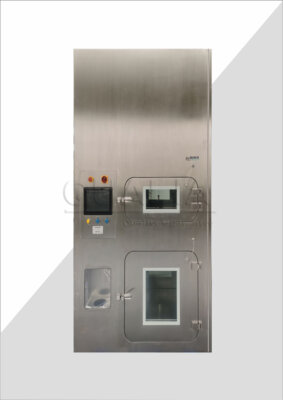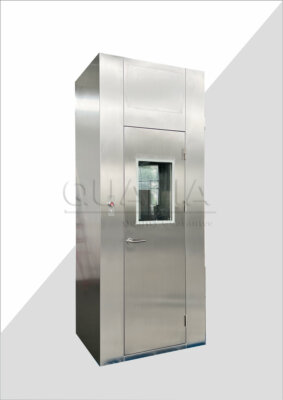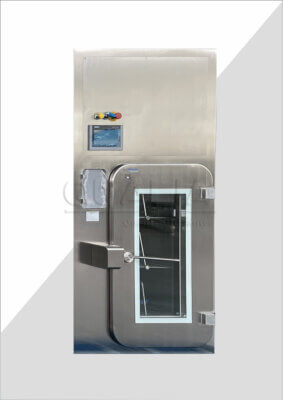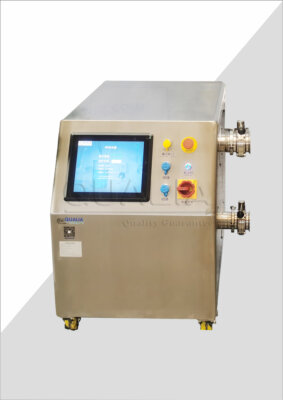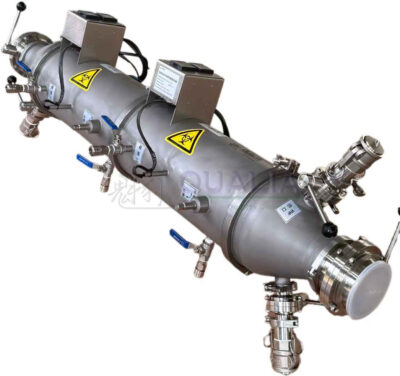

A single final HEPA bank is the base case for hazardous pharmaceutical exhaust wherever the hazard assessment and the project’s design basis allow it, and the second bank in series is carried as a conditional addition where the consequences of a particularly hazardous discharge justify a further filtration stage. WHO GMP guidance for pharmaceutical products containing hazardous substances treats two HEPA banks in series as conditional in exactly that sense, rather than as a standing requirement. The practical consequence for the project basis is that the Single vs Double In-Situ HEPA decision is set by discharge consequence first, and only afterward by resistance, monitoring and service access — with one exception worth settling early: if the applicable project criteria already specify two banks, two is the base and the open questions become how they are installed, monitored and tested.
Set the hazard basis for one or two final HEPA banks
| Project basis | Configuration to evaluate | What to carry into design review |
|---|---|---|
| One final bank is permitted by the hazard assessment and design basis | Single final HEPA bank | Confirm loaded resistance at duty airflow and installed test access for that bank |
| Particularly hazardous pharmaceutical discharge justifies an added filtration stage, or project criteria call for two | Two HEPA banks in series | Compare total loaded resistance and map the monitoring and test boundary for each required result |
The bank count follows from what leaves the stack if a filtration stage underperforms, not from how dirty the air is on the way in. Price the single final bank as the base where the hazard assessment and the applicable design basis permit it, and carry the series option as a priced alternative where the discharge consequence is severe enough to warrant a second stage of filtration. That gives the design review a real comparison instead of a configuration chosen by habit.
Functionally, the two arrangements differ in what a single stage failure means. With one bank, the installed leakage test on that bank is the only barrier between the process air and the discharge point, so its integrity result carries the whole decision. With two banks in series, filtration is applied twice to the same airstream, so a defect in one stage is partially covered by the other — at the cost of a second set of resistance, a second monitoring boundary and a second test access requirement.
Where project criteria already fix the count at two, the useful engineering effort moves to the installation details: whether each bank has its own pressure indication, whether each can be leak-tested as installed, and whether the housings allow safe-change filter removal consistent with the project’s maintenance approach. Those details decide whether the second bank is a verifiable stage or simply added pressure drop.
Separate discharge protection from dust loading and service continuity
Three different problems get solved by three different pieces of equipment, and conflating them is how projects end up with a configuration nobody can justify. A second HEPA bank adds a filtration stage in series. Prefiltration upstream protects the first HEPA bank from particulate loading. A separately isolatable path, where one exists, is what allows the exhaust to keep running while a bank is out of service. None of the three substitutes for either of the others.
When the stated reason for adding the second bank is that the first one loads too fast in dusty service, treat that as a prefiltration and dust-source question and resolve it on its own. WHO guidance for hazardous-substance manufacture describes upstream prefilters for dusty air precisely because loading is a loading problem. Change the prefilter arrangement or reduce dust carryover at source, then set the HEPA stage count on discharge risk. Mixing the two obscures the purpose of the added resistance: the second bank is bought as filtration, not as a loading buffer, and a reviewer who sees it listed under loading cannot tell what it is meant to achieve.
Service continuity is a third and separate check. Two stages in series normally sit in the same airflow route, so taking either one out of service interrupts the same path. If the requirement is that the exhaust keeps running while a filter bank is isolated, ask for a service-state airflow diagram showing the separately isolatable path and the pressure relationship the system can sustain in that state. A diagram that only shows the normal operating case does not answer the question, because the relevant condition is the one with a bank valved out. Whether a given service state is acceptable for the room it serves is a decision for the project’s approved procedure and its designated approver, not something a configuration drawing settles by itself.
Compare resistance over the same operating range
Two offers quoting the same design airflow are not comparable until the resistance figures sit on the same clean and loaded basis. Series stages add resistance, so a double-bank arrangement inevitably asks more of the fan than a single bank moving the same air volume through comparable media. The question is not whether resistance rises, but whether the fan selection still delivers the required airflow at the end of the planned service interval.
A clean-filter pressure figure is the easiest number to quote and the least useful for sizing. Filters gain resistance as they load, and the airflow the system must maintain is the airflow at the loaded condition, not at first start-up. Ask both suppliers to state the loaded resistance basis they used — the change-out differential they assumed for each stage — and compare total path resistance at that agreed basis, including prefilters, dampers, ductwork allowance and the housing itself. If the two offers assumed different loading allowances, the headline pressure difference between them is partly an assumption difference, not an equipment difference.
Then check fan margin explicitly at the required airflow under that loaded condition. A fan sized with comfortable margin on clean filters can sit close to its limit once two HEPA banks approach change-out, and the first symptom is airflow falling below the design value while everything still appears to be running. For containment exhaust, falling airflow changes the pressure relationships the room depends on, which is why the margin question belongs in the technical comparison rather than in commissioning.
As an illustrative comparison, assume two offers for the same duct run and the same duty airflow: one with a prefilter and a single final HEPA bank, one with a prefilter and two HEPA banks in series. If both quote only clean pressure drop, the second looks modestly worse. If both are restated at an agreed loaded condition for every stage, the gap widens, because each HEPA stage contributes its own loading allowance. The assumptions here are stated, not measured; the point is that the ranking between offers can shift once the loading basis is made common.
Check what can be measured and tested at each bank
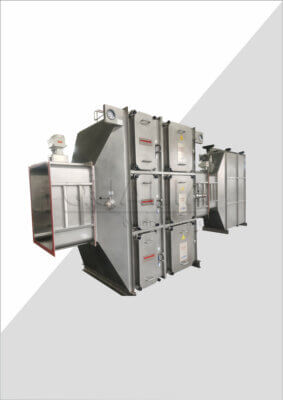
A double-bank housing is only a two-stage design in practice if each bank can be monitored and tested as a distinct boundary. WHO hazardous-substance guidance describes pressure monitoring across filter banks and installed test access as part of the arrangement, so the useful question for an offer is which physical result each access point and each gauge actually produces.
Where a double-bank offer shows one pressure display, that reading combines the resistance of both stages. A combined figure tells you when total resistance has risen, which is useful for scheduling, but it does not tell you which bank is loading or whether one stage is bypassing. If the project needs to know when an individual bank reaches change-out, each bank needs its own differential indication across it, and that is a specification item with a cost, not an assumption.
The same applies to installed leakage testing. Scan or challenge testing needs an injection point upstream of the bank under test and an access position downstream of it, inside the housing geometry. Access provided only at the housing exterior may place both banks inside a single test boundary, so the method proves the combined boundary and cannot separate a defect in the first bank from one in the second. Ask the supplier to map every reading and every installed test position to the specific bank or combined boundary it represents, and to price any additional access the project requires as a separate line.
That mapping also shapes maintenance. Safe-change filter removal through a bag-in/bag-out housing, the sequence for isolating a bank, and whether the downstream bank remains protected during the upstream change are all questions the same drawing should answer. Acceptance of any installed test result, and any return of a bank to service after filter replacement, is governed by the project’s approved procedure and the approver named in it.
Review biosafety laboratory exhaust on its own design basis
Biosafety laboratory exhaust does not inherit the hazardous-pharmaceutical configuration logic, and transferring a commercial arrangement between the two is where projects acquire requirements nobody can trace. The WHO condition for two HEPA banks in series sits in pharmaceutical manufacture of hazardous substances. The CDC/NIH BMBL describes HEPA or equivalent filtration and filter testing for certain BSL-3 primary-barrier exhaust, which is advisory guidance limited to that primary-barrier context and not a general statement about laboratory exhaust stage count.
So for a laboratory project, resolve three things before any configuration is carried across: which exhaust stream is in question — primary barrier exhaust from a cabinet or isolator, or general room exhaust; which containment scenario the filtration is protecting against, including what the room pressure relationships must do during a filter change; and which criteria actually apply to the facility, whether that is the biosafety manual, a national requirement, or a client specification that already fixes the arrangement. Only then does the bank count question become answerable, and the answer may differ from the pharmaceutical case for reasons that have nothing to do with resistance.
Once the arrangement is set, it still has to be converted into separate verifiable checks: filter integrity testing at each defined boundary, duct leakage testing of the containment ductwork, and physical access for safe filter change through bag-in/bag-out housings. Those are three distinct acceptance activities with different methods and different evidence, and an arrangement that satisfies one can obstruct another — a housing that passes a leak test can still leave no room to operate a change bag.
For a productive conversation with a supplier about in-situ filtration housings, have the exhaust stream and its hazard basis defined, the duty airflow with the loaded resistance allowance you intend to use, the room pressure relationships that must hold during normal operation and during a bank isolation, and the list of installed tests and qualification evidence the project will require at each bank. With those in hand, the drawing you get back can be checked against the design basis rather than against a generic layout.
Frequently Asked Questions
Q: Can I ask for a price for the second bank before the design basis is final?
A: Yes, as a conditional alternate. Give both offers the same duty and ask the bidder to show changes to the footprint, resistance and test arrangement so you can evaluate the alternate if the hazard basis calls for it.
Q: Does a second final bank automatically mean that both filters should be changed together?
A: Set the service scope from the condition of each bank and the project’s isolation and handling arrangement. The two filters can share a housing without giving you the same service evidence or access for each.
Q: What if one bidder gives a total pressure drop and another reports each bank separately?
A: Ask both for data covering the same complete path at the same airflow and load condition. Keep any bank-level data separately for service evaluation, and flag an offer as unresolved if you cannot align the total basis.