Facilities that attempt to satisfy EU GMP Annex 1 and the WHO Laboratory Biosafety Manual with a single shower room often discover the conflict only after rooms are built and equipment is specified — at which point the options are a costly redesign, a validation problem that documentation alone cannot solve, or an SOP that will draw findings from at least one inspection team. The mistake is not choosing the wrong shower unit; it is treating the shower room as a shared-purpose space when the two frameworks impose directionally opposite requirements on it. Resolving that conflict requires understanding what each framework is actually trying to control, where the contamination vectors differ, and what evidence each inspectorate will expect to see in the file. What follows gives you the grounding to judge whether your current design and documentation can satisfy both frameworks — or whether you are carrying a compliance gap that will surface at the worst time.
EU GMP Annex 1 personnel shower requirements: the contamination control rationale and what the 2022 revision changed
The 2022 revision of EU GMP Annex 1 reinforced a contamination control strategy framework that requires manufacturers of sterile medicinal products to document and justify every element of how contamination is prevented from entering — and leaving — a Grade A or B environment. Personnel exit airlocks with appropriate change and shower facilities are part of that strategy, but the rationale is often misread. The GMP concern at exit is not decontaminating the person; it is preventing the person from carrying product residues, viable microorganisms, or drug substance out of the controlled environment into adjacent spaces. The direction of control is inward: the shower exists to contain what is inside the classified zone, not to neutralize what the person may have been exposed to.
This distinction matters for equipment selection and SOP logic. Air showers designed for GMP cleanroom entry use high-velocity air to dislodge particles from personnel before they enter the controlled environment. At the exit boundary, the contamination control rationale runs in the same structural direction — preventing egress of product-associated contamination — but the agent of concern is different. Some programmable air shower configurations offer a two-way operating mode that activates a different protocol on exit, which is worth evaluating as an equipment-level option. That capability is a planning criterion, not a mandated GMP requirement; the 2022 revision does not prescribe shower technology, it prescribes a documented contamination control strategy that must be justified for the specific facility.
The practical implication of the 2022 revision for facilities already operating under the previous version is that contamination control strategy documentation must now be more explicit about rationale, not just procedural steps. An SOP that describes what happens in the exit airlock without explaining why — specifically, what contamination vector is being addressed and how the shower interrupts it — is harder to defend under the current framework. If your exit shower SOP was written against the pre-2022 revision and has not been reviewed against the current contamination control strategy language, that is a defensibility gap worth closing before your next inspection.
WHO LBM 4th Edition exit shower requirements: the decontamination rationale and what risk-based flexibility exists
The WHO Laboratory Biosafety Manual 4th Edition approaches the exit shower from an entirely different problem. At BSL-3 and BSL-4, the shower is a decontamination step targeting biological agents present on the surface of PPE or pressurized suits. The person is the contaminated object, and the shower exists to neutralize or remove viable pathogens before the worker re-enters the general laboratory or exits the containment zone. The direction of control is outward: the chemical shower is on the exit route, and its function is to interrupt the outward movement of the agent.
The WHO manual’s risk-based flexibility does not mean the requirements are soft. Facility-specific validation of the decontamination process is the compliance driver, and generic adoption of a published protocol without site-specific evidence will not satisfy the licensing requirements for BSL-4 operations. A commonly referenced validated protocol uses a 2-minute chemical shower with 5% Micro-Chem Plus followed by a 3-minute water rinse, but this is one documented example — not a WHO-mandated universal minimum. What the manual requires is that the chosen method be validated under in-use conditions using biological or chemical indicators, with measurement of remaining biological agents against the detection limit.
The validation burden is more material-specific than teams often anticipate. Representative load testing must account for the different surfaces on the suit — fabric panels, the visor, and boot material — because porosity and surface chemistry affect how well the chemical agent penetrates and deactivates the target organism. A validation study that tests only one material type, or that uses clean coupons rather than coupons laden with dried virus in organic soil, is not producing evidence that will hold up against the representative load standard.
| Аспект | Requirement/Protocol Example | Compliance Evidence Needed |
|---|---|---|
| Validated Protocol | 2-minute chemical shower with 5% Micro-Chem Plus, followed by a 3-minute water rinse. | Facility-specific validation under in-use conditions. |
| Перевірка ефективності | Measurement of remaining biological agents against the detection limit. | Testing with biological/chemical indicators. |
| Representative Load Testing | Validation must account for different suit materials and real-world soil. | Evidence from testing on coupons (fabric, visor, boot) laden with dried virus in organic soil. |
The risk-based flexibility in the WHO framework operates at the protocol selection level — facilities have latitude to select a decontamination agent and contact time appropriate to their specific agents — but it does not extend to the validation evidence requirement. Choosing a different chemical or a different contact time does not reduce the obligation to prove efficacy under in-use conditions specific to your facility, your suits, and your agents.
The directional conflict: how GMP contamination control and biosafety decontamination create opposing flow requirements in the same shower room
The conflict is structural, not procedural. GMP contamination control is oriented inward: the shower at the exit boundary exists to keep product-associated contamination from leaving the controlled zone. BSL-4 biosafety decontamination is oriented outward: the chemical shower on the exit route exists to neutralize biological agents on the suit before the worker moves into a less controlled space. Both frameworks use a shower at a controlled boundary, and both use the shower as a contamination break — but the agent being controlled moves in opposite directions.
When a facility is subject to both frameworks, the same physical shower room is being asked to perform both functions. A GMP inspector reviewing exit airlock SOPs will look for evidence that the shower prevents product contamination from leaving. A biosafety inspector reviewing the same room will look for evidence that the chemical shower decontaminates the suit before exit. Neither framework is wrong, and neither is simply a subset of the other. The tension is that a single shower SOP written to satisfy one direction of control will be missing the conceptual and evidentiary foundation for the other.
This is not primarily an equipment problem. Modern shower units can be configured with programmable protocols — some offer two-way operating modes capable of running different sequences for entry and exit — and that technical flexibility can support different directional protocols in the same physical unit. But equipment capability alone does not resolve the conflict. The SOP must be structured to address both control directions explicitly, the validation evidence must satisfy both frameworks’ standards for proving efficacy, and the documentation must be legible to both inspection teams. A programmable shower with a single undifferentiated SOP leaves the dual-compliance problem intact. Treating the equipment configuration as the solution and the documentation as a secondary task is the mistake pattern most likely to produce a finding.
The deeper planning implication is that this conflict is difficult to discover late. If shower room layout, airlock sequencing, and equipment procurement have already been finalized around a single-framework assumption, the design may not have the physical space or the utility connections to accommodate separate entry and exit shower zones — which is the cleanest design resolution. Teams that identify this tension during schematic design have options; teams that find it during commissioning or validation do not.
SOP requirements: what each framework specifies for written procedures, validation documentation, and inspection evidence
The documentation obligations imposed by each framework are not interchangeable, and an SOP written in one framework’s vocabulary will create findings under the other. EU GMP Annex 1 expects SOP language anchored in contamination control strategy: the document should explain what contamination vector is addressed, how the shower interrupts it, and how the effectiveness of that interruption is demonstrated. The validation logic follows GMP quality system principles — process parameters, acceptance criteria, and periodic review aligned with the contamination control strategy document.
The WHO Laboratory Biosafety Manual operates on a different documentation model. The SOP must be grounded in facility-specific validation evidence generated under in-use conditions. The inspection question is not whether the SOP describes a plausible decontamination sequence; it is whether the facility has demonstrated that the sequence actually achieves the required log reduction of the target biological agent on the actual suit materials used in that facility. Risk-based exit protocol terminology from the biosafety framework refers to a structured process for selecting and validating the appropriate exit sequence — it is not shorthand for simplified procedures.
| What to Validate | Risk if Unclear/Unproven | What the Documentation Should Specify |
|---|---|---|
| Decontamination under in-use conditions | SOP is not proven effective for real-world use, risking pathogen escape. | Evidence from testing with representative loads (e.g., simulated use with soil). |
| Efficacy across all suit materials | Varying material porosity may lead to spots of incomplete decontamination. | Test results from coupons of each material type (fabric, visor, boot). |
| Use of appropriate indicators | Inability to quantitatively measure the log reduction of biological agents. | Proof that biological/chemical indicators were used to measure agent removal against a detection limit. |
The most consequential documentation gap in dual-framework facilities is often not a missing test result but a terminology mismatch that makes the existing evidence invisible to one of the inspection teams. An SOP written in GMP contamination control language may contain validation data that satisfies the biosafety representative load requirement — but if the biosafety inspector cannot locate it through the document’s structure and language, the finding will be written as missing evidence, not as evidence presented in an unfamiliar format. Writing SOPs that bridge both frameworks requires explicit cross-reference language that both teams can follow, and that language cannot be retrofitted cleanly at audit preparation. It needs to be built into the document architecture at the drafting stage.
Reconciling dual compliance: the design and documentation strategies for facilities subject to both frameworks
The most reliable design resolution is physical separation: distinct entry and exit shower zones, each configured and validated for its specific directional function. This eliminates the SOP conflict at the root because each zone carries only one framework’s requirements. The biosafety exit chemical shower operates on the outward decontamination logic, carries the WHO LBM validation evidence, and is written in biosafety protocol language. The GMP entry or exit air shower operates on the contamination control logic, carries the GMP validation documentation, and is written in contamination control strategy language. Neither document needs to bridge frameworks it was not designed to address.
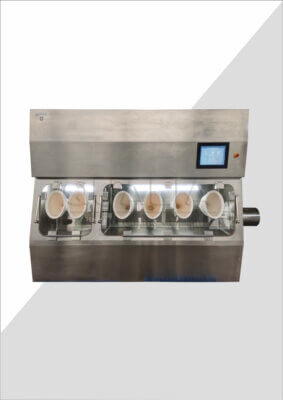
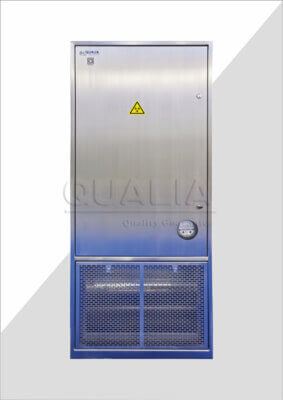
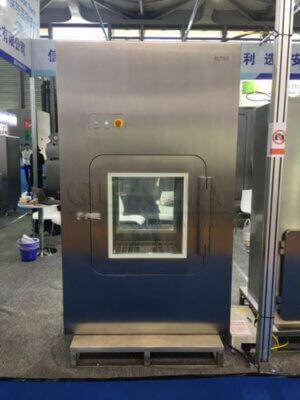
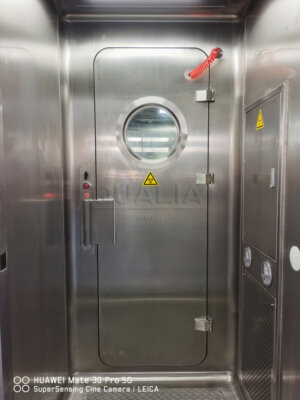
Where physical separation is not feasible — because the floor plan is fixed, utilities are constrained, or the facility has already been built — a programmable shower unit capable of running distinct protocols for entry and exit is worth serious evaluation as an equipment-level input. Some units offer configurable two-way and one-way operating modes that can run a high-velocity air cycle on entry and a chemical mist cycle on exit, or vice versa. For facilities where both GMP contamination control and biosafety decontamination must occur at the same boundary, this kind of equipment flexibility can support differentiated SOPs within a single physical unit. What it cannot do is eliminate the validation burden: each protocol must still be validated against the endpoints required by its governing framework, and the evidence must satisfy both inspection teams independently.
For equipment that specifically supports both air and chemical mist decontamination cycles, a unit like the туманний душ can serve as a starting point for evaluating whether a single installation can be configured and validated to support both directional functions — though commissioning and validation planning should confirm that the specific unit’s programming capabilities align with the SOP architecture before procurement is finalized.
The documentation strategy for dual-compliance facilities follows directly from the design decision. If physical separation is achieved, maintain two independent SOP packages with no cross-regulatory language. If a single programmable unit is used, the SOP must explicitly document each operating mode, the framework it addresses, and the validation evidence that applies to each. Both inspection teams need to be able to find their framework’s requirements and evidence without interpreting the other framework’s language.
The most important sequencing rule for dual-compliance facilities is that legal and regulatory review of each framework’s exit requirements must happen before shower SOP language is finalized — not during audit preparation and not after equipment is installed. Terminology choices made at the first draft stage shape what validation studies get commissioned, which evidence gets generated, and whether the documentation can be defended to both inspection teams simultaneously. Rework at the SOP level after validation studies are complete is expensive; rework at the validation level after a finding is issued is worse.
For a deeper look at how mist shower technology supports contamination control in cleanroom environments, the Туманний душ QUALIA: Передове рішення для контролю забруднень article covers the equipment design principles in more detail.
The core judgment this article supports is not which framework is more demanding — it is whether your current design and documentation treat the shower room as a single-framework space or a dual-framework one, and whether that assumption has been tested against the actual inspection expectations on both sides. Facilities operating under only one framework should use that framework’s terminology exclusively; cross-regulatory language in a single-framework SOP introduces interpretive risk with no compliance benefit. Facilities genuinely subject to both frameworks need to confirm, before SOPs are finalized, whether the physical design supports directional separation, whether the chosen equipment can run independently validated protocols for each direction, and whether the SOP architecture will be legible to both inspection teams without requiring each team to interpret the other’s vocabulary.
What to confirm before finalizing shower SOP language: which framework governs which function in the specific room, whether the validation study scope covers the representative load and material-specific evidence required by the biosafety side, and whether the contamination control strategy narrative required by GMP is anchored to the correct directional rationale for that boundary. Those three questions, answered before drafting begins, are the difference between a document that holds up under both frameworks and one that creates a defensibility gap that audit preparation cannot close.
Поширені запитання
Q: Our facility is subject to BSL-3 oversight but not EU GMP Annex 1 — does any of the dual-compliance guidance apply to us?
A: No — if only one framework governs your operation, the dual-compliance design and documentation strategies in this article do not apply, and you should not try to apply them. Using single-framework SOPs written exclusively in biosafety terminology is the correct approach for BSL-3-only facilities; introducing GMP contamination control language into a biosafety SOP creates interpretive risk with no compliance benefit and may confuse the inspectorate that does govern you.
Q: Once we confirm which frameworks apply and finalize the SOP architecture, what is the immediate next step before drafting begins?
A: Commission the validation study scope before writing a single SOP line. The frameworks differ on what evidence they require — GMP needs contamination control strategy rationale and process parameters; the WHO biosafety framework requires material-specific, representative load testing under in-use conditions. Defining the validation scope first ensures that the studies generate the evidence the SOP will need to cite; drafting the SOP before the validation scope is confirmed risks producing a document that references evidence that was never collected.
Q: At what point does a programmable single-unit shower stop being a viable compliance solution and require physical separation into distinct zones?
A: When the facility’s floor plan or utility infrastructure cannot support independent commissioning and validation of each directional protocol within the single unit, physical separation becomes necessary. A programmable unit is a viable option only if each operating mode — entry air cycle and exit chemical decontamination cycle — can be validated independently against its governing framework’s endpoints. If the unit’s programming constraints, drainage configuration, or airflow design prevent truly independent protocol validation, a single unit produces a shared-evidence problem that documentation alone cannot resolve.
Q: Is a validated chemical shower protocol published for another facility acceptable as compliance evidence under the WHO LBM, or does every site need its own data?
A: A published protocol from another facility is not acceptable as compliance evidence on its own. The WHO LBM requires facility-specific validation under in-use conditions, using the actual suit materials in use at that site — fabric panels, visor, and boot material — and coupons laden with dried virus in organic soil. A published protocol such as the 5% Micro-Chem Plus example can inform protocol selection, but it does not substitute for site-generated data demonstrating efficacy against the detection limit on your specific suits and agents.
Q: If budget constrains us to a single shower installation, is it worth commissioning separate legal and regulatory review of both frameworks, or can an internal team reconcile the requirements?
A: Separate legal and regulatory review is worth commissioning regardless of budget pressure on equipment. The terminology choices made at the SOP drafting stage determine what validation studies get commissioned and what evidence gets generated; an internal team working from the article text alone may not catch the cross-regulatory language conflicts that will produce findings from one inspection team even when the other accepts the document. The cost of rework after a finding is issued — revalidation, SOP revision, potential facility downtime — substantially exceeds the cost of independent regulatory review before SOPs are finalized.
Пов'язаний вміст:
- Туманний душ проти повітряного душу для дезактивації персоналу BSL-3: Який протокол виходу є доцільним
- CDC Biosafety in Microbiological and Biomedical Laboratories: Personnel Shower Requirements for Risk Group 3 Agents
- Вимоги до туманного душу згідно з BMBL 5-го видання: Що повинні включати протоколи виходу BSL-3
- Перевірка повітряного душу: Забезпечення продуктивності
- Системи туманного душу: Технічний довідник для дезактивації персоналу BSL-3 та BSL-4
- Безпека повітряного душу: Відповідність нормативним вимогам
- Хімічний душ проти душу з ВГП: Порівняння ефективності знезараження для виходів з лабораторій з високим рівнем контамінації
- Випробування повітряного душу: Перевірка продуктивності
- Вимоги GMP до повітряного душу: Посібник з дотримання вимог