
Containment systems often lose their verified state quietly. A HEPA cassette gets swapped during a weekend shutdown, a BMS upgrade pushes updated logic to pressure control loops, or a pressure setpoint shifts to resolve a recurring alarm—none of it logged as a formal change. The problem surfaces later, either during a regulatory inspection when qualification records no longer match the installed configuration, or worse, during an incident investigation when it becomes clear that the accepted performance envelope was abandoned without any documented assessment. The discipline that prevents this is a defined set of re-verification triggers: a practical boundary that separates routine maintenance from work that affects the evidence on which acceptance decisions were based. Understanding where that boundary falls, and what it means for each category of intervention, is what makes re-verification a functional programme rather than a compliance formality.
HEPA replacement as a re-verification trigger
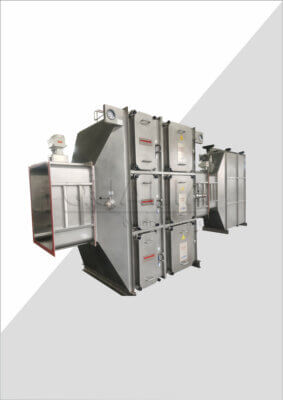
HEPA replacement is probably the most common maintenance event that should trigger a re-verification assessment but frequently does not. The assumption is that a filter is a consumable—replaced when pressure drop rises or scheduled interval passes—and that swapping it falls within normal housekeeping. That logic holds only in the narrow case where the replacement is genuinely identical and the housing, gasket, and clamping system remain undisturbed. The moment any of those conditions changes, the original aerosol challenge data no longer describes the current installation.
The practical danger is that filter housings are often disturbed in ways that are not formally recorded. Gaskets compress, distort, or are replaced with a material that was available on the day rather than specified in the design. Clamping frames may be retorqued to a different value. None of these are individually dramatic events, but each one affects the sealing plane—which in a BSL-3 or BSL-4 system is a primary containment boundary. A pressure-decay test or photometer scan performed before and after replacement can confirm that the reinstated assembly performs within the original acceptance range, and this is worth requiring even for like-for-like swaps in high-containment contexts.
Where the replacement involves an alternative model, a different media grade, or a housing repair, the question shifts from confirmation to reintegration. A filter with a different pressure-drop characteristic will alter the resistance across the extract stack, which in turn can shift the pressure differential at the zone boundary. This is not a theoretical concern—it is a testable condition that can be confirmed or ruled out with a micromanometer and a smoke pattern test. The table below maps the common HEPA replacement scenarios against the questions a re-verification assessment needs to answer before return to service.
| Сценарий | Potential impact on accepted state | What to clarify |
|---|---|---|
| Identical make/model replacement | Minimal; like-for-like swap assuming no housing or seal changes | Confirm that housing, gasket and clamping are unchanged; verify pressure drop is within original range |
| Alternative HEPA model or media grade | Could alter airflow resistance, pressure cascade, or aerosol penetration | Whether a new efficiency or pressure-drop baseline must be established and reintegration testing is required |
| Filter housing repair or modification | May affect seal integrity, bypass leakage, or exposure to downstream duct | Whether a full barrier-integrity challenge (e.g., aerosol photometer) is needed beyond a simple replacement |
| Gasket or clamping frame renewal | Affects the filter-sealing plane, a primary containment boundary | Clarify whether pressure-decay or visual-smoke tests are required to confirm reinstated seal performance |
| HEPA puncture or damage identified during maintenance | Loss of particulate containment; direct breach of critical barrier | Determine mandatory re-verification sequence: repair, clean, challenge, re-certify before return to operation |
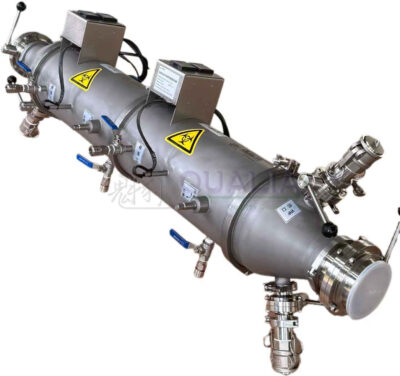
For high-containment applications that rely on bag-in/bag-out filter change technology, the change-out procedure itself is part of the containment sequence, and filter housing integrity under inflation and deflation cycles should be confirmed as part of any re-verification assessment. Bag-in bag-out systems carry specific commissioning evidence—including seal inflation pressure and bag weld integrity—that must remain representative of the installed state after any housing work. Guidance on what that commissioning evidence should include is covered in the BIBO Commissioning Checklist.
Controls updates that affect accepted state
Control system changes are more likely than hardware changes to be treated as IT events rather than engineering events. A software version upgrade is scheduled by the building management team, reviewed for cybersecurity compliance, and deployed—without anyone asking whether the upgrade touches the logic that governs pressure interlocks, fan-failure responses, or alarm thresholds. That gap in process is where re-verification programmes tend to fail.
The accepted state of a BSL-3 or BSL-4 containment system includes documented evidence that specific control responses occur within defined parameters: that a door-failure alarm triggers within a set time, that exhaust-fan loss drives a cascade to a safe pressure state, that differential pressure alarms activate before the room crosses a threshold that affects directional airflow. If a BMS upgrade modifies any of the code paths that govern these functions—even incidentally, through changes to a shared module—the original acceptance evidence is no longer fully representative. EudraLex Volume 4 Annex 15 frames this in terms of maintaining the validated state: changes that affect validated systems require documented assessment and, where appropriate, re-qualification before continued use.
The more difficult case is the setpoint change, because it is often treated as an operational adjustment rather than a change. Moving a room differential pressure setpoint from −15 Pa to −10 Pa to reduce HVAC load may seem like a minor operational tweak, but if the original acceptance test demonstrated containment at −15 Pa, the evidence no longer applies to the new operating state. Whether the new setpoint can still maintain directional airflow under dynamic conditions—doors opening, personnel moving, exhaust-stack wind loading—has not been tested. This is the practical meaning of “operating state outside the accepted envelope.”
| Update type | Risk to accepted state | What to clarify |
|---|---|---|
| BMS/PLC software version upgrade | Logic changes may alter alarm thresholds, interlock sequences, or fail-safe states | Whether the upgrade affects active safety loops and requires functional testing of all safety-critical sequences |
| Damper actuator replacement (non-identical) | Torque, speed, or positioning accuracy can shift airflow balance and pressure relationships | Whether the replacement matches original performance specifications and needs pressure-cascade re-verification |
| Sensor recalibration outside original tolerances | Scaled inputs may mask drift or false-safe conditions in containment monitoring | Confirm that recalibration does not hide a drift that would have triggered an alarm under the accepted settings |
| Setpoint change (pressure, airflow, or differential) | Directly alters the defined containment envelope without evidence it can still be maintained | Whether the change falls within pre-qualified ranges or constitutes a new operating state requiring full re-verification |
| Addition or modification of interlock logic | Can disable or delay critical containment responses (e.g., door opening, fan failure) | Clarify whether any new interlock bypasses or delays defeat a safety function accepted during original commissioning |
Damper actuator replacement deserves specific attention because actuators are often treated as commodity components. A non-identical actuator with different torque or positioning accuracy can introduce a lag in damper response that is invisible under steady-state conditions but meaningful during a transient—a power interruption, a fan-start event, or a rapid door-opening sequence. These are precisely the scenarios that acceptance testing is designed to stress.
Room pressure and airflow modifications after handover
Room pressure and airflow modifications made after initial qualification are a common source of drift from accepted state, and they are often driven by legitimate operational needs—resolving complaints about draught, accommodating a new piece of equipment, or improving energy efficiency. The problem is not the intent; it is that each modification to the airflow system can shift pressure relationships that were previously balanced and accepted.
The pressure hierarchy in a BSL-3 suite—typically a cascading negative differential from corridor to anteroom to laboratory, or in some configurations a positive-pressure buffer protecting adjacent spaces—is not self-correcting after an intervention. Duct rebalancing that improves one zone’s stability may reverse a differential at another doorway. A fan speed reduction that achieves energy savings may reduce the airflow reserve needed to maintain pressure under worst-case door-opening sequences. The original acceptance tests were performed on a specific configuration, and the results describe that configuration only.
What makes this category particularly risky from an audit perspective is that room-pressure modifications are sometimes executed by facilities engineering teams without formal engagement from the qualification function. The modification is treated as HVAC maintenance, but its effect is a change to the containment envelope. ASTM E2500-25 frames verification as a continuous obligation tied to the maintained state of the system, not a one-time event at handover—meaning that post-handover modifications to verified systems should trigger assessment of whether re-verification is warranted.
| Модификация | Impact on containment envelope | What to clarify |
|---|---|---|
| Duct rebalancing or damper repositioning | Alters supply/extract ratios; may reverse pressure differentials at doorways | Whether original pressure hierarchy (cascading negative/positive) is still maintained under all operating modes |
| Fan speed or VSD parameter change | Shifts total air-change rate and room-to-room offset pressures | Confirm that directional airflow (e.g., room-to-corridor bias) remains verifiable by smoke or micromanometer under dynamic conditions |
| Addition of new local exhaust or supply | Introduces new airflow paths that can disrupt established pressure relationships | Clarify whether the modification requires re-validation of worst-case room pressure with all doors closed and open |
| Replacement of entire air-handling unit section | New fan curves or coil pressure drops can shift the whole building pressure profile | Whether the acceptance test definition for “contained” pressures still holds and a full sequential door-test is needed |
| Installation of containment damper in existing duct | Intended to seal off a zone, but may inadvertently create dead-head or backpressure on adjacent spaces | Clarify if the new damper interferes with the failure-mode pressure response (e.g., fan-off, exhaust-failure) |
The failure mode that matters most in this category is the loss of directional airflow under dynamic conditions while steady-state readings remain within range. A micromanometer at a single doorway can show a nominal differential while a smoke test reveals that transient airflow reverses during door operation. Acceptance testing typically includes dynamic scenarios for this reason, and any modification that changes fan performance or duct resistance should include re-testing of the same dynamic cases.
VHP cycle changes and major repairs
Vaporised hydrogen peroxide decontamination cycles are validated to a specific parametric envelope: concentration, exposure dwell time, room volume, distribution pattern, and catalyst recovery. Each of these parameters is tied to material compatibility and sporicidal efficacy data generated during the original validation campaign. A change to any of them—whether driven by a new agent being used, a room reconfiguration, or an upgrade to the VHP generator—should be treated as a trigger for re-verification of the decontamination function.
The most common driver for unplanned VHP cycle changes is an equipment fault: a generator that has been repaired with non-OEM components, a distribution nozzle that has been repositioned after a room modification, or a catalyst bed that has degraded and is now extending recovery time beyond the validated window. Each of these creates a practical gap between the validated cycle and the cycle being run operationally. If a sporicidal indicator challenge has not been performed under the modified conditions, the cycle’s efficacy claim is unsupported.
Major repairs to room fabric—penetration sealing, pressure-boundary wall repairs, floor drain modifications, or window seal replacement—affect room integrity in ways that directly intersect with both pressure containment and VHP cycle performance. A repaired penetration seal that leaks under the negative pressure differential will also allow VHP egress during decontamination, reducing internal concentration and potentially invalidating the dwell-time calculation. The same physical boundary serves both functions, and damage or repair to it should trigger assessment of both.
The decision about whether a repair rises to the level of re-verification trigger often depends on how the original qualification defined the boundary. If the IQ captured specific penetration locations and seal materials as part of the accepted configuration, any change to those elements is a documented deviation from the accepted state. For teams working through the re-verification sequence for VHP systems, the qualification structure described in the VHP Validation Protocol provides useful framing for what the original evidence should include and which parameters are critical to re-challenge. Pneumatic seal integrity at personnel access points also intersects with VHP containment during cycle operation—Пневматическое уплотнение дверей APR are a relevant design consideration here, since seal inflation performance affects both pressure-boundary integrity and cycle containment.
Maintenance versus change-control decision boundary
The friction point in most re-verification programmes is not the clearly major change or the clearly routine task—it is the large middle category of activities where classification is genuinely ambiguous. A gasket replacement with an available alternative, a software patch described as limited to reporting functions, a pressure setpoint adjustment to resolve a nuisance alarm: each of these sits on a decision boundary where the right classification depends on factual questions that are often not asked.
The underlying principle is straightforward: maintenance preserves the accepted state; a change potentially modifies it. The difficulty is that “accepted state” is defined by the qualification record, and qualification records vary considerably in the precision with which they describe the accepted configuration. A qualification record that specifies sensor model numbers, software version strings, and gasket material grades gives the boundary something concrete to work from. One that describes only functional outcomes—”room maintains −15 Pa differential”—leaves a wider grey zone for component substitution.
The practical test for any ambiguous activity is to ask whether the qualification evidence generated during original acceptance would still describe the system after the work is complete. If a sensor is replaced with an identical OEM unit at the same installation point, the evidence is unchanged. If the replacement uses an alternative sensor with different response time or accuracy class, the evidence may no longer represent the installed hardware, even if the new sensor meets a nominal specification on paper. That second case warrants formal assessment before the work proceeds, not after it is complete.
| Деятельность | Likely classification | Reason this affects acceptance evidence | What to confirm |
|---|---|---|---|
| Replacement with identical OEM part installed per original spec | Техническое обслуживание | No deviation from validated design; acceptance data remains representative | Verify part number, install torque/settings, and that no adjacent sub-system was disturbed |
| Substitution of alternative component claimed as equivalent | Potential change | Form, fit, or function may not match; drift from original acceptance evidence is possible | Whether component interchange is formally assessed for containment-critical attributes (leak class, response time, bypass) |
| Software patch limited to non-safety modules | Техническое обслуживание | No functional impact on containment logic; separation of concerns is preserved | Confirm through documented software segregation that no safety-critical code path was touched |
| Setpoint adjustment beyond the documented commissioning range | Изменить | Operating state moves outside previously accepted envelope; evidence no longer applies | Whether the new setpoint requires a fresh acceptance test demonstrating pressure and airflow integrity |
| Addition of a new device to a safety loop (e.g., extra alarm, shunt) | Изменить | Any modification to a safety loop alters the accepted reliability and response architecture | Clarify whether the change invalidates the original safety integrity level (SIL) assessment and triggers re-verification |
The downstream cost of misclassification runs in both directions. Over-classifying maintenance as change creates unnecessary qualification burden and slows repairs that need to happen quickly. Under-classifying changes as maintenance accumulates undocumented deviations from the accepted state that are difficult to unwind during an audit or incident investigation. A practical threshold—based on whether the work touches a critical barrier, an airflow path, an alarm, or a decontamination function—reduces ambiguity at the point where the decision needs to be made.
Re-verification threshold for critical containment functions
Re-verification should be treated as an assessment obligation triggered by specific conditions, not a full-scale re-qualification campaign triggered by any change. The distinction matters because blanket re-qualification requirements create pressure to suppress or misclassify changes, which is the opposite of the intended effect. A structured threshold based on the function being affected is more useful in practice.
Critical containment functions in a BSL-3 or BSL-4 system can be grouped into three categories: physical barrier integrity (HEPA filtration, room envelope sealing, airlock door performance), directional airflow control (room pressures, pressure cascade, fan interlocks), and decontamination efficacy (VHP cycle parameters, cycle monitoring, room integrity during decontamination). Any change that directly affects performance evidence for one of these categories should trigger a formal re-verification assessment. The assessment may conclude that re-testing is not required—for example, a like-for-like replacement with documented part matching—but that conclusion should be recorded, not assumed.
The threshold for re-testing rather than assessment-only is typically reached when: the accepted performance data cannot be shown to still represent the post-change configuration; a new operating state has been introduced that has no prior acceptance evidence; or a safety-critical function (interlock, alarm, exhaust-failure response) has been modified in a way that changes its response sequence. These are conditions, not prescriptive rules, and the WHO Laboratory Biosafety Manual 4th Edition frames similar principles around maintaining verified containment conditions as an ongoing programme rather than a commissioning endpoint.
One common mistake is treating re-verification as a post-change activity only. The most defensible programmes include a pre-change impact assessment as the first step: before any work is authorised on a critical containment system, a formal assessment determines whether the planned work is maintenance or change, and if change, what re-verification scope is appropriate. This creates a record that the decision was made before the work was done, which is significantly easier to defend than a post-hoc justification assembled after an inspector identifies an undocumented modification.
The practical implication of everything above is that re-verification programmes work best when trigger categories are defined precisely enough to be applied consistently by maintenance and engineering teams at the point of planning, not reconstructed retrospectively during a deviation review. The categories—HEPA and housing changes, control system and software updates, room pressure and airflow modifications, VHP cycle and room-fabric changes, and any modification to a safety-critical interlock or alarm—cover the vast majority of interventions that can alter the accepted state of a high-containment system.
Before a qualification team finalises its change-control procedure, three questions are worth confirming: Does the procedure explicitly list the containment functions that trigger mandatory impact assessment? Does the maintenance classification criteria distinguish clearly between identical OEM replacement and equivalent-claim substitution? And does the re-verification scope definition specify which acceptance tests apply to each trigger category, so that the required testing is defined in advance rather than negotiated after a change is already complete? Answering these questions during programme design prevents the classification disputes and undocumented deviations that tend to accumulate over the operational life of a BSL-3 or BSL-4 facility.
Часто задаваемые вопросы
Q: Does this re-verification framework apply if our BSL-3 facility was qualified under a national standard rather than WHO or EudraLex guidance?
A: Yes, the trigger logic applies regardless of which standard governed the original qualification. The underlying principle—that maintenance preserving accepted state is distinct from work that changes the evidence on which acceptance decisions were based—is not standard-specific. What changes is the language and documentation format required by your regulatory authority, not whether HEPA housing disturbance, control logic modification, or VHP parameter shifts invalidate prior acceptance evidence. Map your existing qualification record to the trigger categories described here and apply the same impact-assessment discipline.
Q: Once a re-verification assessment concludes that re-testing is not required, what documentation should exist before the system returns to service?
A: The assessment conclusion itself must be a formal, dated record—not an informal agreement between the maintenance lead and the qualification engineer. At minimum, the record should state the trigger event, the specific acceptance evidence reviewed, the factual basis for concluding it remains representative after the work, and the name of the authorised reviewer. This pre-return record is what an inspector will look for first; a post-hoc justification assembled after the fact is significantly harder to defend than a decision documented before the system was released.
Q: At what point does accumulated incremental change—multiple small setpoint adjustments, successive like-for-like replacements, gradual rebalancing—collectively require a full re-verification even if no single event crossed the threshold?
A: Accumulated drift becomes a re-verification trigger when the installed and operating configuration can no longer be shown to match the original acceptance record in aggregate. No single event may individually invalidate the evidence, but if pressure setpoints, sensor models, gasket materials, and fan curves have each shifted incrementally, the combination may describe a system the acceptance tests never characterised. A practical safeguard is periodic configuration reconciliation—comparing the current installed state against the accepted configuration on a defined schedule—so drift is caught before it compounds to the point where full re-qualification scope is unavoidable.
Q: How does in situ HEPA testing capability affect the scope and cost trade-off for facilities deciding between bag-in/bag-out and standard filter housings?
A: In situ testability shifts the re-verification cost curve significantly. With in situ pipeline HEPA or BIBO configurations designed for scan access, confirming filter and housing integrity after a replacement is a bounded, repeatable test that can be completed during the same maintenance window. Without that access, confirming the sealing plane requires either partial disassembly or acceptance of greater uncertainty. For BSL-3/4 systems where every HEPA replacement should include a post-reinstallation integrity confirmation, the ability to test in place reduces the per-event re-verification burden enough to affect the lifetime cost comparison between housing types.
Q: Is re-verification required when a BSL-3 room is taken out of active use for an extended period and then returned to service, even if no physical changes were made during the idle period?
A: Yes, return to service after extended idle periods warrants a formal assessment even without recorded changes. Gaskets and pneumatic seals can take compression sets or degrade without visible failure; VHP catalyst beds may have been partially passivated; fan bearings and damper actuators can drift from calibrated positions. More critically, an idle system may have had informal adjustments made during the dormant period that were never entered into the change-control record. A recommissioning assessment that verifies current configuration against the accepted state—and confirms critical performance parameters before the room is used with live agent—provides the same protection as a post-change re-verification assessment.
Сопутствующие материалы:
- Документы по валидации лаборатории BSL-3: URS, DQ, отчеты об испытаниях и пакет документов для передачи
- Критерии приемки интеграции системы BSL-3/4: Давление, HEPA, воздушные шлюзы, VHP, EDS и средства контроля
- Контрольный список для пакета передачи BSL-3/4: Комплексные свидетельства приемки для сотрудников по биобезопасности и инженеров объекта
- Pass Box and Dunk Tank Acceptance Criteria for BSL Material Transfer Boundaries
- Критерии приемки лабораторных систем управления BSL: ПЛК, BMS, HMI, состояния тревоги и записи, готовые к аудиту
- Критерии приемки шлюзовых камер и дверей АПР для проектов BSL-3/4: Блокировки, уплотнения и состояния восстановления
- Протокол квалификации туманного душа: Документация IQ OQ и PQ для соответствия требованиям GMP и BSL-3
- HEPA Exhaust Acceptance Criteria for BSL-3/4 Labs: Filter Integrity, Duct Leakage and BIBO Maintenance Access
- Directional Airflow Acceptance Testing for BSL Laboratories: Smoke Tests, Door States and Failure Modes