
A fixed VHP system that serves several rooms raises a planning question before it raises an equipment question: what counts as one treatable zone, and on what basis can two or more rooms be grouped into a single cycle? The answer determines distribution and sensing design, how throughput is calculated, and what qualification work actually has to prove. Getting the zone definition wrong does not surface as an equipment fault — it surfaces later, as a cycle that behaves differently from what the room layout suggested it would.
Zones Begin at Sealable and Controllable Boundaries
| Boundary factor | Project question | 결정 경계 |
|---|---|---|
| Sealable boundary | Can the proposed treatment zone be bounded by a sealable room boundary? | Floor-plan proximity alone does not establish a common zone. |
| Door and damper states | Are the required door and damper states defined for every intended treatment scenario? | A grouping is not defined until those states are clear for each scenario. |
| Airflow isolation | Can airflow isolation be defined for the proposed boundary? | Rooms should not be grouped by proximity when their airflow isolation conditions differ. |
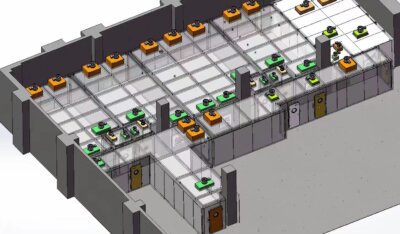
A treatment zone is a control concept, not a floor-plan concept. Two rooms that sit next to each other on a drawing are not automatically a single zone for VHP purposes, and two rooms separated by a corridor are not automatically separate zones. What defines a zone is whether its boundary can be sealed and whether the states of that boundary — doors, dampers, airflow — can be set and verified for the scenario in question.
This matters because a VHP cycle assumes a bounded volume with known leak paths, known distribution behavior, and a known route to aeration. Where a proposed zone’s boundary cannot be sealed in a defined way, the volume the cycle is actually treating becomes uncertain, and so does the concentration and exposure time reaching every surface inside it. A room adjoining a non-sealable gap, an open pass-through, or a damper with an undefined position during treatment cannot be folded into a zone simply because it is physically adjacent to one that can.
Door and damper states need to be specified for every scenario the zone will be used in, not just one representative condition. A boundary that is sealable when a single room is treated alone may not hold the same seal integrity when that room is combined with its neighbor, because the combination can change which doors stay closed, which dampers switch position, and which paths become the designed route for gas movement instead of an incidental leak path. If the door and damper logic for a combined scenario has not been worked out, the grouping is not yet a defined zone — it is a layout assumption waiting for control logic.
Airflow isolation follows the same logic. Rooms that share an airflow path, even indirectly through a return or supply branch, cannot be treated as isolated from each other during a cycle unless that path is positively isolated for the duration of the treatment. Where isolation cannot be defined and demonstrated for a given boundary, that boundary does not yet qualify as a zone edge, regardless of how convenient the adjacent room layout might look for throughput planning.
The practical implication is that zone definition should be settled as a control and containment exercise before equipment sizing or distribution planning begins, because every subsequent decision — generator capacity, injection points, sensor placement, aeration routing — depends on knowing exactly what volume and boundary the system is designed to treat.
Shared Utilities Determine Which Rooms Can Cycle Together
Even where room boundaries are sealable in principle, the question of which rooms can actually cycle together is decided by what they share upstream. A generator, piping run, HVAC branch, or exhaust path that serves more than one room creates a dependency that does not respect the boundary between those rooms. Two rooms can have fully independent sealable envelopes and still be unable to run simultaneous, independent cycles if they draw from the same generator or exhaust the vapor through a shared path.
This is a different constraint from the sealing question addressed earlier. Sealing determines whether a room’s boundary is controllable; shared utilities determine whether the room’s treatment can proceed independently of what is happening elsewhere in the system. A room with a fully sealable envelope can still become unavailable for an independent cycle if its generator is committed to treating another zone, or if its exhaust path cannot support two simultaneous aeration events.
Where the piping network branches to multiple rooms from a common generator, the practical question becomes whether that generator’s output and the piping’s distribution capacity were sized with simultaneous multi-room demand in mind, or whether the configuration assumes sequential use. A generator and piping arrangement selected and sized for one room’s volume, as covered in the guidance on correct VHP unit sizing for room and isolator volume, does not automatically extend its performance assumptions to a combined or concurrent multi-room scenario — the dependency has to be worked out at the system level, not inferred from single-room sizing.
HVAC and exhaust dependencies often prove more constraining than the piping itself, because these systems are frequently sized and controlled at a building or suite level rather than a room level. An exhaust system designed for continuous operational extraction may not have spare capacity, isolation valves, or control sequencing built in to support an aeration phase running in one room while normal operation continues in an adjacent one. Where that capacity or isolation does not exist, the rooms are coupled whether or not their physical boundaries are sealed from each other.
The result is that independent rooms, in a layout sense, can become a single operational bottleneck in a utility sense. Mapping every shared dependency — generator, piping, HVAC, exhaust — against the proposed zone list is what reveals whether the zones that look independent on paper are actually independent in operation, or whether they are competing for the same finite resource every time a cycle is scheduled.
Operating Scenarios Reveal Concurrency and Changeover Constraints
| Operating scenario | Configuration to define | Constraint made visible |
|---|---|---|
| Individual room | The room treated as its own zone and the status of the other zones | Whether shared generator, piping, HVAC, or exhaust dependencies support the assumed independence |
| Combined zones | The rooms grouped together and the distribution, sensing, aeration, and control states for that combination | Whether the combined treatment scenario is fully defined rather than assumed |
| Unavailable zone | The zone that is unavailable within the intended operating scenario | How unavailable-zone conditions affect the stated throughput assumption |
| Cycle changeover | The transition between one zone configuration and the next | How changeover constrains the planned cycle sequence and throughput |
Zone and utility definitions establish what is physically and logically possible; operating scenarios establish what actually happens across a working schedule, and this is where throughput assumptions either hold up or collapse. A multi-room VHP system needs its scenarios mapped explicitly, because a system’s behavior in one configuration does not predict its behavior in another.
Treating a room as an individual zone requires knowing the status of every other zone at that moment, because the shared generator, piping, HVAC, or exhaust dependencies identified earlier determine whether that room’s independence is real or assumed. A room can only run on its own schedule if the resources it depends on are not already committed elsewhere, and that has to be confirmed for the specific scenario, not generalized from the system’s design intent.
Combined-zone scenarios require a further level of definition: the distribution, sensing, aeration, and control states for that specific combination need to be worked out, because a combination is not simply the sum of its component rooms’ individual requirements. Gas distribution that reaches every surface adequately in two rooms treated separately may behave differently when those rooms are treated as one connected volume, and the control logic governing that combined state has to be defined rather than assumed from the individual-room logic.
An unavailable zone changes the throughput picture for the rest of the system. If one zone is out of service — whether for maintenance, a prior cycle still completing aeration, or any other reason — the remaining available zones and their utility dependencies determine what can still be run, and that picture can differ substantially from the assumption that all zones are available simultaneously. Throughput planning based on full zone availability does not describe the system’s behavior during periods when a zone is down.
Changeover between one zone configuration and the next is its own constraint, separate from the cycles themselves. Moving from an individual-room cycle to a combined-zone cycle, or from one combination to a different combination, involves resetting door and damper states, reconfirming airflow isolation, and reallocating shared utility capacity — and the time and control steps that transition requires shape how many cycles a system can actually complete across a working period, independent of how fast any single cycle runs.
Building out this scenario set — individual rooms, combined zones, unavailable zones, and the changeover between configurations — is what keeps throughput assumptions grounded in the system’s actual constraints rather than in an idealized view of how often the system could cycle if every zone were always available and every combination were always pre-configured.
Sensor and Indicator Plans Must Follow Each Zone Configuration
Sensor and indicator placement cannot be fixed once for a multi-room system and left unchanged across every operating scenario, because what a sensor needs to represent changes with the configuration being run. A sensor positioned to represent conditions in a single room, treated alone, is answering a different question than the same physical sensor would need to answer if that room becomes part of a combined zone.
The underlying issue is representativeness. A sensor or indicator exists to confirm that the treatment reached the conditions required at its location, and by extension, that locations like it were also reached. When the zone configuration changes — a room moves from individual treatment to being part of a combined zone, or a combination changes which rooms participate — the locations that matter most for confirming adequate treatment can shift. A sensor placement adequate for an individual-room cycle may miss the point in a combined-zone cycle where distribution is weakest, because that weak point did not exist, or existed elsewhere, in the single-room configuration.
This means the sensing and indicator plan needs to be defined per configuration, not once for the system as a whole. Where a system is intended to run as individual rooms, as various combined zones, and through changeover sequences between them, each of those configurations needs its own answer to where sensors and indicators go and what they are expected to show. A plan built only around the most frequently used configuration leaves the other configurations without a defined basis for confirming that treatment was adequate.
The practical consequence for project planning is that sensor and indicator layout is not a fixed specification attached to the room or to the generator — it is attached to the configuration being run in that room at that moment. Where the zone combination matrix changes after initial design, for example because an additional combined-zone scenario is added later, the sensing plan for that new scenario needs to be worked out on its own terms rather than assumed to be covered by the sensing already in place for the individual rooms involved.
Qualification Evidence Should Cover the Intended Combination Matrix
| Evidence element | 확인해야 할 사항 | 증거의 범위 |
|---|---|---|
| Installation qualification | Installation checks for the actual system | Installation checks do not replace operating qualification challenges. |
| Operating qualification | Challenges of operating limits or worst-case conditions | The protocol must define the actual system tests and limits. |
| Intended zone combinations | Evidence for each combination the system is intended to use | Single-room evidence should not be assumed to transfer to combined zones. |
| Worst-case locations | Challenge evidence at the intended worst-case locations | Coverage should follow the planned zone configuration rather than an assumed representative location. |
| 수락 기준 | Predefined criteria for the qualification work | Project-specific acceptance values must be established for the actual system; they are not supplied here. |
| 편차 | Documented deviations from the predefined qualification plan | Deviations remain part of the qualification record rather than being omitted from the evidence review. |
The qualification stage is where an unclear zone and scenario plan becomes expensive to discover, because qualification evidence has to match the actual combination matrix the system is intended to run — not a single representative configuration assumed to stand in for all of them.
Installation qualification and operating qualification answer different questions, a distinction set out in 유드렉스 4권 부록 15: installation checks confirm the system is built and installed as specified, while operating qualification challenges the system against its operating limits and worst-case conditions. Annex 15 requires predefined acceptance criteria and documented deviations as part of that process. For a multi-room VHP system, installation checks covering the generator, piping, and sensors do not substitute for operating challenges run against each intended zone combination — the two qualify different things, and completing one does not imply the other is complete.
The combination matrix itself needs to be the scope of the operating qualification, not a sample from it. Evidence gathered for one room treated individually does not transfer to a scenario where that same room is treated as part of a combined zone, because the distribution, sensing, and control conditions differ between those scenarios in the ways already addressed. Where the system is intended to run several different combinations, the evidence needs to cover each intended combination, not the configuration that happened to be tested first or tested most conveniently.
Worst-case locations within each configuration need specific attention. A worst-case location in an individual-room cycle may not be the worst-case location once that room becomes part of a combined zone, because the distribution path and the surfaces furthest from the injection or circulation point can shift with the configuration. Qualification coverage needs to follow the zone configuration being tested rather than reuse a worst-case location identified under a different configuration.
Acceptance criteria and deviations remain part of this same record. The criteria for each qualification run need to be predefined for that specific system and configuration, consistent with the Annex 15 requirement that protocols set out the actual system’s tests and limits rather than relying on generic values. Deviations from the predefined plan, where they occur, stay part of the qualification record rather than being set aside once a cycle appears to have worked. This same logic extends beyond initial qualification: where a load pattern, sensor position, or material changes after commissioning, the qualification evidence tied to the original combination matrix needs to be revisited for that changed scenario, following the same reasoning on cycle requalification after load pattern, sensor, or material changes — a new condition in one part of the matrix does not leave the evidence for the rest of the matrix unaffected if the change touches shared distribution, sensing, or control logic.
Where a project team is working with a supplier such as QUALIA on a fixed VHP configuration, the zone and scenario matrix developed through this planning process becomes the basis the supplier’s configuration and quotation review works from — the matrix defines what the generator, distribution, and sensing arrangement actually need to support, rather than the supplier inferring a combination matrix from room dimensions alone.
자주 묻는 질문
Q: Can adjacent rooms be treated as one VHP zone?
A: Only when the proposed grouping has a sealable boundary and its door, damper, and airflow-isolation states can be defined for every intended treatment scenario. Room proximity alone is not enough; also map distribution, sensing, aeration, and control states for the combined zone.
Q: What should be checked before assuming two rooms can run independent cycles?
A: Trace whether the rooms share the generator, piping, HVAC, or exhaust path, then define the required utility and control states for each cycle. Treat the cycles as independent only when those dependencies support the intended concurrent operation.
Q: How should unavailable zones and cycle changeovers be included in throughput planning?
A: Put them into the operating-scenario matrix alongside individual-room and combined-zone cycles. This makes it possible to test the planned sequence and throughput assumptions against the actual zone availability and each transition between configurations.
Q: Can one sensor and indicator plan be used for every zone configuration?
A: Do not assume that it can. Define sensing for each intended individual-room and combined-zone configuration, then identify the worst-case locations that the qualification protocol must challenge.
Q: Does successful single-room qualification cover a combined multi-room zone?
A: No automatic transfer should be assumed. Qualification evidence should address each intended zone combination, the actual system’s operating limits or worst-case conditions, predefined project-specific acceptance criteria, and any documented deviations.