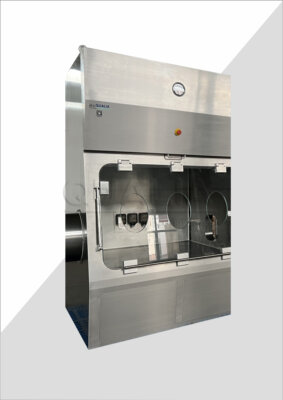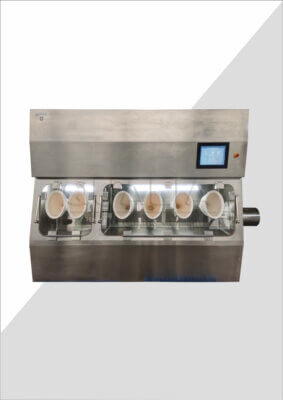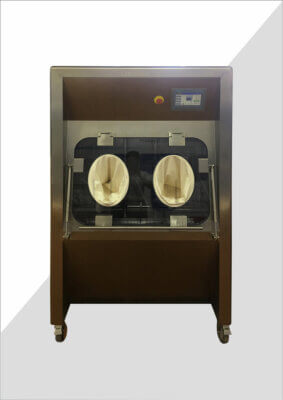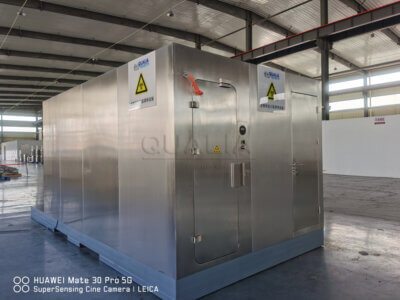

Most procurement reviews for pass-box equipment end at the lock. Buyers confirm that a mechanism exists, satisfy themselves that doors cannot both stand open at the same time, and move on. What that review misses is the fuller picture: hinge alignment that drifts under repeated thermal cycling, door seal compression that degrades across thousands of transfer cycles, and fault conditions — power loss chief among them — that reveal whether the interlock was genuinely engineered or simply specified. A unit that passes visual inspection at factory acceptance can still allow simultaneous door opening under realistic operational stress, which means contamination risk is present at the moment the equipment feels most trustworthy. By the end of this article, you will be better positioned to judge which mechanism type suits your application, what fault scenarios to define before purchase, and which controls-review disagreements are most likely to delay your commissioning.
Door-state risks that interlock design must control
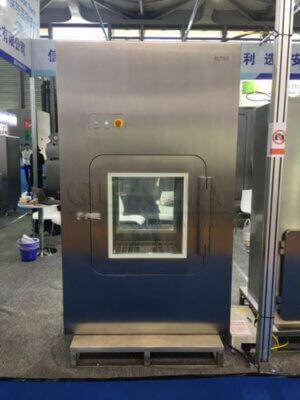
A pass box without an interlock is a storage cabinet with two doors. That distinction is functional, not semantic. The interlock is what makes the device a contamination-control barrier: it enforces the physical rule that the controlled-side door and the uncontrolled-side door are never both accessible at the same time. Remove that guarantee and you remove the entire justification for the unit’s position in the transfer workflow.
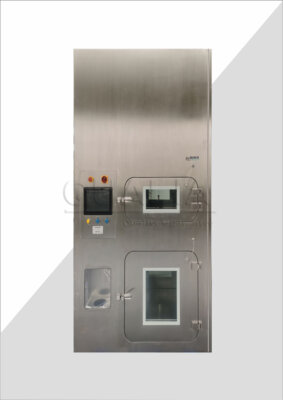
The two primary interlock approaches handle this differently in normal operation. A mechanical interlock uses a physical linkage — locking bars or a cam mechanism — that directly prevents the second door from opening while the first is open. The sequencing is built into the hardware: no software, no power, no sensor reading required. An electronic interlock achieves the same door-state logic through a different path: door position sensors detect the state of each door, a control panel processes that information, and electromagnetic locks hold the second door closed while the first is open. Both approaches enforce non-simultaneous opening, but they do so through fundamentally different means, which shapes everything downstream — maintenance requirements, fault behavior, and controls-review scope.
What many installations underestimate is that the mechanism alone does not sustain the protection over time. The interlock holds a door closed, but hinge alignment determines whether that door actually seats against the seal under varying load. Seal compression determines whether the barrier between environments is maintained when both doors are nominally closed. Cycle wear gradually loosens tolerances in both mechanical linkages and electronic lock hardware. A commissioning check that verifies door sequencing on day one does not confirm that the same behavior holds after two years of production transfers. Interlock design must therefore account not just for the locking logic but for the physical components whose degradation can defeat it.
Mechanism options and their maintenance implications
The choice between mechanical and electronic interlock is a lifecycle decision more than a feature decision. Both types can satisfy the functional requirement for non-simultaneous opening in normal operation. Where they diverge is in what they demand from the facility after installation.
The differences across power dependency, component count, monitoring capability, and fail-safe behavior are substantial enough that the right choice depends on the specific application context rather than a general preference for one type.
| الميزة | التعشيق الميكانيكي | التعشيق الإلكتروني |
|---|---|---|
| Power Requirement | None; purely mechanical linkage works without electricity | Requires power for sensors, electromagnetic locks, and control panel |
| المكونات الرئيسية | Mechanical linkage, physical locking bars | Door position sensors, electromagnetic locks, control panel |
| عبء الصيانة | Claimed maintenance-free; no electrical components to service or calibrate | Requires commissioning, periodic calibration, and spare‑parts inventory |
| Monitoring & Flexibility | No status indication or programmable logic | Supports door status indication, timed logic, and configurable sequencing |
| Fail‑Safe Behavior | Inherently fail‑safe under power loss; interlock remains mechanically engaged | Requires failsafe design (e.g., battery backup) to maintain interlock during power outage |
The maintenance-free characterization associated with mechanical interlocks reflects the absence of electrical components that require commissioning, calibration, or software updates. That simplicity is real. A mechanical linkage that is correctly installed and periodically inspected for wear can operate for extended periods without specialist intervention. However, “maintenance-free” should be read as a relative claim, not an absolute one. Mechanical linkages are still subject to wear, misalignment, and corrosion in harsh environments. The more precise framing is that mechanical interlocks have a narrower, more predictable maintenance scope.
Electronic interlocks carry a different burden. Door position sensors can fail or drift. Electromagnetic locks require consistent power. Control panels need commissioning and, in validated environments, change-control documentation every time logic or timing parameters are adjusted. A spare-parts inventory must be maintained to avoid extended downtime when a sensor or lock component fails. None of these are reasons to exclude electronic interlocks — their monitoring and sequencing capabilities are genuinely valuable in complex transfer workflows — but facilities that choose them should budget for that ongoing upkeep rather than treating the purchase price as the full cost of ownership.
For applications in hazardous environments where spark risk is a concern, the mechanical interlock’s zero-power operation offers a practical advantage that no amount of electronic monitoring capability offsets. That is one of the cleaner decision boundaries in this comparison.
Fault conditions that should be defined before purchase
The question to ask a supplier is not whether the interlock works — it is what the interlock does when something goes wrong. Fault behavior is where mechanism choice has consequences that cannot be recovered at commissioning.
Power loss is the most straightforward fault scenario to define. A mechanical interlock remains physically engaged during a power outage: the linkage holds, and neither door gains unexpected access regardless of what the facility’s electrical systems are doing. An electronic interlock depends on sustained power to maintain electromagnetic lock engagement. If that dependency is not addressed through a defined fail-safe design — battery backup, spring-loaded locking, or a specific fail-secure configuration — a power interruption can release the electromagnetic lock and allow the door to open freely. That condition may be brief, but in a facility handling sensitive biologics or pharmaceutical-grade materials, brief and uncontrolled is a serious exposure.
Sensor failure is a fault scenario that receives less attention but deserves equal scrutiny. An electronic interlock that loses a door position sensor reading may respond by defaulting to an unlocked state, generating an alarm but allowing operation, or halting all transfers pending manual intervention. Which of those responses is appropriate depends on the risk profile of the application, and that decision needs to be made during specification — not discovered during a real event. Defining the expected system response to each credible fault scenario before purchase is the only way to confirm that the chosen mechanism’s behavior matches what the facility’s contamination-control logic actually requires.
A mechanical interlock’s power-loss performance is not evidence that mechanical designs are categorically superior in fault conditions. It is one concrete illustration of fault behavior that can be verified and documented. The same level of verification should be applied to electronic designs across their specific fault modes. Whatever mechanism is chosen, the facility should be able to articulate, in writing, what happens at each door during each fault scenario — and that documentation should exist before the purchase order is issued.
Controls review issues around alarms and overrides
For electronic interlocks, the mechanism selection is often the easier part of the project. The friction that most reliably delays go-live appears during controls review, when operations, QA, and maintenance teams sit down to define alarm behavior, timer settings, and override conditions — and discover they have been holding different assumptions.
Each of those disagreements carries downstream consequences that reach beyond the commissioning schedule.
| Aspect to Define | Potential Friction | Stakeholders to Align |
|---|---|---|
| Door interlock timer settings | Teams may disagree on door‑sequencing time delays, creating tension between transfer throughput and contamination‑control margin | Operations, QA, Maintenance |
| Alarm trigger conditions | Conflicting views on which events (e.g., door held open, interlock defeat) should generate audible or visual alerts | Operations, QA, Maintenance |
| Alarm reset procedure | Disagreement over who may silence or clear alarms, and what documentation or log entry is required | Operations, QA, Maintenance |
| Override access and conditions | Conflict over when override is permitted (emergency, maintenance, cleaning) and how override events are logged and reviewed | Operations, QA, Maintenance |
Timer settings for door sequencing may seem like a minor configuration detail. They are not. Operations teams optimizing transfer throughput will push for shorter delays; QA teams focused on contamination-control margin will want longer confirmation windows. If that tension is not resolved before commissioning, the setting that gets implemented is usually whoever argued most recently rather than whoever applied the most relevant technical judgment.
Alarm reset authority is a particularly common friction point in regulated environments. If an operator can silence an interlock alarm without a documented log entry, that event may be invisible to quality records. If only a QA representative can reset after an interlock defeat, operations faces a procedural bottleneck that creates pressure to avoid triggering alarms in the first place — which is a different kind of contamination risk. The WHO Laboratory Biosafety Manual (4th edition) frames alarm and access control as elements that require coordinated definition across stakeholder groups precisely because the downstream audit consequence of an unresolved assumption is a finding rather than just a procedure gap.
Override logic deserves particular attention. The legitimate use cases for override — maintenance access, cleaning cycles, emergency egress — are narrow. If the conditions under which override is permitted are not defined in writing, with logging and review requirements, the override function becomes a routinely used workaround rather than an emergency provision. Validation documentation that references an override function without defining its scope is difficult to defend in an audit.
The practical implication is that controls review for an electronic interlock pass box should be scheduled with sufficient lead time for genuine stakeholder alignment, not treated as a sign-off exercise at the end of equipment qualification. Starting that conversation during the specification phase — before supplier selection — avoids the most expensive version of this problem.
Proven non-simultaneous opening under fault as the acceptance threshold
If a mechanism cannot demonstrate non-simultaneous door opening under credible fault conditions, it does not meet the minimum functional requirement for cleanroom use. That is the threshold, and it derives from the basic logic of what a pass box is supposed to do rather than from a specific regulatory text.
Normal-operation performance is a necessary condition, not a sufficient one. A mechanism that reliably sequences door opening under routine use but releases both doors during a power outage, a sensor fault, or a controller crash has failed at the moment the protection is most needed. Fault conditions in production environments are not hypothetical edge cases — they are events that will occur over a unit’s operational life, and the interlock’s response to them is as much a part of its function as its behavior during a standard transfer.
The mechanical interlock’s behavior during power loss is a useful concrete illustration of this threshold. Because the interlock is physically engaged, power loss does not change the door-state logic. One door being open means the other remains physically locked, regardless of facility electrical conditions. That is a verifiable, testable behavior that can be documented in commissioning records without specialized instrumentation.
An electronic interlock can also meet this threshold, but it requires deliberate engineering rather than inherent design. Battery backup that maintains electromagnetic lock engagement through a defined power-loss duration, coupled with tested and documented behavior for sensor failure modes, constitutes a credible fail-safe design. The threshold is not that the mechanism must be mechanical — it is that the mechanism must demonstrate non-simultaneous opening under the fault scenarios that are realistic for the installation. A صندوق مرور السلامة البيولوجية deployed in a BSL-3 environment carries different fault-scenario expectations than one used for lower-risk material transfers, and the verification evidence should reflect those specific conditions.
The acceptance check at commissioning should therefore include fault-state testing, not just normal-operation sequencing. Simulating a power interruption during a mid-transfer state and confirming that neither door can be opened simultaneously is a straightforward test. If a supplier cannot support that test or cannot produce documentation of the mechanism’s fault-state behavior, that gap is a procurement signal worth taking seriously.
The most reliable way to avoid a costly gap in pass-box interlock performance is to confirm fault-state behavior in writing before the purchase order is signed, then structure commissioning to test it rather than assume it. That means asking suppliers to document what each door does during a power loss, a sensor failure, and a controller fault — and treating an incomplete answer as a specification gap rather than a documentation courtesy.
If the application involves an electronic interlock, move the controls-review conversation upstream into the specification phase. Alarm thresholds, reset authority, timer logic, and override conditions are not commissioning details; they are validation scope items that affect how audit-defensible the installation will be for the life of the equipment. Resolving them late adds rework and delays that are entirely avoidable. The mechanism comparison matters, but the decisions that most often determine whether an installation performs as intended are made around the table during controls review, not on the factory floor during lock selection.
الأسئلة المتداولة
Q: Does the interlock mechanism choice change if the pass box will be used in a classified hazardous area where spark risk is a concern?
A: Yes — a mechanical interlock is the appropriate choice in that context, and an electronic interlock is not suitable without a hazardous-area certification that covers every electrical component. The mechanical interlock’s zero-power operation eliminates the ignition risk that door position sensors, electromagnetic locks, and control panels introduce. No amount of monitoring capability from an electronic design offsets that exposure in a genuinely ATEX-rated environment.
Q: What should happen immediately after controls review produces agreed alarm, timer, and override definitions?
A: Those agreed parameters should be captured in a formal specification document before supplier selection is finalized, not held informally until commissioning. Once written, they become the baseline against which the supplier configures the control panel, and any deviation during installation triggers a documented change-control event. Treating the output of controls review as a procurement input — rather than a commissioning task — is what prevents the most expensive rework scenarios.
Q: At what point does the added monitoring capability of an electronic interlock stop justifying its commissioning and spare-parts burden?
A: When the transfer workflow is straightforward — single material type, low cycle frequency, no timed sequencing requirement — and the facility lacks in-house controls competency to support ongoing calibration and change-control documentation, the burden exceeds the benefit. The monitoring value is real in complex or high-throughput environments, but a simple application that treats an electronic interlock as a premium upgrade often ends up with a maintenance obligation it cannot sustain without specialist support.
Q: If a supplier cannot produce documentation of fault-state door behavior, is that a disqualifying condition or a negotiable gap?
A: It is a disqualifying condition if the application is in a regulated cleanroom or biosafety environment. The article’s acceptance threshold — proven non-simultaneous opening under credible fault scenarios — cannot be met on the basis of supplier assurance alone. An undocumented fault-state response means the facility absorbs the risk of discovering the actual behavior during a real event rather than a controlled commissioning test. A supplier that cannot produce this documentation before purchase order is issued has not engineered the fault behavior; they have simply not tested it.
Q: Is a mechanical interlock still acceptable for a high-cycle production environment, or does wear eventually make an electronic system the more reliable long-term choice?
A: A mechanical interlock remains acceptable in high-cycle environments provided the inspection and wear-monitoring program matches the cycle load. The maintenance scope is narrower and more predictable than an electronic system, but “narrower” does not mean absent — linkage wear, hinge alignment drift, and seal compression degradation all accelerate with cycle count and require scheduled verification. If the facility cannot commit to that inspection cadence, an electronic system with condition monitoring offers earlier fault detection. The decision turns on maintenance discipline, not on cycle volume alone.
المحتويات ذات الصلة:
- صندوق المرور الثابت: تصميم التعشيق ومعايير التطبيق
- أجهزة تعشيق الدش الهوائي: منع التلوث
- تركيب نظام دش ضبابي: متطلبات التصريف APR تعشيق الباب ومعالجة هواء العادم
- أنظمة الاستحمام بالضباب: مرجع تقني لإزالة التلوث من الأفراد BSL-3 و BSL-4
- تهيئة التعشيق الكهرومغناطيسي لمختبر BSL-3 القابل للنفخ في مختبر BSL-3
- صندوق مرور السلامة البيولوجية: الأنواع ودليل الاختيار لتطبيقات BSL
- صندوق المرور الساكن في الغرف النظيفة: متطلبات التعشيق والتصنيف
- صندوق مرور الغرف النظيفة: متطلبات الاختيار والتكامل
- ختم الباب الصيدلاني APR للأدوية | تطبيقات ومعايير غرف الأبحاث